Kaladanda – Beat Death

Sometime in the early 2000’s , a series of teachings on the Hatha Yoga Pradipika were presented at the school where I taught.  At that time yoga branding was all the rage- a new thing =  and people were using Sanskrit words to define their yoga, their clothing brand, their travel agencies.    We had great fun with this.  You see, at that time most of the people who were branding that way were part of this kind of geeky cool strata of the New York yoga world in which everyone studied Sanskrit because it was “cool”  I’m not making this up, there were fashionable New Yorkers participating in this.  Someone had branded the word Kaladanda for something, I don’t remember what, but we all were given baseball caps with a beautiful design and the word Kaladanda on them.  Kaladanda is a staff carried by the Lord of Death, Yama, in the Ramayana an important Indian epic.  The word is composed of “Kala” which is time and “Danda” is staff – the club with which we beat time.  In the Hatha Yoga Pradipika the Danda is the Yogi’s staff (see Dandasana) or the energy channel that runs a long the spine, formally known as the sushumna nadi.  If we beat time there is no death.    The reference is to our capacity to visit worlds without restrictions through  our yoga practices.  If you’ve ever experienced a truly blissful moment of joyful absorption in your creativity, in love, or on your mat,  you have touched this timeless unrestricted space.  Many of us have, although the magnitude appears to be somewhat more dramatic in the yoga practices.  A well done Hatha Yoga practice empowers the yogi to enter these states of consciousness at will.

How does this work – we spoke last week about the way Arundhati, or kundalini, travels up the sushumna nadi along the spine – and travels through and opens three knots called the granthis – each of these being a conditional experience of limitation.  The Rudra granthi placed at the juncture before the  opening of the third eye is what keeps us anchored in time and space.  To experience a state of consciousness that is beyond time is to know true liberation.

What practical value does this have?  A lot.  You know that wound you are carrying from age 15?  (Forgive me if you are beyond that, but most of us humans carry a little baggage) well, it can be resolved through the practice.  How can that be?  When we carry those moments we don’t really move forward, we keep feeing the same feelings and choosing the same things over and over.  When we touch the space outside of linear time the clarity that arises at that moment allows us to choose differently,  Taking ownership of that power to choose anew heals the wounds from choices made long ago, before we knew better. 

What other practical value does the experience of yogic liberation have?  Entering a transcendental space, the relationship to the body changes.  It ceases to define our experience of life, instead the yogi defines the body.  To me this is a great power of the practice of Hatha Yoga.  One can attain transcendental states  in meditation or chanting or study, but the relationship with the body is transformed uniquely through Hatha Yoga.  Transforming the relationship to the body is pivotal to the spiritual journey.  To be comfortable dealing  with the body as things arise is a form of freedom. 

It is worth reading the stories of the great jivanmuktas of India – as this unique relationship to the body is frequently demonstrated to their followers.  There are many validated tales of Neem Karoli Baba, Ramana Maharshi and others taking disciples disease states into their own body, and by transforming the disease themselves leaving the disciples body healed and whole.

In practical terms in our Hatha Yoga practices a transformed relationship with the body points to an opportunity to shift our yoga experience from confining to liberating.  Through directing how we interact with the body via our thoughts and beliefs while on the mat, we lay the groundwork for a different life with the body.  Some practical tools to begin transforming the relationship with the body:

  1. Om – Om always resolves unclear thinking.
  2. Tune into sensation rather than labeling.  If a knee hurts in postures breath and observe and feel.  But I avoid going into the realm of “there is something wrong” or even “pain”.  I also don’t push it away.  The recommendation would be to stay present with it without developing a story about it.
  3. Make the breath primary and layer the body experience on top of that.
  4. Practices turning the mind towards breath or Om, love or devotion, as you practice.

The tales of beating death are glamorous and enticing. For today we can understand this idea of transcending death is really about changing our experience of time, and our relationship to the body.  This opens the doorway to  understanding and living our lives in a new, less restricted way.

Miracle #6 The Treasure Box

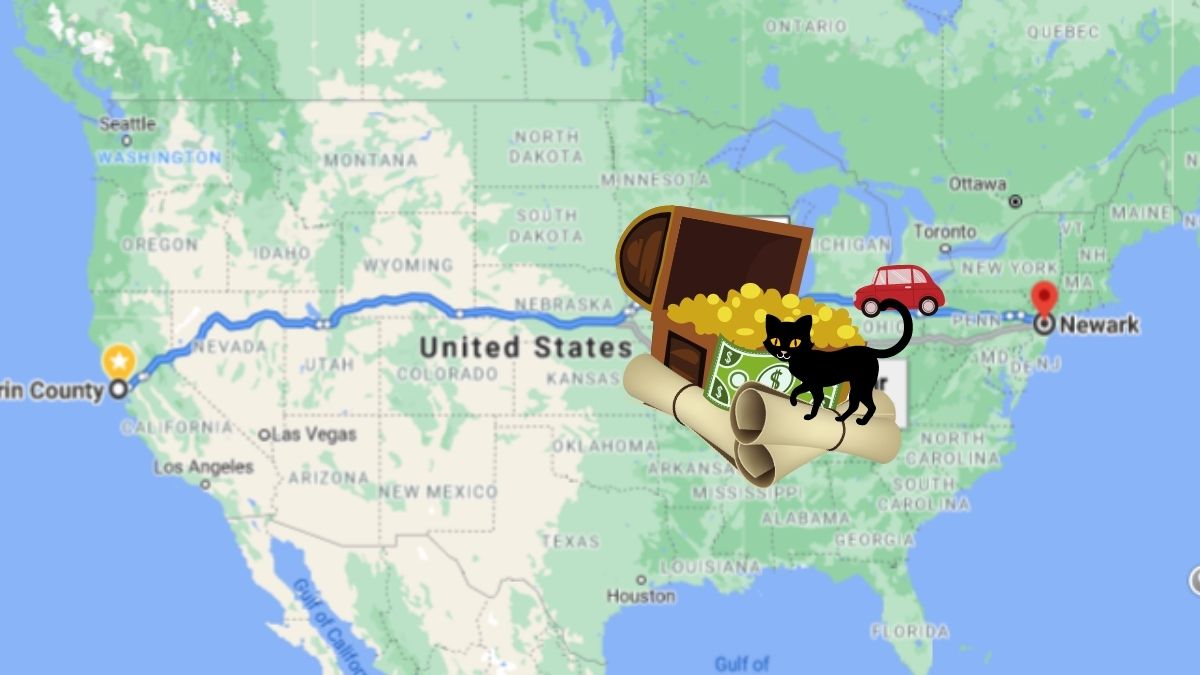
I decided to move to California.  Quit my yoga teaching jobs, gave away half my stuff and my rental apartment, shipped the other half of the stuff and then prepared to cram what was left in the back seat of the little Honda I would be driving across country.  The day before my scheduled departure (and the new tenant was very, very anxious to move into the apartment) I took the Honda in for a pre-drive oil change and the kind service agent told me some sorry news.  All the engine struts in the car were broken.  I had $2000 cash for my transition and now that was gone.  I had a six month old kitten, Lakshmi, traveling with me, so camping and  days driving more than 8 hours or was not an option.  I debated staying (too late) .  I debated not going so far (too late). Finally I just thought, “Well I’ll have to tighten my belt and put the journey on my credit card,” and proceeded as planned.

The first night I was in Virginia heading towards Route 40 cross country, and I stopped for the night.  The hotel room was reasonable, and I offered up my credit card.  The clerk processed all the paperwork, only to note after I signed the room agreement that kittens were not allowed.  I hadn’t even thought of that.  She was, after all, less than 5 lbs.  I insisted the charges on my credit be reversed  and when the desk attendant handed me the paperwork that my stay had been cancelled. I observed, to my dismay, a hefty charge against my card.  Hefty, very, very hefty.  It had been reversed but the refund would take 7 – 10 business days. A major bite was taken out of my credit line.  I’m not going to say I didn’t throw a temper tantrum.  I did.  Now I was stuck in the middle of nowhere, late at night trying to figure out  how to get across the country.  Lakshmi, who refused to give in to “Calming Kitty” herbal relaxation tonic, was meowing loudly to be released from her, all-too-small-carrier.  I used the small amount of cash on hand to stay at a different hotel for the night, figuring I would figure it out in the morning.    

The yoga students who took my class in New Jersey had packed a gift for me before I left.  I planned to open it when I got to California, but I was feeling alone and helpless and in need of cheering up so I decided to open it early.  The box was shaped like a book and decorated in a delicate pink paisley.  I opened the lid to find scrolls, tied with beautiful ribbons.  What?  I thought.  I opened one, and there inside the scroll was a beautiful thank you note.  Wow.  I paused, not wanting to consume the entirety of this delicious experience all at once, but something inside me urged me to go on…open another.  In the next one another beautiful note and …a twenty-dollar bill.  I continued to open them one at a time, some had slipped in gifts of cash, some had not, and there was no correlation…sometimes I didn’t recognize the name on the note at all, but there would be cash with the note.  Sometimes it was someone close…and no cash inside.  There was some $500 in cash in that box.  Just enough to get to California if I scrimped.  It was the first of many miracles on that trip as Lakshmi (the kitten) and I were treated to discount hotel rooms by kitten loving hotel managers and delightful free ashram meals.  Miraculously, 7 days later or so as I found myself cruising across the Richmond Bridge to our destination, Marin County, I still had $50 left in my pocket.  While I wrote a general thank you note to the community in New Jersey, sharing the story of our adventure…not a single person ever stepped up and claimed they had tucked a little cash in that box.

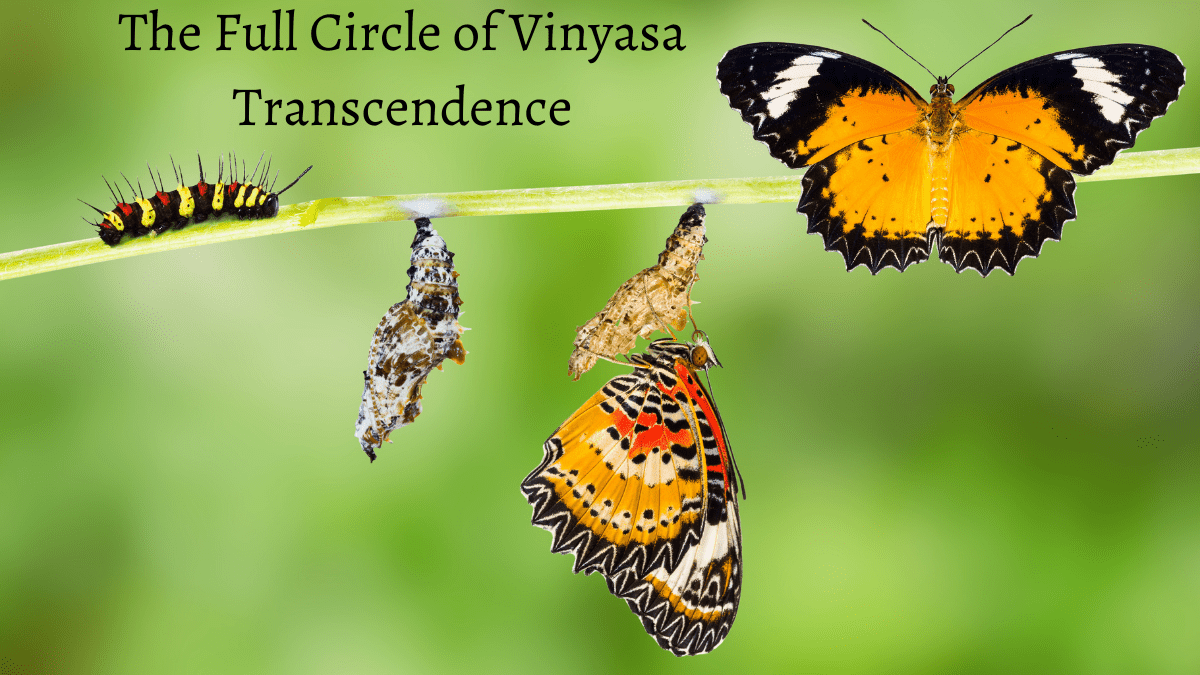
The Full Circle of Vinyasa – Transcendence

In its purest form, the Vinyasa experience  is what Patanjali calls samyamah, a synthesis of  forms of concentration which modulate the fluctuations of the mind, in this case, the focus is on breath, movement, intention and internal anchoring in the moment by moment unfolding of time.  The result is that beautiful transcendental physical flow that so many of us admire, aspire to and experience.   In my experience the vinyasa is an inner experience first, an inner experience of moving intentionally through time and space oriented primarily in an anchoring in the wisdom self. 

To understand this brings us to one of Patanjali’s key instructions about yoga, that yoga is nurtured through the practice of abhyasa (practice time spent dwelling in the true nature) or practice dwelling in our true nature, the wisdom self, and vairagya – detachment.  These practices form the landscape from which the classical practices of renunciation arise.  In it’s essential form, renunciation is an inner practice, developed through outer practice.  A simple moment when you soften around a moment of change can teach us a lot about the inner landscape of yoga.  What do we feel as we begin to move, is it sticky?  Clunky?  Awkward or painful?  Or does it flow?  Are we able to be still comfortably or at a different pace, comfortable?  Our capacity to do that is built on practicing this inner spaciousness which arises with practice and detachment.  The experience of and wake from the COVID related worldwide shutdowns has triggered an avalance of change.  Having survived four job changes and a tumultuous presidential election which, last night I found myself cringing in fear at the thought of further changes which will likely be unfolding as we move forward.  Who knows what’s coming?  Cringing.  I was  actually cringing.  And then, like a good dream my years of practice kicked in and I was awash in love and gratitude rather than fear of what was to come.  I am grateful that I was here in this beauty and that I have had the experience of knowing amazing people in my life.  Things may be different for all of us moving forward, but that doesn’t mean they won’t be good.  I find this way of vinyasa-ishly moving through a challenging experience helps me keep it in perspective.  It’s like walking through the streets of the city, any city.  Every neighborhood has it’s flavor and feel and we are just walking through those varying flavors and feels.  An uncomfortable neighborhood doesn’t require us setting up house there.  One the inner level we don’t need to set up camp in an interior landscape of opinion and belief which doesn’t serve us.  Instead we set up our camp in the wisdom self as we move through the discomforts and comforts  of life.  Th

In its purest form, the Vinyasa experience  is what Patanjali calls samyamah, a synthesis of  forms of concentration which modulate the fluctuations of the mind, in this case, the focus is on breath, movement, intention and internal anchoring in the moment by moment unfolding of time.  The result is that beautiful transcendental physical flow that so many of us admire, aspire to and experience.   In my experience the vinyasa is an inner experience first, an inner experience of moving intentionally through time and space oriented primarily in an anchoring in the wisdom self. 

To understand this brings us to one of Patanjali’s key instructions about yoga, that yoga is nurtured through the practice of abhyasa (practice time spent dwelling in the true nature) or practice dwelling in our true nature, the wisdom self, and vairagya – detachment.  These practices form the landscape from which the classical practices of renunciation arise.  In it’s essential form, renunciation is an inner practice, developed through outer practice.  A simple moment when you soften around a moment of change can teach us a lot about the inner landscape of yoga.  What do we feel as we begin to move, is it sticky?  Clunky?  Awkward or painful?  Or does it flow?  Are we able to be still comfortably or at a different pace, comfortable?  Our capacity to do that is built on practicing this inner spaciousness which arises with practice and detachment.  The experience of and wake from the COVID related worldwide shutdowns has triggered an avalance of change.  Having survived four job changes and a tumultuous presidential election which, last night I found myself cringing in fear at the thought of further changes which will likely be unfolding as we move forward.  Who knows what’s coming?  Cringing.  I was  actually cringing.  And then, like a good dream my years of practice kicked in and I was awash in love and gratitude rather than fear of what was to come.  I am grateful that I was here in this beauty and that I have had the experience of knowing amazing people in my life.  Things may be different for all of us moving forward, but that doesn’t mean they won’t be good.  I find this way of vinyasa-ishly moving through a challenging experience helps me keep it in perspective.  It’s like walking through the streets of the city, any city.  Every neighborhood has it’s flavor and feel and we are just walking through those varying flavors and feels.  An uncomfortable neighborhood doesn’t require us setting up house there.  One the inner level we don’t need to set up camp in an interior landscape of opinion and belief which doesn’t serve us.  Instead we set up our camp in the wisdom self as we move through the discomforts and comforts  of life.  Th

In its purest form, the Vinyasa experience  is what Patanjali calls samyamah, a synthesis of  forms of concentration which modulate the fluctuations of the mind, in this case, the focus is on breath, movement, intention and internal anchoring in the moment by moment unfolding of time.  The result is that beautiful transcendental physical flow that so many of us admire, aspire to and experience.   In my experience the vinyasa is an inner experience first, an inner experience of moving intentionally through time and space oriented primarily in an anchoring in the wisdom self. 

To understand this brings us to one of Patanjali’s key instructions about yoga, that yoga is nurtured through the practice of abhyasa (practice time spent dwelling in the true nature) or practice dwelling in our true nature, the wisdom self, and vairagya – detachment.  These practices form the landscape from which the classical practices of renunciation arise.  In it’s essential form, renunciation is an inner practice, developed through outer practice.  A simple moment when you soften around a moment of change can teach us a lot about the inner landscape of yoga.  What do we feel as we begin to move, is it sticky?  Clunky?  Awkward or painful?  Or does it flow?  Are we able to be still comfortably or at a different pace, comfortable?  Our capacity to do that is built on practicing this inner spaciousness which arises with practice and detachment.  The experience of and wake from the COVID related worldwide shutdowns has triggered an avalance of change.  Having survived four job changes and a tumultuous presidential election which, last night I found myself cringing in fear at the thought of further changes which will likely be unfolding as we move forward.  Who knows what’s coming?  Cringing.  I was  actually cringing.  And then, like a good dream my years of practice kicked in and I was awash in love and gratitude rather than fear of what was to come.  I am grateful that I was here in this beauty and that I have had the experience of knowing amazing people in my life.  Things may be different for all of us moving forward, but that doesn’t mean they won’t be good.  I find this way of vinyasa-ishly moving through a challenging experience helps me keep it in perspective.  It’s like walking through the streets of the city, any city.  Every neighborhood has it’s flavor and feel and we are just walking through those varying flavors and feels.  An uncomfortable neighborhood doesn’t require us setting up house there.  One the inner level we don’t need to set up camp in an interior landscape of opinion and belief which doesn’t serve us.  Instead we set up our camp in the wisdom self as we move through the discomforts and comforts  of life. That, is transcendence.

Vinyasa

A Compilation of commentaries from newsletters sent to students during the moon month

To subscribe to my newsletters: 

Processing…
Success! You're on the list.

Putting It All in Place

Sunday is a workday for me.  Two days of my week are dedicated entirely to creating content, planning classes and workshops, marketing and visioning – to building a scaffolding for the life that I want to be creating.    A workday, but it’s the day I get to flex my entrepreneurial muscles and work towards my own personal vision.  I had plans of everything that I would get done.    I work up early to get started, and when I woke, I knew – I just knew – that the time had come to rearrange the furniture.  Distraction or meaningful digression?  I didn’t know.  But I knew I needed to do it.  And so I did.  I spent the day sweeping away the dust which had accumulated under the desk and reflecting on the feng shui of it all.  Not deliberately forcing the placement of objects in the magical feng shui areas but noting the call of my heart to place an object here, or there, or to carefully dust off a beloved memento.  When I realized how late in the day it had gotten and how many things still needed

to be put in their place, I began to chastise myself about how I had “wasted” my time.  But then my eyes took rest on a yet to be placed object, and I recalled my planned subject matter for the month.  Vinyasa.  While Vinyasa is a term commonly used to refer to a general kind of flowing with breath in the yoga practice, the word itself breaks down into vi and nyasa.  Nyasa I understand this to mean placing something, and the vi confers a sacred intentionality. To place even a tiny object, like a thought or a wish intentionally is a very very big deal.  Mostly I understand this on the basis of my practice.  Not the how, but what was reveealed through practice embedded in spacious understanding.  This month we invoke into our practice a little energy of the elements of conscious co-creation revealed in vinyasa practice.

I was first introduced to this concept at the Jivamukti Yoga School, where Vinyasa is brought together with Sutra III.52 from Patanjali’s  Yoga Sutra to form the basis of a philosophy of vinyasa sequencing.

क्षणतत्क्रमयोः संयमात् विवेकजंज्ञानम् ॥५२॥

kṣaṇa-tat-kramayoḥ saṁyamāt vivekajaṁ-jñānam ॥53॥ Swami Vivekananada

PYS III.53 Through samyama on a particle of time and that which proceeds and succeeds it comes discrimination.

(Translation by Swami Vivekananda –>>)

This sutra is carefully placed at the end of the third pada, or foot, or maybe even step of Patanjali’s technical manual on yoga.  By the time we are this deep into the practice, we have entered the realms of mysticism.  The experiences encountered are multidimensional and beyond language.  But discernment is all about choice, and so the process of practicing this very deliberately, the movement into a conscious placement, the awareness of where we were and where we are going leads us to a place of clarity about how we are moving forward in life.  As always, the yoga illuminates an experience on and off the mat.  It brings us to a place where “going with the flow” and deliberate action are united, yielding conscious intentional movement.  It brings us to a place a conscious creation in conjunction with the power and love of our wisdom selves.  And that is a very powerful position in which to find ourselves.  Which brings me back to rearranging the furniture.  Sometimes, when I’m following

that luminous inner guidance, I am guided to do the most illogical things, but as I move forward with and in alignment with that higher guidance, like today, I find myself in some miraculous place that I could never have arrived at with my intellect, both eternally and in the physical realm.  As we moved through the chaos of the past 18 months or so,  I took a thousand conscious steps forward with guidance and this is where I landed.  I was so busy that I couldn’t adjust my environment to how my life was changing, and now, as I look around my little studio, I realize that it’s now the perfect set up to support where I am now, as I conscious craft where I am going, and I’m looking forward to the inevitable surprises contained in the perfect placements.  What will emerge in this newly reshaped environment I am living in?


Where Vinyasa Begins – Intention

A long time ago when I began to practice yoga vinyasa, one day during practice this thought arose ….this must have something to do with surfing…that riding of the waves of breath and movement.  I sensed, that there was some common element physically.  I found out soon there after that the first “landing” of yoga vinyasa in America was in the surfing communities of Hawaii and California.  The connection between the two disciplines, I felt, must have been mula bandha.  Mula bandha is a physical lift of the pelvic floor which allows one to balance while moving.  Esoterically mula bandha is associated with the practice of inner alignment, to direct one’s energy towards the highest possible levels of mystical consciousness.  It is a practice which leads to tremendous clarity.  We don’t need to go into deep resonance with the sacred to know this, if you’ve even done a few rounds of sun salutation, you know that clarity emerges quickly with such a practice.  While there is a physical component of mula bandha, the activation of it on the level of consciousness is achieved only through intention.  The physical activation of the pelvic floor wakes the energy up.  The direction of our focus will determine where the energy goes.  There is no right or wrong about the directing of energy, but I think it’s good to know that our results will very much be determined by  the direction of the energy.  In true vinyasa fashion this idea is circular, our intention . will determine our focus which will determine the direction of the energy which will then create a result which will influence our intention and so forth. The most important moment In our yoga practice is the moment we override inertia and consciously go about choosing a direction.

                   In the classical schools the only intention considered potent enough to activate the bandha was  desire to know God.  The aspirant would begin each practice bowing down to God and the Guru who represented God in form.  In America this intention became softened somewhat to offering the good of our practice to others, a classic Buddhist practice.  The energetic result is the same because the energy is directed towards something beyond our personal needs.  It’s uplifted.  In recent years in America the practice of intention has shifted again, now to honoring ourselves and good self care.  Good self care is essential to a yoga practice, but as an intention it can keep you anchored in what you need, rather than your most illumined potential. Following Patanjali’s formula we know that what we focus on grows.  We don’t want our needs to grow. The heart of the yoga practice is to transcend our needs and fulfill our potential (hence the complex landscape of renunciation practices which have historically defined the practice).  Deprivation is undesirable and not effective.  But to direct our intention higher than our needs is to up-level our capacity for living.  But even this requires some conscious consideration. We need to be aware of what we are intending.

                    To offer oneself as a vehicle for the divine may result in a role where you are the deliverer of blessings hard truths.  An important, but not always fun role.  An intention to serve may yield gracious and elegant opportunities to serve others, but you may have to deal with constraints on your self expression or ability to make decisions.  To intend to know true compassion may inspire you to give away your last dollar.  To intend to align with the most magnificent and expanded vision of your divine sacred infused snowflake self (no two are alike you know) well….that may lead you on your own magnificent divine journey which may include being compassionate in your own unique snowflake way.   It’s nothing we need to fear.  The point is to be awake and clear in the creative opportunity that Vinyasa presents.  Vinyasa, broken down into it’s parts is to place on purpose.  To place a purposeful intention at the beginning of our practice and then to consciously observe our ability to focus as the moments arise and fall in the practice is to take ownership of the power of asana in a whole new way.   Intending a practice is frequently invoked in yoga class, which is good.  Then it is up to us to discern the best way to use that opportunity.


What to Say About Vinyasa Om

This is the second time this year I felt called to teach about vinyasa, and both times when I went to write, words eluded me.  As this month unfurls practicing, contemplating and teaching vinyasa I come to a place where silence feels best.  Vinyasa, after all, in body or spirit is an experience.  But, it’s my job to teach and if  the only communication which occurs in teaching and learning is silent, so be it.  But there is a place for speaking about breath, movement, intention, purposeful placement and continuous focus on the past, present and future.  So we know, somehow this is not just about our bodies.  If we are spacious enough in  our practice through our practice we come to know that our placement in this moment in the spectrum of time is no accident, and through our conscious intention we can influence where we land in the days to come.  An intention for kindness, for generosity, for clarity and peace, cooperation and good relating can do wonders in transforming our life experience.  Today we’ll just experience, continuity of moment by moment movement through past, present and future on our mats.