Once in the early 2,000’s a friend and I were strolling and shopping and dining in Greenwich Village when we came upon a small store – just a nook really, filled with shiny clear rectangular glass bottles stacked on wooden shelves. A slender handsome hipster with an untucked navy blue shirt and somehow stylishly elegant slightly faded jeans manned the counter.
The bottles and their rectangular labels were identical except for the unique word on each label: Rain, Dirt, Beach, Grass, Dog among the hundreds.
In response to our outburst of giggles he offered sample smells.
A gentle whiff of “dirt”;and I was transported out of the concrete canyon and back to a time before vanity when I was a simple child doing what kids like to do. Play in the dirt.
Tobacco – was my 1960s father and warm leaves drying in the sununveiling a thought of slaves picking leaves in the hot, hot sun and wondering if the fragrance for them was unpleasant. Grass in a bottle was a little too much for both of us, but we both loved tobacco which was mysterious and somehow informative.
Smell emerges in the first trimester of a babies development, the smell of placenta and mother creating a subtle earthy unbreakable bond.
Smell evokes memories – our minds travel far into our histories and possible futures in the presence of them.
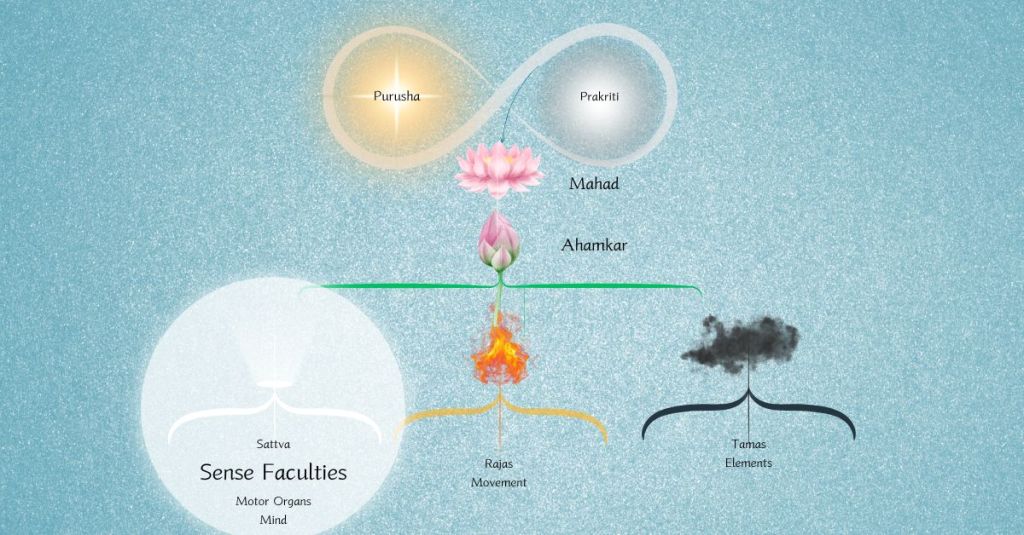
The Sankhya philosophy as commonly mapped on a chart lines up, as a bottom line foundation, the senses. Our connection to the physical realm moves directly through the five sense faculaties and the elements. This will become more meaningful as we move beyond the dense material realm.
Smell is associated with the subtle element earth – the root chakra, the mooladhara chakra – the focal point of the yogi’s shift of attention from the material realm upward from the realms of hunger and fear into more exalted states of consciousness…into awareness, understanding and wisdom. Smell evokes an understanding of ourselves in time, life and death, and anchors us in the physical.
In that essential awakening into that experience of life and death we meet the kaladanada…the yogi’s alchemical transformation from death to immortality. Yes, they actually mean that. Hatha Yoga was a practice of alchemy – a system based on primordial wisdom encoded in the sound of Om. Smell and it’s essential nature is a portal into the ancients through the root chakra, like an uplifting song moves us upward, so does an uplifting fragrance.
Of course for asana yogis, in the days that we still did this…wafting incense – burning of the earth, the smell of smoke offered up to the heavens – an invitation for ascended beings physical and non-physical to bless us with our wisdom.
Processing…
Success! You're on the list.
Whoops! There was an error and we couldn't process your subscription. Please reload the page and try again.
For those of you first joining us, we have been looking at our yoga practices from the perspective of the classical teachings found in the yoga philosophy and related texts. We’ve been using the classical teachings as maps to explore in our asana practice. The segment we are working on now is a segment on the Indian philosophy of Sankhya. The map of the philosophy is shown below. It is a map of the cosmos from a particular perspective. We are journeying from the densest most physical aspects of our being to the most ethereal aspects of the cosmos. Technically, Sankhya and Yoga are completely separated disciplines. Philosophy, science, art are evolving permutations of interwoven understanding. All philosophies, sciences and arts touch one another, influence one another evolve one another. There is likely more than one map of Sankhya floating around the universe or the internet and ideas – like philosophy – end to cross-pollinate. Most yoga teachers learn about Sankhya philosophy in teacher training and I believe it’s worth exploring the subtle influence that it may have exerted in the understandings of yoga that have emerged. This post is not intended as a definitive answer to the question of what the Sankhya philosophy is, but rather how we can use an understanding of the philosophy to deepen our lived understanding of ourselves and our yoga practices.
/*Patanjali advises in Yoga Sutra 2.46:
*स्थिरसुखमासनम्॥४६॥
sthira-sukham-āsanam ||46||
The posture should be stable and easeful. */
We began our exploration of Sankhya and the senses with the sense of touch. We’ll be moving into an exploration of the sense of hearing, but first there are a few additional notes on working with the sense of touch as it relates to our asana practice.
As we develop our practices and deepen our awareness of touch – subtle deep unconscious patterns of tension will surface in our practice. There are two facets of working with that tension: first, to release those deep stress patterns and second, to move our bodies (on and off the mat) in ways that minimize the creation and holding of those stress patterns. When practicing asana it is important not to pile new tension patterns on top of the more deeply held ones in our eagerness to make a posture happen.
The primary way that a new tension pattern is created is to skip a level of your practice. To push through to a new level of posture before you have released the tension patterns which were revealed in a lighter expression of the posture. This results in a strain in the body’s tissue as opposing forces are exerted on a joint, muscle, or a specific pattern in the fascial tissue.
/*Forcing a yoga posture to happen is not the same as transcending pain and pleasure.*/
To stay in ease is to stay in union (yoga). To force, grip or struggle is to create separation – dis-ease. Anti-yoga. To stay in ease doesn’t mean you don’t work hard, stay focused and open to the idea that you might be able to accomplish something beyond your own expectations. Consider this: a certain amount of ease is necessary for any kind of success.
And then there is prana…
As we begin to develop discernment through the sense of physical touch in our practice, we will develop a sensitivity that allows us to detect sensory experiences which originate in prana. Prana is a subtle substance – an energy. Like sound it travels and has a felt presence. Like sound it manifests in a spectrum where different beings can perceive different levels of it. We know that different species perceive sensory information very differently. That would be true of perceiving prana as well. Some of us can feel it acutely, some of us can’t feel it at all.
And finally, sound is prana. Sound in various subtle degrees travels through the body in pranic circuits. This is why it reveals and heals. When we touch the ground with our hands and feet the channels are charged with the heartbeat of the earth.
As we begin to develop this feeling/touch/sensory discernment we discover that some of what we perceive as physical pain are actually blockages or fragilities which on the level of prana.
The clarity of the pranic channels (which we can feel through our sense of touch) is directly related to our capacity to hear and to hear on a subtle level (and to see and to smell and to taste, etc). This is the connection between touch and hearing in the yoga practice
/*Notice in the modified Sankhya Chart below the position of the sense on the map*/
CAN YOU HEAR ME? TURNING TOWARDS THE SOUND OF OUR OWN HEARTS
The Sankhya philosophy provides one possible map of the terrain of the mind body spirit connection. The journey can unfold as a trip where we elevate from tuning in only to our dense physical senses to opening to consciousness awareness in different degrees. This would commonly be called a journey towards enlightenment. The journey can also unfold as a kind of embodiment – where – like shamen we experience an inspired state of consciousness and then bring the inspiration down, to embody and manifest that experience in the physical world. One of the most “known” experiences of this process of bringing spirit into physical reality is the manifestation of deep healing by various saints and mystics. Probably the most well-known is Jesus – whose miraculous healings of lepers and raising of the dead are probably heard of by most people, even if they don’t believe in it. If you dig enough there are tales of other such healings by saints in all traditions. A more secular example of bringing spirit into the physical occurs with inspired innovations i.e. the light bulb or the personal computer. Sometimes innovation is planned and sought after but often it’s inspired.
The senses are the interface of consciousness with the manifested world on the Sankhya map. We touch the world, we hear the world, we see the world and so on. The yogi seeks to manage and clear the senses so that they do not interfere with our exploration of elevated states of consciousness. Yoga seeks to do what some people turn to substances to do. Drugs can numb the chatter of the mind, drugs can ignite an expanded state of consciousness. But with yoga, these states are attained through personal mastery, awareness and skill (i.e. mastering and clearing the senses). It removes the dependency that substances require. Yogis are independent.
Mastery of sound is an essential practice in hatha yoga. The yogin becomes unified with the ancient wisdom that permeates the deep silence connected with through practice. Then, the yogin aspires to staying harmoniously anchored in that “vibration” as they move through the world. This vibration is depicted by the ubiquitous symbol Om. Asana practice is both the ground of that harmonic synchrony and the training for sustained experience of that harmonic synchrony. There are a variety of practices used to cultivate this experience. In a very straightforward everyday way on the mat we can begin to condition ourselves to excel in these practices. The training goes something like this:
External sounds capture our attention on the mat. Some are quite annoying – talking, sirens, construction, airplanes, and other machinery. The yogin trains themselves to turn their attention from the external noise and into the inner landscape. There they meet another layer of sound –
Internal Chatter. Much of the chatter of our minds originates in experiences and beliefs rooted in the past with no place in the present. With mindful attention the yogi becomes aware of their absorption in this inner chatter and they train themselves to turn inward to a still deeper level of sound –
Subtle Sounds – The yogin hear many subtle sounds within as their pranic channels are cleared through consistent practice – Bells, whistles, drums and humming. In time, willingness to turn away from these distracting subtle sounds reveals yet a deeper subtler sound –
Nadam – Most likely this is the subtlest sound that a human can hear. It is steady, constant, ever present – like white noise but more ethereal. Tuning our attention away from more overt inner and outer noises to this perpetual background hum within and without, and allowing ourselves to relax into it begins a process of deep healing and awakening. But even then…the yogin turns their attention away from it, and towards something deeper –
The Anahata Nadam. The anahata nadam is the sound that is complete silence without vibration – the “unstruck” sound. Here the yogin relaxes into the deep silence and in stepwise fashion becomes absorbed in expanding stages of continuity.
We practice this way on the mat, and asana facilitates this process. In later stages conscious meditative seats (asanas) like virasana and padmasana support the process of allowing ourselves to be absorbed in silence without falling asleep or going unconscious.
In practicing asana how can we support this process in personal practice or when leading a class? The playlist. The playlist is most beneficial at early stages of this process. When the chatter of the mind is overwhelming and distracting on the mat that is when you want the playlist. It is also really helpful in situations of deep unconsciousness where you or those you are leading just can’t stay present – which is a result of trauma. It either wakes you up or calms you down. The goal is the experience of yoga – this inner absorptive yoking. It’s important to be aware that familiar music or verbal music will have associated mental imagery and memories and feelings that will be ignited and it’s likely to draw the attention outward rather than inward. Sometimes this is needed. But just be aware that a rousing playlist of familiar or exciting song might operate in a way that is inconsistent with your goal.
When you create your playlists consider creating a musical experience which propels the journey towards yoga and not to somewhere else. Like a soundtrack to a movie you are building up to something: an experience of yogic absorption for yourself or the student.
Indian classical music is designed to take you to this point, so it’s very useful. But if you use it too early in the process it can be too potent and cause a different kind of distraction.
Consider as well that when we take in music it can nourish us; pure sounds are deeply nourishing. Note that doesn’t always mean soft or new agey. A pure note is a perfect note. Some music that we love has those pure notes, and you will develope an ear for the perfect note as your practice unfolds. Allowing yourself to be nourished by deep clear sound is deeply healing as well as enlightening, and this can lead to all kinds of magnificence if approached with an open mind and heart.
The anahata nadam – that deepest level of sound resides in your spiritual heart. That’s where the note of silence lives. So when you touch it for the first time as a yogi you will feel and hear the spiritual heart.
Working with sound in asanas is accessible to all and an abundant and beautiful experience.
Each blog post has an associated newsletter. No marketing! I promise. To sign up to receive the next email please do so below. To see the accompanying newsletter for this post, they are publicly posted on my facebook business page for NatalieteachesYoga.
Processing…
Success! You're on the list.
Whoops! There was an error and we couldn't process your subscription. Please reload the page and try again.
/* To be established in a posture is not about the first time you attain it (although that is to be deeply celebrated). It’s about accessing it – in an aligned fashion – consistently enough that you can grow your alignment within it.*/
Pratiṣṭhāyāṃ – to become established in, is a fundamental concept in yoga practice as described in Patanjali Yoga Sutra. It’s pervasive; we are guided to become established in focus, established in asana, established in meditation, established in practice, established in the experience of yoga and more. Once you are established your path is clear and unfolds quickly. Yoga does not peak with the experience of a flash of insight (although that’s a valuable thing – it’s not the heart of the practice) it’s about establishing oneself in an internal landscape where insight continuously fosters understanding. To be established in a posture is not about the first time you attain it (although that is to be deeply celebrated). It’s about accessing it – in an aligned fashion – consistently enough that you can grow your alignment within it. You are relating to the posture. Deep asana then becomes about that capacity to deepen the alignment of the posture over time. There is an eternal, never-ending quality to establishment.
/*All postures become deep postures through the practice of inhabiting them in time with greater alignment and understanding.*/
Deep asana then is relative to one’s own body – built into the practice over time and emerges with stability and ease. It’s always advisable to step back in practice when one cannot stay stable in the posture with relative ease.
A first mode of deeper alignment which unfolds in deep asana is internal – at the level of the ManomayaKosha or mind body. Presuming you have placed yourself well to begin with in a posture, discomfort is first addressed in the mind. This does not mean that sensations are ignored – on the contrary paying attention to them is awakening into the posture. But, for most of us, placing our bodies in these unusual positions is…odd. So, there is likely to be psychological discomfort and an opening up around that is very powerful.
For those with backgrounds of dance, gymnastics or similar – expectations take the place of the psychological discomfort of the novice. They are constructs in the mind that obscure new levels of awareness. For the physically experienced deep asana is an invitation to shift into a new awakening, into a different kind of bodily experience – experiencing the shape without judgement, competition or preconceived ideas about how the body should inhabit the shape. Discomforts, expectations and conquests are often mental constructs which obstruct our ability to deepen an asana in a fresh, organic and transformative way. They are subtle forms of fear and resistance. If we meet them with spaciousness we come to know and understand ourselves and the posture differently .
/*Discomforts, expectations and conquests are often mental constructs which obstruct our ability to deepen an asana in a fresh, organic and transformative way. They are subtle forms of fear and resistance.*/
Tuning in is a second mode of shifting into deep asana. Feeling the body holistically in space and time. Inner body scans, proprioceptive or kinesthetic exercises and relaxing around resistance deepen the holistic sensory experience of an asana – not once, but continually.
A third mode of establishing into deep asana is time – time in the posture and consistent practice of the posture daily, weekly, or monthly – over months, years, or decades. Doing less, more consistently will yield a deeper result than doing a lot intermittently. It’s seldom a linear process, but the intention to consistency will do much for establishing your practice. A general rule for this is that your posture should always be stable and easeful. So, find your edge at 1 minute, 2 minute, 3 minute and so on. Work the mental resistance first. Begin to identify what your mental resistance looks like.
Example: I’ve been working a 10 minute Virasana, and 10 minute Padmasana (5 minutes each side) sequence for months now. In those postures I’d been meditating in a whole new way. A new proprioceptive awareness (my body in space) of my pelvic girdle began to emerge. This week as I take the postures for practice my mind bounces all over the place – it’s hard to get on my mat to begin with and there is no peace. Breakthrough time – time to step back a little and cultivate the stability of mind that I need, that I can reside in consistently enough to experience the breakthrough. I modify the postures slightly in consistent, strategic ways. A little extra propping, a little extra warming up. I reduce my time in them at the beginning of practice and then engage them again for a short time at the end of practice.
This kind of strategic approach to asana, while analytical, lays the ground for being your own teacher in a personal practice in an illuminated way. You may find other ways to bring strategy and discipline to your practice, but I encourage you…gently…to experiment with modes of deepening your understanding of your practice. It leads to deep healing and a different flavor of progress.
Thank you for reading! Concurrent with each blog post a newsletter is issued. If you’d like to receive it please sign up below. This is not sued for marketing purposes. If you’d like to support financially, my designs are available on Redbubble. See designs on menu. New designs are available on Redbubble within a day or so of being posted here.
Processing…
Success! You're on the list.
Whoops! There was an error and we couldn't process your subscription. Please reload the page and try again.



 Natalie Ullmann