Pratiṣṭhāyāṃ:  A Path to Deep Asana प्रतिष्ठायां

/* To be established in a posture is not about the first time you attain it (although that is to be deeply celebrated). It’s about accessing it – in an aligned fashion – consistently enough that you can grow your alignment within it.*/

Pratiṣṭhāyā – to become established in, is a fundamental concept in yoga practice as described in Patanjali Yoga Sutra. It’s pervasive; we are guided to become established in focus, established in asana, established in meditation, established in practice, established in the experience of yoga and more.  Once you are established your path is clear and unfolds quickly.  Yoga does not peak with  the experience of a flash of insight  (although that’s a valuable thing – it’s not the heart of the practice)  it’s about establishing oneself in an internal landscape where insight continuously fosters understanding.  To be established in a posture is not about the first time you attain it (although that is to be deeply celebrated). It’s about accessing it – in an aligned fashion – consistently enough that you can grow your alignment within it. You are relating to the posture.  Deep asana then becomes about that capacity to deepen the alignment of the posture over time. There is an eternal, never-ending quality to establishment.

/*All postures become deep postures through the practice of inhabiting them in time with greater alignment and understanding.*/

Deep asana then is relative to one’s own body – built into the practice over time and emerges with stability and ease.  It’s always advisable to step back in practice when one cannot stay stable in the posture with relative ease.

A first mode of deeper alignment which unfolds in deep asana is internal – at the level of the ManomayaKosha or mind body.  Presuming you have placed yourself well to begin with in a posture, discomfort is first addressed in the mind.   This does not mean that sensations are ignored – on the contrary paying attention to them is awakening into the posture.  But, for most of us, placing our bodies in these unusual positions is…odd. So, there is likely to be psychological discomfort and an opening up around that is very powerful. 

For those with backgrounds of dance, gymnastics or similar –  expectations take the place of the psychological discomfort of the novice.  They are constructs in the mind that obscure new levels of awareness. For the physically experienced deep asana is an invitation to shift into a new awakening, into a different kind of bodily experience – experiencing the shape without judgement, competition or preconceived ideas about how the body should inhabit the shape.  Discomforts, expectations and conquests are often mental constructs which obstruct our ability to deepen an asana in a fresh, organic and transformative way.  They are subtle forms of fear and resistance.  If we meet them with spaciousness we come to know and understand ourselves and the posture differently . 

/*Discomforts, expectations and conquests are often mental constructs which obstruct our ability to deepen an asana in a fresh, organic and transformative way.  They are subtle forms of fear and resistance.*/

Tuning in is a second mode of shifting into deep asana.  Feeling the  body holistically in space and time. Inner body scans, proprioceptive or kinesthetic exercises and relaxing around resistance  deepen  the holistic sensory experience of an asana – not once, but continually.

A third mode of establishing into deep asana is time   – time in the posture and consistent practice of the posture daily, weekly, or monthly  – over months, years, or decades.  Doing less, more consistently will yield a deeper result than doing a lot intermittently.  It’s seldom a linear process, but the intention to consistency will do much for establishing your practice.  A general rule for this is that your posture should always be stable and easeful.  So, find your edge at 1 minute, 2 minute, 3 minute and so on.  Work the mental resistance first.  Begin to identify what your mental resistance looks like. 

Example:  I’ve been working a 10 minute Virasana, and 10 minute Padmasana (5 minutes each side)  sequence for months now.  In those postures I’d been meditating in a whole new way.    A new proprioceptive awareness (my body in space) of my pelvic girdle began to emerge.  This week as I take the postures for practice my mind bounces all over the place – it’s hard to get on my mat to begin with and there is no peace. Breakthrough time – time to step back a little and cultivate the stability of mind that I need, that I can reside in consistently enough to experience the breakthrough.  I modify the postures slightly in consistent, strategic ways. A little extra propping, a little extra warming up.  I reduce my time in them at the beginning of practice and then engage them again for a short time at the end of practice. 

This kind of strategic approach to asana, while analytical, lays the ground for being your own teacher in a personal practice in an illuminated way.  You may find other ways to bring strategy and discipline to your practice, but I encourage you…gently…to experiment with  modes of deepening your understanding of your practice.  It leads to deep healing and a different flavor of progress.

Thank you for reading! Concurrent with each blog post a newsletter is issued. If you’d like to receive it please sign up below. This is not sued for marketing purposes. If you’d like to support financially, my designs are available on Redbubble. See designs on menu. New designs are available on Redbubble within a day or so of being posted here.

Processing…
Success! You're on the list.

Deep Asana:  Understanding your joints for deep healing.

/*This is the first in a four part series about deep asana and creating personal sequences*/

In the classical schools of yoga  the healing power  of deep asana Is a powerful rubric. By deep asana I am referring to the classical spinal twists (i.e., ardha matsyendrasana) , lotus (padmasana), and all the various binds. These deep squeeze postures  are purposeful in their intensity in a way that large muscle strengthening or or deeply relaxing postures are not. To practice them effectively we must understand how the joints function – and what the deep asana does.

For example

  • Padmasana. The knee is a hinge joint. The ankles are mosaics of tiny interconnecting bones that move like ball bearings to allow maximal movement – but the structural stability of the joint is borne of the way those joints fit together, fettered together by soft tissue – fascia, ligaments, and such. When we do padmasana – the deep exterior rotation of the legs must emerge from the hip socket to protect the functioning of knees and ankles. If we are practicing padmasana – we must balance that deep external rotation of the hip joint with stabilizing strengtheners in our standing practice. Particularly the internal rotations which connect the feet to the earth through the inner ball of the foot. These inner rotations, while originating in the connection to the earth travel up the leg and into the hip socket and pelvic girdle. Stable hip/pelvic girdle structure is needed for standing, walking, and containing the soft internal organs. a correctly activated inner rotation will strengthen whatever tiny muscles which need to be strengthen and will establish ease in those which have been acting as supports when it wasn’t their function. So we must understand how the joints work – and what their purposes are and how they relate to each other.

  • Ardha matsyendrasana: Vertebrae spin gently in restricted rotations around a central axis. Each vertebrae is uniquely shaped for its perfect placement in the column of the spine. The shape of each one contributes to the moving stability of the spinal column. When performing a deep asana form of a spinal twist, we are invited to gently explore the boundaries of the vertebral rotation. The spine must be lifted and relatively straight to protect the cushions between the vertebrae, which protect the nerves. Remember important components of the nervous system travel through the spine – your central nervous system! A classical spinal twist is not a full body twist – it is focused on the spine. The sacrum does not participate in the twist. Instead, the pelvic girdle is given structural stability built from the ground up  either through knowledgeable activation of appropriate muscles or through placement i.e., through sitting squarely on the ground.
  • The pelvic girdle is a bunch of moving pieces. Yep. It’s not a solid bowl. Those moving pieces can misalign in subtle ways,  impact the alignment of the vertebral column and the ability of the vertebrae to turn. The stability in the alignment of your feet and knees supports this structure. Building the asana from the ground up helps with this.
  • Deep asana is not forceful asana. There are lineages where force was used effectively but I am not aware of any school that currently works successfully with dramatic deep quick forceful adjustments into deep asana. Gentle knowledgeable movement is as effective, if not more so in the stable ongoing practice of deep asana.
  • Modifications and simpler postures are your friends. You can design or learn modifications that will work specifically on the joints which present obstacles in our practice of deep asana. In my practice I work for long periods of time in specific modifications to open joints, like the hip or the  turning of the spine, before moving into the deep posture.  This creates a stable foundation for the deeper postures which is safe and healing.

Note – the relationship with deep asana is very different for those who started yoga before their bone structures were fully formed.  Yeah. The sacrum is still forming up to age 5. For the rest of us – bones remain malleable through our lives, depending on lifestyle – so change is possible, but it is best executed gradually and consistently.

Through the squeezing wringing of soft tissues in the joints – deep seated stress patterns in the fascial tissue are released, and structures in the pranamayakosha – the pranic body are aligned and rejuvenated. After squeezing – fresh blood and prana will flow into a joint to nourish it.

I encourage you to learn more about the way your joints function and how each posture – in its classical form (see Light on Yoga) articulates the joints. Note that Mr. Iyengar who is depicted in the pictures in this book, started very young. He’s like a gumby. But you can still see external rotations, internal rotations, deep spine twists, in those classical images. Gently experiment with what you learn – so it is no longer an academic exercise to learn about your yogic anatomy.

My Mailchimp newsletter is sent concurrently with this – it’s designed to illuminate related ideas to stimulate understanding and spark your thinking about your practice. I promised I won’t send you marketing emails.

Processing…
Success! You're on the list.

The Field of Mind & Yogic Anatomy: The Manomaya Kosha

“Yogas Chitta Vritti Nirodha” Patanjali Yoga Sutra 1.2 :

The state of yoga is achieved when we cease identifying with the fluctuations of the mind.

The mind as understood in the context of yoga anatomy is distinct from the brain. The brain doesn’t determine it’s function or condition. It is part of the subtle realms of consciousness which are distinct from the five senses.  Some yogic scholars identify the mind as a sixth sense.  The mind field, or what is called the Manomaya Kosha in the yogic anatomy maps of the five sheaths consists of conscious, unconscious, and super conscious thoughts, beliefs, concepts and ideas  — imagination, fantasy, projection, delusion and intellect.  In considering this sheath as a field we step into a realm of expansion revealed through the practices of yoga:  asana, meditation, observation, study.  Unlike the realms of prana, or wisdom or bliss the Manomaya Kosha sits in our awareness all the time. Some of it’s functions are more easily identified than others.  It interprets and defines. It assigns meaning. It governs perception. The world culture is permeated with instruction manuals for its management.   Just as we can become absorbed in the experience of the body to such an extent that everything else disappears (in sicknesses, deep pleasures or pain) we can become absorbed in the mind to such an extent that we lose sight of everything else (obsessive compulsive disorder, excessive worry, pessimism, delusion, illusion, fantasy).

Becoming aware of what happens in the ManomayaKosha, when we lose ourselves in it and what we can accomplish by managing it is a key development in our yoga practices. So essential is it in the practice of yoga – that the first line of Patanjali Yoga Sutra (which heads up this blog post) references it directly. Like the food body (Anamaya Kosha) and the pranic body (Pranamaya Kosha) can be clear and healthy and flexible and strong  – so can the mind body (the Manomaya Kosha).

The Manomaya Kosha sits at the juncture between what is human nature and what is spiritual nature. 

There are two primary tools for working with the Manomaya Kosha in our yoga practices.  The first is observation and the second is the mastery of the “seat”.

In yoga, our observation training consists of concentration on the breath, observing thoughts as they arise, consciously training to calm those fluctuations as we practice, and disciplining the body through focusing the mind.  There is association between the depths of postures and the depth of clarity in the Manomaya Kosha.  A deep posture being one where we are fully present (not lost in fantasy or topor or competitiveness or worry) and working deeply (relative to one’s own capacities) the tissues of the Anamayakosha (the muscles, bones organs skin – all of it – being squeezed and stretched and pressed upon.

We might work the observation piece like this:

  • Decide to awaken to what is in your mind
  • Establish a state of stepping back internally and witnessing (this can be the tough part)
  • Observe it objectively – meaning without getting involved – just “watch”. You will observe the arising, existing and falling away of a thought.
  • Keeping attention partially in the breath can facilitate the state of witnessing

The seat or connection to the earth is a foundation through which we master the mind in our asana practice.  It’s not unusual for awareness of our connection to the ground to be non-existent.  In all asana, and especially the classical meditative seats, there is a relationship to being grounded and experiencing a lifted spine.  This lifted spine is thought to work like an antenna for higher states of wisdom. If you are fortunate enough to see a buddha statue with a pointed hat…you are seeing his antenna!

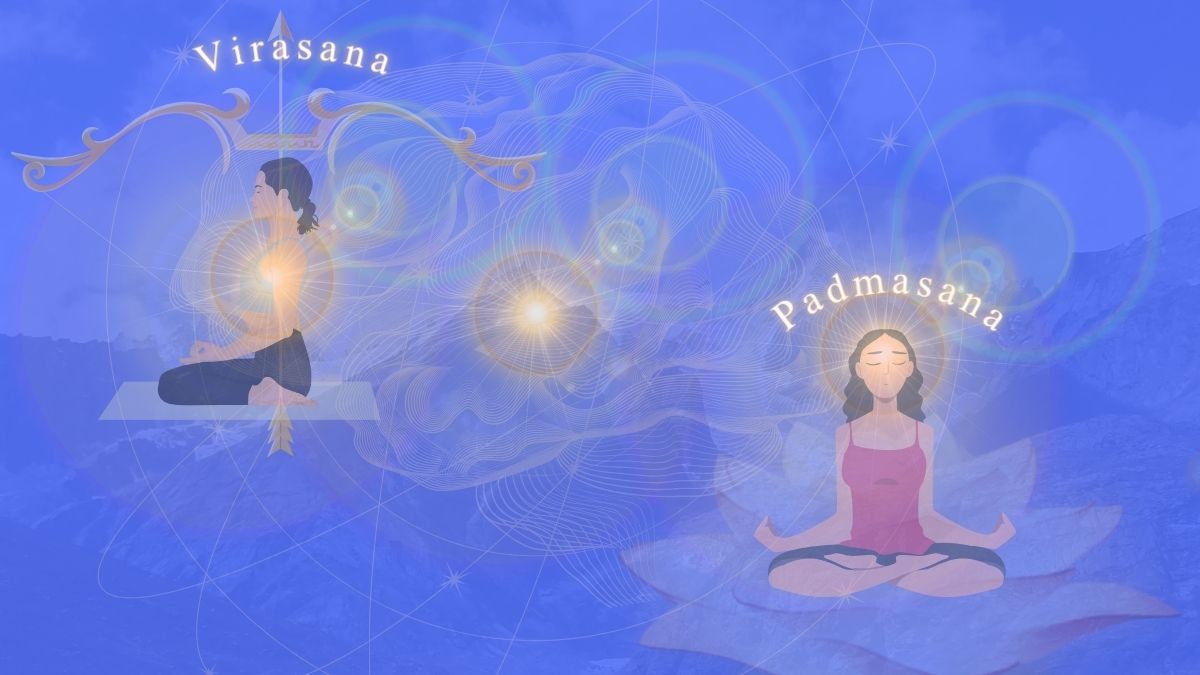
The classical seats I’d like to illuminate today are Virasana = the hero and Padmasana the lotus.  I encourage you to explore both of these with physical teachers (in person) and through your own research. These postures often become accessible only after considerable yoga practice. 

Virasana the hero is taken with the knees together, sitting between the heels with the sitz bones grounded.  The knees together – drawing inward – create a powerful gathering and focusing of energy which supports concentration and focus –  practices required for managing the mind.  The focused energy also creates a stability which lifts the spine.

Padmasana – the lotus – is unique in it’s combination of deep grounding and expansiveness.  The sitz bones are rooted into the earth, the knees are out to the side and the shins cross so that the soles of the feet face the sky.    When the shins cross a powerful acupressure point known as SP6 – the juncture of three major “yin” channels -Liver, Kidney and Spleen is toned.  Yin draws the energy inward. As with Virasana this inward energy creates a stability that lifts the spine.  Any posture with knees open to the sides will create openness and spaciousness.  With Padmasana we master our capacity to remain focused and steady in more and more expansive states of consciousness.  Padmasana allows us to sit with the experience of enlightenment. 

Want a little more “woo” in your life? No? Me neither. But yoga philosophy approached with wisdom is grounding and empowering. The philosophical elements are explored in my newsletter. I promise…it’s not a marketing email although I do suggest readings and music. You can sign up here. They are also posted simultaneously on my facebook business page – NatalieteachesYoga. Thanks for reading!

Processing…
Success! You're on the list.