About the body – Speaking in Paradigms

Paradigm: From Merriam Webster: : a philosophical and theoretical framework of a scientific school or discipline within which theories, laws, and generalizations and the experiments performed in support of them are formulated the Freudian paradigm of psychoanalysis broadly : a philosophical or theoretical framework of any kind

In the course of my early yoga career I learned at least three different combinations of feet positions in Trikonasana.  It seemed everyone was teaching something different.  Couldn’t we all just settle on one right way?  I pressed my mentors for an explanation and they allowed my frustrated questions to just fly past them. I determined which of those was “correct” and advocated it heartily.  But as my journey continued I learned that various foot positions have their own logic within certain schools where they are taught. They are reflections of each yoga schools paradigm of the body.  But the logic won’t necessarily hold in a school with a different paradigm. 

There is the western science view of the body, the Indian view of the body (based on energy, tradition, or a particular lineage), there is the American pop culture point of view of the body (based on? who knows) or my mother’s point of view about the body.  There is the Chinese medicine view of the body, the macrobiotic view of the body, the Barbara Brennan school view of the body. The surgical view of the body, the chiropractic view of the body. The variety is endless. 

I had one client who made a clear decision with his wife that they were going to stick to the straight Western science understanding of the body in all circumstances and that would govern their decisions.  It was a conscious choice.  I had a bodywork teacher who used western scientific language to describe the nature of traditional energy medicine to his students – the resulting vision of the body and it’s place in the universe is deeply wise and well considered.  When I began practicing, my body was this unruly thing that I wished was more elegant, more beautiful, more manageable, more comfortable and less of a bother – it was a paradigm of dislike.  As I continued my practice that point of view transformed into understanding the body  as a reflection of my emotional well being, and later still as a field of interwoven energies which could be used to heal.  I now understand it as a manifestation within the vast field of consciousness and an opportunity to evolve. 

It doesn’t really matter which point of view we take about the body when we practice, but it is important to explore what our point of view is when we are making choices about our practice.  How are we relating to our bodies? From what point of view and why?

Yoga can work with all these differing paradigms, and it can be beneficial to explore how our experience changes with differing views. I encourage you to consider in your practice this week…how is it that I understand my body?  Scientifically?  Intuitively? Mechanically?  Kinesthetically? Emotionally? Some combination? How do I experience it right now?  How do I want to experience it moving forward? Notice when you are taking class what point of view the class is constructed from, and notice the nature of the result you get and how you feel.

Awakening Inner Authority

Teacher and student- the heart of yoga

Balancing on your own two arms – it’s a heart thing💖

In the newsletter this month we’ve been focusing on the relationship between teacher and student. By understanding the ideal dynamic of that relationship in classical practice we can enhance our capacity to learn yoga well on our own or with outer teachers. 

When looking to external sources for guidance, information, understanding – there is a transfer of authority involved in the learning. We learn by imbuing a source with authority. To learn we must be willing to consider that the external source has valid and relevant understanding of what we want to learn, and we must be willing to try on, sincerely, what they have to offer- to be open to it.  At this time scientists and doctors are held up as the pinnacle of valid authority-in other cultures in other times shamans and mystics are revered authorities. For some, journalists are valid authority. Judges are authorities in our culture.   

From the yoga perspective authority is not inherent in any of those people. Others confer that authority on them.  True authority exists on a whole other level – in the realm of inner wisdom that we all have access to. Scientific findings are replaced, legal decisions are over turned, medical advice is found to be wrong.  From the yoga perspective relative authorities like these can be useful but the truest of authorities is the limitless consciousness that we can access by looking within ourselves – beyond intellect, beyond knowledge in the deep silence.

Regardless of your reasons for practicing yoga it’s likely your mind has quieted down through the practice – revealing glimpses of peace and stillness.  This inner fount of silence and peace is also the source of ultimate authority.  It’s not your personality, it’s not your intellect-it’s the place inside you where your true potential resides waiting to be revealed. The more we choose to connect with it the more that silent wisdom self pervades our point of view.

So how do we access this fount consistently? Asana (postural) practice is a big part of this – by staying peaceful in an uncomfortable position we train ourselves to access this peaceful place at will.  There are layers to this….first we just stay an extra breath and then another and then another. Next we practice staying focused on the breath rather than  discomfort.  Once we have mastered that we can bring ease into the posture by softening gripping resistance.  Then in that space of wisdom and peace we can mindfully press more deeply into our alignment or our depth in the posture with wisdom. Press forward with wisdom.

As you practice nurturing this peace within while on your mat, it might be worthwhile to practice accessing that quiet space within when challenged to make a choice.  Test the wisdom.  This process of testing the wisdom born of silence can be helpful in making a relationship with our inner authority.  We begin to recognize the difference between acting from our fear or our wisdom, and our faith in this subtle deeper wisdom grows.  We begin to reclaim the authority that we may have given away to the world around us.

Processing…
Success! You're on the list.

Yoga, Freedom and Moving into Sovereignty

The focus this moon month in the newsletter is freedom or in Sanskrit, Mukti.  Mukti translates as “liberation”,  freedom, and it’s important to understand that freedom in the sense of yoga is different than freedom in of our day-to-day life – although they are related. We may think that having tons of money would be freedom or rebelling against social conventions would be freedom. Freedom is not inherent in those experiences.  Ask anyone who has very large amounts of money or who has lived in the counterculture for a long time and in their story you will hear of the oppressions that still remain.  In yoga  freedom is something that we develop inside ourselves as we cease identifying with the fluctuations (vritti’s) of our mind. That’s the  second sutra of Patanjali’s Yoga Sutra. The fluctuations of our mind frequently take the form of how we think of ourselves, how we think of others and how we think of the world we live in. These mental constructs can become rigid and block our ability to be open and spacious and, well, liberated.  The freedom of the yogi comes in the form of an inner sovereignty which allows us to become the masters of our own minds and to use that freedom to choose the path of love over and over again.

Yoga is a discipline that leads to freedom The practices of yoga involve experiencing certain kinds of restraint and under those conditions finding the freedom there. When the  restraint is lifted you have a different understanding of who you are. Restraint comes in the form of tying yourself in a knot in an awkward posture and remaining peaceful.  Restraint can mean  being willing to suspend our immediate desires in order to allow a higher state of wisdom consciousness to guide our actions.

When we tie ourselves in a knot in a posture we stir up the deep resistances we have to living.  The knots are knots within our consciousness and so the goal is that to breathe, to be present to what’s happening and not fight with it. Consider this first level of freedom one that you could find contentment even when circumstances around you are not to your liking.  That’s a tremendous amount of freedom. Sometimes for whatever reason it’s not the best idea to change a circumstance. Even though it’s uncomfortable, it’s better to be strong. This capacity is honed in the practice of asana.  Accept the limitation, breathe be still and allow your inner guidance to direct you step by step to moving beyond the limitation into a deeper expression of the posture.

This kind of yoga training reveals discernment – the capacity to understand if our impulses are coming from our authentic heart desires or our desire to control. It’s a powerful means of developing aligned autonomous inspired choice making. Sovereignty. It is a gift of the yoga practice born of moment by moment alignment with self and that is the freedom. Rather than having others dictate who we are or who we become  or what actions we take in our lives we are free to take action in alignment with our highest best interest.  Yoga will take us to a healthy and beautiful body of all different kinds of shapes and sizes but this is the heart of the yoga  – this sovereignty and the freedom that emerges through practice.

My personal Upcoming Moon Months Sequence – for your ….imagination

I’ve been speaking a lot about designing your own sequences, and I thought it might be useful if I shared a sequence that I create for myself.  I do find they organically change a little from practice to practice – I’ll be inspired to tweak or shift something while in the practice- but unless I’m just having a day of goofing around, I always get on my yoga mat with a planned sequence that I’m working with for an extended period of time.  By performing it consistently in time, I learn was it does.  Physically I’m always aiming for balance in the musculoskeletal structure, and openness and support of the spine, which in the HYP is called the “yogi’s staff”.  To have a clear spine is essential to good health and good yoga.  That “clarity” can occur even with long standing spinal issues if you approach your practice with balance in mind.

I don’t suggest that you do this sequence, as it’s designed for me, but it’s to give you some ideas about what you can do – get you out of the box, so to speak.  These are all ordinary asana segments I’ve payed with for some time, but I’ve put them together just for me.  Of course, check with your doctor before trying anything here.

I practiced Bikram and Jivamukti for a long time.  In Bikram, you do every posture twice so it’s progressive.  A friend recently did a presentation on Tesla, the great inventor, and she shared that he loved the numbers 369, and attributed mystical important to them.  I thought, what if I  did each posture three times instead of Bikram’s two?  What evolved from that practice was that I began to do mini-segments 3 times.  It sounds goofy, but it worked – it built heat in the body, my postures deepened in a sustainable way, my spine felt light and free.  This has a dramatic opening because I have a hip issue I was born with, so I always work on my hips first.  The tension that accumulates there from living was a barrier to the rest of my practice, when I do it first, nothing hurts in my practice.  There is no sun salute because I’m recovering from a wrist injury and the chattaranga variations are a little remote at the moment. That means the transitions are too creative to articulate here.  That is part of the fun, it’s driving me into novel transitions.   Since I want to reclaim them, I work with plank and Up Dog.  Any questions please feel free to ask. 

Also, for teachers, I would never teach this in an open class.  Hence the understanding that I’m sharing a personal sequence.  I’ve practiced since 1993 and been a bodyworker…so I take freedoms with my own body that I would never take with other people’s bodies.

 I drop sections depending on how much time I have.

Yes , it’s in Sanskrit, mostly – with misspellings (oh to have more hours in a day to proofread).  Perhaps this is a good time to check out Light on Yoga by B.K.S Iyengar if you are unfamiliar with the names.  Well, or Goggle, but Mr. Iyengar was a true master, lifetime teacher, who studied with the root guru – Krishnamacharya.  So, please put the book on your reading list.

Remember this is for contemplation only!  Check with your doctor before attempting any exercise.

About the Body – Thoughts on designing sequences for personal practice

I’ve waited years to talk about this!  It’s absolute freedom to me to be honest about designing your personal yoga practice.  You see, when you teach yoga you have to learn to construct a sequence which will be manageable for the largest number of people in the demographic that you are working with.  It’s a fabulous way to learn, taking group classes.  The support is amazing and often, especially in the early stage of practice – you can go further in association with others.  There comes a time in practice though…a time when it’s really time for you to discover your own personal connection with yoga and the truth that is being uncovered in you by the practice.  This can really only be done on your own.  No one else can feel what you feel.  No one else can really understand that revelation that you have.  It all travels through our personal filters.  And what, if not the actualization of our own yoking to the sacred, to the infinite, to the wise  – are our practices about?  It’s something to celebrate when we are called to develop our personal practice.

Generally I suggest that you start out considering two approaches to designing.  The first is to get on your mat and play – and in this I encourage you work with and without music.  Music will drive you in a particular direction, but it can also obscure what is going on inside at a deeper level.  It’s a complicated topic which we’ll address in future posts.  The key at this point is to be aware that it will have an impact in your practice.  The second is to decide on a goal and then work towards it.  For this second, more structured sadhana-like way to practice yoga asana – I suggest you start by picking a few basic key postures and doing them every day.   Overall, I design my sadhana moon month by moon month, and each month I will design a full sequence for myself. I decide the minimum postures I will do on a busy day.  Each day when I get on my mat it falls somewhere in the spectrum.  I always have a posture which is key for the moon month.  I try to tie it into my spiritual theme.  I always did that for the students and yes, I do it now just for myself.  I don’t hesitate to indulge the desires I have about my body, but I always try to give them a context.  For example, I gained weight during COVID (can you believe that? Lol) and I want to change that.  So my spiritual themes are around sadhana and the discipline contained therein.  That spiritual practice supports what I need to do for my body- which right now is to practice almost everyday.  We are integrated beings and there will always be a physical and spiritual coherence in our practice if we are open to it. 

Also, in this more structured component of developing practice it’s good to decide how you want to learn to understand your body.  Some people thrive with that anatomical memorization of parts.  Eh, not me.  For me, learning about the energy body was the doorway to learning about the muscles and bones and tendons and organs.  Once you decide on your approach, there are many resources online books and workshops.  If you are serious about yoga, I highly recommend, Light on Yoga by BKS Iyengar.  He has sample sequences at the end of the book which are great learning devices. 

IF YOU FORCE NOTHING YOU WILL BE 100% SAFE.  FORCE NOTHING!

Remember to bring your wisdom with you on your mat.  In my years as a teacher I’ve seen people fall out of arm balances because they were drinking before class, people pushing postures until they snap, all kinds of things.  Most recently, my last employer – probably in his early seventies, felt fat from the COVID too.  He jumped immediately into doing 200 sit ups with a 25 pound weight on his head.  I said, “I would never let one of my students do that”.  He kept doing it.  Let’s put that in the “don’t try this at home” file.  The beauty of yoga is that you can gain without pain, and that the results of everything you do are cumulative  – a sustainable practice builds sustainable gains.  Moderation, balance and consistency are better than dramatic pushes followed by collapses into nothingness because you’ve overdone it. 

It is my deepest wish that this information will be useful to you, that you will grow in your life through your practice.  Keep practicing all is coming.

Would you like a weekly newsletter about yoga?

Processing…
Success! You're on the list.

Experiencing Yoga:  Overcoming Obstacles within – without

This month in class – as we practice asana, we are holding space for the understanding of yoga as presented in the first pada or book of the timeless text Patanjali’s Yoga Sutra. In this pada Patanjali lays out the arc of yoga – he spells out the origin and result of the practice as well as  some fundamentals of practice itself.  He also spells out the inner and outer obstacles.  This is important.  Hundreds of thousands, maybe millions of people in the world find well-being in yoga.  We all want that  well-being, but, well, maybe we just don’t feel like we can do yoga. My teacher once taught me that the hardest part of yoga was just getting to class. Do you have obstacles? What are they?  As a yogi, I confront those obstacles daily. As a yoga teacher, my life is filled with persons telling me why they can’t practice — at job interviews, at the bank, at the dinner table and in the grocery store.    Hey, maybe you just don’t want to! Nothing wrong with that!  But if you do want to, acknowledging the obstacles and being willing to engage them can be a powerful move forward towards actually becoming stable in your practice. It’s really important to note that Patanjali spells out both inner obstacles (our thoughtforms) and outer obstacles (i.e.not feeling well). Adopting a two pronged approach to address these two apparently separate dimensions of our being can be a powerful catapult into a strong practice.

For many of us, the outer obstacles seem to be the easiest to focus on in the beginning.  It seems that  if there was just a little less traffic we could get there.  But, from the perspective of yoga, the outer obstacles always have an inner corollary.  The outer obstacles Patanjali identifies are: illness, laziness, negligence, the attraction of pleasures, confusion about the practice, attachment to the way things are and a tendency to fall back on old habits.  The inner barriers to the experience of yoga are the various thoughtforms that we have been conditioned to believe are true and unchangeable (“I’m not athletic – never have been since I was a kid”).    The solution to the equation is yoga.  In the samadhi pada Patanjali describes the experience of yoga arising as we shift away from identification with our conditioned thoughtforms and engage with and identify with the ground of consciousness which is fresh and clear and unfettered. 

Arm balances – historically – have always been a big struggle for me.  It took seven years for me to do a handstand.  When I finally stood on my hands, it was a surprise.  My physical effort had been minimal; linking to some measure of illumined consciousness had been maximal.  It’s a story I lived many times in my years of practice.  Today, faith in myself and a willingness to let go and link up with a more illumined perspective is still essential to my practice.  If that linkage wobbles, so does my posture.  But what I saw in that moment of my first handstand was that I had held myself down with the belief that I could not support myself with my own two hands.  To be honest, that epitomizes much of my life journey and my journey through yoga.  It’s been a journey from dependence to independence. 

The first step is a little bit of willingness to see what our inner thought forms are.  We don’t have to worry about changing them.  A willingness to consider that they are there can go a long way towards dissolving them.  Patanjali identifies them as:

  • What we’ve learned intellectually from valid sources
  • What we’ve learned intellectually from invalid sources
  • Hearsay – what we’ve heard about, but have never experienced.
  • The arising of states of non-wakefulness (sleepiness)
  • Recall – drawing forth of past experiences (memory)

Because the obstacles can be so deeply embedded in our programming it does take a bit of faith to get on the mat at all.  But if we desire the sovereignty to deeply transform ourselves and our world that desire can propel us along in our practice until faith in the practice emerges.  It’s all in what you focus on.

Sama Stitihi – The Unified Body

When we think in terms of unification and yoga, the prevalent tendency is to consider yoking the mind to the body, or the body to the spirit, or the spirit to the mind.  But within the experience of the body itself – a possibility of a more unified experience exists.  Bliss arises in the practice when our attention and focus are such that the whole body is functioning as one unit.  Rather than moving the legs and arm we discover ourselves extending our very being into tine and space.  It’s an Aha.  In my experience with myself and others in practice and teaching I understand that this experience arises when the body is harmonious: healthy, balanced, serene and understood. 

The body is a field of consciousness.  It IS and expression of our beingness.  It’s not our master.  My experience is that when I experience my body in bits and pieces that somehow, within myself I am in bits and pieces as well, and it’s time to be willing to open more, resist less and just stop fighting with myself and what is in my life.

Sama Stitihi (simple standing), also known as Tadanasa (mountain posture) is about the discovery of this sama – sameness or unification.  It’s said that this posture is the easiest and the most difficult.  It’s one thing to simply stand still.  It’s another thing to stand in that way fully present and alive. 

So how do we get there?  There are infinite paths, but some of the things I work on  is tuning into the body from the inside out…organs, bones, tendons, ligaments etc.  and observing when I am divided in myself, in conflict with the things I want or the things I feel.  It’s important to bear in mind that the state of yoga is sometimes described as perfect alignment with our divine source.  Within that alignment with source all conflict dissolves.    

About the Body – Alignment

Understanding Alignment — in the body.

“Just tell me what to do.”

 I hear that a lot as a yoga teacher.  Life can be overwhelming, and when we get to yoga, we just want to let.  That has its place in our practice.  But like eating chocolate cake It’s best used in a particular time and place – but not all the time.  It’s easy to get lost and miss what we come to the mat do to, whether it be physical or spiritual results we are aiming for.  The personal experience of life and yoga blossoms with individual alignment and connection to the effulgent source of being. This requires a bit of trailblazing to find our way through the wilderness of situations and challenges we encounter on and off the mat.  This call to authenticity and engagement led me to study the source texts in the original (rather than relying solely on expert commentary) and to apply them in the moment  – opening into the essential experience of living yoga. This includes physical body postural alignment.  Alignment always is an individual matter. While masters of yoga can pin point an alignment issue, I’ve found it isn’t complete if my own insight and understanding doesn’t emerge from it.

 There are very, very few alignment instructions in the texts (another reason why Iyengar’s “Light on Yoga” was such a breakthrough yoga classic). The texts discuss the shapes of a few postures in a general way (the Hatha Yoga Pradipika) and Patanjali advises that our posture should be stable and  joyful, or  steady and easeful (although the translations for that vary widely). So we are given a general principle ( think of it as equivalent to gravity) and then it’s up to us to find it in the world and decide what it means. The journey of self-discovery that yoga offers can elude us if we rely just on the teacher who offers their experience. To find our own understanding requires that we embrace the forms, as we as we have encountered them in class on YouTube, etc., and then let’s explore this mystical formula oin our own f steadiness and ease in our own bodies.

It requires attention, honesty with ourselves and a willingness to feel. You see, in the end, what a yoga practice always reveals (and this is supported in the texts) is that the level of change is in mind. This is a universal principle. If the mind is heavy or inert the body will be, or perhaps wobbliness arises during change in the life, etc. and you may find difficulty balancing.  So I invite you to open to discover your alignment through exploring balancing steadiness and ease and take note of what interferes with  the experience of steadiness and ease when you are on your mat.  Most of the people I’ve worked with find that it’s surprising what the underlying issues are, and the sense of freedom that emerges as a result of that work is well worth the effort.

Kaladanda – Beat Death

Sometime in the early 2000’s , a series of teachings on the Hatha Yoga Pradipika were presented at the school where I taught.  At that time yoga branding was all the rage- a new thing =  and people were using Sanskrit words to define their yoga, their clothing brand, their travel agencies.    We had great fun with this.  You see, at that time most of the people who were branding that way were part of this kind of geeky cool strata of the New York yoga world in which everyone studied Sanskrit because it was “cool”  I’m not making this up, there were fashionable New Yorkers participating in this.  Someone had branded the word Kaladanda for something, I don’t remember what, but we all were given baseball caps with a beautiful design and the word Kaladanda on them.  Kaladanda is a staff carried by the Lord of Death, Yama, in the Ramayana an important Indian epic.  The word is composed of “Kala” which is time and “Danda” is staff – the club with which we beat time.  In the Hatha Yoga Pradipika the Danda is the Yogi’s staff (see Dandasana) or the energy channel that runs a long the spine, formally known as the sushumna nadi.  If we beat time there is no death.    The reference is to our capacity to visit worlds without restrictions through  our yoga practices.  If you’ve ever experienced a truly blissful moment of joyful absorption in your creativity, in love, or on your mat,  you have touched this timeless unrestricted space.  Many of us have, although the magnitude appears to be somewhat more dramatic in the yoga practices.  A well done Hatha Yoga practice empowers the yogi to enter these states of consciousness at will.

How does this work – we spoke last week about the way Arundhati, or kundalini, travels up the sushumna nadi along the spine – and travels through and opens three knots called the granthis – each of these being a conditional experience of limitation.  The Rudra granthi placed at the juncture before the  opening of the third eye is what keeps us anchored in time and space.  To experience a state of consciousness that is beyond time is to know true liberation.

What practical value does this have?  A lot.  You know that wound you are carrying from age 15?  (Forgive me if you are beyond that, but most of us humans carry a little baggage) well, it can be resolved through the practice.  How can that be?  When we carry those moments we don’t really move forward, we keep feeing the same feelings and choosing the same things over and over.  When we touch the space outside of linear time the clarity that arises at that moment allows us to choose differently,  Taking ownership of that power to choose anew heals the wounds from choices made long ago, before we knew better. 

What other practical value does the experience of yogic liberation have?  Entering a transcendental space, the relationship to the body changes.  It ceases to define our experience of life, instead the yogi defines the body.  To me this is a great power of the practice of Hatha Yoga.  One can attain transcendental states  in meditation or chanting or study, but the relationship with the body is transformed uniquely through Hatha Yoga.  Transforming the relationship to the body is pivotal to the spiritual journey.  To be comfortable dealing  with the body as things arise is a form of freedom. 

It is worth reading the stories of the great jivanmuktas of India – as this unique relationship to the body is frequently demonstrated to their followers.  There are many validated tales of Neem Karoli Baba, Ramana Maharshi and others taking disciples disease states into their own body, and by transforming the disease themselves leaving the disciples body healed and whole.

In practical terms in our Hatha Yoga practices a transformed relationship with the body points to an opportunity to shift our yoga experience from confining to liberating.  Through directing how we interact with the body via our thoughts and beliefs while on the mat, we lay the groundwork for a different life with the body.  Some practical tools to begin transforming the relationship with the body:

  1. Om – Om always resolves unclear thinking.
  2. Tune into sensation rather than labeling.  If a knee hurts in postures breath and observe and feel.  But I avoid going into the realm of “there is something wrong” or even “pain”.  I also don’t push it away.  The recommendation would be to stay present with it without developing a story about it.
  3. Make the breath primary and layer the body experience on top of that.
  4. Practices turning the mind towards breath or Om, love or devotion, as you practice.

The tales of beating death are glamorous and enticing. For today we can understand this idea of transcending death is really about changing our experience of time, and our relationship to the body.  This opens the doorway to  understanding and living our lives in a new, less restricted way.

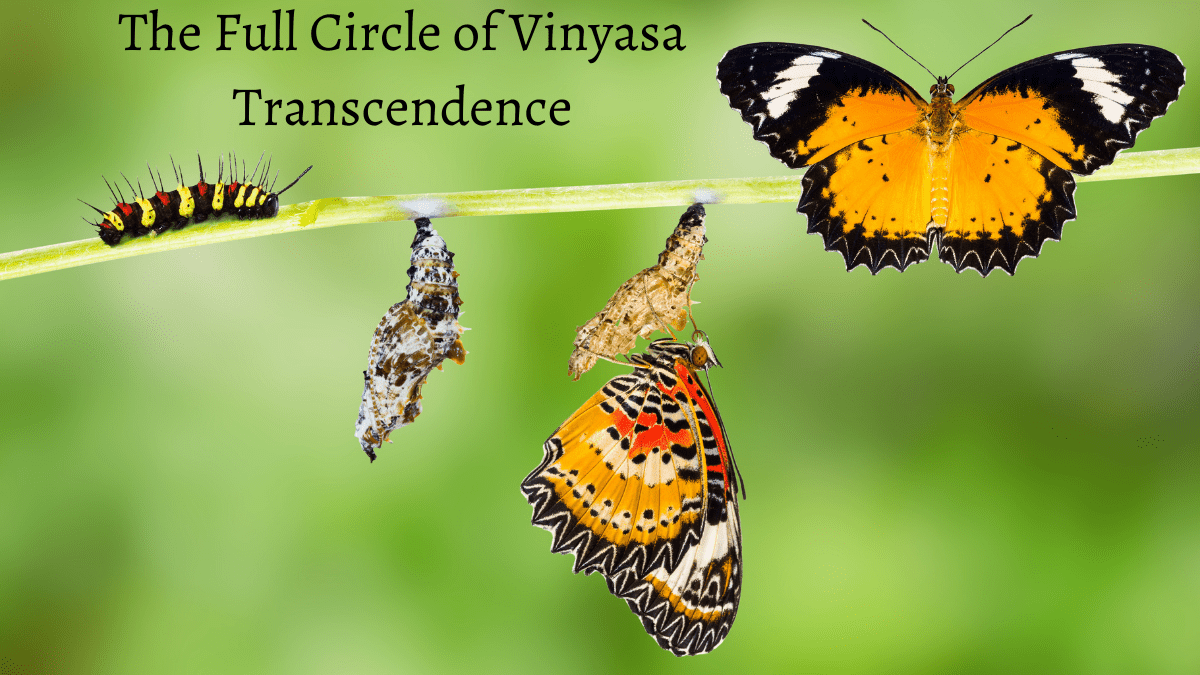
The Full Circle of Vinyasa – Transcendence

In its purest form, the Vinyasa experience  is what Patanjali calls samyamah, a synthesis of  forms of concentration which modulate the fluctuations of the mind, in this case, the focus is on breath, movement, intention and internal anchoring in the moment by moment unfolding of time.  The result is that beautiful transcendental physical flow that so many of us admire, aspire to and experience.   In my experience the vinyasa is an inner experience first, an inner experience of moving intentionally through time and space oriented primarily in an anchoring in the wisdom self. 

To understand this brings us to one of Patanjali’s key instructions about yoga, that yoga is nurtured through the practice of abhyasa (practice time spent dwelling in the true nature) or practice dwelling in our true nature, the wisdom self, and vairagya – detachment.  These practices form the landscape from which the classical practices of renunciation arise.  In it’s essential form, renunciation is an inner practice, developed through outer practice.  A simple moment when you soften around a moment of change can teach us a lot about the inner landscape of yoga.  What do we feel as we begin to move, is it sticky?  Clunky?  Awkward or painful?  Or does it flow?  Are we able to be still comfortably or at a different pace, comfortable?  Our capacity to do that is built on practicing this inner spaciousness which arises with practice and detachment.  The experience of and wake from the COVID related worldwide shutdowns has triggered an avalance of change.  Having survived four job changes and a tumultuous presidential election which, last night I found myself cringing in fear at the thought of further changes which will likely be unfolding as we move forward.  Who knows what’s coming?  Cringing.  I was  actually cringing.  And then, like a good dream my years of practice kicked in and I was awash in love and gratitude rather than fear of what was to come.  I am grateful that I was here in this beauty and that I have had the experience of knowing amazing people in my life.  Things may be different for all of us moving forward, but that doesn’t mean they won’t be good.  I find this way of vinyasa-ishly moving through a challenging experience helps me keep it in perspective.  It’s like walking through the streets of the city, any city.  Every neighborhood has it’s flavor and feel and we are just walking through those varying flavors and feels.  An uncomfortable neighborhood doesn’t require us setting up house there.  One the inner level we don’t need to set up camp in an interior landscape of opinion and belief which doesn’t serve us.  Instead we set up our camp in the wisdom self as we move through the discomforts and comforts  of life.  Th

In its purest form, the Vinyasa experience  is what Patanjali calls samyamah, a synthesis of  forms of concentration which modulate the fluctuations of the mind, in this case, the focus is on breath, movement, intention and internal anchoring in the moment by moment unfolding of time.  The result is that beautiful transcendental physical flow that so many of us admire, aspire to and experience.   In my experience the vinyasa is an inner experience first, an inner experience of moving intentionally through time and space oriented primarily in an anchoring in the wisdom self. 

To understand this brings us to one of Patanjali’s key instructions about yoga, that yoga is nurtured through the practice of abhyasa (practice time spent dwelling in the true nature) or practice dwelling in our true nature, the wisdom self, and vairagya – detachment.  These practices form the landscape from which the classical practices of renunciation arise.  In it’s essential form, renunciation is an inner practice, developed through outer practice.  A simple moment when you soften around a moment of change can teach us a lot about the inner landscape of yoga.  What do we feel as we begin to move, is it sticky?  Clunky?  Awkward or painful?  Or does it flow?  Are we able to be still comfortably or at a different pace, comfortable?  Our capacity to do that is built on practicing this inner spaciousness which arises with practice and detachment.  The experience of and wake from the COVID related worldwide shutdowns has triggered an avalance of change.  Having survived four job changes and a tumultuous presidential election which, last night I found myself cringing in fear at the thought of further changes which will likely be unfolding as we move forward.  Who knows what’s coming?  Cringing.  I was  actually cringing.  And then, like a good dream my years of practice kicked in and I was awash in love and gratitude rather than fear of what was to come.  I am grateful that I was here in this beauty and that I have had the experience of knowing amazing people in my life.  Things may be different for all of us moving forward, but that doesn’t mean they won’t be good.  I find this way of vinyasa-ishly moving through a challenging experience helps me keep it in perspective.  It’s like walking through the streets of the city, any city.  Every neighborhood has it’s flavor and feel and we are just walking through those varying flavors and feels.  An uncomfortable neighborhood doesn’t require us setting up house there.  One the inner level we don’t need to set up camp in an interior landscape of opinion and belief which doesn’t serve us.  Instead we set up our camp in the wisdom self as we move through the discomforts and comforts  of life.  Th

In its purest form, the Vinyasa experience  is what Patanjali calls samyamah, a synthesis of  forms of concentration which modulate the fluctuations of the mind, in this case, the focus is on breath, movement, intention and internal anchoring in the moment by moment unfolding of time.  The result is that beautiful transcendental physical flow that so many of us admire, aspire to and experience.   In my experience the vinyasa is an inner experience first, an inner experience of moving intentionally through time and space oriented primarily in an anchoring in the wisdom self. 

To understand this brings us to one of Patanjali’s key instructions about yoga, that yoga is nurtured through the practice of abhyasa (practice time spent dwelling in the true nature) or practice dwelling in our true nature, the wisdom self, and vairagya – detachment.  These practices form the landscape from which the classical practices of renunciation arise.  In it’s essential form, renunciation is an inner practice, developed through outer practice.  A simple moment when you soften around a moment of change can teach us a lot about the inner landscape of yoga.  What do we feel as we begin to move, is it sticky?  Clunky?  Awkward or painful?  Or does it flow?  Are we able to be still comfortably or at a different pace, comfortable?  Our capacity to do that is built on practicing this inner spaciousness which arises with practice and detachment.  The experience of and wake from the COVID related worldwide shutdowns has triggered an avalance of change.  Having survived four job changes and a tumultuous presidential election which, last night I found myself cringing in fear at the thought of further changes which will likely be unfolding as we move forward.  Who knows what’s coming?  Cringing.  I was  actually cringing.  And then, like a good dream my years of practice kicked in and I was awash in love and gratitude rather than fear of what was to come.  I am grateful that I was here in this beauty and that I have had the experience of knowing amazing people in my life.  Things may be different for all of us moving forward, but that doesn’t mean they won’t be good.  I find this way of vinyasa-ishly moving through a challenging experience helps me keep it in perspective.  It’s like walking through the streets of the city, any city.  Every neighborhood has it’s flavor and feel and we are just walking through those varying flavors and feels.  An uncomfortable neighborhood doesn’t require us setting up house there.  One the inner level we don’t need to set up camp in an interior landscape of opinion and belief which doesn’t serve us.  Instead we set up our camp in the wisdom self as we move through the discomforts and comforts  of life. That, is transcendence.