
/*note; there are more complex Sankhya charts – the one we are using is very basic*/
The elements are one section of the ground floor of the Sankhya Chart. They are the basic building blocks of the physical object filled universe. If we were standing at the bottom of the chart, looking up, we would see that things become simpler, less divided, as the chart ascends. If we were at the top of the chart looking downward, we would see that the fundamental duality, Purusha and Prakriti, contain within them all of what descends from them; the top row further divides via the Prakriti into multiple smaller parts. The elements are some of those smaller parts. This process of division continues well beyond the base of the chart. The process of re-unification continues well above the top of the chart. The bottom of the chart — the level at which consciousness interacts with the material world — consists of the senses and the elements.. We have discussed the senses. We now begin to discuss five primary elements: Earth, Water, Fire, Air, Space. The element Earth or Prithvi, our starting point, establishes the solidity of our physical experience.
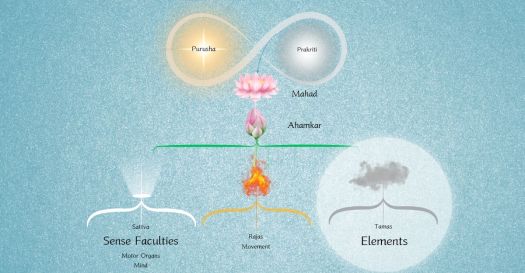
The elements rarely, if ever, occur in a pure form. They are always co-mingled with one another. How this plays out becomes apparent by contemplation. Think…mud, or ocean- salt- water. As yogi’s we learn to identify each element and then consider how we can contemplate them and subsequently work with them in our asana practice. A well-done Asana practice will harmonize the elements but even greater is that asana practice is a means of direct experience of the elements.
Let’s start with the words of sage Patanjali, author of The Yoga Sutras of Patanjali.
From Patanjali’s Yoga Sutra, third padah:


/*PYS 3.44 One-pointed meditation on the five forms which every element takes, produces mastery over every element. These Five forms are the gross nature, the elemental form, the quality, the pervasiveness and the basic purpose. */tr Alice Bailey
/*PYS 3.45 Through this mastery, minuteness and siddhis (powers) are attained, likewise bodily perfection and freedom from all hindrances*/ tr Alice Baily
The third padah, in which these sutras are placed, describes the expected results or expressions of power that arise with well-done practice. The divine feminine force, Shakti, is the life force which the asana yogi learns to cultivate and move effectively through various yogic disciplines. When concentration and intention merge in practice the yoga – the yoking – results in various manifestations of power. In full mastery the yogi becomes anchored in the experience of yoking to God.
These sutras describe the practice of Samayama (powerfully sustained steadfast concentration) on the elements, or a specific element.
Consider earth in the form of a mountain. Tadasana. It is solid, stable, heavy, strong, dense, and movable only by the faith contained in a mustard seed. It is the essence of physicality. It might be nice to just sit for a while and contemplate an inner or outer image of a mountain. After placing the body parts in order in your Tadasana, you might, while standing steadily, consider what it might be like to be a mountain.
In our bodies the earth element is associated primarily with muscle and bone. Bone shares the structural and material qualities of crystals, which emerge from the earth itself. Bone also has association with another element – water – because of the essential marrow and marrow’s relationship to the liquids in the body. Muscle and bone together form the structural elements of our physical body and are the foundation of every asana.
Balance of the earth element in the body brings a sense of grounding which is uplifting rather than heavy. As our good friend Patanjali says, our posture will then be steady and joyful.
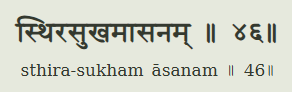
/*The posture should be steady and joyful.*/ PYS 2.46 I believe this translation to be attributable to Sharon Gannon co-founder of Jivamukti Yoga. Sukham – easy sweet joyful. Sthira -strong and stable.
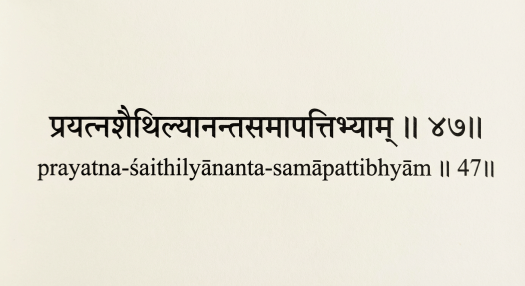
/*Steadiness and ease of posture is to be achieved through persistent slight effort and through the concentration of the mind upon the infinite*/ PYS 2.47 tr. Alice Bailey
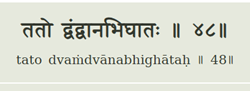
/*Then, no assaults from the pairs of opposites*/ PYS 2.48 tr. Manilal Nabhubai Dvivedi
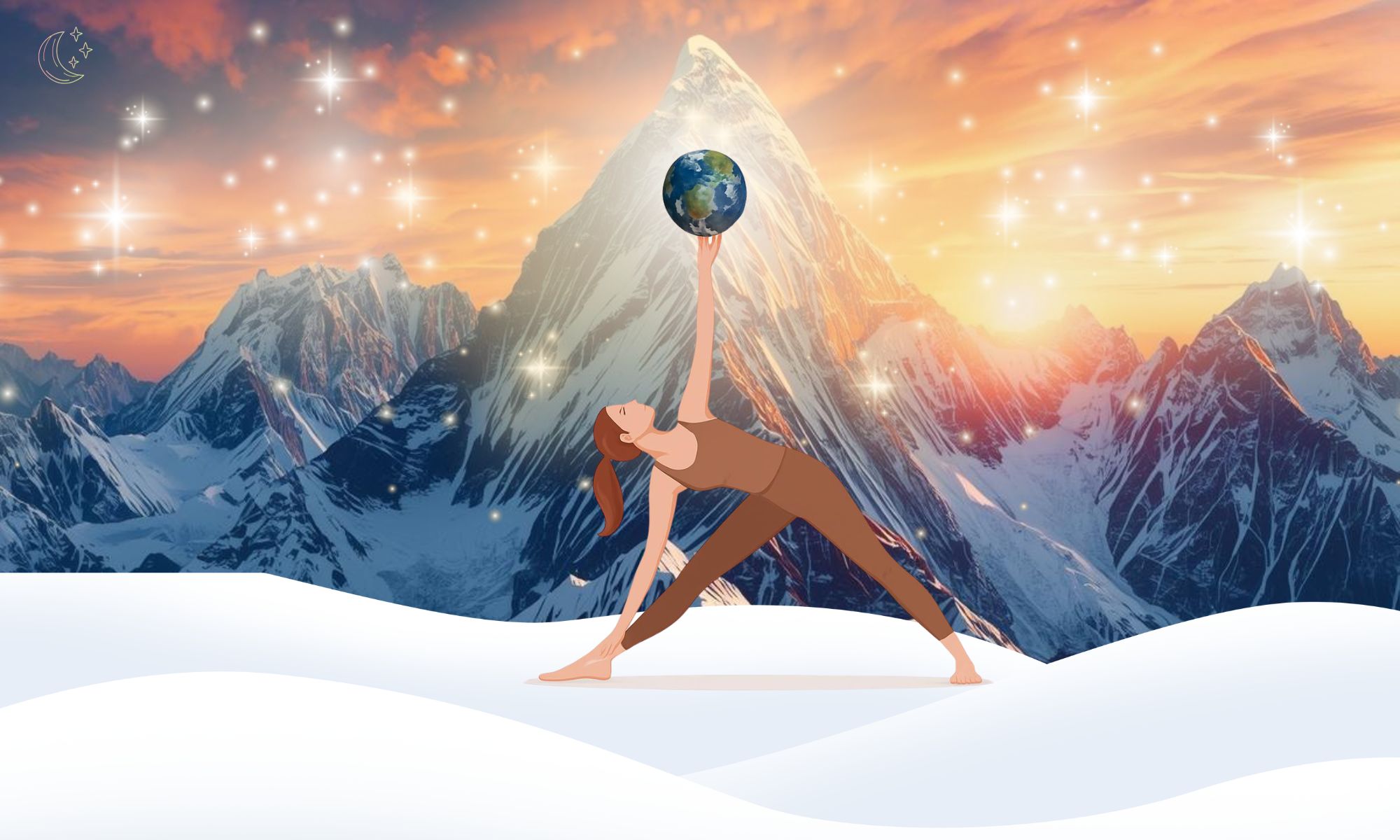
Notice that the remedies in these translations point to the infinite. It’s the aspiration of reaching for the higher realms of the Sankhya chart. How nice that the posture trikonasana reflects the shape of the mountain and the Sankhya chart, while reaching for the infinite. That reached up arm changes the whole relationship to the earth, doesn’t it? And if you struggle with your shoulders in the posture, perhaps you are carrying too much on them and might invite some trust into your life. The solutions to asana challenges aren’t always fully resolved on the physical level, as we will discover as we climb the Sankhya Chart.
We don’t really need to understand that; we will experience the truth ourselves if we practice. Yes, the key is practice – with a right amount of ease in working with the challenges you have chosen in your practice, and an elevated intention.
When we detach from forcing and allow ease to emerge, the parasympathetic nervous system can proceed with its magical powers of healing. This deep level of healing resolves into improved adaptation and resilience.
For much of my life I had a tremendous aversion to cold. A yoga friend once took me cold dipping in the San Pablo Bay north of San Francisco. Brrrrr.
The water was 48 degrees. As I gasped, she reminded me to “breathe…like yoga”. It worked. Quickly. I was neck deep in the water, and blissful. There was no difference between the hot and the cold. My experience of that yogic result was tested – within weeks of that date I moved to Arizona, in June, 120 degrees. Moving furniture up and down the stairs. I survived. But the amazing thing was that my body completely adapted from the cold and damp of the Bay area to the extreme hot and dry of the desert. It’s not a brag, I attribute this resilience to my years of yoga practice, and the discipline required to maintain the practice. It’s something that naturally arises with well-done practice. I was excited to experience it.
While exposing ourselves to hot and cold is not a prescribed practice for yoga asana, it does demonstrate the power of overcoming preferences in our practice. Hot or cold room, soft or hard floor, alone or with others, hard or easy, with a teacher we like and or don’t like. This overcoming of the pairs of opposites is a cornerstone of developing a practice that is steady and joyful. Sthira and sukha. This includes the conditions within the body as well. In classical practices they would stay with pain. I think this requires a tremendous amount of wisdom to do, but let’s face it, the postures aren’t built to be comfortable. We don’t have to get to pain to have some work to do. We use our breath, our acceptance, our ease, our desire to be free to allow ourselves to relax into it mindfully.
Transcending opposites will clarify the experience of your connection to the earth. I have witnessed this in many students. Consider how ungrounded we can become in the presence of a distraction in life or an annoyance during practice? By training to overcome this we become more grounded, we feel our feet on the ground and present, and we come to know what the element of earth feels like.
This brings us into harmony with right now, wherever we are, on planet earth.


 Natalie Ullmann