Why practice ?ย 

Classical yoga is designed as an intentional practice where the body is used as a vehicle to know ourselves,  to realize ourselves in our whole true nature. This true nature is also referred to as the state of yoga, and it arises as we cease identifying with the fluctuations of the mind. When that happens….

เคคเคฆเคพ เคฆเฅเคฐเคทเฅเคŸเฅเคƒ เคธเฅเคตเคฐเฅ‚เคชเฅ‡เคฝเคตเคธเฅเคฅเคพเคจเคฎเฅ เฅฅ เฅง.เฅฉ เฅฅ

tadฤ draแนฃแนญuแธฅ svarลซpe’vasthฤnam || 1.3 ||

(3) Then the seer abides in His Own Nature   /*tr. Swami Satchitanada*/

Our true nature is understood to extend beyond the limits of our physical form, and  so we could think of the practices as tapping into, unlocking or accessing understanding, wisdom and creative capabilities which are beyond the firings of the neurons in our brain.  This experience of the state of yoga releases the time bound functions of ourselves, of the cells of the body, revealing the brightness of the mind. This occurs without force. Alignment of the body mind spirit in practice opens the portals.  When that occurs we discover potential – Our true nature or pure organic potential.  It’s mystical and it’s not religious.  These capacities extend  beyond the individual self so there is a recovery of knowledge.  There is also recovery of our connection with what we might call the universal mind and that in turn illuminates our connection to all other minds. (Sutra 4.4 personal translation) It’s also described as yoking to God  – an old fashioned word for something which is still contemporary and relevant. There are many ways to parse out this experience.

As yogiโ€™s we are invited to travel the path to these results in a very personal way. 

The nature of discipline called for to achieve these ends is self-discipline.  Yoga is a study in self-discipline which, as it evolves, opens into a realm of refined and elegant personal sovereignty. Like any other craft, such a discipline invites us to do a little planning, a little strategy.  Yoga is not a “do your own thing kind of freedom” as much as it is a “refined structure revealing the deeper nature of personal freedom and potential” thing, and so it requires a little thought,  a little work, a little investigation. And so every year as I prepare for the practice of the coming year I ask myself – why practice?  Why practice in this way?  Why not throw it all away and take up pickleball like everyone else?

First I tend to approach this intention setting with an understanding of whatโ€™s happening.  What am I called to respond to? 

The world around us is currently in overdrive.  There is nothing peaceful and still about it.  In the world of business in particular โ€“ globalization, technology and competitive drive has created an environment which is sharp, deceptive, requiring of constant attention and agility , adaptation and perpetual learning, and study.  That what we are dealing with โ€“ if not for ourselves, for our children.  How can we craft practice goals for the year within that chaotic landscape?

This is how I see it, your place in the landscape is unique, You will have your own unique constellation of chaos. But the question the practice raises remains the same. And the faith piece is discovered through practicing in unlikely landscapes. The landscape dictates the curriculum. I encourage you not to make it all about fixing the chaos, but instead, about aligning you more deeply with your heart. It requires a relinquishment of the shoulds. “I gained weight this year. I should do a hard sweaty practice. My heart responds no, actually you need to relax, rest your nervous system and go out for walks, and maybe paint some yantras…because they are fun!” The new year is an invitation to tune into your heart and listen to what it longs to do. The faith piece or shraddha is the faith that that all the different shapes of yoga are designed to support us. So we might ask – what does yoga do and how can I work it to apply it in my present circumstance?ย  What is my central intention?ย  And what tools in my toolkit will help me fulfill that intention?

Establishing a clear intention to pursue the bountiful rewards of yoga – that accessing of an infinite well of understanding, creativity, healing, joy, love and accomplishment- supports a swifter approach the goal. Patanjali tells us:

Yoga Sutra 1.21: Tฤซvra-saแนƒvegฤnฤm ฤsannaแธฅ

เคคเฅ€เคตเฅเคฐเคธเค‚เคตเฅ‡เค—เคพเคจเคพเคฎเคพเคธเคจเฅเคจเคƒ เฅฅ เฅง.เฅจเฅง เฅฅ

tฤซvrasaแนƒvegฤnฤmฤsannaแธฅ || 1.21 ||

/*To the keen and intent practitioner this Samadhi comes quickly.*/tr. Swami Satchitananda

/*Success is nearest to those whose efforts are intense and sincere.*/tr. Osho

Samadhi, this full consciousness of the yoga โ€“ nothing lacking, is realized most quickly when we embrace that fullness as a goal.  When we know where we are going (having intent) will get us there faster.  Yes, Samadhi is a meditative state to be attained, but if sustained we can be in it all the time.  After all Swami Satchitananda, a renunciate, built Yogaville, Omโ€™d at Woodstock and changed the landscape of American thought – no small feat. Osho โ€“ having attained Samadhi at an early age rocked the world with his radical upending of spiritual norms.  And so did Gautama Buddha. A well-structured yoga practice supports a well constructed life. We may not become celebrities, but our impact is vast nonetheless.

So, our intentions are critical for they will contribute to the world in a bigger way than we might imagine.

Because of the subtle and vast nature of yoga, I’ve found it works best to set a subtle intention for the year, i.e. to understand peace or creation or backbending rather than to stop being angry, manifest a stack of gold and do urdhva dhanurasana. Being specific in that way can also yield quick results but the subtler intentions bring effective long term healing and transformation. For starters you may want to peruse Patanjali’s Yoga Sutras, third padah, The Vibhuti Padah. This entire section of the book speaks of attainments in yoga. Used incorrectly they can be obstacles to the larger goal of samadhi, but the study of their nature will give you an idea of how yoga works. It’s a list of what you might concentrate on, and the result that comes from concentrating in that way. By focusing on an elephant, you gain the strength of an elephant and so on. An intention is no more than what you will concentrate on, invite in, seek out and look for. Maitri or friendliness, how about that for an intention!

Because yoga is affilitated with the realms beyond desire, I invite you to craft your intentions beyond desire. Consider it as the study that it is, and trust that what the practice will evoke and bring forth from you and for you will grace you with sublime understanding of that which you seek to be creating.

Scroll down for some thoughts about posts the coming year. For in depth commentary on some of the aspects of the blogposts, please sign up for the newsletter. This isn’t for marketing, ever. It’s designed to be thought provoking and inspire you to practice yoga!

Processingโ€ฆ
Success! You're on the list.

******************************************************************

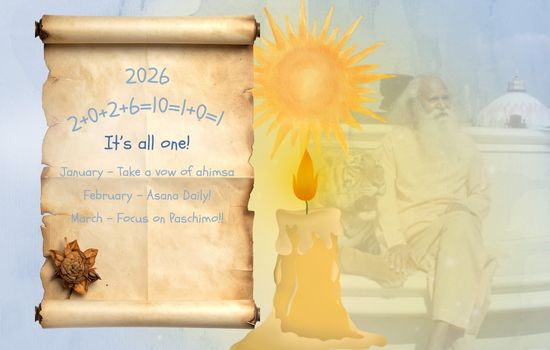
We will continue our journey through the map of the Sankhya Philosophy in the coming year, with a resurrection of the โ€œAbout the bodyโ€ teachings and some structured discussion on asana. 

It took us a year to get through the senses.  Of course it did, the sense organs are anchored into dense physical reality totally bound by the slowest vibration of earth.  Slow is not badโ€ฆbut we are talking the material world, very dense – which is also not bad.  But as we move our way up the chart to the highest states of consciousness the subtleties of energy, mind and beyond โ€“ we become lighter, less time bound.  Itโ€™s a science fiction idea, but something the human race is embracing.  Time is fluid and can be our tool rather than our master.  As we explored the senses we discovered means to manage them, and to purify them.  These sense directed practices continue as long as we are practicing, although we may engage with them differently along the way.  In January we will begin with our exploration of the elements, also materially but molecular and energetic as opposed to solid.  If you have ever had acupuncture youโ€™ve worked with your elements.  And now, acupuncture is a common feature of medical practice.  We are all lightening up! 
About the Body – Hatha, The Heart and the Thoracic Spine

Hatha Yoga in the classical sense is a journey of integration where the body becomes the perfect vehicle for a different kind of consciousness โ€“ the adamantine body.  This happens through integration โ€“ where the physical form is transformed by the substance of that consciousness. Through breath and positioning the energy channels of the body โ€“ the nadis โ€“ become clear.  Allowing yourself to experience breath in the varieties of positions  is essential.  And I use the word โ€œexperienceโ€ deliberately.  It isnโ€™t about forcing the breath through a posture that feels stuck.  Itโ€™s about being easeful and allowing enough that the breath can still be felt and enjoyed regardless of what shape you in.  In that sense it is a cleansing the breath is a cleansing solvent for the nadis.  There is not better place to breathe than in a posture where you are bumping up again your limitations.  Often they are not muscle and bone, they are energetic โ€“ energy is stagnant.  And, when the energy is stagnant, so is your mind.  Movement is so important, and yoga asana is designed for this.  This cleansing of the physical form allows the spirit to become more tangible in the physical realm.  A well-done posture facilitates this integration.

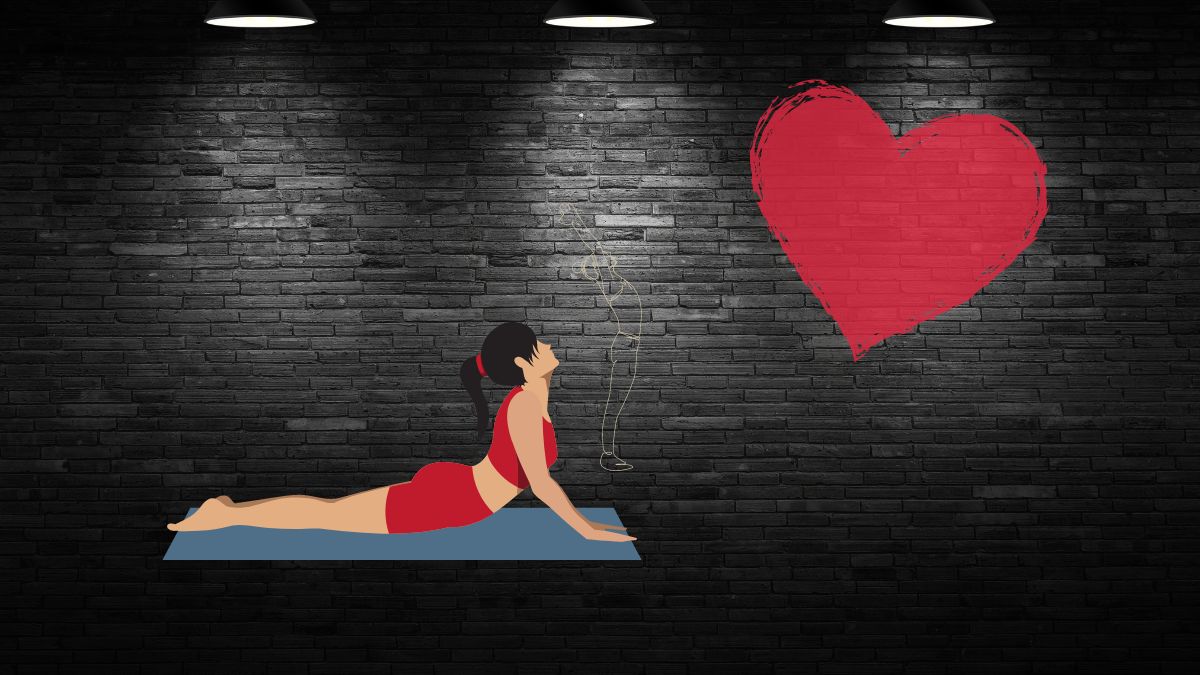
That intersection of matter and spirit begins at the level of the thoracic spine โ€“ at the heart.    The integration is simplest and most straightforward in the backbends.  This alignment of these two forces (material and spiritual) occurs when the feet are well positioned. Parallel the feet in a back bend and the point of integration of the primary opposing forces โ€“ of gravity and upliftment  is shifted from the lumbar spine to the thoracic spine.  This  creates a gentle, subtle space in that very restricted area.  You will know the opening has occurred by the way you feel.  There may be tears or a sense of wonder or great love which occurs with the opening.  The practice at that juncture is to be spacious and allowing of the powerful feelings which unfold -and to understand that your practice is moving into another level โ€“ beyond mere physical release and into transformation. 

Interested in stepping a little more deeply into the philosophy and inner practices of yoga? I send a newsletter once a week or less, in conjunction with blog posts, where we explore the inner practices of yoga within the context of a life. Sometimes drawn directly from the traditional yoga texts, and sometimes just commentary on the big picture of a yoga practice – I always intend it to convey something that will be useful to you. I don’t sell anything in these newsletters – it’s an offering and a way to keep my own practice fresh.

Processingโ€ฆ
Success! You're on the list.

Paschimottanasa โ€“ the Grand Poobah of forward bends.ย 

(Itโ€™s a very, very powerful posture)

Paschimottanasana is a seated forward bend with legs extended straight in front of you.  Itโ€™s best if your knees point towards the ceiling so the feet  are neither rocked in nor rocked out.  If you find that you can hardly fold at all โ€“ donโ€™t be discouraged.  Itโ€™s very common โ€“ itโ€™s just no one gets their picture taken if they arenโ€™t touching their toes yet!!  Some find it helpful to bend the knees and rest the chest on the thighs.  You can also sit on the front edge of a folded blanket.

Either your standing forward bends will be easier โ€“ or your seated forward bend will be easier.ย  It reflects certain anatomical tensions in the neck and hips.ย  If the seated forward bend is stubborn and unchanging, I suggest you work a variety of ย standing forward bends first to warm up for paschimottanasana.ย  The folklore is that ย paschimottanasana is about โ€œletting goโ€ย  whatever that means.ย  Let go of what?ย  ย ย I could write a thesis on thatโ€ฆbut generally it meant I needed to soften my edges, releasing the fixed ideas that I had about how the world should work.ย  It involved letting others win disagreements, accepting discomfort, allowing change and opening to possibilities and opportunities in my life that I never would have considered.ย  It was about choosing ease.ย  For you it might mean letting go of fear and charging forward by being more active โ€“ engaging your thighs or activating your bicep muscles to pull you closer to your toes.ย  Itโ€™s always good to try do so the thing that doesnโ€™t come naturally in the moment.ย  I feel lazyโ€ฆactivating my thighs (or some other part of my anatomy) may be just thing.ย  If Iโ€™m struggling, then more ease is called for.

The bladder meridian runs down the entire back of the body, so being balanced with water will help as well.  That might mean more water, but it also might mean less water โ€“ itโ€™s about balance.

Experimentation is helpful here.  That is a great thing about our yoga postures โ€“ they give us data about ourselves that we can use to refine our lives. 

Most of all, like all things yoga, forward bend requires practice -so even if you donโ€™t like itโ€ฆkeep practicing!!

About the Body – Thoughts on designing sequences for personal practice

Iโ€™ve waited years to talk about this!  Itโ€™s absolute freedom to me to be honest about designing your personal yoga practice.  You see, when you teach yoga you have to learn to construct a sequence which will be manageable for the largest number of people in the demographic that you are working with.  Itโ€™s a fabulous way to learn, taking group classes.  The support is amazing and often, especially in the early stage of practice โ€“ you can go further in association with others.  There comes a time in practice thoughโ€ฆa time when itโ€™s really time for you to discover your own personal connection with yoga and the truth that is being uncovered in you by the practice.  This can really only be done on your own.  No one else can feel what you feel.  No one else can really understand that revelation that you have.  It all travels through our personal filters.  And what, if not the actualization of our own yoking to the sacred, to the infinite, to the wise  โ€“ are our practices about?  Itโ€™s something to celebrate when we are called to develop our personal practice.

Generally I suggest that you start out considering two approaches to designing.  The first is to get on your mat and play โ€“ and in this I encourage you work with and without music.  Music will drive you in a particular direction, but it can also obscure what is going on inside at a deeper level.  Itโ€™s a complicated topic which weโ€™ll address in future posts.  The key at this point is to be aware that it will have an impact in your practice.  The second is to decide on a goal and then work towards it.  For this second, more structured sadhana-like way to practice yoga asana – I suggest you start by picking a few basic key postures and doing them every day.   Overall, I design my sadhana moon month by moon month, and each month I will design a full sequence for myself. I decide the minimum postures I will do on a busy day.  Each day when I get on my mat it falls somewhere in the spectrum.  I always have a posture which is key for the moon month.  I try to tie it into my spiritual theme.  I always did that for the students and yes, I do it now just for myself.  I donโ€™t hesitate to indulge the desires I have about my body, but I always try to give them a context.  For example, I gained weight during COVID (can you believe that? Lol) and I want to change that.  So my spiritual themes are around sadhana and the discipline contained therein.  That spiritual practice supports what I need to do for my body- which right now is to practice almost everyday.  We are integrated beings and there will always be a physical and spiritual coherence in our practice if we are open to it. 

Also, in this more structured component of developing practice itโ€™s good to decide how you want to learn to understand your body.  Some people thrive with that anatomical memorization of parts.  Eh, not me.  For me, learning about the energy body was the doorway to learning about the muscles and bones and tendons and organs.  Once you decide on your approach, there are many resources online books and workshops.  If you are serious about yoga, I highly recommend, Light on Yoga by BKS Iyengar.  He has sample sequences at the end of the book which are great learning devices. 

IF YOU FORCE NOTHING YOU WILL BE 100% SAFE.  FORCE NOTHING!

Remember to bring your wisdom with you on your mat.  In my years as a teacher Iโ€™ve seen people fall out of arm balances because they were drinking before class, people pushing postures until they snap, all kinds of things.  Most recently, my last employer โ€“ probably in his early seventies, felt fat from the COVID too.  He jumped immediately into doing 200 sit ups with a 25 pound weight on his head.  I said, โ€œI would never let one of my students do thatโ€.  He kept doing it.  Letโ€™s put that in the โ€œdonโ€™t try this at homeโ€ file.  The beauty of yoga is that you can gain without pain, and that the results of everything you do are cumulative  – a sustainable practice builds sustainable gains.  Moderation, balance and consistency are better than dramatic pushes followed by collapses into nothingness because youโ€™ve overdone it. 

It is my deepest wish that this information will be useful to you, that you will grow in your life through your practice.  Keep practicing all is coming.

Would you like a weekly newsletter about yoga?

Processingโ€ฆ
Success! You're on the list.

The Elements of Sadhana: Santosha- Contentment

In the newsletters we’ve been talking about creating a sadhana – a conscious spiritual practice of yoga, a discipline of yoga as conscious spiritual practice. This past week I introduced the mahavratam or great vows outlined in Patanjaliโ€™s Yoga Sutra. These vows aren’t something that Patanjali devised โ€“ he compiled them from studying with the esteemed yoga masters of the day (which was some time a few  thousand years ago no precise date is known).  There are ten of them. They are often considered to be moral imperatives. In practice Iโ€™ve found it more useful and more authentic  – I get better results – if I let that idea of morality go and open up to practicing them whenever and however I can, trusting that they are actually learning devices for me.  Through practicing them I open to understanding who I am and who everyone else is.  As I open to understanding I make better  choices. The ten mahavratam are: nonviolence, non stealing,  adherence to truth, continence, non- hoarding, cleanliness, contentment, austerity, self- reflection and devotion. In the newsletter I briefly talked about the practice of saucha or cleanliness. Today Iโ€™d like to speak a little bit about contentment, or santosha. 

One thing to consider when practicing these – theyโ€™re also called yamas and niyamas, restraints and observances – is that we are always creating. We are creative beings – extensions of the divine, which is the creative energy of the universe, the supreme creative energy of the universe. This is an underlying paradigm of the yoga practice.  The yoga practice will reveal that we a specks of divine creative consciousness โ€“ and we can live from that truth. This is co-creating, which is yoga – to be yoked to the divine. The restraints and observances clear the palette of our consciousness, enabling creativity which is unbridled by our past. 

 With yoga the idea is that creating in alignment  with the infinite divine opens the doorway to limitless possibilities- and that wisdom, that intelligence – will create richer more satisfying possibilities than our personalities with their cravings and conditioned attunement to lack. If we choose it, these practices deepen our understanding of the elements of a good life.  This is partly why I encourage you to set aside the idea that they are imposed morality.  Practiced lovingly, they open the way to a delicious abundant live.  Less is more. 

With the practice of santosha or contentment this connection between our behaviors our beliefs our thoughts in the world that we experience is made very clear. 

Perhaps in your life you have met those or perhaps you’ve been in this space yourself ( I know I have been) where you feel a need to complain about everything. Iโ€™ve seen a real uptick in this during the COVID situation. 

 I think we can all agree there is much to be addressed in the world., but right now we have to accept whatโ€™s happened and what is happening and learn to work with it. Shaking our fists at a perceived enemy is unlikely to change the worldโ€ฆchanging ourselves is likely to change the world, not only because we engage those conversations differently. 

But letโ€™s think back to the before time – before COVID – and remember those days in offices or classrooms or social gatherings where we or our friends or neighbors or our family would lapse into days where we complained and complained and complained. Surely we’ve all known in ourselves or others that momentum that complaining develops – once you start complaining there just seems to be more to complain about. The yogis understood this very deeply through their meditations , analysis and self reflection. The practice of contentment is to practice contentment under all circumstances thatโ€™s a key of these mahavratam โ€“ under all circumstances.   So in any moment (the grandeur of universality demands we operate one moment at a time) when faced with complaining, we choose contentment.  Itโ€™s like putting down a heavy object.  โ€œI just donโ€™t want to carry the weight of my complaints, so Iโ€™m a gonna put this down, right here.โ€  Itโ€™ll be okay.  Once weโ€™ve entered a quieter state of mind, wise action can emerge more clearly. 

What does that mean – in the yoga practice – to work a difficult situation? Perhaps it is to rest in the understanding that youโ€™ve participated in the creation of it and take responsibility for the fact that youโ€™re there. You skip the blame (of yourself and others) you skip the victim story and nurture and invite the ability to see the situation differently.  Liberation arises when we realize there is no one to blame.  The practice of contentment opens our minds so that we are able to see that. To be honest, in content I perceive that there is nothing to complain about.  Itโ€™s all perfect.  But to deeply know that feeling we have to practice.  

One of the ways that we can train ourselves in the vast practice of contentment is to practice on our yoga mats. One of the most obvious powerful and potent ways to do this is to be content with a posture even as you are working to transform it. Where I am is fine but Iโ€™d like to deepen it. Iโ€™d like to expand it; Iโ€™d like to move to the next expression of it. So the first part of that is to enjoy every posture just where you are with it. This is one of the reasons why the postures that we canโ€™t do are so important. As I say this I realize that this is one of the biggest difficulties of a home practice is that we never bump into those postures that we donโ€™t like. At the same time if the classes available around us are not suitable – to force ourselves to go into a class that is just full of difficulties makes no sense either.  So what can be a good idea in your practice is to add a small step towards a posture that you would like to attain someday. For me right now this is wheel urdva dhanurasana. 

 I had an accident last fall where my wrist was smashed. Iโ€™ve consciously decided to recover slowly. In my full practice days I would do three full or wheel postures every day.  Wow right?  To me that seems like wow.  I was never a born gymnast. That posture has intense ramifications on the wrist and feels remote to me but at a certain point I had an intuition a revelation that in fact I would be able to do it again in this lifetime So what Iโ€™m going to practice this moon month is to sit at the wall and take a camel posture and place my hands on the wall. A highly modified introduction to the movement that would lead to wheel. And I am content.. This is the beauty of modifications in yoga. What they do is – if you practice them fully,happily embracing what the modification has to offer you – it’s actually like working the full posture you develop the shape energetically on a deep level and it opens from the inside out. One day yourโ€™re ready and the full posture emerges โ€“ like a chuck busting out of an egg. 

So how do we learn about modifications if weโ€™d like to incorporate them in our sadhana?  I highly recommend them even if you donโ€™t have an injury. Spend some time in modified postures.  By working with the modifications youโ€™ll learn some of the paradigms of postural yoga. Weโ€™re very fortunate to live in an opulent world where thereโ€™s all kinds of information about yoga on the Internet so Iโ€™m sure you can find some information about modifications there.  As far as books books go and even Internet the best school of yoga from which to learn about modifications is the Iyengar school so I encourage you to look into that when choosing postures to work in your sadana. 

Once youโ€™ve practiced santosha on your mat for some time don’t be surprised if you  catch yourself practicing it in your life.  You donโ€™t have to make a big trip out of doing all of these mahavratam.  Just know that they can extend to all circumstances, and theyโ€™re not limited.  Your contentment is not limited to certain circumstances.  You can start practicing them in certain circumstances until you feel confident to apply them in more challenging circumstances.  

OK thatโ€™s our blog post for today. As always itโ€™s my sincere wish that this information be useful to you and that your practice will lead you to a blessed and wonderful life. 

Vinyasa

A Compilation of commentaries from newsletters sent to students during the moon month

To subscribe to my newsletters: 

Processingโ€ฆ
Success! You're on the list.

Putting It All in Place

Sunday is a workday for me.  Two days of my week are dedicated entirely to creating content, planning classes and workshops, marketing and visioning โ€“ to building a scaffolding for the life that I want to be creating.    A workday, but itโ€™s the day I get to flex my entrepreneurial muscles and work towards my own personal vision.  I had plans of everything that I would get done.    I work up early to get started, and when I woke, I knew – I just knew – that the time had come to rearrange the furniture.  Distraction or meaningful digression?  I didnโ€™t know.  But I knew I needed to do it.  And so I did.  I spent the day sweeping away the dust which had accumulated under the desk and reflecting on the feng shui of it all.  Not deliberately forcing the placement of objects in the magical feng shui areas but noting the call of my heart to place an object here, or there, or to carefully dust off a beloved memento.  When I realized how late in the day it had gotten and how many things still needed

to be put in their place, I began to chastise myself about how I had โ€œwastedโ€ my time.  But then my eyes took rest on a yet to be placed object, and I recalled my planned subject matter for the month.  Vinyasa.  While Vinyasa is a term commonly used to refer to a general kind of flowing with breath in the yoga practice, the word itself breaks down into vi and nyasa.  Nyasa I understand this to mean placing something, and the vi confers a sacred intentionality. To place even a tiny object, like a thought or a wish intentionally is a very very big deal.  Mostly I understand this on the basis of my practice.  Not the how, but what was reveealed through practice embedded in spacious understanding.  This month we invoke into our practice a little energy of the elements of conscious co-creation revealed in vinyasa practice.

I was first introduced to this concept at the Jivamukti Yoga School, where Vinyasa is brought together with Sutra III.52 from Patanjaliโ€™s  Yoga Sutra to form the basis of a philosophy of vinyasa sequencing.

เค•เฅเคทเคฃเคคเคคเฅเค•เฅเคฐเคฎเคฏเฅ‹เคƒ เคธเค‚เคฏเคฎเคพเคคเฅ เคตเคฟเคตเฅ‡เค•เคœเค‚เคœเฅเคžเคพเคจเคฎเฅ เฅฅเฅซเฅจเฅฅ

kแนฃaแน‡a-tat-kramayoแธฅ saแนyamฤt vivekajaแน-jรฑฤnam เฅฅ53เฅฅ Swami Vivekananada

PYS III.53 Through samyama on a particle of time and that which proceeds and succeeds it comes discrimination.

(Translation by Swami Vivekananda –>>)

This sutra is carefully placed at the end of the third pada, or foot, or maybe even step of Patanjaliโ€™s technical manual on yoga.  By the time we are this deep into the practice, we have entered the realms of mysticism.  The experiences encountered are multidimensional and beyond language.  But discernment is all about choice, and so the process of practicing this very deliberately, the movement into a conscious placement, the awareness of where we were and where we are going leads us to a place of clarity about how we are moving forward in life.  As always, the yoga illuminates an experience on and off the mat.  It brings us to a place where โ€œgoing with the flowโ€ and deliberate action are united, yielding conscious intentional movement.  It brings us to a place a conscious creation in conjunction with the power and love of our wisdom selves.  And that is a very powerful position in which to find ourselves.  Which brings me back to rearranging the furniture.  Sometimes, when Iโ€™m following

that luminous inner guidance, I am guided to do the most illogical things, but as I move forward with and in alignment with that higher guidance, like today, I find myself in some miraculous place that I could never have arrived at with my intellect, both eternally and in the physical realm.  As we moved through the chaos of the past 18 months or so,  I took a thousand conscious steps forward with guidance and this is where I landed.  I was so busy that I couldnโ€™t adjust my environment to how my life was changing, and now, as I look around my little studio, I realize that itโ€™s now the perfect set up to support where I am now, as I conscious craft where I am going, and I’m looking forward to the inevitable surprises contained in the perfect placements.  What will emerge in this newly reshaped environment I am living in?


Where Vinyasa Begins – Intention

A long time ago when I began to practice yoga vinyasa, one day during practice this thought arose โ€ฆ.this must have something to do with surfingโ€ฆthat riding of the waves of breath and movement.  I sensed, that there was some common element physically.  I found out soon there after that the first โ€œlandingโ€ of yoga vinyasa in America was in the surfing communities of Hawaii and California.  The connection between the two disciplines, I felt, must have been mula bandha.  Mula bandha is a physical lift of the pelvic floor which allows one to balance while moving.  Esoterically mula bandha is associated with the practice of inner alignment, to direct oneโ€™s energy towards the highest possible levels of mystical consciousness.  It is a practice which leads to tremendous clarity.  We donโ€™t need to go into deep resonance with the sacred to know this, if youโ€™ve even done a few rounds of sun salutation, you know that clarity emerges quickly with such a practice.  While there is a physical component of mula bandha, the activation of it on the level of consciousness is achieved only through intention.  The physical activation of the pelvic floor wakes the energy up.  The direction of our focus will determine where the energy goes.  There is no right or wrong about the directing of energy, but I think itโ€™s good to know that our results will very much be determined by  the direction of the energy.  In true vinyasa fashion this idea is circular, our intention . will determine our focus which will determine the direction of the energy which will then create a result which will influence our intention and so forth. The most important moment In our yoga practice is the moment we override inertia and consciously go about choosing a direction.

                   In the classical schools the only intention considered potent enough to activate the bandha was  desire to know God.  The aspirant would begin each practice bowing down to God and the Guru who represented God in form.  In America this intention became softened somewhat to offering the good of our practice to others, a classic Buddhist practice.  The energetic result is the same because the energy is directed towards something beyond our personal needs.  Itโ€™s uplifted.  In recent years in America the practice of intention has shifted again, now to honoring ourselves and good self care.  Good self care is essential to a yoga practice, but as an intention it can keep you anchored in what you need, rather than your most illumined potential. Following Patanjaliโ€™s formula we know that what we focus on grows.  We donโ€™t want our needs to grow. The heart of the yoga practice is to transcend our needs and fulfill our potential (hence the complex landscape of renunciation practices which have historically defined the practice).  Deprivation is undesirable and not effective.  But to direct our intention higher than our needs is to up-level our capacity for living.  But even this requires some conscious consideration. We need to be aware of what we are intending.

                    To offer oneself as a vehicle for the divine may result in a role where you are the deliverer of blessings hard truths.  An important, but not always fun role.  An intention to serve may yield gracious and elegant opportunities to serve others, but you may have to deal with constraints on your self expression or ability to make decisions.  To intend to know true compassion may inspire you to give away your last dollar.  To intend to align with the most magnificent and expanded vision of your divine sacred infused snowflake self (no two are alike you know) wellโ€ฆ.that may lead you on your own magnificent divine journey which may include being compassionate in your own unique snowflake way.   Itโ€™s nothing we need to fear.  The point is to be awake and clear in the creative opportunity that Vinyasa presents.  Vinyasa, broken down into itโ€™s parts is to place on purpose.  To place a purposeful intention at the beginning of our practice and then to consciously observe our ability to focus as the moments arise and fall in the practice is to take ownership of the power of asana in a whole new way.   Intending a practice is frequently invoked in yoga class, which is good.  Then it is up to us to discern the best way to use that opportunity.


What to Say About Vinyasa Om

This is the second time this year I felt called to teach about vinyasa, and both times when I went to write, words eluded me.  As this month unfurls practicing, contemplating and teaching vinyasa I come to a place where silence feels best.  Vinyasa, after all, in body or spirit is an experience.  But, itโ€™s my job to teach and if  the only communication which occurs in teaching and learning is silent, so be it.  But there is a place for speaking about breath, movement, intention, purposeful placement and continuous focus on the past, present and future.  So we know, somehow this is not just about our bodies.  If we are spacious enough in  our practice through our practice we come to know that our placement in this moment in the spectrum of time is no accident, and through our conscious intention we can influence where we land in the days to come.  An intention for kindness, for generosity, for clarity and peace, cooperation and good relating can do wonders in transforming our life experience.  Today weโ€™ll just experience, continuity of moment by moment movement through past, present and future on our mats.

Where Vinyasa Begins Intention

A long time ago when I began to practice yoga vinyasa, one day during practice this thought arose โ€ฆ.this must have something to do with surfingโ€ฆthat riding of the waves of breath and movement.  I sensed, that there was some common element physically.  I found out soon there after that the first โ€œlandingโ€ of yoga vinyasa in America was in the surfing communities of Hawaii and California.  The connection between the two disciplines, I felt, must have been mula bandha.  Mula bandha is a physical lift of the pelvic floor which allows one to balance while moving.  Esoterically mula bandha is associated with the practice of inner alignment, to direct oneโ€™s energy towards the highest possible levels of mystical consciousness.  It is a practice which leads to tremendous clarity.  We donโ€™t need to go into deep resonance with the sacred to know this, if youโ€™ve even done a few rounds of sun salutation, you know that clarity emerges quickly with such a practice.  While there is a physical component of mula bandha, the activation of it on the level of consciousness is achieved only through intention.  The physical activation of the pelvic floor wakes the energy up.  The direction of our focus will determine where the energy goes.  There is no right or wrong about the directing of energy, but itโ€™s good to know that our results will very much be determined by  the direction of the energy.  In true vinyasa fashion this idea is circular, our intention . will determine our focus which will determine the direction of the energy which will then create a result which will influence our intention and so forth. The most important moment In our yoga practice is the moment we override inertia and consciously go about choosing a direction. 

In the classical schools the only intention considered potent enough to activate the bandha was  desire to know God.  The aspirant would begin each practice bowing down to God and the Guru who represented God in form.  In America this intention became softened somewhat to offering the good of our practice to others, a classic Buddhist practice.  The energetic result is the same because the energy is directed towards something beyond our personal needs.  Itโ€™s uplifted.  In recent years in America the practice of intention has shifted again, now to honoring ourselves and good self care.  Good self care is essential to a yoga practice, but as an intention it can keep you anchored in what you need, rather than your most illumined potential. Following Patanjaliโ€™s formula we know that what we focus on grows.  We donโ€™t want our needs to grow. The heart of the yoga practice is to transcend our needs and fulfill our potential (hence the complex landscape of renunciation practices which have historically defined the practice).  Deprivation is undesirable and not effective.  But to direct our intention higher than our needs is to uplevel our capacity for living.  But even this requires some conscious consideration. We need to be aware of what we are intending. 

To offer oneself as a vehicle for the divine may result in a role where you are the deliverer of blessings hard truths.  An important, but not always fun role.  An intention to serve may yield gracious and elegant opportunities to serve others, but you may have to deal with constraints on your self expression or ability to make decisions.  To intend to know true compassion may inspire you to give away your last dollar.  To intend to align with the most magnificent and expanded vision of your divine sacred infused snowflake self (no two are alike you know) wellโ€ฆ.that may lead you on your own magnificent divine journey which may include being compassionate in your own unique snowflake way.   Itโ€™s nothing we need to fear.  The point is to be awake and clear in the creative opportunity that Vinyasa presents.  Vinyasa, broken down into itโ€™s parts is to place on purpose.  To place a purposeful intention at the beginning of our practice and then to consciously observe our ability to focus as the moments arise and fall in the practice is to take ownership of the power of asana in a whole new way.   Intending a practice is frequently invoked in yoga class, which is good.  Then it is up to us to discern the best way to use that opportunity. 

(c)natalieullmann

Make it Easy on Yourself, Trust the Process

โ€œBut, whether the form be perfect or imperfect, the Being of the form is perfect [wisdom] power, substance, and intelligence.โ€ The Life and Teaching of the Masters of the Far East, David T. Spalding.

I was married in my early thirties to an academic, a social scientist.  Iโ€™d been raised by a father who was protestant farmer turned highly successful businessman, a capitalist.  His advice to me when I was growing up was that I could have whatever I wanted if I worked hard.  My husband the academic found this very funny, as he observed me struggling to climb my way up the corporate ladder.  โ€œYou think hard work will save you.  This is a faulty philosophy.โ€ I resisted his analysis, but I never forgot it, and as the years went by realized that there was some truth to it.  Shortly before my father passed away I spoke to him about my occupational struggles and he said, โ€œWell, I guess I just got lucky.โ€  These days, I understand that perhaps success is a result of combination of things.  I have accepted the idea that it really isnโ€™t hard work alone.  My ex-husband would have broken down the various obstacles to receiving (or not) rewards for hard work as some combination of class and economic oppression.  This may be true from a certain perspective.  But there are those, like my father, who successful slip through all those obstacles and find themselves successful, sometimes wildly unexpectedly, as in his case.  From the yoga perspective, whether on the mat or off, the key to successful navigation of the complex landscape of our lives is a combination of focus and spiritual alignment, or steadiness and spacious, or stability and ease โ€“ all these being expressions of the dynamic play of the opposites threaded through the universe and managed through the practices of yoga.  This month we are contemplating the idea of sukha (or comfort, ease, sweetness, joy) which Patanjali, a well-respected ancient sage and expert in yoga, advises is a key component of a successful posture.  One key to bringing sukha into our practices on and off the mat, is to identify  where we make things harder than they are, and let go of that. 

One of the first things we can get hung up on is doing the posture โ€œright”.  Doing the posture โ€œrightโ€ is very hard work, and well, there isnโ€™t a lot of agreement about what is โ€œrightโ€ in a posture.   Even the shapes themselves change in time.  If we try to get all the details โ€œrightโ€ we can end up working too hard prematurely. We might be better served to consider just doing a posture well – meaning, weight balanced, reaching in all directions of the body equally, being present in  our bodies and breathing.  You will get there.  In time, the details will fill themselves in.  You will grow from feeling your feet on the ground, to feeling your toes and your navel and your shoulder blades.  The body will wake up through breathing and quieting the mind.  We donโ€™t have to think about the postures.  We feel them and do them.

Another thing we can get hung up on is unrealistic expectations.  I remember taking Bikram classes in New York City.  Bikram had a standard set of instructions that the teachers memorized.  One of the instructions was to touch the top of your head to your toes in seated forward bend.  I yanked and pulled and sweated for years until finally one of the teachers said โ€œMaybe two people in the world can get their head to their toes.  But we show up and we do our best and we benefit just from that.โ€  I lightened up on myself a lot of after that and my postures lightened up as well.

Another way a person could work too hard in asana would be expecting that our progress would unfold in a straight line.   It seldom does.  Yoga brings into alignment infinite aspects of our being.  Sometimes regression in one area (say the physical) brings progress in another area (say, the spiritual).  In the school where I studied the folklore was that if you injured yourself it was a call to meditation and a change in the quality of the  relationship with the body.  Indeed.  Becoming comfortable and easy in our practice is partly about allowing those fluctuations in experience without resistance.  We soften into spaciousness around the moment and open to what needs tending to.  Sometimes we soften the  physical effort and discover that there is a subtlety in the body that we are invited to tend to, say, microscopically adjusting the position of our little toe (and then the whole leg shifts). 

Breathing. Feeling.  Being.  Maybe this is the essence of sukha, to remember that we are not working machines, made to be constantly doing, but that we are breathing feeling whole beings  meant to be living and unfolding gently, powerfully and lovingly into an experience of magnificence which is unimaginable but ever present, like the blossoming of a flower. 

Oh, and, when my father passed away he left me a little bit of money.  I was getting nowhere in my corporate ladder climbing and so I followed by heart and stopped doing those late nights at the office and attended a yoga teacher training.  Surprise, surprise, when the year ended and I graduated from teacher training  I was rewarded with a raise and a promotion at my corporate job.  They were pleased at how I had changed.  Hmmmโ€ฆ.

Trust the process.  Trust the process of yoga.  Maybe it is all easier than we think. 

Processingโ€ฆ
Success! You're on the list.

Destination Sovereignty: Ready, Set Action!

Action Plan, Timeline, Quality Assurance

If youโ€™ve been following the yoga posts on my blog, you know that I often refer to an understanding of yoga through which we become aligned with our true nature, which is composed of divine qualities.  I think itโ€™s important to understand that while yoga, like many spiritual systems,  can subtly slide into putting forth dogma, in my opinion, itโ€™s not intended to be that way, even  if, maybe especially if we follow the formulas outlined in the sacred texts.  In that vein, the โ€œdivine qualitiesโ€ or true nature referred to in the texts would be the highest expression of a particular quality as opposed to a reflection of moral purity.     When we begin to speak of taking actions on our dreams and visions, my experience is that it works best when coupled with an understanding of myself becoming the person who would take those action, and in order to do that, I often need to nurture my expression of particular flavors of qualities.  This week as we begin to translate our dreams into action plans  I suggest that we incorporate into our action plans and timelines the inner qualities which support our ability to draw forth that which we are creating. 

Say, for example that we want to draw in a new romantic relationship.  There are many flavors that such a relationship could manifest in.  At some times in our lives we might want passion and adventure.  At other times in our lives, sweetness and harmony.  The thing is, if I want a passionate adventurous relationship, I better be brining some passion and adventure into the relationship as well.  If I want stability, I better bring some of that in as well. If I want sweetness and harmony I better bring some of that to the table as well.  So what I do  is, I add those qualities to my action plans.  At the top of my daily action plan, I consider the actions that I plan to take, and I list the necessary qualities at the top.  If itโ€™s a relational day, I put kindness and graciousness.  If itโ€™s an administrative day, I put effectiveness at the top of the list and if itโ€™s a day of teamwork, I might start my action plan with an intention to embody  collaboration.

Because co-creation is part of a yogic lifestyle, I try to express the qualities in terms of that which would be in alignment with the beautiful qualities which we all share.  So, if my vision is to become World Tennis Champion, while my first instinct is to conquer or defeat my competitors, as I reflect  on the yogic foundation, I know that will move me away from a state of yoga.  It creates division.  Instead I might say โ€œPersonal Best in very single match I play this year. โ€œ  Think about this in terms of sustainability.  I could become the World Champion through an accidental tennis blooper of some kind.  But my personal best will transform me into a champion as a person, and then Iโ€™ll have something lasting.  Whatโ€™s my action then?  Practice every day, study the moves of the masters, 5 minutes a day envisioning my perfect serve and my competitor shaking my hand with glee because it was so much fun to for them to play against the highly skilled player Iโ€™d become.  I mean really, what could be a better victory than one where your opponent concedes that you played the best game!!!

The timelines to envision, are pretty classic, 10 years,5 years, 3 years, 1 year, 3 mos. 1 mos. I week, 1 day might be a general guideline. Of course you arenโ€™t going to do all of them every day or month or even quarter โ€“ that kind of rigidity might create restriction rather than expansion.  But checking in at systematic intervals keeps the vision grounded.  One of the things Iโ€™ve learned is that magnificent visions can emerge , powerfully from tiny steps taken in alignment.  I was on a whole other career path when I discovered yoga, and I never intended to leave that path for yoga.  But I found myself spending a lot of time on my yoga mat, loving what I was doing and just wanting to do more of it.  It all emerged from there.  The other career which I charged through and sweated around, never amounted to much of anything, either internally or externally, a paycheck and some transient glimmers of accomplishment.  But the yoga became a rich and transformative life path for me.  When we are aligned with our deepest selves our thoughts visions and dreams become powerful, and it allows for a more organic unfolding, with minimal struggle. 

Action steps?

Similar to the manifestation, actions steps and time lines involve sitting and writing.  How do I envision this ten years, five years etc.  And know that my success in the ten year plan is going to be connected to my success in the one day plan and will be supported by my steadiness in my yoga practice. Some days moving off the action plan is the action plan!  Yoga develops our discernment to detect if our inspirations are divinely guided detours or laziness and fear.  If you havenโ€™t yet started practicing yoga, you can begin just by sitting and breathing easily for 5 minutes with your eyes closed. Or you can come to take one of my classes!

Perhaps I will see you on Saturday when we will gather to review the process of co-creating and share the visions weโ€™ve been nurturing the last few weeks.  Sharing the vision can be a powerful means of energizing our visions, and allows us to cheer each other on!  Pay what you are able and feel comfortable with. 

Please register at the link below

Register in advance for this meeting:

https://us02web.zoom.us/meeting/register/tZcrd-qtrjIpH9z4EHsJhn1lvDoFmiAib_6h

Destination Sovereignty: Co-creating your next step, Pt. 3 – the vision board

I was newly divorced and starting a new life in a new town.ย  Iโ€™d set my sights on aligning myself more deeply with my heartโ€™s desires, and that meant I was reading new age magazines and trying out all sorts of new and different ideas and lifestyle choices.ย  One night I was leafing through an issue of the New Life magazine when I spied a picture of this man and I thought, โ€œHe is going to be my next boyfriend.โ€ย  I laughed at myself and shelved the magazine and that funny thought.ย 

A month or two later on Memorial Day, I walked 2 miles from my house to the home of a woman who hosted the our local coop.ย  It was pretty hot outside.ย  I lived and worked in the New York City area, so I had no car.ย  At the food coop, I was offered a ride home by a women I met there. ย As we chatted in the car I kept getting this nagging feeling that I should ask her about the fellow in the magazine. I finally did.ย  It turned out, she had known him a long time, and was very fond of him.ย  She had nothing but the kindest things to say about him.ย  I was wondering if I should take his class, and so I did.ย  And indeed he turned out to be my next boyfriend.ย  The woman who knew him actually became a more important figure in my life than he was, becoming to me a student and then a friend and then a neighbor and ย then a teacher.ย  One day when we were first neighbors she invited me to a two days sales conference she was going to.ย  I went.ย  The man leading the program told us a story about a woman who cut out a picture of a guy from a magazine and then ended up marrying that very guy!!ย  This is not to promote magical thinking, but it illustrates an important idea for us to consider.ย  We are swimming in possibilities all the time, and on some level we are aware of them.ย  The co-creative process is one in which we can draw down those possibilities and playful plop them into out lives and see how they fit.ย 

Now, lots of things can interfere with that process.ย  Fear, obligations, fear, doubt, fear, fickleness and so on.ย  Thatโ€™s not to say that we are in some way flawed if we donโ€™t create apparent successes.ย  Itโ€™s always successful on some level if we think in terms of the yogic pathway, because itโ€™s a mode of coming to know who we are, really, in a rich and abundant way.ย  ย ย But I like a story I heard once about Paul McCartney. When asked where he got his songs from, he responded that โ€œYou just reach out and pick one.โ€ย  This aspect of co-creation really shines forth when we begin the process of a vision board.ย  While a very strategic vision board is possible, most people I know just reach out and pick what they want from the world around them. It adds a lighthearted energy to the process of creation.

Give yourself some time with this one.ย  You can do it however you want, painting, collage, etch-a-sketch, whatever gets you thinking and dreaming.ย  I usually cut pictures out of magazines and mail and wherever, all year round so I have them to draw on when Iโ€™m ready to start my collage. ย I never finish it in one day.ย  A big part of it is allowing the intuition to flow around what belongs and what doesnโ€™t.ย  Part of the reason I started saving images all year was that sometimes I would really really like something, but, I didn’t want it now.ย  So, I would tuck image into the collage drawer for next time.ย  The flip side of that was allowing myself to put images on the vision board that I really didnโ€™t see happening in my life, but that I really liked or loved.ย  Itโ€™s been interesting how the items have shown up in my life.ย  For years I put a little round image that said โ€œI am lovedโ€ on my vision board.ย  It kept showing up in my life, and I kept putting it on ย my vision board. Last week my new employer walked into the office with an โ€œI am loved buttonโ€ on his hat.ย  That wasnโ€™t quite what Iโ€™d envisioned but on reflection I realized that I truly was living in a deeper state of love, generally, than I was a few years ago.ย  Seeing it on his hat just provided the opportunity to reflect on that.

So how do we approach the vision board itself?ย  Basically itโ€™s just a 2 or 3 dimensional vision of what you want in your life and it can be whatever you wantโ€ฆ.words, pictures, drawings, sculpture.ย  Have fun with it.ย  I’ve known people who do whole notebooks of vision collages. These days I do five different sections and then piece them together in one collage, like a quilt. One section each for each aspect of my life., financial, relationship, health, creativity, wisdom, travel and helpful friends, prosperity.ย ย  This year as I worked my vision boards it was harder to separate everything out into those categories, they overlapped a lot. Iโ€™ve spent much of my year in my studio apartment during the shelter-in-place, so indeed, the separate facets of my life are all merged together. And that is just to say that, as with yoga, as with healing and personal growth, that honoring the process is part of the process.ย 

I like to be resourceful with my boards, using whatever is around.ย  Junk mail, flyers, card board from the backs of tablets, paper bags.ย  I like to create a life creating, pulling things together, versus having them drop out of the sky, so, my process reflects the process as I enjoy living it.ย  I generally do not try to re-create what Iโ€™ve put on my goals or list on my board.ย  I love ย to see how the words and the images merge together in the lived experience of my life in a variety of ways.

Oh, and , as always this works well when coupled with some form of awareness practice like meditation, chanting or yoga, and is, in itself an awareness practice.

If you like, you can come share your vision board with us on the December 26th, 4 PM Pacific Time on Zoom.  Pay what you are able to and comfortable with.

Register in advance for this meeting:

https://us02web.zoom.us/meeting/register/tZcrd-qtrjIpH9z4EHsJhn1lvDoFmiAib_6h

We look forward to visioning with you!