Why practice ? 

Classical yoga is designed as an intentional practice where the body is used as a vehicle to know ourselves,  to realize ourselves in our whole true nature. This true nature is also referred to as the state of yoga, and it arises as we cease identifying with the fluctuations of the mind. When that happens….

तदा द्रष्टुः स्वरूपेऽवस्थानम् ॥ १.३ ॥

tadā draṣṭuḥ svarūpe’vasthānam || 1.3 ||

(3) Then the seer abides in His Own Nature   /*tr. Swami Satchitanada*/

Our true nature is understood to extend beyond the limits of our physical form, and  so we could think of the practices as tapping into, unlocking or accessing understanding, wisdom and creative capabilities which are beyond the firings of the neurons in our brain.  This experience of the state of yoga releases the time bound functions of ourselves, of the cells of the body, revealing the brightness of the mind. This occurs without force. Alignment of the body mind spirit in practice opens the portals.  When that occurs we discover potential – Our true nature or pure organic potential.  It’s mystical and it’s not religious.  These capacities extend  beyond the individual self so there is a recovery of knowledge.  There is also recovery of our connection with what we might call the universal mind and that in turn illuminates our connection to all other minds. (Sutra 4.4 personal translation) It’s also described as yoking to God  – an old fashioned word for something which is still contemporary and relevant. There are many ways to parse out this experience.

As yogi’s we are invited to travel the path to these results in a very personal way. 

The nature of discipline called for to achieve these ends is self-discipline.  Yoga is a study in self-discipline which, as it evolves, opens into a realm of refined and elegant personal sovereignty. Like any other craft, such a discipline invites us to do a little planning, a little strategy.  Yoga is not a “do your own thing kind of freedom” as much as it is a “refined structure revealing the deeper nature of personal freedom and potential” thing, and so it requires a little thought,  a little work, a little investigation. And so every year as I prepare for the practice of the coming year I ask myself – why practice?  Why practice in this way?  Why not throw it all away and take up pickleball like everyone else?

First I tend to approach this intention setting with an understanding of what’s happening.  What am I called to respond to? 

The world around us is currently in overdrive.  There is nothing peaceful and still about it.  In the world of business in particular – globalization, technology and competitive drive has created an environment which is sharp, deceptive, requiring of constant attention and agility , adaptation and perpetual learning, and study.  That what we are dealing with – if not for ourselves, for our children.  How can we craft practice goals for the year within that chaotic landscape?

This is how I see it, your place in the landscape is unique, You will have your own unique constellation of chaos. But the question the practice raises remains the same. And the faith piece is discovered through practicing in unlikely landscapes. The landscape dictates the curriculum. I encourage you not to make it all about fixing the chaos, but instead, about aligning you more deeply with your heart. It requires a relinquishment of the shoulds. “I gained weight this year. I should do a hard sweaty practice. My heart responds no, actually you need to relax, rest your nervous system and go out for walks, and maybe paint some yantras…because they are fun!” The new year is an invitation to tune into your heart and listen to what it longs to do. The faith piece or shraddha is the faith that that all the different shapes of yoga are designed to support us. So we might ask – what does yoga do and how can I work it to apply it in my present circumstance?  What is my central intention?  And what tools in my toolkit will help me fulfill that intention?

Establishing a clear intention to pursue the bountiful rewards of yoga – that accessing of an infinite well of understanding, creativity, healing, joy, love and accomplishment- supports a swifter approach the goal. Patanjali tells us:

Yoga Sutra 1.21: Tīvra-saṃvegānām āsannaḥ

तीव्रसंवेगानामासन्नः ॥ १.२१ ॥

tīvrasaṃvegānāmāsannaḥ || 1.21 ||

/*To the keen and intent practitioner this Samadhi comes quickly.*/tr. Swami Satchitananda

/*Success is nearest to those whose efforts are intense and sincere.*/tr. Osho

Samadhi, this full consciousness of the yoga – nothing lacking, is realized most quickly when we embrace that fullness as a goal.  When we know where we are going (having intent) will get us there faster.  Yes, Samadhi is a meditative state to be attained, but if sustained we can be in it all the time.  After all Swami Satchitananda, a renunciate, built Yogaville, Om’d at Woodstock and changed the landscape of American thought – no small feat. Osho – having attained Samadhi at an early age rocked the world with his radical upending of spiritual norms.  And so did Gautama Buddha. A well-structured yoga practice supports a well constructed life. We may not become celebrities, but our impact is vast nonetheless.

So, our intentions are critical for they will contribute to the world in a bigger way than we might imagine.

Because of the subtle and vast nature of yoga, I’ve found it works best to set a subtle intention for the year, i.e. to understand peace or creation or backbending rather than to stop being angry, manifest a stack of gold and do urdhva dhanurasana. Being specific in that way can also yield quick results but the subtler intentions bring effective long term healing and transformation. For starters you may want to peruse Patanjali’s Yoga Sutras, third padah, The Vibhuti Padah. This entire section of the book speaks of attainments in yoga. Used incorrectly they can be obstacles to the larger goal of samadhi, but the study of their nature will give you an idea of how yoga works. It’s a list of what you might concentrate on, and the result that comes from concentrating in that way. By focusing on an elephant, you gain the strength of an elephant and so on. An intention is no more than what you will concentrate on, invite in, seek out and look for. Maitri or friendliness, how about that for an intention!

Because yoga is affilitated with the realms beyond desire, I invite you to craft your intentions beyond desire. Consider it as the study that it is, and trust that what the practice will evoke and bring forth from you and for you will grace you with sublime understanding of that which you seek to be creating.

Scroll down for some thoughts about posts the coming year. For in depth commentary on some of the aspects of the blogposts, please sign up for the newsletter. This isn’t for marketing, ever. It’s designed to be thought provoking and inspire you to practice yoga!

Processing…
Success! You're on the list.

******************************************************************

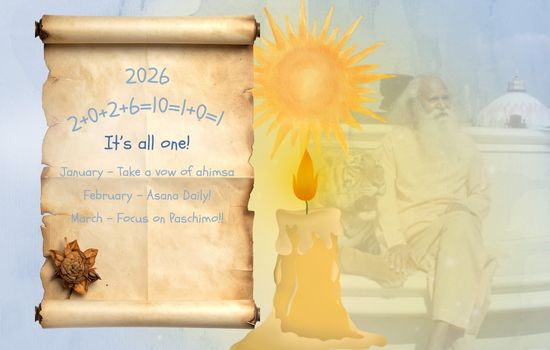
We will continue our journey through the map of the Sankhya Philosophy in the coming year, with a resurrection of the “About the body” teachings and some structured discussion on asana. 

It took us a year to get through the senses.  Of course it did, the sense organs are anchored into dense physical reality totally bound by the slowest vibration of earth.  Slow is not bad…but we are talking the material world, very dense – which is also not bad.  But as we move our way up the chart to the highest states of consciousness the subtleties of energy, mind and beyond – we become lighter, less time bound.  It’s a science fiction idea, but something the human race is embracing.  Time is fluid and can be our tool rather than our master.  As we explored the senses we discovered means to manage them, and to purify them.  These sense directed practices continue as long as we are practicing, although we may engage with them differently along the way.  In January we will begin with our exploration of the elements, also materially but molecular and energetic as opposed to solid.  If you have ever had acupuncture you’ve worked with your elements.  And now, acupuncture is a common feature of medical practice.  We are all lightening up! 
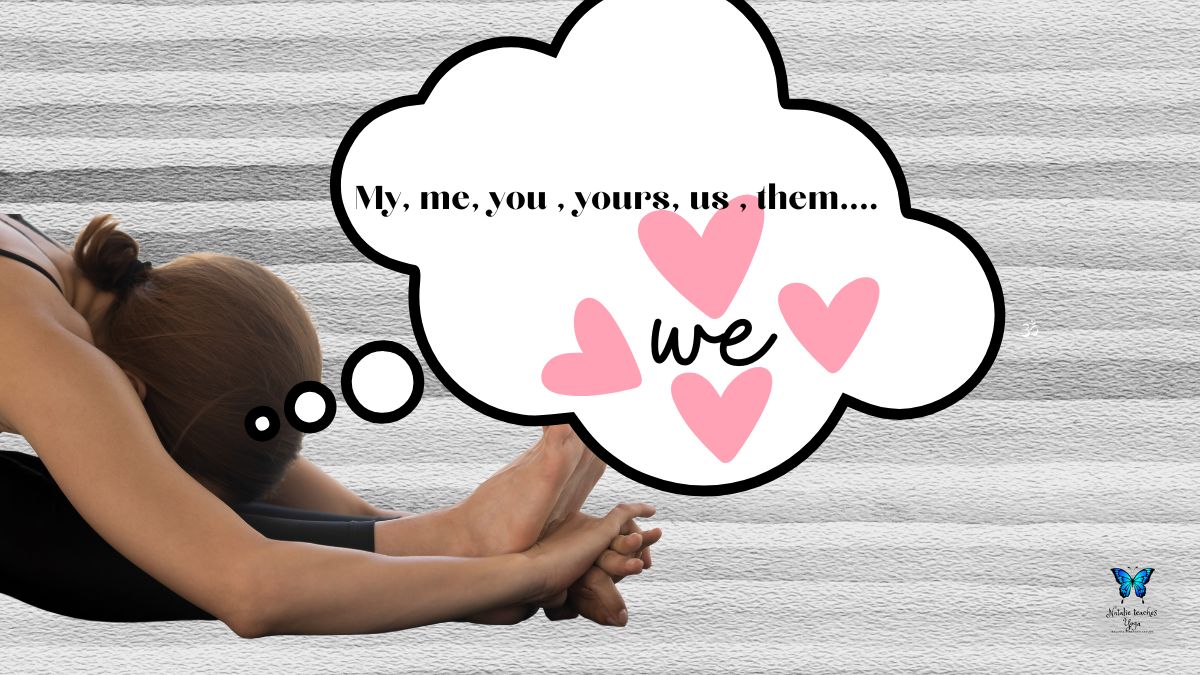
Paschimottanasa – the Grand Poobah of forward bends. 

(It’s a very, very powerful posture)

Paschimottanasana is a seated forward bend with legs extended straight in front of you.  It’s best if your knees point towards the ceiling so the feet  are neither rocked in nor rocked out.  If you find that you can hardly fold at all – don’t be discouraged.  It’s very common – it’s just no one gets their picture taken if they aren’t touching their toes yet!!  Some find it helpful to bend the knees and rest the chest on the thighs.  You can also sit on the front edge of a folded blanket.

Either your standing forward bends will be easier – or your seated forward bend will be easier.  It reflects certain anatomical tensions in the neck and hips.  If the seated forward bend is stubborn and unchanging, I suggest you work a variety of  standing forward bends first to warm up for paschimottanasana.  The folklore is that  paschimottanasana is about “letting go”  whatever that means.  Let go of what?    I could write a thesis on that…but generally it meant I needed to soften my edges, releasing the fixed ideas that I had about how the world should work.  It involved letting others win disagreements, accepting discomfort, allowing change and opening to possibilities and opportunities in my life that I never would have considered.  It was about choosing ease.  For you it might mean letting go of fear and charging forward by being more active – engaging your thighs or activating your bicep muscles to pull you closer to your toes.  It’s always good to try do so the thing that doesn’t come naturally in the moment.  I feel lazy…activating my thighs (or some other part of my anatomy) may be just thing.  If I’m struggling, then more ease is called for.

The bladder meridian runs down the entire back of the body, so being balanced with water will help as well.  That might mean more water, but it also might mean less water – it’s about balance.

Experimentation is helpful here.  That is a great thing about our yoga postures – they give us data about ourselves that we can use to refine our lives. 

Most of all, like all things yoga, forward bend requires practice -so even if you don’t like it…keep practicing!!

About the Body – Thoughts on designing sequences for personal practice

I’ve waited years to talk about this!  It’s absolute freedom to me to be honest about designing your personal yoga practice.  You see, when you teach yoga you have to learn to construct a sequence which will be manageable for the largest number of people in the demographic that you are working with.  It’s a fabulous way to learn, taking group classes.  The support is amazing and often, especially in the early stage of practice – you can go further in association with others.  There comes a time in practice though…a time when it’s really time for you to discover your own personal connection with yoga and the truth that is being uncovered in you by the practice.  This can really only be done on your own.  No one else can feel what you feel.  No one else can really understand that revelation that you have.  It all travels through our personal filters.  And what, if not the actualization of our own yoking to the sacred, to the infinite, to the wise  – are our practices about?  It’s something to celebrate when we are called to develop our personal practice.

Generally I suggest that you start out considering two approaches to designing.  The first is to get on your mat and play – and in this I encourage you work with and without music.  Music will drive you in a particular direction, but it can also obscure what is going on inside at a deeper level.  It’s a complicated topic which we’ll address in future posts.  The key at this point is to be aware that it will have an impact in your practice.  The second is to decide on a goal and then work towards it.  For this second, more structured sadhana-like way to practice yoga asana – I suggest you start by picking a few basic key postures and doing them every day.   Overall, I design my sadhana moon month by moon month, and each month I will design a full sequence for myself. I decide the minimum postures I will do on a busy day.  Each day when I get on my mat it falls somewhere in the spectrum.  I always have a posture which is key for the moon month.  I try to tie it into my spiritual theme.  I always did that for the students and yes, I do it now just for myself.  I don’t hesitate to indulge the desires I have about my body, but I always try to give them a context.  For example, I gained weight during COVID (can you believe that? Lol) and I want to change that.  So my spiritual themes are around sadhana and the discipline contained therein.  That spiritual practice supports what I need to do for my body- which right now is to practice almost everyday.  We are integrated beings and there will always be a physical and spiritual coherence in our practice if we are open to it. 

Also, in this more structured component of developing practice it’s good to decide how you want to learn to understand your body.  Some people thrive with that anatomical memorization of parts.  Eh, not me.  For me, learning about the energy body was the doorway to learning about the muscles and bones and tendons and organs.  Once you decide on your approach, there are many resources online books and workshops.  If you are serious about yoga, I highly recommend, Light on Yoga by BKS Iyengar.  He has sample sequences at the end of the book which are great learning devices. 

IF YOU FORCE NOTHING YOU WILL BE 100% SAFE.  FORCE NOTHING!

Remember to bring your wisdom with you on your mat.  In my years as a teacher I’ve seen people fall out of arm balances because they were drinking before class, people pushing postures until they snap, all kinds of things.  Most recently, my last employer – probably in his early seventies, felt fat from the COVID too.  He jumped immediately into doing 200 sit ups with a 25 pound weight on his head.  I said, “I would never let one of my students do that”.  He kept doing it.  Let’s put that in the “don’t try this at home” file.  The beauty of yoga is that you can gain without pain, and that the results of everything you do are cumulative  – a sustainable practice builds sustainable gains.  Moderation, balance and consistency are better than dramatic pushes followed by collapses into nothingness because you’ve overdone it. 

It is my deepest wish that this information will be useful to you, that you will grow in your life through your practice.  Keep practicing all is coming.

Would you like a weekly newsletter about yoga?

Processing…
Success! You're on the list.

Destination Sovereignty: Ready, Set Action!

Action Plan, Timeline, Quality Assurance

If you’ve been following the yoga posts on my blog, you know that I often refer to an understanding of yoga through which we become aligned with our true nature, which is composed of divine qualities.  I think it’s important to understand that while yoga, like many spiritual systems,  can subtly slide into putting forth dogma, in my opinion, it’s not intended to be that way, even  if, maybe especially if we follow the formulas outlined in the sacred texts.  In that vein, the “divine qualities” or true nature referred to in the texts would be the highest expression of a particular quality as opposed to a reflection of moral purity.     When we begin to speak of taking actions on our dreams and visions, my experience is that it works best when coupled with an understanding of myself becoming the person who would take those action, and in order to do that, I often need to nurture my expression of particular flavors of qualities.  This week as we begin to translate our dreams into action plans  I suggest that we incorporate into our action plans and timelines the inner qualities which support our ability to draw forth that which we are creating. 

Say, for example that we want to draw in a new romantic relationship.  There are many flavors that such a relationship could manifest in.  At some times in our lives we might want passion and adventure.  At other times in our lives, sweetness and harmony.  The thing is, if I want a passionate adventurous relationship, I better be brining some passion and adventure into the relationship as well.  If I want stability, I better bring some of that in as well. If I want sweetness and harmony I better bring some of that to the table as well.  So what I do  is, I add those qualities to my action plans.  At the top of my daily action plan, I consider the actions that I plan to take, and I list the necessary qualities at the top.  If it’s a relational day, I put kindness and graciousness.  If it’s an administrative day, I put effectiveness at the top of the list and if it’s a day of teamwork, I might start my action plan with an intention to embody  collaboration.

Because co-creation is part of a yogic lifestyle, I try to express the qualities in terms of that which would be in alignment with the beautiful qualities which we all share.  So, if my vision is to become World Tennis Champion, while my first instinct is to conquer or defeat my competitors, as I reflect  on the yogic foundation, I know that will move me away from a state of yoga.  It creates division.  Instead I might say “Personal Best in very single match I play this year. “  Think about this in terms of sustainability.  I could become the World Champion through an accidental tennis blooper of some kind.  But my personal best will transform me into a champion as a person, and then I’ll have something lasting.  What’s my action then?  Practice every day, study the moves of the masters, 5 minutes a day envisioning my perfect serve and my competitor shaking my hand with glee because it was so much fun to for them to play against the highly skilled player I’d become.  I mean really, what could be a better victory than one where your opponent concedes that you played the best game!!!

The timelines to envision, are pretty classic, 10 years,5 years, 3 years, 1 year, 3 mos. 1 mos. I week, 1 day might be a general guideline. Of course you aren’t going to do all of them every day or month or even quarter – that kind of rigidity might create restriction rather than expansion.  But checking in at systematic intervals keeps the vision grounded.  One of the things I’ve learned is that magnificent visions can emerge , powerfully from tiny steps taken in alignment.  I was on a whole other career path when I discovered yoga, and I never intended to leave that path for yoga.  But I found myself spending a lot of time on my yoga mat, loving what I was doing and just wanting to do more of it.  It all emerged from there.  The other career which I charged through and sweated around, never amounted to much of anything, either internally or externally, a paycheck and some transient glimmers of accomplishment.  But the yoga became a rich and transformative life path for me.  When we are aligned with our deepest selves our thoughts visions and dreams become powerful, and it allows for a more organic unfolding, with minimal struggle. 

Action steps?

Similar to the manifestation, actions steps and time lines involve sitting and writing.  How do I envision this ten years, five years etc.  And know that my success in the ten year plan is going to be connected to my success in the one day plan and will be supported by my steadiness in my yoga practice. Some days moving off the action plan is the action plan!  Yoga develops our discernment to detect if our inspirations are divinely guided detours or laziness and fear.  If you haven’t yet started practicing yoga, you can begin just by sitting and breathing easily for 5 minutes with your eyes closed. Or you can come to take one of my classes!

Perhaps I will see you on Saturday when we will gather to review the process of co-creating and share the visions we’ve been nurturing the last few weeks.  Sharing the vision can be a powerful means of energizing our visions, and allows us to cheer each other on!  Pay what you are able and feel comfortable with. 

Please register at the link below

Register in advance for this meeting:

https://us02web.zoom.us/meeting/register/tZcrd-qtrjIpH9z4EHsJhn1lvDoFmiAib_6h