
The Field of Mind & Yogic Anatomy: The Manomaya Kosha

“Yogas Chitta Vritti Nirodha” Patanjali Yoga Sutra 1.2 :

The state of yoga is achieved when we cease identifying with the fluctuations of the mind.

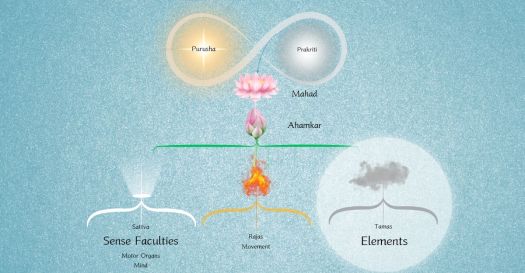
The mind as understood in the context of yoga anatomy is distinct from the brain. The brain doesn’t determine it’s function or condition. It is part of the subtle realms of consciousness which are distinct from the five senses.  Some yogic scholars identify the mind as a sixth sense.  The mind field, or what is called the Manomaya Kosha in the yogic anatomy maps of the five sheaths consists of conscious, unconscious, and super conscious thoughts, beliefs, concepts and ideas  — imagination, fantasy, projection, delusion and intellect.  In considering this sheath as a field we step into a realm of expansion revealed through the practices of yoga:  asana, meditation, observation, study.  Unlike the realms of prana, or wisdom or bliss the Manomaya Kosha sits in our awareness all the time. Some of it’s functions are more easily identified than others.  It interprets and defines. It assigns meaning. It governs perception. The world culture is permeated with instruction manuals for its management.   Just as we can become absorbed in the experience of the body to such an extent that everything else disappears (in sicknesses, deep pleasures or pain) we can become absorbed in the mind to such an extent that we lose sight of everything else (obsessive compulsive disorder, excessive worry, pessimism, delusion, illusion, fantasy).

Becoming aware of what happens in the ManomayaKosha, when we lose ourselves in it and what we can accomplish by managing it is a key development in our yoga practices. So essential is it in the practice of yoga – that the first line of Patanjali Yoga Sutra (which heads up this blog post) references it directly. Like the food body (Anamaya Kosha) and the pranic body (Pranamaya Kosha) can be clear and healthy and flexible and strong  – so can the mind body (the Manomaya Kosha).

The Manomaya Kosha sits at the juncture between what is human nature and what is spiritual nature. 

There are two primary tools for working with the Manomaya Kosha in our yoga practices.  The first is observation and the second is the mastery of the “seat”.

In yoga, our observation training consists of concentration on the breath, observing thoughts as they arise, consciously training to calm those fluctuations as we practice, and disciplining the body through focusing the mind.  There is association between the depths of postures and the depth of clarity in the Manomaya Kosha.  A deep posture being one where we are fully present (not lost in fantasy or topor or competitiveness or worry) and working deeply (relative to one’s own capacities) the tissues of the Anamayakosha (the muscles, bones organs skin – all of it – being squeezed and stretched and pressed upon.

We might work the observation piece like this:

  • Decide to awaken to what is in your mind
  • Establish a state of stepping back internally and witnessing (this can be the tough part)
  • Observe it objectively – meaning without getting involved – just “watch”. You will observe the arising, existing and falling away of a thought.
  • Keeping attention partially in the breath can facilitate the state of witnessing

The seat or connection to the earth is a foundation through which we master the mind in our asana practice.  It’s not unusual for awareness of our connection to the ground to be non-existent.  In all asana, and especially the classical meditative seats, there is a relationship to being grounded and experiencing a lifted spine.  This lifted spine is thought to work like an antenna for higher states of wisdom. If you are fortunate enough to see a buddha statue with a pointed hat…you are seeing his antenna!

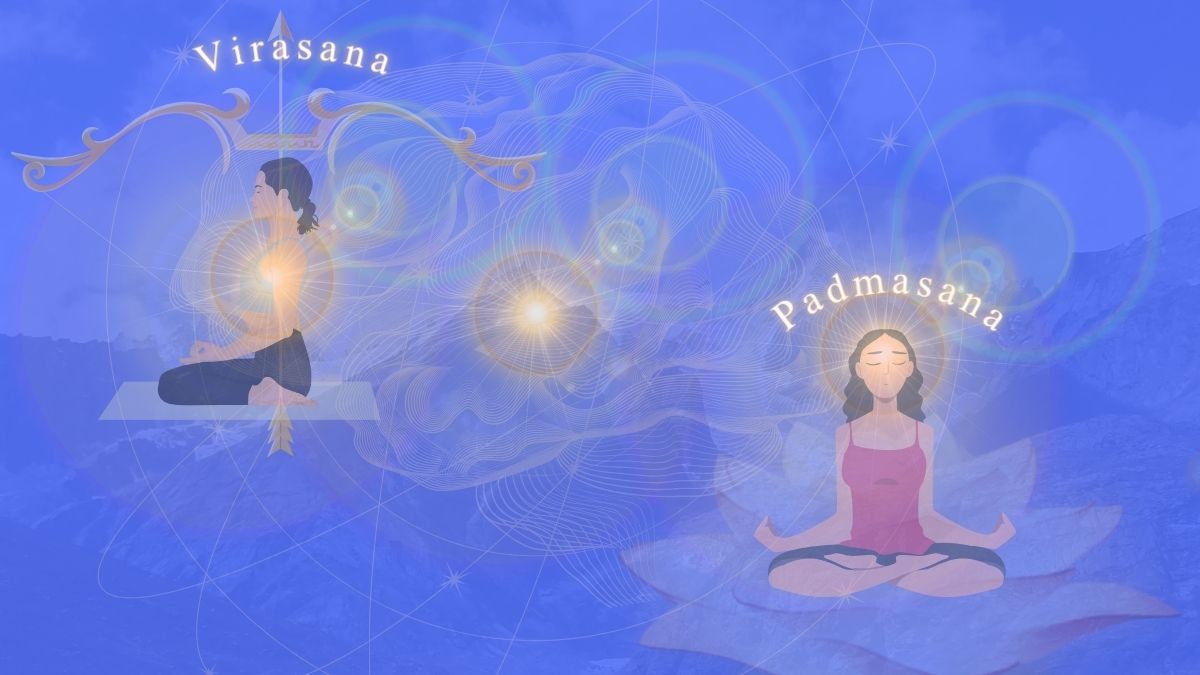
The classical seats I’d like to illuminate today are Virasana = the hero and Padmasana the lotus.  I encourage you to explore both of these with physical teachers (in person) and through your own research. These postures often become accessible only after considerable yoga practice. 

Virasana the hero is taken with the knees together, sitting between the heels with the sitz bones grounded.  The knees together – drawing inward – create a powerful gathering and focusing of energy which supports concentration and focus –  practices required for managing the mind.  The focused energy also creates a stability which lifts the spine.

Padmasana – the lotus – is unique in it’s combination of deep grounding and expansiveness.  The sitz bones are rooted into the earth, the knees are out to the side and the shins cross so that the soles of the feet face the sky.    When the shins cross a powerful acupressure point known as SP6 – the juncture of three major “yin” channels -Liver, Kidney and Spleen is toned.  Yin draws the energy inward. As with Virasana this inward energy creates a stability that lifts the spine.  Any posture with knees open to the sides will create openness and spaciousness.  With Padmasana we master our capacity to remain focused and steady in more and more expansive states of consciousness.  Padmasana allows us to sit with the experience of enlightenment. 

Want a little more “woo” in your life? No? Me neither. But yoga philosophy approached with wisdom is grounding and empowering. The philosophical elements are explored in my newsletter. I promise…it’s not a marketing email although I do suggest readings and music. You can sign up here. They are also posted simultaneously on my facebook business page – NatalieteachesYoga. Thanks for reading!

Processing…
Success! You're on the list.

About the Body: Focus, Concentration, Drishti

What is Drishti?  Drishti is the placing the gaze at a particular place while in a yoga posture (an asana).  Specific points of gaze are prescribed for certain postures, but it can be helpful to begin with just a few general rules. 

  •  The gaze is placed specifically and gently and a little out of focus.  Ideally you don’t really “look” at anything.  (this technique can be applied in tratak as well – see this week’s newsletter on Facebook).
  • A properly placed gazing point will properly position the head and neck, so if your neck hurts in a posture, adjust where you are gazing.
  • As a general rule, the neck is long, and the chin is neutral.  The gaze then rests directly in front of you. 
  • In some postures, the head is turn to look upward (Trikonasana or Ardha Chandrasana).  In these cases the head is turned and the gaze is directed towards the sky, however if that strains the neck or forces the chin up or down, then place the eye gaze straight in front of you – in the same direction your heart or sternum bone is facing.
  •  The tip of the nose can be used in any posture.  In my opinion this can be the most intense of the drishtis.

What does the drishti do?  It builds your focus!!  Through applying it you may discover what focus can really do for your postures.  It raises the heat level in the body.  It steadies the mind, and thus steadies the body.  It brings you into the present – which can help enormously if you are practicing being in postures for a long time (which is really good to do!).  Focus can help you learn to manage discomfort – not through ignoring, but used wisely focus gazing outward and breathing when you are uncomfortable can teach you to be present to and transform your experience of pain.    

Processing…
Success! You're on the list.

About the body:  Empowerment and Ease

About the body:  Yoga and the Parasympathetic nervous system

When we breathe calmly, peacefully, rhythmically through the nostrils, we ignite our parasympathetic nervous system – the relaxation response.  In that mode – many things happen.  Rigid long held stress patterns in the body dissolve, the immune system is nourished and deep healing occurs.  It is also easier to access deeper levels of inner states of consciousness – which allow for different perceptions of the world – for transformation on the level of mind. 

As we take a posture we want to ignite this kind of easeful experience while remaining awake, alert and active.  The more challenging a posture is for us – the more powerful it will be to nurture this kind of breathing.  This is pivotal in transforming our life experience from being a person with a body that is always controlling us – to being a person who has some degree of mastery over the physical and energetic bodies.  It’s important.  

Interested in a little philosophy with your postures? Please join my newsletter community. No ads, just ideas. Once a week.

Processing…
Success! You're on the list.

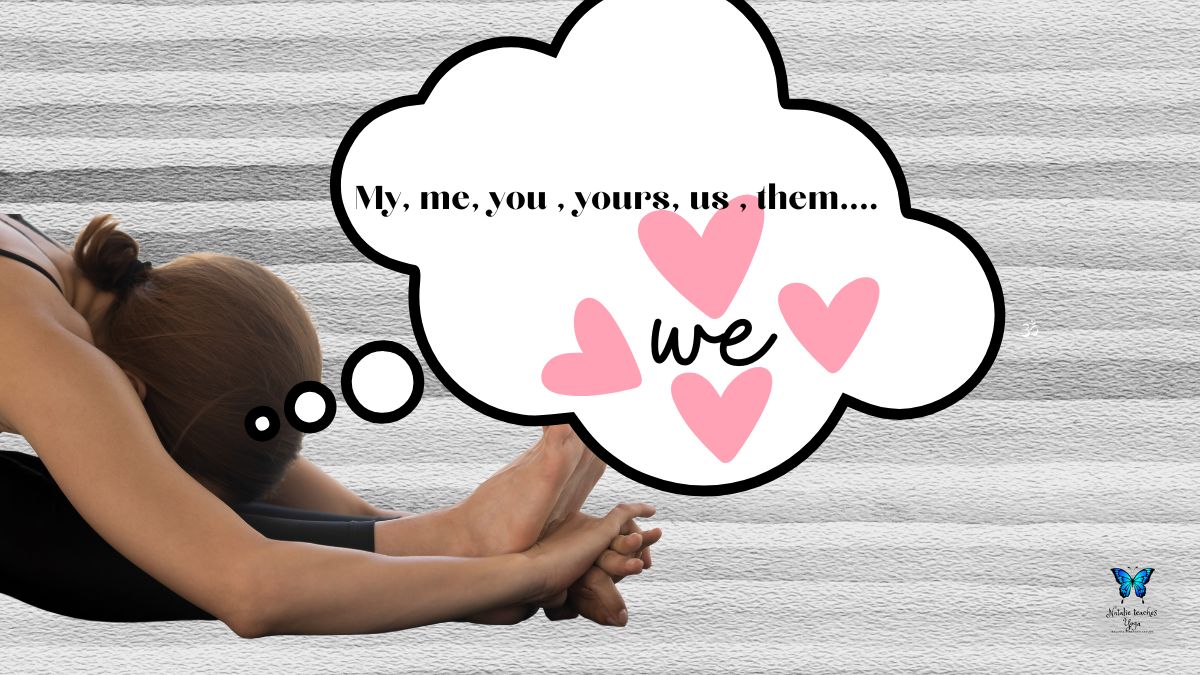
Paschimottanasa – the Grand Poobah of forward bends. 

(It’s a very, very powerful posture)

Paschimottanasana is a seated forward bend with legs extended straight in front of you.  It’s best if your knees point towards the ceiling so the feet  are neither rocked in nor rocked out.  If you find that you can hardly fold at all – don’t be discouraged.  It’s very common – it’s just no one gets their picture taken if they aren’t touching their toes yet!!  Some find it helpful to bend the knees and rest the chest on the thighs.  You can also sit on the front edge of a folded blanket.

Either your standing forward bends will be easier – or your seated forward bend will be easier.  It reflects certain anatomical tensions in the neck and hips.  If the seated forward bend is stubborn and unchanging, I suggest you work a variety of  standing forward bends first to warm up for paschimottanasana.  The folklore is that  paschimottanasana is about “letting go”  whatever that means.  Let go of what?    I could write a thesis on that…but generally it meant I needed to soften my edges, releasing the fixed ideas that I had about how the world should work.  It involved letting others win disagreements, accepting discomfort, allowing change and opening to possibilities and opportunities in my life that I never would have considered.  It was about choosing ease.  For you it might mean letting go of fear and charging forward by being more active – engaging your thighs or activating your bicep muscles to pull you closer to your toes.  It’s always good to try do so the thing that doesn’t come naturally in the moment.  I feel lazy…activating my thighs (or some other part of my anatomy) may be just thing.  If I’m struggling, then more ease is called for.

The bladder meridian runs down the entire back of the body, so being balanced with water will help as well.  That might mean more water, but it also might mean less water – it’s about balance.

Experimentation is helpful here.  That is a great thing about our yoga postures – they give us data about ourselves that we can use to refine our lives. 

Most of all, like all things yoga, forward bend requires practice -so even if you don’t like it…keep practicing!!

About the Body: The Body as a Communication Device

In the classic medieval text the “Hatha Yoga Pradipika” or The Guiding Light of the Yoking of the Sun and Moon – we learn that in classical yoga, the practice of Hatha Yoga culminates in the body’s resonance with the sound of “Om”.  We are tuned by the practice to a vibration where opposites are united and revealed as facets of one source. That state of unity creates a particular feeling tone. In my experience when that happens, we are feeling the love of the universe within our own form.  To do this, the biochemical aspect of the body requires cleansing (diet and various cleansing practices – the shat karma kriyas – the process of sweating during practice), the musculoskeletal system needs to be toned and balanced, and the energy body, emotions and the mind require discipline and clearing through meditation and sound practices (Om) and adjustments in personal care and ways of relating.  I know it sounds like a lot, but for most of us we do a little at a time, transforming at a pace that is appropriate for us.  The result of this is a clear “sound”.  We can hear it in the sound of our voice.  We can also hear it inside us as our intuition and wisdom become illuminated.  A common test is to listen to your Om at the beginning and end of the class. Or any old time you feel out of tune.  This clarity of resonance or lack there of is key to our capacity to communicate.  If you’ve ever tried to sort things out with a friend when you felt foggy day you know it’s more difficult than  when you are awake and clear.  The body is a communication device – not just with our tongues and mouths, but with our posture, the brightness of our eyes, and our health.  Imbalance in our system is reflected in the body.  And through working with techniques of Hatha Yoga we can bring the system back into balance. 

A good place to start is always the musculoskeletal system. The density of the bones and the memory capacity for the fascial tissue and muscles impacts the balance of the whole body mind spirit system.  So how do we start? 

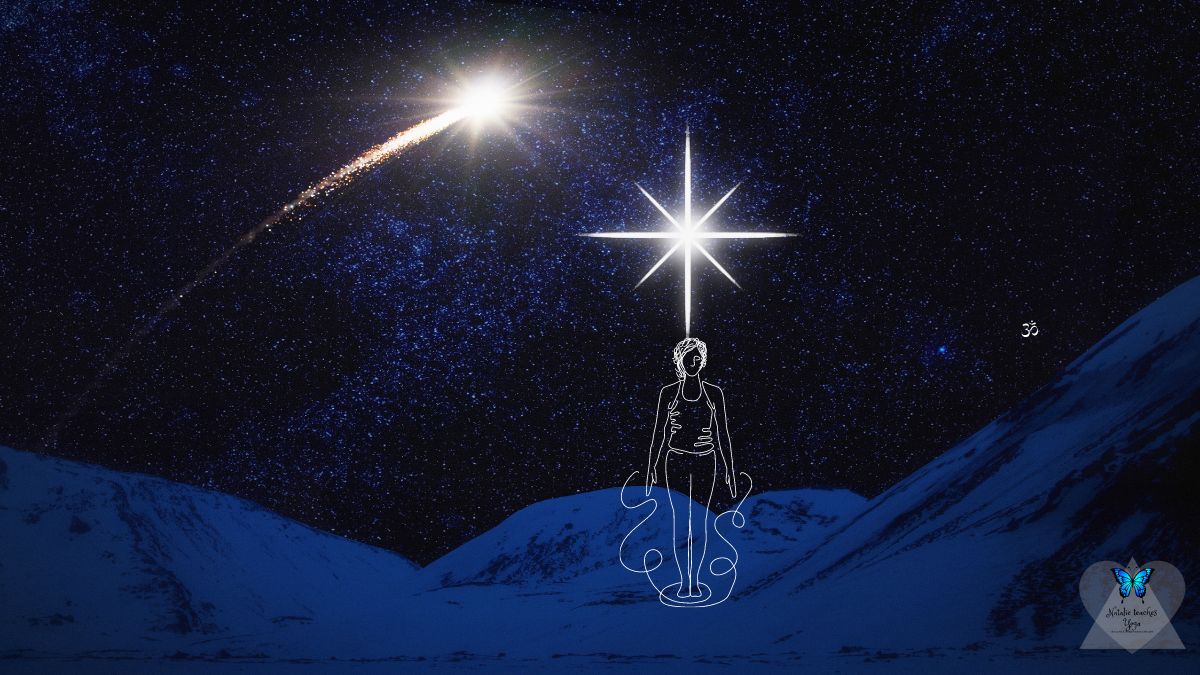
All yoga starts with Tadasana – or Mountain  -or Simple Standing Posture.  It is so simple and straightforward that every tension is apparent. We just stand upright with the balance of the weight distributed evenly across the soles of the feet, arms alongside the body.  Personally, I never try to force change in Tadasana.  I use it as a measure.  How is my Tadasana at the beginning of practice? What is it like at the end.  Like the Om, it’s often very different, reflecting as greater state of balance and resonance.  Sometimes I’ll just stand in it for a long time and feel the tension patterns surface. 

Those tension patterns can tell us a lot about how we could create positive change in our lives.  There is no formula.  For me it’s always my hamstrings get short and tight and my head juts forward.  Over the years – through spacious self-reflection and input from yoga colleagues – I’ve come to know that when that pattern emerges – some piece of me is not in the present moment.  I’m hanging on to a belief, or perception or way of being that doesn’t serve me anymore.  Often by the time my body communicates something – I’ve been ignoring it for a while.  Sometimes insights about what needs to change will emerge during asana practice, sometimes meditation or the other forms of practice can help to illuminate the issues.  The key is to seek to understand in a receptive way rather than just to fix or overcome and that understanding lays the groundwork for transformation of the body and everything else through my practice.

My newsletter lays a philosophical ground drawn from Patanjali Yoga Sutra 1.40 to work with in conjunction with this blog post. Take a look here: To Know – Results of the Experience of Yoga – https://mailchi.mp/4f8d72e44e70/to-know-yoga-and-the-experience-of-knowing

Sign up for the newsletter here:

Processing…
Success! You're on the list.

About the Body: Navasana:  The Boat that Crosses Samsara

The imagery of yoga is embedded in the understanding of yoga.  On one level the imagery is just about communicating an idea – how to convey an abstract principle in a way that all kinds of students can understand.  On another level it is about communicating technique – something is called what it is called for a reason.  On another level it ignites our spiritual know which supports the execution of the posture. 

One of my favorite examples of the spiritual image of a posture conveying the experience of the posture is  Navasana – boat posture.    In the classical yogic way of looking at life – there is suffering. The practices of yoga, meditation, mindfulness, and the associated behavioral prescriptions are considered a vehicle which can carry us to the other side of suffering – peace, joy and liberation.  The suffering is global and cosmic.  It’s also deeply personal, intimate and immediate. The capacity of the global suffering to land as the personal experience of suffering in our lives is mitigated by our practice of yoga.   The uncomfortable experience may be present, but we don’t experience it the same way when we are well practiced.  Navasana, or boat posture, is an asana where we embody the boat which can safely convey us across the vast presence of suffering in the cosmos to the safe shore of the state of yoga. 

 At its worst, Navasana is a clench your teeth, grin and bear it hold your breath posture.  At its best we lightly balance on our sitz bones, heart lifted, reaching our toes to the sky.   We can aspire to endure the posture or to understand the posture enough to find the lift that will take us across the sea of discomfort that life can be.  It’s a posture that invites us to take ourselves lightly.  

In my experience working with students the key to the posture is the connection of the sitz bones to the earth.  Too far forward, the posture will be more challenging than it needs to be – but notice where the challenge emerges in the body.  It points to an area that may need some awakening  try a combination of strengthening and stretching the area with good breath and attention.  Too far back on the sitz bone the heart closes.   To discover the sweet spot for balance prop yourself a bit.  Sit with knees bent.  Place your hands on the floor slightly behind you.  Lift one foot at a time until you feel comfortable with the action.  Lift both feet, then press your hands into the earth and rock forward on your sitz bones, experimenting to find the spot where it’s easiest to hold your feet in the air.  Lift your hands.

Processing…
Success! You're on the list.

About the Body: Being Present

Our bodies are fields of vibration.  It’s obvious right? Even though it feels woo.  My teeth are denser than my muscles…that means that they are at a lower vibration.  They are more solid. 

An exercise we can use to experience this directly is to focus internally from the densest to the subtle-est. Bones and muscles,  tendons and ligaments, internal organs and the fascial tissue that weaves it all together, and then the boundary of the skin, then feeling the air on the skin.  You can experiment with this yourself. Don’t hesitate to use your imagination to connect with the various parts of the body. 

This simple exercise is priceless in terms of becoming aware of our bodies in time and space.  Often we aren’t in our bodies! We are thinking about past and future…using the imaginal mind to unfurl stories and memories which exist only in our minds.  – when we open our eyes they aren’t here any more, or they don’t exist yet. 

If you’ve ever attended a Vipassana meditation retreat you may have done a simpler more diffuse body scan to begin your meditation practice.

Bringing our attention, focus and awareness back into our bodies is an essential part of the transformation power of yoga.  As we learn to be present to the body in this spacious non-judgmental way, the emotional wounds the body carries can be healed.  The power of this cannot be overestimated.  Carrying a body full of memory interferes with our capacity to fill our present moments with newness- the fullness of our love our creativity. 

Was this useful for you?  I hope so.  If it was I encourage your to sign up for my newsletter.  Once a week or so …its yoga information and inspiration based.  No sales, but I do share songs I love that might be fun additions to you practice.

Processing…
Success! You're on the list.

Awakening Inner Authority

Teacher and student- the heart of yoga

Balancing on your own two arms – it’s a heart thing💖

In the newsletter this month we’ve been focusing on the relationship between teacher and student. By understanding the ideal dynamic of that relationship in classical practice we can enhance our capacity to learn yoga well on our own or with outer teachers. 

When looking to external sources for guidance, information, understanding – there is a transfer of authority involved in the learning. We learn by imbuing a source with authority. To learn we must be willing to consider that the external source has valid and relevant understanding of what we want to learn, and we must be willing to try on, sincerely, what they have to offer- to be open to it.  At this time scientists and doctors are held up as the pinnacle of valid authority-in other cultures in other times shamans and mystics are revered authorities. For some, journalists are valid authority. Judges are authorities in our culture.   

From the yoga perspective authority is not inherent in any of those people. Others confer that authority on them.  True authority exists on a whole other level – in the realm of inner wisdom that we all have access to. Scientific findings are replaced, legal decisions are over turned, medical advice is found to be wrong.  From the yoga perspective relative authorities like these can be useful but the truest of authorities is the limitless consciousness that we can access by looking within ourselves – beyond intellect, beyond knowledge in the deep silence.

Regardless of your reasons for practicing yoga it’s likely your mind has quieted down through the practice – revealing glimpses of peace and stillness.  This inner fount of silence and peace is also the source of ultimate authority.  It’s not your personality, it’s not your intellect-it’s the place inside you where your true potential resides waiting to be revealed. The more we choose to connect with it the more that silent wisdom self pervades our point of view.

So how do we access this fount consistently? Asana (postural) practice is a big part of this – by staying peaceful in an uncomfortable position we train ourselves to access this peaceful place at will.  There are layers to this….first we just stay an extra breath and then another and then another. Next we practice staying focused on the breath rather than  discomfort.  Once we have mastered that we can bring ease into the posture by softening gripping resistance.  Then in that space of wisdom and peace we can mindfully press more deeply into our alignment or our depth in the posture with wisdom. Press forward with wisdom.

As you practice nurturing this peace within while on your mat, it might be worthwhile to practice accessing that quiet space within when challenged to make a choice.  Test the wisdom.  This process of testing the wisdom born of silence can be helpful in making a relationship with our inner authority.  We begin to recognize the difference between acting from our fear or our wisdom, and our faith in this subtle deeper wisdom grows.  We begin to reclaim the authority that we may have given away to the world around us.

Processing…
Success! You're on the list.

Yoga, Freedom and Moving into Sovereignty

The focus this moon month in the newsletter is freedom or in Sanskrit, Mukti.  Mukti translates as “liberation”,  freedom, and it’s important to understand that freedom in the sense of yoga is different than freedom in of our day-to-day life – although they are related. We may think that having tons of money would be freedom or rebelling against social conventions would be freedom. Freedom is not inherent in those experiences.  Ask anyone who has very large amounts of money or who has lived in the counterculture for a long time and in their story you will hear of the oppressions that still remain.  In yoga  freedom is something that we develop inside ourselves as we cease identifying with the fluctuations (vritti’s) of our mind. That’s the  second sutra of Patanjali’s Yoga Sutra. The fluctuations of our mind frequently take the form of how we think of ourselves, how we think of others and how we think of the world we live in. These mental constructs can become rigid and block our ability to be open and spacious and, well, liberated.  The freedom of the yogi comes in the form of an inner sovereignty which allows us to become the masters of our own minds and to use that freedom to choose the path of love over and over again.

Yoga is a discipline that leads to freedom The practices of yoga involve experiencing certain kinds of restraint and under those conditions finding the freedom there. When the  restraint is lifted you have a different understanding of who you are. Restraint comes in the form of tying yourself in a knot in an awkward posture and remaining peaceful.  Restraint can mean  being willing to suspend our immediate desires in order to allow a higher state of wisdom consciousness to guide our actions.

When we tie ourselves in a knot in a posture we stir up the deep resistances we have to living.  The knots are knots within our consciousness and so the goal is that to breathe, to be present to what’s happening and not fight with it. Consider this first level of freedom one that you could find contentment even when circumstances around you are not to your liking.  That’s a tremendous amount of freedom. Sometimes for whatever reason it’s not the best idea to change a circumstance. Even though it’s uncomfortable, it’s better to be strong. This capacity is honed in the practice of asana.  Accept the limitation, breathe be still and allow your inner guidance to direct you step by step to moving beyond the limitation into a deeper expression of the posture.

This kind of yoga training reveals discernment – the capacity to understand if our impulses are coming from our authentic heart desires or our desire to control. It’s a powerful means of developing aligned autonomous inspired choice making. Sovereignty. It is a gift of the yoga practice born of moment by moment alignment with self and that is the freedom. Rather than having others dictate who we are or who we become  or what actions we take in our lives we are free to take action in alignment with our highest best interest.  Yoga will take us to a healthy and beautiful body of all different kinds of shapes and sizes but this is the heart of the yoga  – this sovereignty and the freedom that emerges through practice.

The Elements of Sadhana: Santosha- Contentment

In the newsletters we’ve been talking about creating a sadhana – a conscious spiritual practice of yoga, a discipline of yoga as conscious spiritual practice. This past week I introduced the mahavratam or great vows outlined in Patanjali’s Yoga Sutra. These vows aren’t something that Patanjali devised – he compiled them from studying with the esteemed yoga masters of the day (which was some time a few  thousand years ago no precise date is known).  There are ten of them. They are often considered to be moral imperatives. In practice I’ve found it more useful and more authentic  – I get better results – if I let that idea of morality go and open up to practicing them whenever and however I can, trusting that they are actually learning devices for me.  Through practicing them I open to understanding who I am and who everyone else is.  As I open to understanding I make better  choices. The ten mahavratam are: nonviolence, non stealing,  adherence to truth, continence, non- hoarding, cleanliness, contentment, austerity, self- reflection and devotion. In the newsletter I briefly talked about the practice of saucha or cleanliness. Today I’d like to speak a little bit about contentment, or santosha. 

One thing to consider when practicing these – they’re also called yamas and niyamas, restraints and observances – is that we are always creating. We are creative beings – extensions of the divine, which is the creative energy of the universe, the supreme creative energy of the universe. This is an underlying paradigm of the yoga practice.  The yoga practice will reveal that we a specks of divine creative consciousness – and we can live from that truth. This is co-creating, which is yoga – to be yoked to the divine. The restraints and observances clear the palette of our consciousness, enabling creativity which is unbridled by our past. 

 With yoga the idea is that creating in alignment  with the infinite divine opens the doorway to limitless possibilities- and that wisdom, that intelligence – will create richer more satisfying possibilities than our personalities with their cravings and conditioned attunement to lack. If we choose it, these practices deepen our understanding of the elements of a good life.  This is partly why I encourage you to set aside the idea that they are imposed morality.  Practiced lovingly, they open the way to a delicious abundant live.  Less is more. 

With the practice of santosha or contentment this connection between our behaviors our beliefs our thoughts in the world that we experience is made very clear. 

Perhaps in your life you have met those or perhaps you’ve been in this space yourself ( I know I have been) where you feel a need to complain about everything. I’ve seen a real uptick in this during the COVID situation. 

 I think we can all agree there is much to be addressed in the world., but right now we have to accept what’s happened and what is happening and learn to work with it. Shaking our fists at a perceived enemy is unlikely to change the world…changing ourselves is likely to change the world, not only because we engage those conversations differently. 

But let’s think back to the before time – before COVID – and remember those days in offices or classrooms or social gatherings where we or our friends or neighbors or our family would lapse into days where we complained and complained and complained. Surely we’ve all known in ourselves or others that momentum that complaining develops – once you start complaining there just seems to be more to complain about. The yogis understood this very deeply through their meditations , analysis and self reflection. The practice of contentment is to practice contentment under all circumstances that’s a key of these mahavratam – under all circumstances.   So in any moment (the grandeur of universality demands we operate one moment at a time) when faced with complaining, we choose contentment.  It’s like putting down a heavy object.  “I just don’t want to carry the weight of my complaints, so I’m a gonna put this down, right here.”  It’ll be okay.  Once we’ve entered a quieter state of mind, wise action can emerge more clearly. 

What does that mean – in the yoga practice – to work a difficult situation? Perhaps it is to rest in the understanding that you’ve participated in the creation of it and take responsibility for the fact that you’re there. You skip the blame (of yourself and others) you skip the victim story and nurture and invite the ability to see the situation differently.  Liberation arises when we realize there is no one to blame.  The practice of contentment opens our minds so that we are able to see that. To be honest, in content I perceive that there is nothing to complain about.  It’s all perfect.  But to deeply know that feeling we have to practice.  

One of the ways that we can train ourselves in the vast practice of contentment is to practice on our yoga mats. One of the most obvious powerful and potent ways to do this is to be content with a posture even as you are working to transform it. Where I am is fine but I’d like to deepen it. I’d like to expand it; I’d like to move to the next expression of it. So the first part of that is to enjoy every posture just where you are with it. This is one of the reasons why the postures that we can’t do are so important. As I say this I realize that this is one of the biggest difficulties of a home practice is that we never bump into those postures that we don’t like. At the same time if the classes available around us are not suitable – to force ourselves to go into a class that is just full of difficulties makes no sense either.  So what can be a good idea in your practice is to add a small step towards a posture that you would like to attain someday. For me right now this is wheel urdva dhanurasana. 

 I had an accident last fall where my wrist was smashed. I’ve consciously decided to recover slowly. In my full practice days I would do three full or wheel postures every day.  Wow right?  To me that seems like wow.  I was never a born gymnast. That posture has intense ramifications on the wrist and feels remote to me but at a certain point I had an intuition a revelation that in fact I would be able to do it again in this lifetime So what I’m going to practice this moon month is to sit at the wall and take a camel posture and place my hands on the wall. A highly modified introduction to the movement that would lead to wheel. And I am content.. This is the beauty of modifications in yoga. What they do is – if you practice them fully,happily embracing what the modification has to offer you – it’s actually like working the full posture you develop the shape energetically on a deep level and it opens from the inside out. One day your’re ready and the full posture emerges – like a chuck busting out of an egg. 

So how do we learn about modifications if we’d like to incorporate them in our sadhana?  I highly recommend them even if you don’t have an injury. Spend some time in modified postures.  By working with the modifications you’ll learn some of the paradigms of postural yoga. We’re very fortunate to live in an opulent world where there’s all kinds of information about yoga on the Internet so I’m sure you can find some information about modifications there.  As far as books books go and even Internet the best school of yoga from which to learn about modifications is the Iyengar school so I encourage you to look into that when choosing postures to work in your sadana. 

Once you’ve practiced santosha on your mat for some time don’t be surprised if you  catch yourself practicing it in your life.  You don’t have to make a big trip out of doing all of these mahavratam.  Just know that they can extend to all circumstances, and they’re not limited.  Your contentment is not limited to certain circumstances.  You can start practicing them in certain circumstances until you feel confident to apply them in more challenging circumstances.  

OK that’s our blog post for today. As always it’s my sincere wish that this information be useful to you and that your practice will lead you to a blessed and wonderful life.