Moment by Moment

Tadasana, again. 

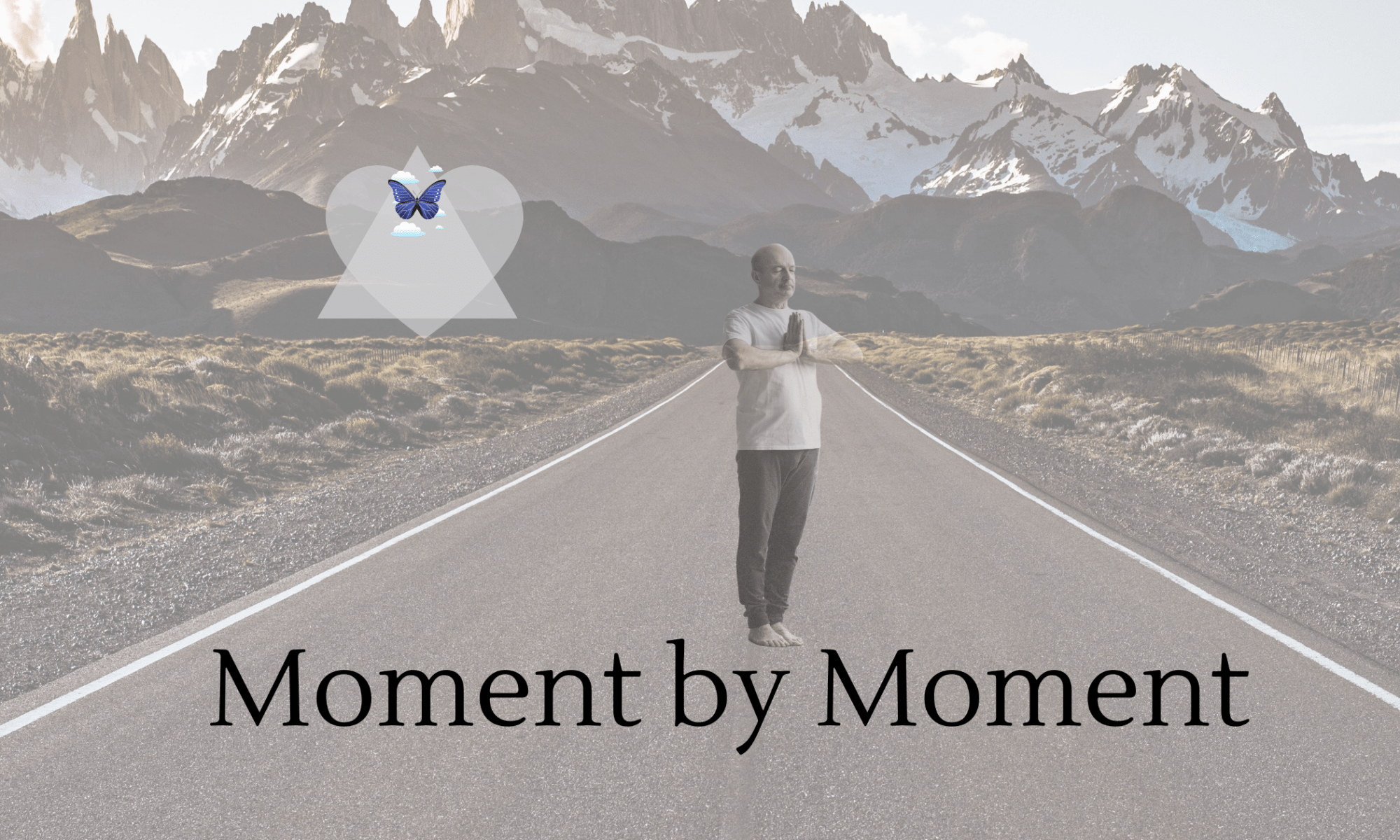
Tadasana is the simple standing foundation posture in the hatha yoga practice.  It is the beginning and the end.  The atom and the galaxy.  The man in the image above is in a variation of Tadasana. 

Some days, I get on the mat and it just seems like I don’t feel like doing anything.  But, I’ve committed to my practice, and while I definitely have periods of it falling away, I know that the root of the empowerment in yoga is DISCIPLINE.  I’ve learned over the years that forcing myself to do things that I don’t want to do (a very old school idea of discipline) seldom yields a good result.  Instead it generates a deep rift in my relationship to myself.  I am forcing myself to do something I don’t want to do.  That, is not the kind of seed I want to plant.    Perhaps understanding where I am will reveal what my next steps are.  So….Tadasana.

I stand in Tadasana.  I am amazed at how quickly I am aware of the imbalance in my physical body and I question how long I’ve been IN the imbalance and not been aware of it until now.  When I began practicing in 1993, I may not have perceived it so quickly.   My weight is forward in the balls of my feet.  I am projecting myself into the future – which is a fancy way of saying “fear”.  Of course I am.  And at this moment in time, it’s likely that you are too!  In the fast emerging post-Covid economy we are all grasping at a secure future. 

Security can never come from a fear-based foundation – at least from the perspective of yoga philosophy.  Security comes from nurturing a sense of security.  From a yogic perspective that kind of thinking creates difficult scenarios.  Projecting into the future doesn’t place us in the right position to make wise decisions. 

I examine the weight distribution shifting front and back.  The balance point eludes me.  I recognize in the  imbalance, a pattern.  The front right corner of my right foot lifts and weight shifts into my left heel.  What would create balance here?  I consider that Trikonasana, the triangle, provides opportunities to explore the connection to the earth differently.  I have nothing to lose, so I try it, and then back to Tadasana.  The imbalance has diminished, but it’s still not easy to stay centered front and back in tadasana.  I try Vriksasana, tree posture, and my hip emits a little pop.  Back to Tadasana.  Wallah!!  Tadasana arises like a mountain, stable, uplifted and free.    The energy flows through my body and insight arises about why I am here and what I am doing.  I am pulled to meditate and reminded of the power of asana to set the stage for meditation by liberating energy.    Asana nurtures clarity vs. delusion, which is more common that we might think.  It’s been a big day in my personal yoga practice – all emerging from shifting into the “now” of balanced weight distribution. 

Patanjali Yoga Sutra (an ancient text on yoga) sutra 4.33, “The sequential progression of moments is understood at the final end of it’s changes” teaches this power of each present moment as points of creation.  My lived experience of this teaching is that at the end of a series of moments we see how we arrived at a destination.  I’ve found that this arises as a clear vision of every pivotal decision I’ve made which contributed to the outcome that I am experiencing.  When this understanding arises it is always amazing, although not always cheerful.  It’s a way  of owning that we  responsible we are for our lives.   Painful as this may seem, only through this awakening process can we transcend the perception of ourselves as victims, and thus become active creative agents. 

This month we consider moving through transitions in this mindful present tense kind of way.  It’s not that we don’t have goals, I know when I’m transitioning from down dog to plank that I’m aiming for a plank, but it is the way I position myself in each microsecond of that transition which builds the plank that I will find myself in. 

I think it’s no accident that the heroes of the great Indian epics are archers.  Imagine having such a sense of vision of the pathway to a target that you could accurately set up your bow and arrow in such a way that oncoming winds would work in your favor!!  Magnificence!  Our lives are no different.  The present moment by moment awareness of the multitude of choices that we make every single minute of every single day….taking OWNERSHIP of that decision-making power, is a choice of great consequence and a fertile field for creativity.

With love and blessings

Natalie

Thanks for sharing the link http://www.natalieteachesyoga.com or my name whenever you refer to anything presented here.

Santosha (contentment)

An attitude of contentment (santosha) gives rise to unexcelled happiness, mental comfort, joy, and satisfaction. ||42||

In Marin County/San Francisco we are now at exactly 20 weeks since the first day of the shutdown.  That is a very long time, and much has happened in those five months.

One of the teachings of yoga which has become a bit controversial these days is a practice called Santosha.  In that practice, the yogi assumes that everything is perfect as it is, and goes about making living their life in that way.

Here is the underlying principle.  If you react to something you do not like, it creates a condition, a likelihood that that the condition will stay the same, or keep repeating in the life.  By choosing to look at everything as perfect, the yogi plants a seed for everything to unfold perfectly.  Here is an example (and I’m not saying this is true or not true, it’s just a hypothetical example)

During the shutdown, many people who live their lives with relative freedom experienced, maybe for the first time in their lives, a degree of oppression that prevented them from walking down the street, eating where they wanted to, going to church, hanging out in a bar, earning morning.  Whatever it is.  Everyone had a different experience of this, and many felt oppressed.  In that oppression minds were opened to understand a little better what life feels like for those who live in perpetual oppression.  We had a big shift.  Things may not be resolved as of yet, but there was definitely a shift.  So the yogi, understanding that everything is perfect, knows that only a shutdown  of this magnitude would have created the pressure cooker in which so many  minds and hearts could be changed.

On a more personal level it’s useful to look at where we each are right now.  What happened for us?  What shifted?  In those shiftings, what opportunities were created?  Sometimes we just have to train ourselves to see them.

Long before I practiced yoga, a very savvy NY recruiter was sending me out to interview for paralegal positions in some of the fanciest law firms in New York City.  Good pay, great benefits.  She also sent me to this tiny little firm, two attorneys, just hiring their first patent clerk.  I saw an opportunity.  She was astounded.  It turns out that she just included them because she knew one of their daughters.  They taught me so much about patents at that little firm, and it served me well for years to come.  Things are not always what they appear.

So, in yoga, the maximal push of a posture is not always the means to the biggest result.  On one level, when we first start, that’s how we “feel”  progress.  But in yoga the subtle shifts are sometimes the most powerful.

संतोषातनुत्तमस्सुखलाभ

saṁtoṣāt-anuttamas-sukhalābhaḥ

From the practice of contentment, one obtains unsurpassed comfort and joy.

Stability and Joy Revisited

“Yoga is the process of dehypnotism”  Shri Brahmananda Saraswati

This month the underpinning  ideas of our practices were stability (shtira)  and  joy (sukkah), as embodied in parivritta trikonasana, the Rotated Triangle.  We nurtured a balanced and activated foundation in the legs and feet, which provided the opportunity to then “reach out” with the upper body, leading with the heart and extending out into the world around us.  In practice on the mat it can be just that simple – an intention to connect to planet earth well, and an intention to extend that experience of connectedness (which is love)  into the world around us. With patience, the body will follow where the mind leads. 

Here is the crown jewel in all of this.  The stability and joy doesn’t really need to be cultivated at all. They are already within you, waiting to be revealed.  They are aspects of your true nature, svarūpe. The experienced yogin stands in their true nature.  To stand in one’s true nature is to be yoked (yoga’d!) to your essence.  Our ability to root our feet, activate our legs and extend our hearts and our arms will reflect how well we are yoked to our true nature in any moment.  The more we are yoked to our true nature internally, the more we will experience joy which creates activation, extension and rootedness in a posture.  It is a process.  For most of us, still buffeted by the fluctuations of our minds, there will be a fluttering throughout any posture when the stability fluctuates. 

A friend recently pointed out the degree to which the current state of affairs on planet earth is surfacing our shadows and much projecting on one another is occurring.  It is a prime time to become aware of our inner stability.  The media and perhaps those around us are posing powerful influences.  Using a wide variety of means to manipulate the stuff of our minds, they bombard us with opinions, accusations and suggested terrors.  We all have ways of dealing with this.  I have a friend who seems to be immersing herself in horror stories.  Catharsis!  The fear is expelled, but the conditioning of  vulnerability remains.  Yoga suggests, instead, that we dehypnotize ourselves through the process of unplugging from externals and plugging instead into the reservoir of peace and joy which is accessed through the silence in our mind.  Yes, we can stay connected to  peace with our eyes open, even when a disagreement is going on.  That is the power of yoga. 

So how do we practice this?  Self-observation.   The moment we catch ourselves fluctuating, we stop and make it a point to detach from what is coming at us from the outside and anchor in to something inside.  We develop a habit.  Say that someone around you does not like your political stance or your mask choice.  They direct angry energy at you, it is quite intense.  For most of us the first reaction is likely to be retaliation.  Any action we take which emerges from the small self will have limited effectiveness.  The actions we take while connected to our inner resources will have limitless effectiveness.  If I’m not anchored in myself and I shout back, I may get the person to go away for a while, but it’s likely to be temporary.  The same issue will arise again.  If instead we choose to stand silent in our truth, extending love all the while, our actions will extend out to hearts and minds and in ways we cannot see.

Consider taking the knee (a graceful and magnificent gesture of support and love) vs. burning down  a building.  The first extends love and changes hearts.  The second inspires nothing and demands a retaliation.  Taking the knee is an expression of svarūpe.  The first is a manifestation of fear and disconnection.  There are those who would like us to remain forever fluctuating, buffeted and hypnotized into fear and submission.  Yoga teaches that we can break away from that influence and choose to stand in love, instead.  In that breakaway our inner freedom is ensured.  Only Love is truly sovereign.  Only love (in all it’s flavors, truth, joy, sweetness etc.) is svarūpe.  We can train ourselves to choose and we can train ourselves to be steady in remaining unplugged from  external influences.  (and by the way, we can train throughout every day, not just in the big events.  Lakshmi, the cat who lives with me, forever tries to press me to be at her beck and call at all times.  It is a herculean effort to stay connected within and take care of everything else which needs to be done!  But I grow stronger and her efforts to communicate become more skillful all the time. 

Ha—tha—-Yo—ga

“….the Kula Arnava Tantra states [that the] the ultimate purpose of Hatha-Yoga, which is God-realization, or enlightenment, here and now, in a divinized immortal body.  This is often expressed as the state of balance or harmony (samarasa) in the body, when ordinarily diffuse life energy is stabilized in the central channel.  This idea is present in the term hatha yoga itself, which is esoterically explained as the union (yoga) between “sun” and “moon” the conjunction of the two great dynamic principles of aspects of the body-mind. “  Georg Feurstein, commenting on the Kula-Arnava Tantra, in the Yoga Tradition (1998)

This sums it up!!

Here are many words which describe the potential of a yoga practice, all of which reflect the culture and time in which they were said.  In an age of skepticism (now), few are enticed to the mat for something like “God-realization”.  What does that even mean?  “Divinized immortal body”.  We have bionics, why do all the work of hatha yoga?  So, let’s step back from the words of the Georg, and uncover the essence of this.  The yogi attains a magnificent state through the alchemical combining of two opposites into one presence in which opposition ceases entirely. Let’s consider that the opposition never really existed.  The body and mind were always one, the left and the right were always two parts of one body, but some how we experience ourselves as fragmented.  When we cease to swing from one polarity to another, we will function optimally.  In any moment, to function optimally would be to outperform any previous and similar circumstance.  In other words, evolution.    When we cultivate honoring balance and harmony on and off the mat, the best aspects of ourselves will shine through our physical form:  emotional and relational depth, creativity, wisdom and innovation of all kinds.  Whatever our field of endeavor, yoga practice with a mind towards balance and harmony expands what we are capable of. 

We’ve been in Shelter in Place for 15 weeks now.  In the months before the shutdown, I’d left a long term, very exhausting job, and unexpectedly found myself teaching yoga again.  I was a substitute teacher.  I taught enthusiastically through the holidays, stacking classes with abandon, sure that when the holidays were over the intense need for coverage would diminish.  It did not.  My base camp was a tiny yoga studio in the Inner Richmond, San Francisco.  Sometime in February people began to get sick.  Teachers, students, front desk staff one by one being taken mysteriously ill.  The studio ran out of substitute teachers and I was working my ass off.  I was chugging along thinking everything was fine, I was rising to the occasion!  I’d lost my center.  On March 17, 2020 when Marin Country went into Shelter in place, I took to my bed, tired beyond having the energy to question or fear what was happening.  I never got sick.  I was exhausted. 

It’s 15 weeks since the shutdown.  Today, I made a new recipe for lunch.  Everything was calm –  the bounty of colors and smells as I tossed the ingredients one by one into the pan drew me deep into the present moment.   I realized that I was in balance for the first time in a long time.  It took 15 weeks of solitude, nurturing and yoga for me to return to my center.  It amazes me that it took that long.  Compared to many modern American lives, my life is pretty balanced.  Today was a day of focus, accomplishment, giving and nurturing.   The point is, when we go out of balance, the rebalancing may call for  some awareness, some presence and some time.

What do I notice in this new state of balance? After all, each time we rebalance we land in a different place.   I’m aware.  Aware of how I am standing, alert to the smells, sounds, sights and tastes of the world around me.  It’s easy for me to respond to the neighbor who asks for a little of my time.  Laughing comes easier, and so does hope.

An imbalance can sneak up on us.  First, we are doing a little more of one thing and then another.  Before you know it, we’ve lost our center.  While a “divinized immortal body” may seem remote to us, the fragility that arises when we become out of balance is familiar to just about everyone.  When we are in balance, we are strong and resilient.    Balanced here refers to resting our attention, awareness and presence inside of ourselves, rather than having our attention pulled by ten thousand things.   Or in the language of Mr. Feuerstein, “ordinarily diffuse life energy is stabilized in the central channel.”  Classically this is done in meditation, but our waking lives are reflections of those inner energies, and the inner energies are reflections of our waking lives. When we are centered our attention is broad enough to hold the awareness of all the facets of our lives while we stay stably rooted in our own awareness.   

It’s a superpower, to choose where and when to give your attention to something, and to choose to stay focused when the guy next door is using his chain saw.  It’s a superpower to cultivate the skill of harmonizing the body and staying well.  It’s a superpower to not be buffeted by the fluctuations of the world around us.

There are many approaches to harmonizing the body  and reclaiming our center in the yoga practices.  What I consider the most useful, is to  just begin with the structure of a given posture.  The weight balanced between both feet. This weight distribution will, in turn balance our channels, right and left, or in classical practice the sun and the moon.  If we practice just this, with consistency and detachment the sense of fragmentation dissolves as our central channels are awakened.  We begin the movement towards a deeper level of potential and fulfillment.

Presence in Practice

From:  Patanjali’s Yoga Sutras:

PYS 1.12:          abhyasa-vairagya-abhyam tan-nirodhah

In Devanagri:      अभ्यासवैराग्याअभ्यां तन्निरोधः

Pronunciation:  abhyāsa-vairāgya-ābhyāṁ tan-nirodhaḥ

Idea:  The fluctuations of the mind cease through the dwelling in yoga and detachment. 

During a recent conversation with a dear friend I became upset and said many regrettable things.  Try as I might to fix it, it cannot be changed.  I’d like to take my words back, but I can’t.  The first of the yoga sutras calls our attention to the moment we turn our attention to yoga.  On one level, the entire text is summarized in that call to the power of our attention.  In practice I found the potency of practice isn’t initially in the focus itself, but in our ability to turn our attention back to our chosen point of focus when it has wandered.  In other words, choosing to turn our attention to practice is a powerful choice. Through our choices our lives are built.  Between each sentence of this paragraph, thoughts of the relationship arises.  Mid thought, I catch myself and return my attention to the sutra about which I intend to write.

As I sit down to write this, the disruption in my relationship haunts me.  In regret I continue to mull the past.  I assess and reassess.  He is not a forgiver; I think.  Neither am I; I think.  My attention flickers to avoiding any place I might run into him.   That would be very inconvenient.  I’m also not sure that it would be the best choice.   I finally decide that it is time to accept that the relationship will never be the same again.  Perhaps, I think at this point, it will be better in some way that I do not understand.  No, perhaps it’s better to avoid.  I grow tired of the fluctuations of my mind and turn my attention to the task at hand.  Writing this post.  My attention turns towards yoga. For a moment only. 

I am attached to what I want this relationship to look like.  To avoid the relationship entirely is to stay attached to what I think it should look like, which, truth be told, was the problem to begin with.  It’s my responsibility to be present to what exists, spaciously.  Not gritting my teeth and enduring, but allowing deep acceptance of how things are, and allowing the transformation that occurs when I get out of my own way enough for the situation to become spacious.

Abhyasa has two flavors   It refers to dwelling in the illuminated consciousness that allows us to see everything clearly and with love (the state of yoga).  It also refers to consistency in practice.  We take aim at a desired state of mind.  We develop spiritual muscle by continuing to turn our attention to the practices which nurture that state of mind, with consistency and discipline.  When I choose to honor my commitment to practice asana (postures) 5 minutes a day, I build spiritual muscle.  When I resist the urge to quit practicing and go have a snack, I build spiritual muscle.  When I forgive myself for skipping practice and show up the next day like I never missed a day, I build spiritual muscle.  Abhyasa, as consistency, is about building spiritual muscle.  In the long run, this is cultivating the strength to live in alignment with our inner truth.  Every time we choose to practice, we are choosing to align with our inner truth rather than external demands.  Through practice, living in our inner truth becomes a lived reality. 

Detachment is a practice of staying aligned with our inner truth, rather than allowing ourselves to be absorbed or repelled by a circumstance, object or person.   As I write this, my attention turns back to the situation with my friend.  The spiritual muscle of Abhyasa provides the strength for me to turn my attention to this article.  As I begin to consider detachment I understand what love would do in the situation.  Before I contemplated detachment, I thought only of what I thought I should do.  But in detachment my heart tells me – Your job now is not just to be present …but to be present in LOVE which is the willingness to be shown what “presence” really is.    Which might just be another way of saying being shown what friendship really is.

Through this we come to know what love really is, and what love really is, yoga really is.

Practice Possibilities;  Honor your commitment to be present in your practice in whatever way you have committed to and for as long as you have committed to practice that way.   Allow love to unfold in your life by exploring the spectrum of avoidance, presence and absorption in your relating this week.  Taking notes will help you remember what transpired.

ATHA YOGA-ANUŚĀSANAM (अथ योगानुशासनम्)

ATHA YOGA-ANUŚĀSANAM is the first sutra or line in the yogic text Patanjali’s Yoga Sutra. It is believed that about 2000 years ago, Yoga Master Patanjali studied deeply the yoga methods and results of successful yogins of his day.  He then organized them into what we could consider a concise technical manual of the yoga system.  The text consists of concise statements or sutras which can be memorized and then drawn from at will, as needed.  By some accounts, Patanjali is considered a mythical being.  By other accounts he is considered  a revered sage of this day.  But the general consensus is that Patanjali’s Yoga Sutras is useful guide for the development and deepening of a yoga practice. 

The first sutra of the text reads:

ATHA YOGA-ANUŚĀSANAM
(अथ योगानुशासनम्)

Which may be translated as:

                Now, Yoga. 

This apparently simple statement, like many of the simple statements found in the ancient yoga texts,  is packed like a holograph.  The whole truth of the volume of Patanjali’s sutra is contained in these 2 words.  This particular sutra, because of its vast simplicityis translated and retranslated and commented upon in a wide variety of ways.  But for today, for now, I would like to discuss the element of the present moment in a yoga practice.  Yoga, the experience of yoga, the whole of the interconnectedness of all things, is contained in the present moment.  

This seems an extraordinary statement – how could everything be now?  Especially if we are here in a very temporal form, which appears to be limited.  I feel like I’m here now.  What more is there to experience?

Our physical bodies are reservoirs of subconscious information. The shapes and forms and feeling qualities of our bodies are impacted by our past experiences.   A long-departed habit can reemerge when conditions spark a memory.  A long-departed skill re-asserts itself with surprising speed, when conditions for its expression arise.  As we move our bodies through the forms of asana (the yogic postures or poses) we awaken those unresolved memories of our history.  As we learn to work with the body to release long held stress patterns, we also learn to release those unresolved memories. 

When we experience an upset or a trauma the most fundamental unconscious reaction  is to stop our breath.  Our breath is an expression of a subtle energy called prana.  A  light bulb turning on and off is an expression of electricity –when electricity flows through the bulb it turns on.  When the electricity is shut off, the lightbulb goes off.  Prana is like electricity, when it flows things happen.  When the breath shuts down in reaction to trauma or shock, it shuts down the flow of prana.  That moment of interrupted unconsciousness is stored in the body and the stagnation interrupts the flow of prana further.  That stagnated energy and the sensory memory connected to it, is not available in the now. 

As we gently approach these areas of holding by gentle breathing during asana–  the channels of flow are reestablished.  The prana flows through the stagnated areas like water – flushing out the memories and re-assimilating those fragments of consciousness into our “now”.  Our creative energy flows more fully.  We experience a greater degree of wholeness.  The experience of wholeness is an experience of feeling better.

The process of bringing the unconscious to the conscious in asana doesn’t require force or sacrifice – it merely requires a little willingness to see and feel that which may be uncomfortable.  It is a process which often unfolds over time, but, some instances of reemerging consciousness can be instantaneous and powerful.  The key is to prepare ourselves to allow the breath to flow uninterrupted for deeper levels of self-emergence.  That process allows the prana to flow and restores movement, awareness, creativity and agility.