The Field of Mind & Yogic Anatomy: The Manomaya Kosha

“Yogas Chitta Vritti Nirodha” Patanjali Yoga Sutra 1.2 :

The state of yoga is achieved when we cease identifying with the fluctuations of the mind.

The mind as understood in the context of yoga anatomy is distinct from the brain. The brain doesn’t determine it’s function or condition. It is part of the subtle realms of consciousness which are distinct from the five senses.  Some yogic scholars identify the mind as a sixth sense.  The mind field, or what is called the Manomaya Kosha in the yogic anatomy maps of the five sheaths consists of conscious, unconscious, and super conscious thoughts, beliefs, concepts and ideas  — imagination, fantasy, projection, delusion and intellect.  In considering this sheath as a field we step into a realm of expansion revealed through the practices of yoga:  asana, meditation, observation, study.  Unlike the realms of prana, or wisdom or bliss the Manomaya Kosha sits in our awareness all the time. Some of it’s functions are more easily identified than others.  It interprets and defines. It assigns meaning. It governs perception. The world culture is permeated with instruction manuals for its management.   Just as we can become absorbed in the experience of the body to such an extent that everything else disappears (in sicknesses, deep pleasures or pain) we can become absorbed in the mind to such an extent that we lose sight of everything else (obsessive compulsive disorder, excessive worry, pessimism, delusion, illusion, fantasy).

Becoming aware of what happens in the ManomayaKosha, when we lose ourselves in it and what we can accomplish by managing it is a key development in our yoga practices. So essential is it in the practice of yoga – that the first line of Patanjali Yoga Sutra (which heads up this blog post) references it directly. Like the food body (Anamaya Kosha) and the pranic body (Pranamaya Kosha) can be clear and healthy and flexible and strong  – so can the mind body (the Manomaya Kosha).

The Manomaya Kosha sits at the juncture between what is human nature and what is spiritual nature. 

There are two primary tools for working with the Manomaya Kosha in our yoga practices.  The first is observation and the second is the mastery of the “seat”.

In yoga, our observation training consists of concentration on the breath, observing thoughts as they arise, consciously training to calm those fluctuations as we practice, and disciplining the body through focusing the mind.  There is association between the depths of postures and the depth of clarity in the Manomaya Kosha.  A deep posture being one where we are fully present (not lost in fantasy or topor or competitiveness or worry) and working deeply (relative to one’s own capacities) the tissues of the Anamayakosha (the muscles, bones organs skin – all of it – being squeezed and stretched and pressed upon.

We might work the observation piece like this:

  • Decide to awaken to what is in your mind
  • Establish a state of stepping back internally and witnessing (this can be the tough part)
  • Observe it objectively – meaning without getting involved – just “watch”. You will observe the arising, existing and falling away of a thought.
  • Keeping attention partially in the breath can facilitate the state of witnessing

The seat or connection to the earth is a foundation through which we master the mind in our asana practice.  It’s not unusual for awareness of our connection to the ground to be non-existent.  In all asana, and especially the classical meditative seats, there is a relationship to being grounded and experiencing a lifted spine.  This lifted spine is thought to work like an antenna for higher states of wisdom. If you are fortunate enough to see a buddha statue with a pointed hat…you are seeing his antenna!

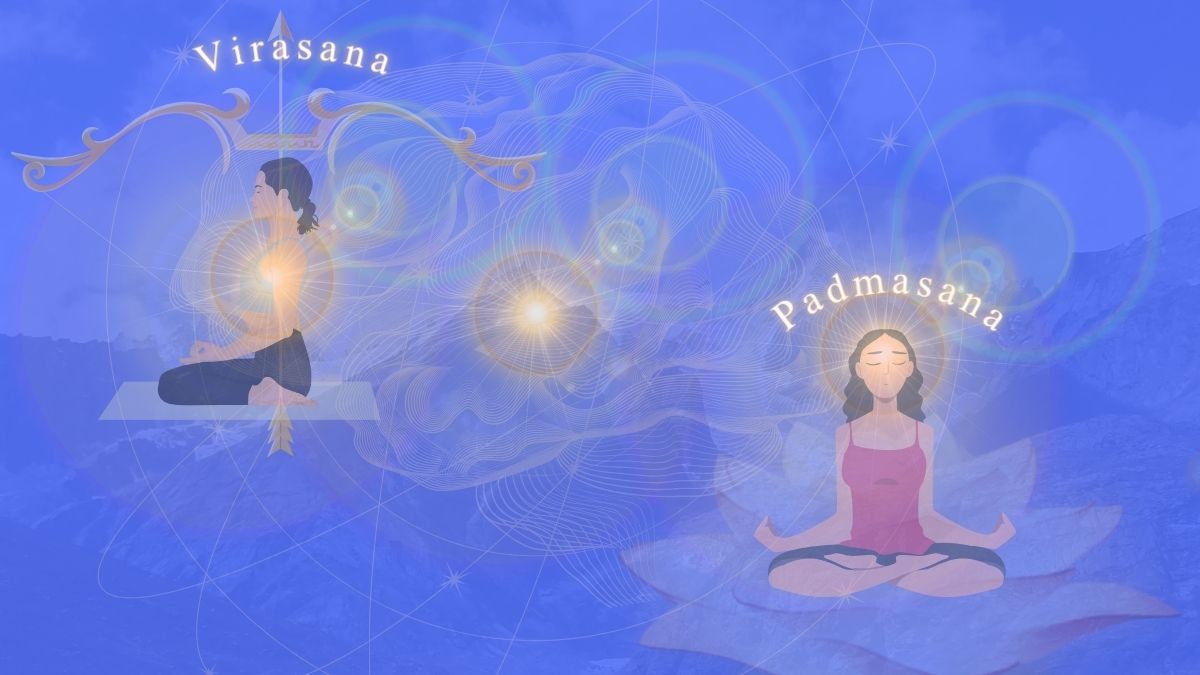
The classical seats I’d like to illuminate today are Virasana = the hero and Padmasana the lotus.  I encourage you to explore both of these with physical teachers (in person) and through your own research. These postures often become accessible only after considerable yoga practice. 

Virasana the hero is taken with the knees together, sitting between the heels with the sitz bones grounded.  The knees together – drawing inward – create a powerful gathering and focusing of energy which supports concentration and focus –  practices required for managing the mind.  The focused energy also creates a stability which lifts the spine.

Padmasana – the lotus – is unique in it’s combination of deep grounding and expansiveness.  The sitz bones are rooted into the earth, the knees are out to the side and the shins cross so that the soles of the feet face the sky.    When the shins cross a powerful acupressure point known as SP6 – the juncture of three major “yin” channels -Liver, Kidney and Spleen is toned.  Yin draws the energy inward. As with Virasana this inward energy creates a stability that lifts the spine.  Any posture with knees open to the sides will create openness and spaciousness.  With Padmasana we master our capacity to remain focused and steady in more and more expansive states of consciousness.  Padmasana allows us to sit with the experience of enlightenment. 

Want a little more “woo” in your life? No? Me neither. But yoga philosophy approached with wisdom is grounding and empowering. The philosophical elements are explored in my newsletter. I promise…it’s not a marketing email although I do suggest readings and music. You can sign up here. They are also posted simultaneously on my facebook business page – NatalieteachesYoga. Thanks for reading!

Processing…
Success! You're on the list.

The Five Dimensions of You:  The Yogic anatomy of the Koshas – The PranamayaKosha

The study of yoga and yogic anatomy is a slowly evolving process of ever deepening understanding.  There is a difference between “knowing” yogic anatomy on a visceral level and memorizing the vocabulary.   Why is this relevant? Self-Mastery. As we explore these different modes of viewing ourselves through yogic anatomy, we open ourselves to new depths of understanding physically, psychologically, and spiritually.  We gain an illumined understanding of ourselves, our purposes and our pathway.  We become wise enough to navigate subtler realms as mapped in the concept of the sheaths or koshas (Yogic Anatomy – The Five Koshas,). The sheaths or koshas are interwoven and not distinct, like oxygen and helium molecules in the air – or dimensions as mapped by mathematics and science.  Experiencing them is like opening a portal to a universe similar to the one we live in “normally” but, it’s different.  . One moment we feel dull and confused and then an inner portal opens and we experience elevation – organically. We access wisdom, knowledge or subtle sensations of the body – and understand our wholeness differently.  Last post we explored the concept of the food body or Anamayakosha. Today I’d like to open the portal to the pranamayakosha – the pranic or breath body. It’s near and dear to all of us, and we experience it all the time.  We might not be aware of it. Exploring the pranamayakosha we step into the subtle realms of yoga.  It’s the first of the subtle koshas that many practitioners experience, which tells us that it’s connected the food body.  It’s impact on our psychological well-being tells us that it’s connected to knowledge, wisdom and bliss as well.  Just as becoming aware and awake to our physical body requires some understanding and attention, becoming aware and awake to our pranic body requires some understanding and attention too. This is why the pranamaya kosha is so important in our yoga practices – it’s where we start to explore a world beyond our usual perceptions. When the pranamaya kosha is clear – not muddied – it’s easier to experience the other bodies or sheaths with clarity.

It’s hypothesized that  prana (subtle energy – like human electricity) flows through the fascia. We don’t know for sure. We can’t yet measure it; we can only observe its effects.  This could change – science moves towards understanding yoga all the time. 

Within the pranamayakosha, the ancient yogis discerned a vast network of tiny channels which they called the nadis There are hundreds of thousands of nadis. One portal which opens the yogi’s perceptions of the pranamayosha is the breath.  Consider how breath is processed by the physical body: an invisible substance – air travels through a physical network of tiny tubes and sacs in the lungs through which the invisible substance of oxygen is absorbed and the invisible substance of carbon dioxide is released.  Prana is like this – it’s absorbed from the universe around us and it permeates and moves through the physical form –nourishing and cleansing it.  When the prana moves we are awakened, energized and healed.

Within the pranamayakosha are numerous structures formed by the intersection of the nadis. The chakras are vortexes located at key junctures of the nadis and the physical nervous system. There are three primary nadis which bracket the chakra system– the ida,  pingala and sushumna.  The prana moving through these three nadis governs the process of spiritual evolution.  When it moves clear and unobstructed we plug into knowledge, wisdom and bliss.

A first pathway to working with the pranamaykosha is to unclog the nadis and get the prana moving. All asana will unclog the nadis.  Vinyasa yoga will get the prana moving quickly.  . 

A second pathway to work with pranamayakosha is pranayama.  Pranayama is is a practice of restraining the breath in order to unclog the nadis. This is most effective when asana has been practiced consistently for a long time. Asana clears superficial levels of congestion – so the work of pranayama – deep and powerful breathwork – is not obstructed by more superficial congestion.  Pranayama is a transformative healing practice.  It’s best to prepare for it.

A third pathway to working with the pranamayakosha is sound.  The familiar sound and symbol of OM is called the “nadam”.  The ancient rishi’s or wise ones observed that Om purifies the whole system, like an ultrasound which accesses deep internal caverns of the body below the surface.  My experience with this is that working with classical Indian sound practices is the most effective means of actually clearing the nadis. Yogi’s chant the sound of OM, they meditate on the sound of Om, they listen to the sound of Om.   This would also include listening to or studying and learning Indian classical music which is designed around an understanding of OM. A fine experiment would be to explore different kinds of music when you practice.  At first what you are used to listening to may prove to be very energizing, but as you grow more adept at working with prana and sound, you may notice that Indian classical music is a distinctly powerful complement to your yoga practice.

A fourth pathway for working with the pranamayakosha is ”managing your energy” and in the yoga practices this is accomplished through attention.  A starting practice is focusing the breath or the gaze in your asana practice, with an intention to understand what your attention does to your energy and your postures.  Too weak of a process of reigning in attention leads the energy to scatter.  Too powerful of a restraint will be too harsh for the tender pranic channels. 

Four modes of creating a relationship with the pranic body:

  1. Yoga Asana
  2. Pranayama (advised for well experienced practioners)
  3. Sound
  4. Attention

A last note about the pranic body – The ancient yogic texts speak of the adamantine body formed by the hatha yoga practice.  This is distinctly related to and an outcome of the management and toning of the pranic body.  When the pranic body is well cared for – clear and moving and strong we become incredibly resilient.  The texts say all dis-ease is eradicated.  As contemporary yogis we can say that our immune system becomes incredibly potent in response to the health of the pranic body.  This, as the article included here indicates, is a result of consistent, well-done practice. 

To receive newsletters with a different perspective on the blogposts, please subscribe to my Mailchimp! I promise…no ads. Just more talk about yoga, maybe some reading and musical suggestions. All designed to supplement your yoga practice.

Processing…
Success! You're on the list.

Repetition and Understanding Asana

There are a few ways that repetition is useful in a yoga practice.  First, it wears a groove and opens us to experiences of greater depth.  Constant change in our yoga practices is amazing- it builds resilience and the ability to adapt.  But this experience of yoga – to become yoked to our deeper wisdom self – requires that we dig down deep enough to hit a level of awakening beyond our normal waking state.  One benefit of getting in a groove, if we do it consciously, is that when our practice gets disrupted it’s easier to shift back into the positive mental and physical states we are cultivating.   Perpetual change can break  apart obstructions which obscure those deeper levels of ourselves, but once again, repetition is a key component to really getting deep in there.  Like digging a hole, if we just take out a scoop here and there as we wish…our well will never be dug deep enough to access the clear pure water.  Yoga works the same way.

Repetition is also a great tool for assessing our bodies from day to day.  To get an accurate assessment, we need to do the same posture as we did the day before.  Yesterday, my Ardha Matsyendrasana (Half seated spinal twist) was at a level I’d never experienced in 30 years of practice.  Today, it wasn’t even at my average.  This is interesting.  It’s information about my body, my habits and my stress responses to the world around me.  Repetition can lead to realization and understanding.

The other thing to consider though, is that repetition invites unconsciousness if it’s not the right time and place to do it.  I remember when I started practicing I frequented the local  Bikram studio. I thrived in the heat and the repetition.  Then one day my knees started to hurt.  I took a break from the practice and focused on Vinyasa for a while.  As I embraced returning to vinyasa, I realized that in Bikram class I was going to sleep. Instead of using repetition to fine tune my execution of the postures – I practiced by rote, but was thinking about cupcakes.  At first I thought the form of yoga I was doing was the problem.  I realized as I practiced more and became more knowledgeable that, no, I had just gotten bored and stopped paying attention to the details.  As a teacher I saw many students who gave up a posture or a style of yoga because they felt it wasn’t good for them. My experience is that when we experience a painful result it’s a call to greater attention to our moments on the mat, and to develop greater self awareness of the body in whatever way we can.  Sometimes a change in practice wakes us up.  Sometimes we just need to tune in deeply to what we are doing.

So how to practice with repetition in a way that is wise?  You can place the posture repeatedly at certain junctures in the sequence you are practicing.  Say Arhdhamatsyendrasana…at the beginning  before sun salutes, after standing, between back bends and forward bends, between each back bend.  Working this way requires that you begin with a very gentle execution of the posture and go progressively deeper. 

Another approach is to design a short sequence to prepare for the posture you are working on  and then repeat that entire short sequence at key junctures in your daily practice.  This creates depth, and you can tweak the  sequence to explore the impact of various lead ins to the posture you are exploring.

The last approach I’ll mention today is that you can just repeat a single posture several times a day, every day for a certain amount of time – a week, a month, a year.  This will help you truly own the posture in a healthy way – it creates an intimacy with it that can change your whole understanding of yoga. Practicing repetition in asana practice is a profound way to deepen your practice and to experientially deepen your understanding of particular postures, how they work, the dynamics created by placing them in certain points of sequence. It’s a great way to transition your practice and teaching from a place where you are practicing and teaching what you have been told by others into a place where you are practicing and teaching from your own inner knowing. 

About the body:  Empowerment and Ease

About the body:  Yoga and the Parasympathetic nervous system

When we breathe calmly, peacefully, rhythmically through the nostrils, we ignite our parasympathetic nervous system – the relaxation response.  In that mode – many things happen.  Rigid long held stress patterns in the body dissolve, the immune system is nourished and deep healing occurs.  It is also easier to access deeper levels of inner states of consciousness – which allow for different perceptions of the world – for transformation on the level of mind. 

As we take a posture we want to ignite this kind of easeful experience while remaining awake, alert and active.  The more challenging a posture is for us – the more powerful it will be to nurture this kind of breathing.  This is pivotal in transforming our life experience from being a person with a body that is always controlling us – to being a person who has some degree of mastery over the physical and energetic bodies.  It’s important.  

Interested in a little philosophy with your postures? Please join my newsletter community. No ads, just ideas. Once a week.

Processing…
Success! You're on the list.

About the Body: A Balanced Connection to the Earth

At its simplest…any asana is wholesomely built on a balanced connection to the earth.  Whatever parts of the body are connected with the earth…evenly distribute the weight throughout that footprint and then reach up and out.  This is an accessible basis of alignment rooted in physical and spiritual realities.   It also does something interesting…done with ease and spacious focused breathing it will re-balance the structure of the body by strengthening that which needs strength and softening imbalanced patterns of tension.  The weight distribution across the seat of the posture (the part of the body which connects to the earth) becomes the limiting factor in how far you take the posture on a given day.  In standing postures the energetic work comes with mastery of the foot structure – what lifts up (the arches) and what roots downs (outer edges and heels) and balancing that dynamic. 

One posture which demonstrates this in an interesting way is Virabadrasana 1 or Warrior 1.  Classically, the back foot is at a 45 degree angle to the front foot.  Reaching into the heel and stretching the front knee forward – we then gently adjust the hips to move the left hip forward.  Sometime this taught instead with the back heel lifted so the hips can be square like a lunge.  The classical version  – with the dynamic of rooting through the feet, allows for grounding and upliftment, stability and joy.  By lifting the back heel into a lunge like position…the position of the hips squared forward becomes primary, and the connection to the earth secondary.  Of course I am clearly biased!  An artful student could apply these ideas in a lunge – like Virabhadrasa 1.  I do believe that a body is similar to any other physical structure.  You wouldn’t build the third floor of a building before you’d built the foundation.   But the point is to investigate  how you are anchoring your posture – and if that creates equanimity, balance, joy.  The word asana refers to a seat or one’s situation in relation to the earth.  In this sense these energetics are also connected to the idea of giving and receiving – taking in and releasing – which is reflected in the breath and in our capacity to be spacious and stable as we move through our lives. 

It’s worth the experiment to explore Virabhadrasana 1 to learn what stability means to you in a kinesthetic sense.  Which approach leads you to feel stable and why?  And which version allows you to reach out and expand in a multitude of directions.  It’s always good to practice an experiment like this consistently over a chosen period of time.  The body will be different every day and life experiences will have an impact on the felt experiences and the actual musculoskeletal alignment on any given day.  Big changes in a life can bring deep changes in the body – by investigating with some consistency in practice as we move through life we can develop insight, clarity and understanding.

Processing…
Success! You're on the list.

Yoga, Freedom and Moving into Sovereignty

The focus this moon month in the newsletter is freedom or in Sanskrit, Mukti.  Mukti translates as “liberation”,  freedom, and it’s important to understand that freedom in the sense of yoga is different than freedom in of our day-to-day life – although they are related. We may think that having tons of money would be freedom or rebelling against social conventions would be freedom. Freedom is not inherent in those experiences.  Ask anyone who has very large amounts of money or who has lived in the counterculture for a long time and in their story you will hear of the oppressions that still remain.  In yoga  freedom is something that we develop inside ourselves as we cease identifying with the fluctuations (vritti’s) of our mind. That’s the  second sutra of Patanjali’s Yoga Sutra. The fluctuations of our mind frequently take the form of how we think of ourselves, how we think of others and how we think of the world we live in. These mental constructs can become rigid and block our ability to be open and spacious and, well, liberated.  The freedom of the yogi comes in the form of an inner sovereignty which allows us to become the masters of our own minds and to use that freedom to choose the path of love over and over again.

Yoga is a discipline that leads to freedom The practices of yoga involve experiencing certain kinds of restraint and under those conditions finding the freedom there. When the  restraint is lifted you have a different understanding of who you are. Restraint comes in the form of tying yourself in a knot in an awkward posture and remaining peaceful.  Restraint can mean  being willing to suspend our immediate desires in order to allow a higher state of wisdom consciousness to guide our actions.

When we tie ourselves in a knot in a posture we stir up the deep resistances we have to living.  The knots are knots within our consciousness and so the goal is that to breathe, to be present to what’s happening and not fight with it. Consider this first level of freedom one that you could find contentment even when circumstances around you are not to your liking.  That’s a tremendous amount of freedom. Sometimes for whatever reason it’s not the best idea to change a circumstance. Even though it’s uncomfortable, it’s better to be strong. This capacity is honed in the practice of asana.  Accept the limitation, breathe be still and allow your inner guidance to direct you step by step to moving beyond the limitation into a deeper expression of the posture.

This kind of yoga training reveals discernment – the capacity to understand if our impulses are coming from our authentic heart desires or our desire to control. It’s a powerful means of developing aligned autonomous inspired choice making. Sovereignty. It is a gift of the yoga practice born of moment by moment alignment with self and that is the freedom. Rather than having others dictate who we are or who we become  or what actions we take in our lives we are free to take action in alignment with our highest best interest.  Yoga will take us to a healthy and beautiful body of all different kinds of shapes and sizes but this is the heart of the yoga  – this sovereignty and the freedom that emerges through practice.

About the body the body  – In time

Hatha Yoga Pradipika Verses 103-104

“All of the all the processes of hatha and laya yoga are but the means to attain raja yoga. (samadhi) One who attains Raja yoga is victorious over time (death).” (Bihar edition and translation)

Perhaps when you were a child you experienced being measured. Sometimes parents make marks on the wall to emphasize how much a child has grown physically. As children we were measured physically, intellectually, emotionally… how we are growing? Then at some point the nature of that measuring starts to compare itself to an end point rather than the beginning point.  We mark a wrinkle (one step towards old age) A gray hair (another step towards old age). Perhaps we worry more about a physical symptom than we would have when our hair was colored rich and deep and our skin was rosy and clear.  One great blessing of combining the inner and outer yogas is that the processes are designed to liberate us from time. A mark of a well-done yoga practice is that decline is minimized and many times even reversed. One advantage of studying the tales of the great accomplished masters is that they completely transcend time. They choose when to leave the body behind. It’s a great teaching. There are many records  (Paramahansa Yogananda, Shri Brahamananda Saraswati ) of enlightened beings whose bodies did not compose after death but remained intact as their devotees prepared the funeral rites. When Shri Brahmananda Saraswati was cremated it is said that his ashes were pure and white as snow. He also regenerated his body and brain after a stroke through study and practice of Sanskrit (an energetically based yoga practice).

What does that mean for us as contemporary yogis? We don’t really know. We don’t really know what that means. Will we be immortal? Do we want to be immortal? Will we just stay lively? Will we live on as souls beyond the body?

What we do know is that well-done yoga is a rejuvenating practice.  It’s hormonal, it’s energetic, it’s the nervous system but essentially to tap into the field of consciousness is to tap into that place beyond time and that is infinite.  To keep the spiritual dimensions of the practice front and center. Serenity makes for a great facelift.

How do we make this more tangible? The usual choices for this kind of experiment are meditation or chanting. The point is your body will change through these practices.  And you can practice it and find out.  Just note that other lifestyle choices will mitigate your results.  Wise lifestyle choices will enhance them. 

For me the door which opened the understanding of this spirit body connection was yogic chanting. I knew it immediately even though I was not spiritually or athletically accomplished. I was living in New York and had much pain in my body — weight training, aerobics, desk work, crazy diet — so many possible culprits for the pain. After finding no remedy that was clear through the western medicine lens I started yoga to ease the pain.

I noticed almost immediately that if the class started with an Om  my body didn’t hurt as much during class. I thought it was a goofy thing and I made jokes about it. I figured I was imagining things, but then I found the Jivamukti Yoga Center in New York. Chanting was central to that practice,  and I learned there that the ancient yogis understood that the body is made of sound. To those I spoke with and studied with there, when I made the statement that my practice was better if I Om’d first, it made perfect sense. I stayed with that practice for years and experienced many complex postures that I never imagined that I would do in part because my relationship with my body changed as I worked with this understanding that the body was made of sound. Things I could never imagine at 29 opened up for me as I moved towards and through a so called middle age. I am now 58 and I have less pain in my body than I did at age 29 – even in the wake of injury.

For this I rely on my yoga practice.

For the practitioner I believe that the bottom line of this is that we begin to consider that our bodies are not our masters — our hearts and our souls are. To embrace the spiritual aspects of the practice is not to deny the body but to nourish it at a deep level — beyond DNA, consciousness (which is experienced through practice) nourishes our very cells. You will be strengthened by it and it will cost you nothing to try.

Refuge: Commentaries from last months emails

April 1, 2021Refuge in Hatha Yoga

HYP 1.10 for those continually tempered by the heat of tapah (pain – difficulty – challenges) hatha is like the hermitage giving protection from the heat.  For those always  united in yoga, hatha is the basis acting like a tortoise.

Perhaps this has happened to you —you select a relaxing and remote vacation destination, longing for a break from the hassles of day to day life.  A deposit of thousands of dollars is placed – the time between making the arrangements and the date of the trip is consumed with the desire for that rest and relaxation.  The state which will come when life as you know it is escaped for a little while.  The day arrives.  The plane is delayed, the luggage is lost, negotiating the unfamiliar terrain of the destination, for whatever reason, falls out of the realm of an adventure and just feels a little arduous.  Now, I love to travel, I’m not knocking it, but it’s not always the escape that we want it to be, there are no guarantees of relaxation or freedom on any journey.  But, as this sentence from the Hatha Yoga Pradipika puts forth, a well done yoga practice allows us to establish an essential experience of ease and refuge within.

Granted, a yoga class can have similar distractions to a pilgrimage in terms of time, obstacles, disruptions.  But the function of a yoga class is to learn, to be together in learning and community  The discovery of the inner refuge is the path of our personal practice.

The inner work of yoga, depending on the techniques you practice, can reveal many different things.  There is the awakening of insight and contemplation, there is creativity and conscious co-creation, there is awakening and there is refuge.  We have many alternatives to choose from.

What’s specific about the techniques of Hatha Yoga is that they support and develop this experience of refuge specifically.  It’s put forth here at the beginning of the text, which is claimed to have historical roots in the origins of the practice of Hatha Yoga itself.  The beginning of the text states it’s lineage back to the teaching of Shri Adinath, the first yogi, also known as Lord Shiva.  As the text unfolds we are advised to create the conditions for the experience of Hatha Yoga.  The conditions within and without, create a scaffolding for this experience of transition from a state of dualism to an experience of unity, and in that unity there is peace, there is refuge, there is healing and there is rest.

Last month we explored the kundalini energy.  When directed in unconscious ways the creative energy can lead to the experience of fluctuation, conflict and unstable moods.  Well directed and managed energy can be elevated to a steady state where such disruptions are minimized or ideally left behind.  Think about it, we know sorrow only because we have known happiness, two opposing energies will always conflict until they are harmonized and when a pendulum swings one way it inevitably swings the other way.  The idea as I understand it is that when we become anchored in this steady unified, harmonized state,  which is yoga then the fluctuations and conflicts occur, but we are not imprisoned or buffeted by them.  I measure the depth of the yoga practice these days, by my ability to stay steady in the face of those fluctuations. 

This month we’ll explore techniques of focus on breath and gaze which support this experience of unity.  The Hatha Yoga Pradipika refers to miraculous states where the physical body is transformed through the practice.  This experience unfolds as we master our ability to be in union as we move in the physical world. 

ENERGY ANATOMY – The Manipura Chakra

The Manipura Chakra (the city of jewels) is located in the area of the solar plexus under the rib cage.  This chakra is “worked” when we twist, when we work with our diaphragms in breathing exercises and bandhas, and when we work with our gaze.  Spiritually, psychologically, this center affects and is effected by or relationships with others in community — how we see them and how we are seen.  My experience is that the gaze is a deep purifying technique for the manipura chakra.  To use our drishti (a technique of gazing) breaks down the experience of self and other and harmonizes the relationships between.

Yoga at Home

One of the nicest things about working in a personal practice at home is that you can draw out the technique which your personal journey is calling for and work with it on your own schedule and with your own ability to focus and observe and digest the experiences that you have with a given technique.    There is no one way of yoga.  Traditionally, one would work one on one with a teacher, and a form of relationship which is no longer really available or desirable for many of us.  Our opportunity in engaging our personal curriculum of yoga in a structured and mindful way provides the opportunity to experience a personal relationship with what refer to these days as the Wisdom Self.  Engaging the Wisdom Self opens a deep level of knowing which reveals the journey step by step and provides an illuminated understanding of our personal function, our opportunities for rich and unique growth, and decisions which lead to deep healing. 

Processing…
Success! You're on the list.

HYP 1.10 for those continually tempered by the heat of tapah (pain – difficulty – challenges) hatha is like the hermitage giving protection from the heat.  For those always  united in yoga, hatha is the basis acting like a tortoise.

April 11, 2021

Many spiritual traditions contain within them an indicator of the power of taking refuge, as a means and an end.  In Buddhism, one takes refuge in the awakened consciousness or the Buddha, the community, and the essential truth.  In Christianity, it’s the experience of salvation, or being saved by surrendering into Christ consciousness.  In yoga, that refuge is liberation or mukti, the experience of releasing into the limitless divine which is known by many many names.  .  This passage is located at the very beginning of the Hatha Yoga Pradipika, a seminal text on the yogic processes.  The Hatha Yoga Pradipika is a manual for balancing the forces of the physical body to enable deeper levels of absorption in the state of union or yoga.  Hatha Yoga is notable for it’s simplicity, it’s power and it’s promise, that the dissolving the separation of opposites or the sun and the moon, will protect us from the experience of pain. 

While the language of the HYP is mysterious and riddle-like, the practice is simple.  The text itself enumerates some extreme measures….living alone in a hermitage built to specifications outlined therein, avoiding overeating and regular folks, and avoiding long pilgrimages and women – to name a few.  But basically, whittled down to essence, the foundations of preparation prescribe that we create a life which is relatively free of conflict. The hermitage of yoga is built of our own powerful moment by moment choices to stay centered or give into the temptation to fluctuate or be fluctuated.

We live in a world of duality:  right or wrong, this or that, black or white, red or blue, science or fiction, spirit or  matter, male or female, etc.  It is our attachment to the opposing elements of that duality which causes the fluctuation within, and the conflict without.  Hatha refers to the union of the Sun and the Moon.  Our intuitive psychic qualities and our active and engaged qualities cease to be in opposition to one another.  Instead they work together. 

If you’ve ever butt heads with someone with a stubbornly opposing viewpoint you know how much conflict within and without is caused by that duality.  When we choose peace the duality ceases to have power over us and we are protected from the pain of the fluctuations.  We move towards yoga. 

Processing…
Success! You're on the list.

April 17, 2021

Refuge II: Peace in the Body

The Hatha Yoga Pradipika describes the process of Hatha yoga as a refuge for those best by the pain of suffering.  A considerable amount of our suffering is of the body, and later on in the text when the results of practice are described we are encouraged that the pain will cease.  The text specifically points to a moment when all physical disease is eradicated.  Last week we spoke of the transformative power of moving beyond duality as reflected in the word Hatha.  Dualities are infinite in number (although limited in expression) and one such duality is the divide between the mind and the body.  Think about it.  How much of your time is spent warring with your body?  Even many forms of so-called self-care are merely thinly disguised ways to try to make the body different than it is:  it’s appearance, behavior sensations.  Either it’s in charge or we are (you know those struggles over the chocolate thing).  In the meditative processes of yoga it’s sometimes spoken of that the mind is a battlefield.  Well so is the body.  Part of the power of well-done Hatha yoga is that this dichotomy between mind and body can be dissolved into peace, and the body, once a battleground becomes instead a vehicle, a tool, a field which can be used for healing and transformation on a psycho-spiritual level. 

In yoga 2021, we are best by images of what we should look like.  They are changing but the images of perfection still loom large.  There is much suffering in the attempt to spend your life trying to look like someone else!  Any spiritual path can be distorted into suffering. A well-done practice, engaged with wisdom and discernment, yields a state of peace with the form we are in. 

My classes are small. Being out of the studio is a blessing for that reason.  Part of that is – I encourage students to back off, to give up the striving for the physical ideal, but to still be engaged.   It’s pretty specialized…and good for those who are wanting to engage their inner being.  It also requires an understanding uniquely yogic that just because you give up striving doesn’t mean that you won’t’ get what you want.   It also requires and understanding that the inner work has the power to transform the physical form.  Imagine this – your limitation – say a restriction in the hamstrings – to sit in the limitation and breathe and find peace and not fight against the limitation is the field of true inner strength.  To learn to move forward without pushing against or opposition, but instead through the creative willingness and love in your heart, well….It’s a moment to find beauty in what is instead of what should be.  And-practicing that way balances the energy field and tones the body in an integrated way.  Creating balance within the limitation rather than saying …”If conditions were different…I would be balanced” This is a measure of true power.

As I practiced this way I found that many times something would change without my doing anything.  One day I would be light enough to invert spontaneously.  A deeper or more specified level of engagement and articulation would reveal itselve providing a deeper experience of integrated balance.  But mostly, my relationship with my body changed.  I began to love it for what it was, this little skin suit I trip around in.  That alone lightened the whole thing up.

Many of you know that I broke my wrist last October.  As healing progressed deeper levels of balance and healing were revealed.  It was a significant injury.  I’m finding that those years I spent finding peace in the limitation I had, in order to move beyond them is serving me very well.  The injured  part of my body is something I love and want to care for, it isn’t an obstacle or a burden or really even a limitation.  It’s an opportunity.  This is the first major injury I’ve had since practicing yoga, so much had my agility improved through practice, this kind of thing was rare and unexpected.    But compared to my experience of breaks I had experienced in my twenties which were painful and inconvenient.  My body became a landscape of areas which I dissociated from.  (One of which was this wrist, which I had broken before).  This is now an opportunity to relate to this broken part of my body with more awareness, to reintegrate into the whole of who I am in a new way.

This allows something else to happen.  I become able to celebrate the way the miraculous unfolds in the physical form  When I began to do down dog again, the carpals began to regrow. This appeared on the x-rays.

I am able to celebrate and bear witness too the body’s miraculous power os regeneration.  At an age when the world would tell me my body should be deteriorating it’s regenerating instead.  I imagine as I open my mind up to really accept and understand this,  it will change everything.  These are just a few of the ways that making peace with and building a relationship with the body via the practice of hatha yoga can be practical and useful.  So, you know….come to class!!!

Love

Natalie

Processing…
Success! You're on the list.

April 26, 2021

Refuge III:  Refuge in Community

Although the Hatha Yoga Pradipika advises that the practitioner establish in solitude, in the larger scope of the practices of yoga, of which Hatha Yoga is only one (others include mediation, text study, chanting, service and others) the yogi is advised to take refuge in the satsang- or meeting with other truth seekers.  Buddhism as well suggests that we take refuge in the community or “sangha”.  Settling into an inner landscape of non-dualism (which merely means that we stop making a division between this and that) is in itself a form of refuge.  But does this mean that we have to leave the material world behind and just melt into that inner state of peace and lack of conflict?  No. We can take refuge in our ability to practice seeing others without conflict – in a state of right relationship:  appreciating  them as sacred, focusing on the spirit which expresses through them as individuals, and neither judging nor adulating them.

This understanding emerged in my practice after a long time.  I kept searching for truth seekers or those who would provide right relationship for me, but to no avail.  As I worked with resolving my judgements and adulations (in yoga terms aversions and attachments) I found that finding right relationship in the life I was living meant to recalibrate the way that I was relating.  Period.  Can I suspend my judgement about who I think someone is or what a specific relationship means enough to allow the particular gift of a given exchange to be revealed?

In the exalted spiritual philosophies we hear about oneness and emptiness  and mirroring.  In simple day to day practice I found that became distilled into  physical form by not judging and not adulating.  From there discernment began to arise, revealing deeper potentials or possibilities for the relationships I was in.  What emerged was a much richer tapestry of relationship, one which I could not have imagined in that kind of good-bad, stay-go kind of relating I had been engaged with. 

And then, a little bonus emerged.  What was reflected back to me about myself in those relationships began to transform in a very rich, full, helpful way.

The practice of Hatha Yoga, cultivating my ability not to veer into one extreme or another, provided the support  and discipline  which empowered me to choose in every interaction whether I wanted to judge or not. 

Processing…
Success! You're on the list.

Refuge 4:  The Power of Spirit

HYP:IV.113. A Yogin in Samadhi is not vulnerable to any weapons, not assailable by any persons, not subject to control by the use of mantras and yantra-s (incantations and magical diagrams).

When the yogi succeeds in leaving behind their dualistic thinking, quote, this and that, unquote, good and bad, up and  down one attains an experience of unified mind, which is the entryway to the experience of yoga. It can arise in an instant, though some stay in it for an extended period of time. It’s blissful. It’s peaceful. It’s healing. It is a refuge. We are evolving spiritually, we humans, and what I see and know around me is that many people experience unified mind.  Through the  practices of yoga we can intentionally cultivate it. While most of us living in 2021 are unlikely to have enemies assaulting us with mantras and yantras, we are daily subject to bombardment by influences.   Our capacity to be still, centered and true to ourselves in the wake of this is true empowerment. This sentence above,  the last line in the Hatha Yoga Pradipika, is a beautiful affirmation of the living refuge which is manifest as we cultivate unified mind through our practice.

While I don’t recommend stopping a bullet with the power of your mind, there are stories of the invulnerability of the human body when one is anchored in higher consciousness.  In one of the books scribed by the great jazz musician and yogi, Alice Coltrane, it is briefly mentioned that through the auspices of her guru Swami Satya Sai Baba, she was lifted out of her body into a transcendental peaceful state of consciousness during a significant earthquake. The body was unharmed.

I was skeptical of the relevance of this story until my mind became a bit a little clearer. I know for me that I can make a crisis worse through my noisy inner dialogue. The longer I practice the more I am able to hold peace within,. Allowing for , even wondrous,  outcomes to emerge from seeming challenges. It isn’t a blind faith, it is a consciously cultivated capacity to project a positive future for myself, rather than a fearful one. When we nurture conflicting thoughts, which is really a mundane example of dualism, this gets projected outward. We do not see our best interests amidst the fluctuations of our minds. As we learn to choose to nurture peace rather than conflict in our thoughts,  this is projected outward. We project a more harmonious future. Don’t worry, the centered peace projected out does not mean an absence of action, fun or pleasure, it just means that the conflict is gone.

As our access to media expands we can be bombarded by the opinions of those who profit greatly from capturing our trust and opinions.  To step away from the tides of this influence and anchor in and remain established (pratishtayam) in the inner refuge, we create to yoga, we become unassailable. By that I mean we can continue on our personally charted journey of evolution. The practices of yoga are designed for this degree of self-mastery or sovereignty. Yogi’s can choose to explore deeper and deeper subtler dimensions of this journey, which reveal the magic and powerful love and healing which is revealed through practice.
Interested in empowered choice – making?  Check out my Destination Sovereignty Programming!

Processing…
Success! You're on the list.

Refuge IV:  The Power of Spirit

HYP:IV.113. A Yogin in Samadhi is not vulnerable to any weapons, not assailable by any persons, not subject to control by the use of mantras and yantra-s (incantations and magical diagrams).

When the yogi succeeds in leaving behind their dualistic thinking, quote, this and that, unquote, good and bad, up and  down one attains an experience of unified mind, which is the entryway to the experience of yoga. It can arise in an instant, though some stay in it for an extended period of time. It’s blissful. It’s peaceful. It’s healing. It is a refuge. We are evolving spiritually, we humans, and what I see and know around me is that many people experience unified mind.  Through the  practices of yoga we can intentionally cultivate it. While most of us living in 2021 are unlikely to have enemies assaulting us with mantras and yantras, we are daily subject to bombardment by influences.   Our capacity to be still, centered and true to ourselves in the wake of this is true empowerment. This sentence above,  the last line in the Hatha Yoga Pradipika, is a beautiful affirmation of the living refuge which is manifest as we cultivate unified mind through our practice.

While I don’t recommend stopping a bullet with the power of your mind, there are stories of the invulnerability of the human body when one is anchored in higher consciousness.  In one of the books scribed by the great jazz musician and yogi, Alice Coltrane, it is briefly mentioned that through the auspices of her guru Swami Satya Sai Baba, she was lifted out of her body into a transcendental peaceful state of consciousness during a significant earthquake. The body was unharmed.

I was skeptical of the relevance of this story until my mind became a bit a little clearer. I know for me that I can make a crisis worse through my noisy inner dialogue. The longer I practice the more I am able to hold peace within. Allowing for , even wondrous,  outcomes to emerge from seeming challenges. It isn’t a blind faith, it is a consciously cultivated capacity to project a positive future for myself, rather than a fearful one. When we nurture conflicting thoughts, which is really a mundane example of dualism, this gets projected outward. We do not see our best interests amidst the fluctuations of our minds. As we learn to choose to nurture peace rather than conflict in our thoughts,  this is projected outward. We project a more harmonious future. Don’t worry, the centered peace projected out does not mean an absence of action, fun or pleasure, it just means that the conflict is gone.

As our access to media expands, we can be bombarded by the opinions of those who profit greatly from capturing our trust and opinions.  To step away from the tides of this influence and anchor in and remain established (pratistayam) in the inner refuge, we create to yoga, we become unassailable. By that I mean we can continue on our personally charted journey of evolution. The practices of yoga are designed for this degree of self-mastery or sovereignty. Yogi’s can choose to explore deeper and deeper subtler dimensions of this journey, which reveal the magic and powerful love and healing which is revealed through practice.

Compilation of Newsletters for the April Moon Month

Kundalini Image

Compilation of Newsletters for the April Moon Month

Arundhati, the Awakening of Creation

This word arose in my awareness this month as I took a glance at The Hatha Yoga Pradipika scribed by Swami Swatmarama.  The translation I read, issued by the Bihar School in India, contained commentary by Swami Muktibodandanda of the lineage of Swami Sivananda Saraswati.  While the  text is thought to have been scribed in the centuries after 6 AD, it claims it’s mystical roots in the primordial origins of the sacred knowledge of Hatha Yoga from the beginning of time.  Swami Muktabonananda mentions Arundhati as another name for  kundalini, the powerful feminine creative source, which resides dormant and resting in the terrain of the subtle energy body commonly associated with the cradle of the pelvic bowl.  Muktabodananda breaks the word Arundhati down into “arun” translated as “dawn” and “dhati” which he translates to mean to “generate” or “create”. The dawning of a new creation.   Arundhata, he adds, means unobstructed.  It’s a  powerful description of the potent and mysterious creative potential within each and every one of us, and a clue to tapping into the potential of our yoga practice.  Hatha Yoga in it’s essential expression is a discipline in the management and effective direction of this creative force, leading us to a place of full alignment with  and expression of our sacred potential in this world and beyond.

Folklore runneth over with tales of the power and pitfalls of awakening this goddess force.  The most famous teller of these tales is Gopi Krishna who wrote a book about the unexpected eruption of his kundalini force and the trials and tribulations of having the energy charge through his body.  Any time we encounter powerful expressions of feminine creative forces it’s good to consider that, historically, feminine power has been feared and this has resulted in a great deal of distortion of information related to these energies.  My experience in energy work while working with students and clients over the years is that the awakening of this force does not have to be violent or disruptive.  It does not require forceful action to ignite it (although you can try that if you want).  It’s part of human evolution that it organically awakens when we have certain experiences, some of which are the practices of yoga.  Yoga ignites it and supports in the management and direction of  the energy.  What is important is how well prepared you are and how well you are able to sustain a healthy environment for the unfolding of this energy.

When the energy is managed in a balanced and well directed manner, what unfolds is gentle awakenings and shifts in perspective and understanding.  The way this is cultivated, is through balance.  In the simplest sense, creating an environment in the body, mind and life which is neither aggressive nor passive (think easefully assertive), neither nurturing of depression nor anger (think peace), and vaster than self absorption (think relating) will create a habitat for a productive and rich unfolding. Nurturing  a balanced state allows the process to be one of healing, rather than a struggle to control.

When the energy is directed in an uplifting but grounded  fashion,  the creative process reflects a spiritually evolutionary journey, and an important one.  It’s the upliftment that leads us to a higher vision, the transcendence of a mundane understanding of the world we live in.  What is the use of this?  A well balanced cultivated transcendence nurtures an empowered and liberating perspective.  It opens us up to our capacity to choose.  In a gentle and non-reactive way, we learn, step by step, to function without feeling trapped in the confirmed of the opinions or perceptions of those around us.  WE are opened to align with our inner truth across the varying facets of our person — from our relationship to our body to our relationship with our higher power and everything in between (in realms of love, power, creativity).

OM

From Patanjali’s Yoga Sutra:  1.28-1.29:

Repeat the sound of Om and all is revealed.  This anchors one in inner consciousness and dissolves obstacles.

This month we are investigating the direction and management of or essential creative  force, known by many names, primarily kundalini, but this month I’m thinking of it as Arundhati.  This week we’ll begin by exploring the most simple and fundamental technique for managing this energy, and that is Om.

Om is vibrationally whole.  It contains within it every sound, and every possible vibration so it is the closest thing to totality that we can merge with materially.  When we focus on parts – this or that – then our creative force becomes divided. This can diminish clarity and inhibit the yogic process.

Om is beyond language.  Beyond language there is no limit – we can create something wholly new and not yet conceived of.  Beyond language we are not bound to create within that which already can be named.

The resonance of Om permeates all levels of our being – the physical, emotional, mental and  spiritual so it’s capacity to illuminate unity impacts all of the dimensions of who we are.

Practically, how does this mystical practice pan out?  Well, when you have a moment of conflict, within or without.  Stop and Om, inside or out and allow yourself to tune into the sound and feel, it will uplift the energy and pull into the center.  Before practice, it points us in the right direction.

The Straight Arrow

To begin with:  It’s said that no effort in yoga  is ever lost.  It stays with you forever – no matter how clumsy the attempt.

The bottom line? In it’s purest form, the Arundhati (another term for the primordial sacred energy kundalini) travels through the energy channels along the spine, easily piercing the tangles and moving upward directly toward illuminated consciousness.  The only thing that can create this experience is pure devotion.  One instant of pure devotion to a spiritual ideal, love, truth or God, can be sufficient.  In an instant Arundhati’s journey is complete and we experience the Truth of everything.  The purity of the devotion comes from an unadulterated desire to experience that spiritual ideal.

Unadulterated is one word which could reflect this, uninterrupted is another one.  That would mean never wavering into lack of faith or anger or delusion about the state of affairs in the universe – meaning that we have right relationship to both our spiritual lives and our material lives in an undivided way.  Holding the space for both of them as the waves of life press against us.

In the tales of the Mahabharata and the Ramayana (ancient Indian epics which illuminate the principles of yoga), the heart of the stories revolve around archery, the greatness of the archers and the dedication to their craft.  The stories illuminate the rewards of accomplishment and the pitfalls which deter the practitioners as well.  Author Ramesh Menon, one translator of these epics, details the nature and the precision of a well-aimed arrow – the all-consuming focus and calculation required.  The target is determined,  and at the beginning of the arrow’s journey it is positioned in such a way that one would expect it to travel smoothly through varying conditions  towards it’s destination – the target.  To have such expertise and insight is phenomenal.

In a pure classical yoga practice there is only one target – the state of yoga.  If we aren’t aiming for that target, well that’s okay, the effect is never lost.  This is a spiritual principle, but you may have already observed it’s a physical one too.  You may have experienced  that when an asana aligns it’s more of a discovery than an accomplishment and after a break in practice you move back to the level of accomplishment more swiftly than the initial journey. The point is that all practice is sustainable on some level.

These detours of the straight line of Arundhati aren’t always errors.  Sometimes they are little side trips into discoveries and experiences which are helpful.  The yoga practice teaches us that just about any action or experience when offered with a sense of devotion, can serve to establish the right direction in the inner flow of our consciousness.

It’s All Good

We started the month speaking about the creative force Arundhati, most often known as kundalini.  We spoke of how this force can be violently awakened, or naturally awakened.  We’ve used spaciousness in the hips to gently open the channels surrounding the energy in it’s dormant state, and focused on our third eye centers to encourage the energy in an upward direction.  Is that it?  Is that Yoga?  Well, these are practices of yoga, but in the experience of “YOGA”, the state of union arises unites and ignites the central energy channel, the sushumna, from our roots to our crowns.  Then, there is union, there is yoga, there is bliss, there is understanding and wisdom.

So how do we do this?  Let’s take a simple decision.  Should I eat chocolate chips or carrots?  The mind flips from one to the other, “good” “bad” “black” “white” “sun” ‘moon” “right” “left”.  This movement of the mind is reflected in the channels of energy by movement from right to left, left to right.  We fluctuate.  Patanjali says that Yoga occurs when the fluctuations are no longer dominant.  Stop.  Breath.  Lift the pelvic floor. Focus on the 3rd eye center.  Center!!

Maybe the first time or the millionth time you do this the creative energy moves fully into the central channel and you move out of duality.  If you are all in, roots to crown, mind and heart, you move out of duality.  “Carrots good, chocolate chips good.  It’s all good”.  This is the union of the sun and the moon.  Opposites and fluctuations between apparent opposites no longer exist.  Any choice made from that point of view is beyond duality.  There is no wrong choice.  We become the Om itself.  Yogis absorbed in this Om state experience profound healing.  We are yoked to the cosmos within and without on a sublime level.  Don’t forge…Om is a technique which will get you there, as well, it’s the journey and the destination.

On a practical level we step into the flow.  Everyone experiences this state of union organically from time to time.  The practices of yoga allow us to cultivate them intentionally.

Compilation of Newsletters for the April Moon Month

Arundhati, the Awakening of Creation

This word arose in my awareness this month as I took a glance at The Hatha Yoga Pradipika scribed by Swami Swatmarama.  The translation I read, issued by the Bihar School in India, contained commentary by Swami Muktibodandanda of the lineage of Swami Sivananda Saraswati.  While the  text is thought to have been scribed in the centuries after 6 AD, it claims it’s mystical roots in the primordial origins of the sacred knowledge of Hatha Yoga from the beginning of time.  Swami Muktabonananda mentions Arundhati as another name for  kundalini, the powerful feminine creative source, which resides dormant and resting in the terrain of the subtle energy body commonly associated with the cradle of the pelvic bowl.  Muktabodananda breaks the word Arundhati down into “arun” translated as “dawn” and “dhati” which he translates to mean to “generate” or “create”. The dawning of a new creation.   Arundhata, he adds, means unobstructed.  It’s a  powerful description of the potent and mysterious creative potential within each and every one of us, and a clue to tapping into the potential of our yoga practice.  Hatha Yoga in it’s essential expression is a discipline in the management and effective direction of this creative force, leading us to a place of full alignment with  and expression of our sacred potential in this world and beyond.

Folklore runneth over with tales of the power and pitfalls of awakening this goddess force.  The most famous teller of these tales is Gopi Krishna who wrote a book about the unexpected eruption of his kundalini force and the trials and tribulations of having the energy charge through his body.  Any time we encounter powerful expressions of feminine creative forces it’s good to consider that, historically, feminine power has been feared and this has resulted in a great deal of distortion of information related to these energies.  My experience in energy work while working with students and clients over the years is that the awakening of this force does not have to be violent or disruptive.  It does not require forceful action to ignite it (although you can try that if you want).  It’s part of human evolution that it organically awakens when we have certain experiences, some of which are the practices of yoga.  Yoga ignites it and supports in the management and direction of  the energy.  What is important is how well prepared you are and how well you are able to sustain a healthy environment for the unfolding of this energy.

When the energy is managed in a balanced and well directed manner, what unfolds is gentle awakenings and shifts in perspective and understanding.  The way this is cultivated, is through balance.  In the simplest sense, creating an environment in the body, mind and life which is neither aggressive nor passive (think easefully assertive), neither nurturing of depression nor anger (think peace), and vaster than self absorption (think relating) will create a habitat for a productive and rich unfolding. Nurturing  a balanced state allows the process to be one of healing, rather than a struggle to control.

When the energy is directed in an uplifting but grounded  fashion,  the creative process reflects a spiritually evolutionary journey, and an important one.  It’s the upliftment that leads us to a higher vision, the transcendence of a mundane understanding of the world we live in.  What is the use of this?  A well balanced cultivated transcendence nurtures an empowered and liberating perspective.  It opens us up to our capacity to choose.  In a gentle and non-reactive way, we learn, step by step, to function without feeling trapped in the confirmed of the opinions or perceptions of those around us.  WE are opened to align with our inner truth across the varying facets of our person — from our relationship to our body to our relationship with our higher power and everything in between (in realms of love, power, creativity).

OM

From Patanjali’s Yoga Sutra:  1.28-1.29:

Repeat the sound of Om and all is revealed.  This anchors one in inner consciousness and dissolves obstacles.

This month we are investigating the direction and management of or essential creative  force, known by many names, primarily kundalini, but this month I’m thinking of it as Arundhati.  This week we’ll begin by exploring the most simple and fundamental technique for managing this energy, and that is Om.

Om is vibrationally whole.  It contains within it every sound, and every possible vibration so it is the closest thing to totality that we can merge with materially.  When we focus on parts – this or that – then our creative force becomes divided. This can diminish clarity and inhibit the yogic process.

Om is beyond language.  Beyond language there is no limit – we can create something wholly new and not yet conceived of.  Beyond language we are not bound to create within that which already can be named.

The resonance of Om permeates all levels of our being – the physical, emotional, mental and  spiritual so it’s capacity to illuminate unity impacts all of the dimensions of who we are.

Practically, how does this mystical practice pan out?  Well, when you have a moment of conflict, within or without.  Stop and Om, inside or out and allow yourself to tune into the sound and feel, it will uplift the energy and pull into the center.  Before practice, it points us in the right direction.

The Straight Arrow

To begin with:  It’s said that no effort in yoga  is ever lost.  It stays with you forever – no matter how clumsy the attempt.

The bottom line? In it’s purest form, the Arundhati (another term for the primordial sacred energy kundalini) travels through the energy channels along the spine, easily piercing the tangles and moving upward directly toward illuminated consciousness.  The only thing that can create this experience is pure devotion.  One instant of pure devotion to a spiritual ideal, love, truth or God, can be sufficient.  In an instant Arundhati’s journey is complete and we experience the Truth of everything.  The purity of the devotion comes from an unadulterated desire to experience that spiritual ideal.

Unadulterated is one word which could reflect this, uninterrupted is another one.  That would mean never wavering into lack of faith or anger or delusion about the state of affairs in the universe – meaning that we have right relationship to both our spiritual lives and our material lives in an undivided way.  Holding the space for both of them as the waves of life press against us.

In the tales of the Mahabharata and the Ramayana (ancient Indian epics which illuminate the principles of yoga), the heart of the stories revolve around archery, the greatness of the archers and the dedication to their craft.  The stories illuminate the rewards of accomplishment and the pitfalls which deter the practitioners as well.  Author Ramesh Menon, one translator of these epics, details the nature and the precision of a well-aimed arrow – the all-consuming focus and calculation required.  The target is determined,  and at the beginning of the arrow’s journey it is positioned in such a way that one would expect it to travel smoothly through varying conditions  towards it’s destination – the target.  To have such expertise and insight is phenomenal.

In a pure classical yoga practice there is only one target – the state of yoga.  If we aren’t aiming for that target, well that’s okay, the effect is never lost.  This is a spiritual principle, but you may have already observed it’s a physical one too.  You may have experienced  that when an asana aligns it’s more of a discovery than an accomplishment and after a break in practice you move back to the level of accomplishment more swiftly than the initial journey. The point is that all practice is sustainable on some level.

These detours of the straight line of Arundhati aren’t always errors.  Sometimes they are little side trips into discoveries and experiences which are helpful.  The yoga practice teaches us that just about any action or experience when offered with a sense of devotion, can serve to establish the right direction in the inner flow of our consciousness.

It’s All Good

We started the month speaking about the creative force Arundhati, most often known as kundalini.  We spoke of how this force can be violently awakened, or naturally awakened.  We’ve used spaciousness in the hips to gently open the channels surrounding the energy in it’s dormant state, and focused on our third eye centers to encourage the energy in an upward direction.  Is that it?  Is that Yoga?  Well, these are practices of yoga, but in the experience of “YOGA”, the state of union arises unites and ignites the central energy channel, the sushumna, from our roots to our crowns.  Then, there is union, there is yoga, there is bliss, there is understanding and wisdom.

So how do we do this?  Let’s take a simple decision.  Should I eat chocolate chips or carrots?  The mind flips from one to the other, “good” “bad” “black” “white” “sun” ‘moon” “right” “left”.  This movement of the mind is reflected in the channels of energy by movement from right to left, left to right.  We fluctuate.  Patanjali says that Yoga occurs when the fluctuations are no longer dominant.  Stop.  Breath.  Lift the pelvic floor. Focus on the 3rd eye center.  Center!!

Maybe the first time or the millionth time you do this the creative energy moves fully into the central channel and you move out of duality.  If you are all in, roots to crown, mind and heart, you move out of duality.  “Carrots good, chocolate chips good.  It’s all good”.  This is the union of the sun and the moon.  Opposites and fluctuations between apparent opposites no longer exist.  Any choice made from that point of view is beyond duality.  There is no wrong choice.  We become the Om itself.  Yogis absorbed in this Om state experience profound healing.  We are yoked to the cosmos within and without on a sublime level.  Don’t forge…Om is a technique which will get you there, as well, it’s the journey and the destination.

On a practical level we step into the flow.  Everyone experiences this state of union organically from time to time.  The practices of yoga allow us to cultivate them intentionally.

Be among the first to read these newsletters, and have the links to class delivered to your inbox directly!!

Processing…
Success! You're on the list.

The Full Circle of Vinyasa – Transcendence

In its purest form, the Vinyasa experience  is what Patanjali calls samyamah, a synthesis of  forms of concentration which modulate the fluctuations of the mind, in this case, the focus is on breath, movement, intention and internal anchoring in the moment by moment unfolding of time.  The result is that beautiful transcendental physical flow that so many of us admire, aspire to and experience.   In my experience the vinyasa is an inner experience first, an inner experience of moving intentionally through time and space oriented primarily in an anchoring in the wisdom self. 

To understand this brings us to one of Patanjali’s key instructions about yoga, that yoga is nurtured through the practice of abhyasa (practice time spent dwelling in the true nature) or practice dwelling in our true nature, the wisdom self, and vairagya – detachment.  These practices form the landscape from which the classical practices of renunciation arise.  In it’s essential form, renunciation is an inner practice, developed through outer practice.  A simple moment when you soften around a moment of change can teach us a lot about the inner landscape of yoga.  What do we feel as we begin to move, is it sticky?  Clunky?  Awkward or painful?  Or does it flow?  Are we able to be still comfortably or at a different pace, comfortable?  Our capacity to do that is built on practicing this inner spaciousness which arises with practice and detachment.  The experience of and wake from the COVID related worldwide shutdowns has triggered an avalance of change.  Having survived four job changes and a tumultuous presidential election which, last night I found myself cringing in fear at the thought of further changes which will likely be unfolding as we move forward.  Who knows what’s coming?  Cringing.  I was  actually cringing.  And then, like a good dream my years of practice kicked in and I was awash in love and gratitude rather than fear of what was to come.  I am grateful that I was here in this beauty and that I have had the experience of knowing amazing people in my life.  Things may be different for all of us moving forward, but that doesn’t mean they won’t be good.  I find this way of vinyasa-ishly moving through a challenging experience helps me keep it in perspective.  It’s like walking through the streets of the city, any city.  Every neighborhood has it’s flavor and feel and we are just walking through those varying flavors and feels.  An uncomfortable neighborhood doesn’t require us setting up house there.  One the inner level we don’t need to set up camp in an interior landscape of opinion and belief which doesn’t serve us.  Instead we set up our camp in the wisdom self as we move through the discomforts and comforts  of life.  Th

In its purest form, the Vinyasa experience  is what Patanjali calls samyamah, a synthesis of  forms of concentration which modulate the fluctuations of the mind, in this case, the focus is on breath, movement, intention and internal anchoring in the moment by moment unfolding of time.  The result is that beautiful transcendental physical flow that so many of us admire, aspire to and experience.   In my experience the vinyasa is an inner experience first, an inner experience of moving intentionally through time and space oriented primarily in an anchoring in the wisdom self. 

To understand this brings us to one of Patanjali’s key instructions about yoga, that yoga is nurtured through the practice of abhyasa (practice time spent dwelling in the true nature) or practice dwelling in our true nature, the wisdom self, and vairagya – detachment.  These practices form the landscape from which the classical practices of renunciation arise.  In it’s essential form, renunciation is an inner practice, developed through outer practice.  A simple moment when you soften around a moment of change can teach us a lot about the inner landscape of yoga.  What do we feel as we begin to move, is it sticky?  Clunky?  Awkward or painful?  Or does it flow?  Are we able to be still comfortably or at a different pace, comfortable?  Our capacity to do that is built on practicing this inner spaciousness which arises with practice and detachment.  The experience of and wake from the COVID related worldwide shutdowns has triggered an avalance of change.  Having survived four job changes and a tumultuous presidential election which, last night I found myself cringing in fear at the thought of further changes which will likely be unfolding as we move forward.  Who knows what’s coming?  Cringing.  I was  actually cringing.  And then, like a good dream my years of practice kicked in and I was awash in love and gratitude rather than fear of what was to come.  I am grateful that I was here in this beauty and that I have had the experience of knowing amazing people in my life.  Things may be different for all of us moving forward, but that doesn’t mean they won’t be good.  I find this way of vinyasa-ishly moving through a challenging experience helps me keep it in perspective.  It’s like walking through the streets of the city, any city.  Every neighborhood has it’s flavor and feel and we are just walking through those varying flavors and feels.  An uncomfortable neighborhood doesn’t require us setting up house there.  One the inner level we don’t need to set up camp in an interior landscape of opinion and belief which doesn’t serve us.  Instead we set up our camp in the wisdom self as we move through the discomforts and comforts  of life.  Th

In its purest form, the Vinyasa experience  is what Patanjali calls samyamah, a synthesis of  forms of concentration which modulate the fluctuations of the mind, in this case, the focus is on breath, movement, intention and internal anchoring in the moment by moment unfolding of time.  The result is that beautiful transcendental physical flow that so many of us admire, aspire to and experience.   In my experience the vinyasa is an inner experience first, an inner experience of moving intentionally through time and space oriented primarily in an anchoring in the wisdom self. 

To understand this brings us to one of Patanjali’s key instructions about yoga, that yoga is nurtured through the practice of abhyasa (practice time spent dwelling in the true nature) or practice dwelling in our true nature, the wisdom self, and vairagya – detachment.  These practices form the landscape from which the classical practices of renunciation arise.  In it’s essential form, renunciation is an inner practice, developed through outer practice.  A simple moment when you soften around a moment of change can teach us a lot about the inner landscape of yoga.  What do we feel as we begin to move, is it sticky?  Clunky?  Awkward or painful?  Or does it flow?  Are we able to be still comfortably or at a different pace, comfortable?  Our capacity to do that is built on practicing this inner spaciousness which arises with practice and detachment.  The experience of and wake from the COVID related worldwide shutdowns has triggered an avalance of change.  Having survived four job changes and a tumultuous presidential election which, last night I found myself cringing in fear at the thought of further changes which will likely be unfolding as we move forward.  Who knows what’s coming?  Cringing.  I was  actually cringing.  And then, like a good dream my years of practice kicked in and I was awash in love and gratitude rather than fear of what was to come.  I am grateful that I was here in this beauty and that I have had the experience of knowing amazing people in my life.  Things may be different for all of us moving forward, but that doesn’t mean they won’t be good.  I find this way of vinyasa-ishly moving through a challenging experience helps me keep it in perspective.  It’s like walking through the streets of the city, any city.  Every neighborhood has it’s flavor and feel and we are just walking through those varying flavors and feels.  An uncomfortable neighborhood doesn’t require us setting up house there.  One the inner level we don’t need to set up camp in an interior landscape of opinion and belief which doesn’t serve us.  Instead we set up our camp in the wisdom self as we move through the discomforts and comforts  of life. That, is transcendence.