
Yoga and taste – cultivating essence

Essence by Natalie Ullmann

रसोऽहमप्सु कौन्तेय प्रभास्मि शशिसूर्ययो: ।
प्रणव: सर्ववेदेषु शब्द: खे पौरुषं नृषु ॥ ८ ॥

raso ’ham apsu kaunteya, prabhāsmi śaśi-sūryayoḥ
praṇavaḥ sarva-vedeṣu, śabdaḥ khe pauruṣaṁ nṛṣu
Bhagavad Gita Chapter 7 Sloka 8

7.8: I am the essence of pure water, O Arjuna, the radiance of the sun and the moon. I am the sacred syllable Om among the Vedic mantras; I am the sound in ether, and the ability in humans. (Bhagavan Shri Krishna)

In this sloka from the Bhagavad Gita Krishna points out that divinity expresses as the essential quality of all things.

I’d like to add the “leap of the cat” to this list.  My cat Lakshmi has had number of serious physical challenges – she is 13 and continues to blossom thrive.  Over the years I’ve seen that the sign that she is truly on the mend is the return of the “leap”.  She’s been recovering from surgery and I was delighted the other day to see her leap up on a forbidden table and knock over a lamp – signs of life. 

In our exploration of the senses – taste has a big part of play as a portal to the tangible essence of purity in the physical realm. 

The journey of yoga is a journey of reclaiming the aspects of ourselves that are NOT physically based.  It’s a journey to understand and experience our essential nature  which is unlimited and  wholesome(which is more fun than it sounds).   As the reclaiming occurs we discover our essential nature is divine.  We come to know what that means, and through that we come to know the divinity all around us and beyond us.    

Sankhya, a classical philosophy of India, commonly taught alongside the practices of yoga, is represented by a chart of the journey from the densest physical experience to the essential sublime.  We have been exploring how the construction of the chart can be  used to hone and develop our practices in such a way that they have depth, sustainability and transformative potency.

With the sense of taste we delve into a further mining of the yogi’s jewel of discernment.  Though cultivating full awareness of the tastes we ingest we begin our journey to discern the pure, the nourishing, the essential.  Developing a taste for this in our food extends out into the development of the taste for that which is truly clear, supportive and essential in our lives.

The yogi’s journey is  very much about minimalism as ideal self-care. To hone simplicity, balance, nourishment and well-being in such a way that we can maintain it easily and leave time for practice.  The good life is an uncluttered life.    From this perspective an ideal is to learn to identify what is essential and detach from everything else.

To begin to taste pure food and pure water is to begin the journey of deep knowing about what we need – to care for our physical bodies, our relationships, our roles;  uncovering that which is essential for our well-being.  This isn’t good or bad – it’s practical.  Every facet of our lives take time.  By identifying that which is essential we can streamline. 

This is not to say that we don’t have fun from time to time. 

So how do we engage our sense of taste in a productive way?

Taste is a reflect of something – a reflection of qualities of a substance or an object.   Lettuce is light and juicy, potatoes are sweet and earthy, brown rice is also sweet and tomatoes are zingy and pungent.   Fresh food tastes vital and bright and stale  food tastes dull and  flat.  Our food is transformed into body tissue, and the more vital the body tissue, the more rapidly we will progress in our yoga practice. Imagine pouring red beets into your bloodstream, or cleansing the body with juiced fresh kale – dark robust and full of chlorophyll. 

Some general rules which can help with the development of yogic taste:

Think live instead of dead.  (fresh broccoli vs.  a hamburger)
Simple instead of processed.  (baked potato vs a potato chip)
Mother nature instead of the chemist (fresh herbs and spices vs. “natural flavoring”)
Nutritious instead of empty. (Butternut Squash vs. refined sugar)
Varietal instead of dull (Beets, cabbage, lettuce, lemon, seaweed vs. lettuce every
single day).
Satisfying instead of depriving (taco Tuesdays with fresh corn tortillas and tomatoes
vs. brown rice and broccoli every day)

The yogi develops deep awareness of the sense of the taste of freshness.  At first, it may not seem like the most fulfilling choice.  The experienced yogi may enjoy both steamed broccoli and store bought highly processed French fries – but recognizes clearly the fulfillment of the taste of freshness in in the steamed broccoli.  Divinely made -with discernment, the taste of fresh vegetables surpasses anything man made -without effort.  The more awareness we have around those choices – the more our sense of taste develops.

Remember, as hatha yogis we are transforming the lead of our bodies as they are into the alchemical body – withstanding of all disease processes, a body which can regenerate and heal itself.  We change on a molecular level through practice.  Nourishing the body with that which is pure and wholesome, comes from nature supports a practice through which the nature potency of the body mind spirit complex is brought forth. 

For every blog post (about once a month or less – there is an accompanying newsletter with a different perspective on the subject at hand. Yoga after all is experienced as trying things on from one perspective to another and another until the light goes on about the whole that encompasses the parts. You will not be subjected to marketing.

Processing…
Success! You're on the list.

2024 Why Practice?

/* hello friends, my apologies – these posts somehow ended up in drafts when I thought I sent them. Call forth a study of awareness and one clearly meets their own unconsciousness!! They are best read before the new year posts. Thank you for reading!!*/

As the new year begins we will  embark on a journey through a leisurely study  of Sankhya philosophy as a tool to enrich our personal  yoga practices.  Sankhya is a philosophy rooted in India. It’s prevalent in the bhakti yogic text of the Bhagavad  Gita.  It’s foundational for the understanding of yoga’s sister discipline – the healing art of Ayurveda.  When I attended teacher training – we had to learn it.  But in practice I found it, limiting, laborious confusing, even as I understood on some deeper level that my assessment was off because I never gave it due attention.

So I’ve decided to spend time in my practice now exploring sankhya within my daily practice…and I thought you might enjoy being with me on that journey. It’s complex, and like our exploration of the koshas will unfold over months.

When working with the  dimensions of the classical root teachings around yoga – I find it imperative to practice with  a teaching – in order to really understand its relevance to the practice.   The intellectual exercise alone is not sufficient.

For me that means not a simple one-time design of a sequence – but a dedicated period of time that I practice with it daily.  A proverb from my teacher “through repetition, the magic is forced to rise”.  This is true in all aspects of our practice. 

Why  would we want to deepen our practice by digging into the realms of philosophical thought and then trying to apply them on the mat? 

Through the classical practices of yoga we yoke to the infinity of mind.  From Patanjali Yoga Sutras: 

तदसंख्येयवासनाभिश्चित्रमपि परार्थं संहत्यकारित्वात् ॥ ४.२४ ॥

tadasaṃkhyeyavāsanābhiścitramapi parārthaṃ saṃhatyakāritvāt || 4.24 ||

Yoga Sutra IV.24  The mindstuff itself reflects the infinity of the mind and acts as the unifying agent of the countless individual manifestations.

As we go through practicing Sankhya we will uncover the pivotal nature of the mind stuff and the higher mind.  This sutra touches on that…As we get clear – our mind will not reflect our neurosis, our insecurities or our fears.  Our mind will reflect the infinite state of consciousness.  At the point that it reflects that it generates a perception or union rather than division.  Of “one” rather than a multitude.  In that state we become super high functioning. 

What does that have to do with asana?  What will be revealed in an intimate way is that your physical body is intimately interconnected with the infinity of mind.  Yep.  Think healing on a grand scale.

What does that high functioning unified state look like?

Good meditation

Staying calm and effective while in turbulent or painful conditions.

Finding creative solutions

Inspired action and direction.

Becoming true. 

Transforming the body.

I like becoming true best. In the moment of yoga when we experience union we know who we are – not just spiritually but what we are here to do physically.  And to keep this out of the abstract – let’s say it clarifies purpose, it renders understanding in our lives, it opens possibilities- to experience the truth of who we are in tangible direct ways. 

It’s tempting to think we know who we are.  But the identity – the truth of ourselves is ever expanding, constantly changing and beyond any cultural definitions.  The world will always tell us who it wants us to be.  Yoga will always draw forth who we can be.  With discipline, understanding and wisdom yoga reveals a pathway through which those two apparently differing identities can be yoked together and cultivated as a pathway of personal growth and mastery.

The gift of approaching a study like Sankhya is that it becomes a tool through which we can tweak and adjust and fine tune our journey into and through this kind of dynamic expanding grounded  Self-expression.

In the map of Sankhya we will discover the poles of higher consciousness (simplicity) and grounded physical experience (complexity).  The fulcrum between the two is the mind.  So we will discover – as Patanjali shares with us in the sutra above that what occurs in the mind reaches into the experiences of the most fundamental sensory and action-based functions – and also reaches into the depth of what is often called the “Self”

We can experiment with this.  Meditate for 5-10 minutes before doing your self-practice. Observe your experience on the mat from a sensory perspective with and without meditating first.  And then continue that.  Maybe try it for a week, and then take a week off. Listen for a rhythm of your own which helps you explore what meditation does for your asana practice. It’s not unusual to have physical breakthroughs after deepening your meditation practice.  For this exercise  you would probably want to consider working with  a classical form of meditation like Vipassana. 

————————————————————————————————————————

Why practice?  What’s the point of incorporating the teachings from the so-called source texts.

Not relevant.

I have heard this many times as a teacher and a student.  That the classical teachings are not relevant.  Before we set sail on the ship of sankhya, I thought it would be helpful to consider why “Not relevant” is not the answer.  For this it’s helpful to revisit the folklore around the development of hatha yoga, and turn our vision towards how a so called “sacred text” can influence our practice in a significant way – a way worth the time it takes to incorporate such study into our practice.

Hatha Yoga was said to emerge among the untouchable caste in India sometime ago.  The untouchable caste was not permitted to attend or be in association with those who were performing sacred rituals.  They weren’t permitted anything at all of the spirit.  They weren’t permitted to honor God in any way that was known or acceptable at the time.  Humans do this.  They exclude.

There is a lot of power in spirituality.  To know and have a relationship with “God”.  People with power like to restrict access to that to a selective group.   And so, in India it is said that Lord Shiva (a a God who had some physical existence as well) taught Hatha yoga to the untouchables as a form of worship that could be secret,  and that they could not be prevented from performing.   Note:  this is very rough explanation of a very complex historical, social phenomenon.  It suffices for a paragraph, but I do encourage greater study. 

The point I’d like to make is that Hatha Yoga was designed to connect people with sacred truth – which is beyond our intellects, beyond our brains, beyond our imaginations.  It’s only found through revelation.  Hatha Yoga is an equalizer.  Anyone can practice in such a way that the doors to revelation can open.   The importance of lineage – if you have heard of that – is that it ensures that the practice descends from teacher to student in such as way that the sacred opening is still available.  It’s not obscured.  Once again, it’s very likely that there are those out these who would like those doors to relevation to be obscured or want to claim the power of the practice for themselves.  But staying true to the sacred truth – the essential truth ensures that you will be moving towards the truth. 

What does that have to do with sacred texts?  And by that, I mean texts that have some connection to those original sources.  Patanjali’s Yoga Sutras, The Bhagavad Gita, the Hatha Yoga Pradipika and so on. 

By studying them yourself…it reinforces that your will move you  in the direction of the truth.  When we were told we had to study Sanskrit in my teacher training in 1999 – we questioned this.  Isn’t it a dead language (well, I think it’s being resurrected by the worldwide yoga community)?  There were a few points made in the conversation:

By reading these texts, we didn’t have to rely on anyone else’s interpretation. 

Even if we didn’t study  Sanskrit, we were told that we should read at least four different translations to experience the broad scope of meaning contained in the original worlds.

Sanskrit is said to be vibrational – it came into being when people were first trying to use the sounds of the voice to communicate.  Because of that – the feeling behind the words can be experienced.  It opens the door to a supra-verbal understanding of the human in the cosmos. 

The texts open up different ways of seeing life and practice our place in the  cosmos and the power that each and everyone of us has to transform ourselves and the world we live in.  The study creates experiences in the mind reflective of what asana creates in the body.  The body is also a reflection of what we access with the mind.  They are deeply interwoven.

In practice – reading sacred texts, even in our first languages – is difficult.  Because the truth contained in a true source text is so vast it’s like a holograph – it contains everything in each microscopic unit.  At first we may not be able to read it at all, because on the surface no meaning comes through.  As we practice – we gain clarity and the meaning of the texts becomes more accessible. 

Processing…
Success! You're on the list.

Jnanamaya Kosha: Understanding the Past and Future in the Ever Present Now

The Jnanamaya Kosha or Wisdom Body is the 4th (sheath, dimension, body, or kosha) identified in the koshic anatomical maps of yoga. This kosha will reveal experience beyond time and duality, where our differences collapse and a single moment contains eternity.,

Wisdom is timeless and of the moment, and at a certain point absolute right and wrong dissolve into merely moments and choices. It arises from a perception that is not hampered by opinion.  When we are living in wisdom we move in synchrony with the workings of the universe.  This reflected in Patanjali’s Yoga Sutra III:53

Through samyama on a particle of time and that which proceeds & succeeds it comes discrimination. –Translation by Swami Vivekananda.

A very simple way to consider this is a “flash” of  inspiration.   That unmistakable flood of everything all at once – like a holograph – you see the big picture and the details.  That holographic non-linear experience is a hallmark of the Jnanamaya Kosha. Sometimes it’s so subtle that you don’t even know the wisdom is moving through you, you just find yourself turning left when you need to go left. 

Time and sequence still exists in the JnanaMaya kosha – but  linear cause and effect dissolve into a bigger picture.   The Jnanamaya Kosha has a “zoom out” quality – the picture, the details and the context transform the sense of where you are in space and time.

My teacher used to say “You have to go way in to go way out”.  The deeper you go into your subtle interior in your yoga practice, the more expansive and holistic your vision is.  It is startling, surprising, and awesome.  It’s likely to be totally ordinary at the same time. 

Through the revelations contained in the Jnanamayakosha we may find the missing piece in the puzzle of our lives.  It reveals a deep understanding of an individual’s path through life, in the context of a billion other lives.  We may see the advantage of a shift in direction.  We are invited into intention,  discernment and awareness. The Jnanamaya Kosha is beyond time.

At the same time it reveals the macro operations of the universe. 

In the Jnanamaya Kosha – the large and the small lose their meaning.  A smile to a stranger on the street appears as significant as performing brain surgery – depending on the intent.  We may feel a sense of power and magnitude – as if our destinies are vast and magnificent, but all that wisdom asks of us may be a moment of kindness.  Because we see that an act of kindness, or honesty, no matter how small, is a magnificent act.

Here we meet our personal journeys to grow into deeply wise humans. It’s the intersection of the timeline of our lives with universal truth and how things work. 

The greatest obstacles entering the Jnanamaya Kosha is the hesitance we have that a vast degree of change that may be asked of us as the result of encountering this level of truth. It may arise as skepticism, dismissal of the numinous, or commitment to conventional paradigms, our mental constructs, busyness, and ambition of all kinds. Some methods which open the portal to the Jnanamayakosha are:

  • Well-done  Vinyasa ignites and reveals the Jnanamaya Kosha. Cultivate a pure and steady rhythm of breath. a healthy amount of detachment, and an ability to flow well and wisely through the sequence of postures.  Surrender into  synchronization with the rhythm of breath and  establish the practice in an elevated intention.
  • Study how things work through the laws of karma. This breaks our conventional paradigms of why things happen and opens us up to new ways of understanding cause and effect. Hold these laws lightly for the best effect.  
  • Patanjali’s Yoga Sutra provides many, many prescriptions for practice and the expected results.  For example – the sutra above.  Many of them are simpler to practice than this one.
  • Study of music
  • Study the  yoga asana sequencing of  the great masters.

For a few additional suggestions for playing in the Jnanamaya Kosha please see my Facebook page – NatalieteachesYoga for the most recent newsletter – or subscribe and it will be delivered to your inbox next month. No ads, I promise! Just substantive yoga content. 

Processing…
Success! You're on the list.

The Field of Mind & Yogic Anatomy: The Manomaya Kosha

“Yogas Chitta Vritti Nirodha” Patanjali Yoga Sutra 1.2 :

The state of yoga is achieved when we cease identifying with the fluctuations of the mind.

The mind as understood in the context of yoga anatomy is distinct from the brain. The brain doesn’t determine it’s function or condition. It is part of the subtle realms of consciousness which are distinct from the five senses.  Some yogic scholars identify the mind as a sixth sense.  The mind field, or what is called the Manomaya Kosha in the yogic anatomy maps of the five sheaths consists of conscious, unconscious, and super conscious thoughts, beliefs, concepts and ideas  — imagination, fantasy, projection, delusion and intellect.  In considering this sheath as a field we step into a realm of expansion revealed through the practices of yoga:  asana, meditation, observation, study.  Unlike the realms of prana, or wisdom or bliss the Manomaya Kosha sits in our awareness all the time. Some of it’s functions are more easily identified than others.  It interprets and defines. It assigns meaning. It governs perception. The world culture is permeated with instruction manuals for its management.   Just as we can become absorbed in the experience of the body to such an extent that everything else disappears (in sicknesses, deep pleasures or pain) we can become absorbed in the mind to such an extent that we lose sight of everything else (obsessive compulsive disorder, excessive worry, pessimism, delusion, illusion, fantasy).

Becoming aware of what happens in the ManomayaKosha, when we lose ourselves in it and what we can accomplish by managing it is a key development in our yoga practices. So essential is it in the practice of yoga – that the first line of Patanjali Yoga Sutra (which heads up this blog post) references it directly. Like the food body (Anamaya Kosha) and the pranic body (Pranamaya Kosha) can be clear and healthy and flexible and strong  – so can the mind body (the Manomaya Kosha).

The Manomaya Kosha sits at the juncture between what is human nature and what is spiritual nature. 

There are two primary tools for working with the Manomaya Kosha in our yoga practices.  The first is observation and the second is the mastery of the “seat”.

In yoga, our observation training consists of concentration on the breath, observing thoughts as they arise, consciously training to calm those fluctuations as we practice, and disciplining the body through focusing the mind.  There is association between the depths of postures and the depth of clarity in the Manomaya Kosha.  A deep posture being one where we are fully present (not lost in fantasy or topor or competitiveness or worry) and working deeply (relative to one’s own capacities) the tissues of the Anamayakosha (the muscles, bones organs skin – all of it – being squeezed and stretched and pressed upon.

We might work the observation piece like this:

  • Decide to awaken to what is in your mind
  • Establish a state of stepping back internally and witnessing (this can be the tough part)
  • Observe it objectively – meaning without getting involved – just “watch”. You will observe the arising, existing and falling away of a thought.
  • Keeping attention partially in the breath can facilitate the state of witnessing

The seat or connection to the earth is a foundation through which we master the mind in our asana practice.  It’s not unusual for awareness of our connection to the ground to be non-existent.  In all asana, and especially the classical meditative seats, there is a relationship to being grounded and experiencing a lifted spine.  This lifted spine is thought to work like an antenna for higher states of wisdom. If you are fortunate enough to see a buddha statue with a pointed hat…you are seeing his antenna!

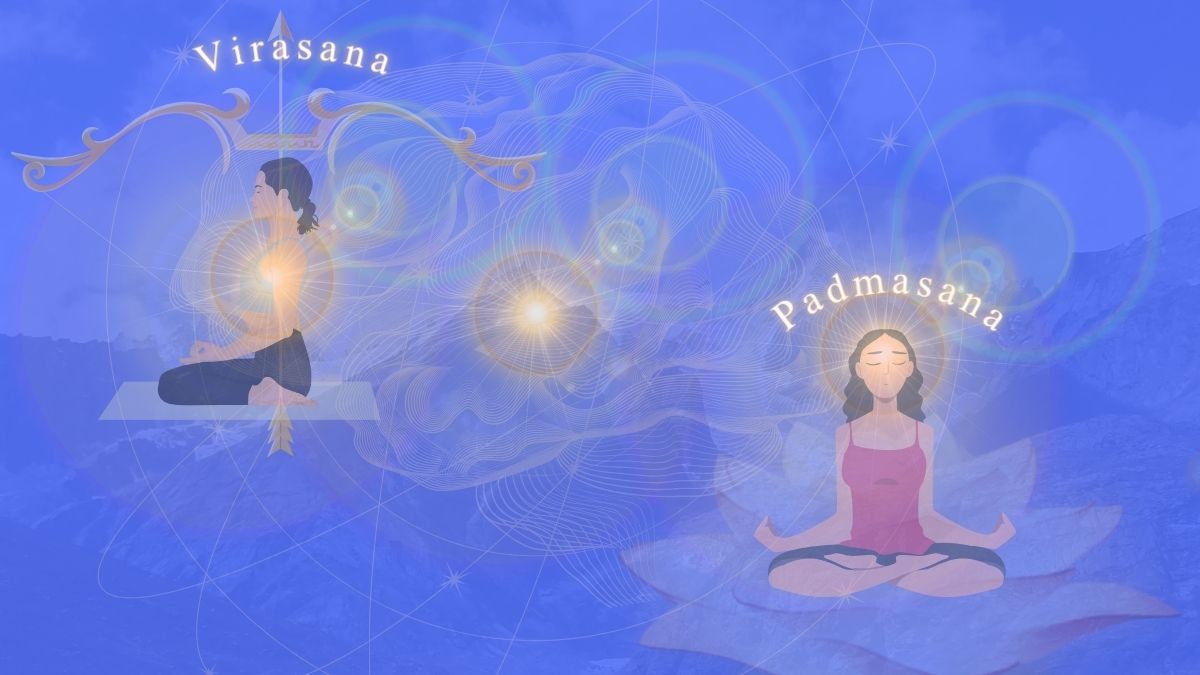
The classical seats I’d like to illuminate today are Virasana = the hero and Padmasana the lotus.  I encourage you to explore both of these with physical teachers (in person) and through your own research. These postures often become accessible only after considerable yoga practice. 

Virasana the hero is taken with the knees together, sitting between the heels with the sitz bones grounded.  The knees together – drawing inward – create a powerful gathering and focusing of energy which supports concentration and focus –  practices required for managing the mind.  The focused energy also creates a stability which lifts the spine.

Padmasana – the lotus – is unique in it’s combination of deep grounding and expansiveness.  The sitz bones are rooted into the earth, the knees are out to the side and the shins cross so that the soles of the feet face the sky.    When the shins cross a powerful acupressure point known as SP6 – the juncture of three major “yin” channels -Liver, Kidney and Spleen is toned.  Yin draws the energy inward. As with Virasana this inward energy creates a stability that lifts the spine.  Any posture with knees open to the sides will create openness and spaciousness.  With Padmasana we master our capacity to remain focused and steady in more and more expansive states of consciousness.  Padmasana allows us to sit with the experience of enlightenment. 

Want a little more “woo” in your life? No? Me neither. But yoga philosophy approached with wisdom is grounding and empowering. The philosophical elements are explored in my newsletter. I promise…it’s not a marketing email although I do suggest readings and music. You can sign up here. They are also posted simultaneously on my facebook business page – NatalieteachesYoga. Thanks for reading!

Processing…
Success! You're on the list.

About the Body: Focus, Concentration, Drishti

What is Drishti?  Drishti is the placing the gaze at a particular place while in a yoga posture (an asana).  Specific points of gaze are prescribed for certain postures, but it can be helpful to begin with just a few general rules. 

  •  The gaze is placed specifically and gently and a little out of focus.  Ideally you don’t really “look” at anything.  (this technique can be applied in tratak as well – see this week’s newsletter on Facebook).
  • A properly placed gazing point will properly position the head and neck, so if your neck hurts in a posture, adjust where you are gazing.
  • As a general rule, the neck is long, and the chin is neutral.  The gaze then rests directly in front of you. 
  • In some postures, the head is turn to look upward (Trikonasana or Ardha Chandrasana).  In these cases the head is turned and the gaze is directed towards the sky, however if that strains the neck or forces the chin up or down, then place the eye gaze straight in front of you – in the same direction your heart or sternum bone is facing.
  •  The tip of the nose can be used in any posture.  In my opinion this can be the most intense of the drishtis.

What does the drishti do?  It builds your focus!!  Through applying it you may discover what focus can really do for your postures.  It raises the heat level in the body.  It steadies the mind, and thus steadies the body.  It brings you into the present – which can help enormously if you are practicing being in postures for a long time (which is really good to do!).  Focus can help you learn to manage discomfort – not through ignoring, but used wisely focus gazing outward and breathing when you are uncomfortable can teach you to be present to and transform your experience of pain.    

Processing…
Success! You're on the list.

About the body: Upping the Asana Game

Yoga is designed to be a lifetime practice.  Well-done practices evolve with us as we move through the changes of our lives – inviting ongoing processes of healing to unfold as our consciousness opens into deeper levels of awareness.  We’ve been talking about awareness of the spiritual heart.  One facet of the practice is that discipline and structure are required in order to have mastery over the mind and body so they don’t interfere with or obscure our experience of our essential being – our spiritual heart. 

In observation as a teacher, and as a long time yoga student, a primary focus in discipline is managing   sloth and torpor – and their  opposites – ambition and grasping.  To obtain the best results in our practice – we are well served to find a structured path between these two extremes.  We might call this the “Goldilocks” amount of effort.  Just enough.  When we are a bit lazy about our practice – it won’t be enjoyable enough to motivate us to make a commitment – we won’t really get the full picture what the yoga can do for us.  When we drive too hard there can be a backlash that causes us to drop out for some time.  Consistent practice (which in and of itself requires discipline) joined with healthy effort creates not only a lifetime practice, but also sufficient internal results to ignite the desire to keep practicing. 

One simple and very universal nonaggressive technique that we can develop to up our game in yoga is focus. Generally the practice of focus in asana will unfold from the external to the internal.  At first, we cultivate focus by not thinking about what is going on outside the room, then not thinking about what is going on beyond our mat, and then having full attention in the body and then full attention in the breath and then being able to abide consistently in the small quiet space in our hearts or minds as we move through a series of postures.  At some point we are able to do this for a sustained amount of time.  One way to check your focus is whether you are sweating or not!  Yep.  Breath makes you sweat, but so does focus.  If your practice isn’t “warming up” for you, try bringing a little more focus.  Some ways to do this might be practicing moving from one asana to another focusing on the breath.   The same move over and over i.e. Downward facing dog to Warrior One.   One breath one movement.  If your mind drifts outside of your body, try really focusing on the feeling of your hands and feet on the floor.  At first, it’s good to focus on something really neutral – and within your own body mind.  It can be helpful not to tell a story to yourself about what arises.  Just observe.  And stick to it for a while.  One week breath and movement, one week feeling hands and feet. 

—————————————————————-

I publish a newsletter in conjunction with these blog posts which rolls out themes related to the inner practices of yoga – the landscape of the mind in practice – often tied in with classic philosophical notes. Like to take a look? It only comes out every week or so, and there are no ads. I promise!

Processing…
Success! You're on the list.

Paschimottanasa – the Grand Poobah of forward bends. 

(It’s a very, very powerful posture)

Paschimottanasana is a seated forward bend with legs extended straight in front of you.  It’s best if your knees point towards the ceiling so the feet  are neither rocked in nor rocked out.  If you find that you can hardly fold at all – don’t be discouraged.  It’s very common – it’s just no one gets their picture taken if they aren’t touching their toes yet!!  Some find it helpful to bend the knees and rest the chest on the thighs.  You can also sit on the front edge of a folded blanket.

Either your standing forward bends will be easier – or your seated forward bend will be easier.  It reflects certain anatomical tensions in the neck and hips.  If the seated forward bend is stubborn and unchanging, I suggest you work a variety of  standing forward bends first to warm up for paschimottanasana.  The folklore is that  paschimottanasana is about “letting go”  whatever that means.  Let go of what?    I could write a thesis on that…but generally it meant I needed to soften my edges, releasing the fixed ideas that I had about how the world should work.  It involved letting others win disagreements, accepting discomfort, allowing change and opening to possibilities and opportunities in my life that I never would have considered.  It was about choosing ease.  For you it might mean letting go of fear and charging forward by being more active – engaging your thighs or activating your bicep muscles to pull you closer to your toes.  It’s always good to try do so the thing that doesn’t come naturally in the moment.  I feel lazy…activating my thighs (or some other part of my anatomy) may be just thing.  If I’m struggling, then more ease is called for.

The bladder meridian runs down the entire back of the body, so being balanced with water will help as well.  That might mean more water, but it also might mean less water – it’s about balance.

Experimentation is helpful here.  That is a great thing about our yoga postures – they give us data about ourselves that we can use to refine our lives. 

Most of all, like all things yoga, forward bend requires practice -so even if you don’t like it…keep practicing!!

About the Body: A Unique Constellation of Tension and Ease

Each of our bodies is a unique constellation of tension and ease born of the musculoskeletal landscape we were born with, the impact of habits of movement,  the impact of emotional, psychological and physical trauma, and bodily awareness,  In Hatha Yoga, we are invited to iron out these differences – bringing the ecosystem of our individuality into a harmony embodied in the sound vibration of Om.

The seasons are turning cooler, our attentions turn inward yet again, and we are invited to shift gears in our yoga practices. This subtle adjusting of focus and style to harmonize with the seasons is a classical organic element of yoga practice which invites us to consider balance in our lives, our practices and our creative work. In yoga the balance emerges as the fine tuning of our awareness and integration in the pairs of opposites  – activation and ease.  The foundation for this teaching is found in Patanjali’s Yoga Sutra.

The postures develop our capacity to discern.  We can consider the following in crafting our personal practices  – the perfect posture is born of cultivating a personal understanding of places in the body you need to activate, and the places in the body that you to would benefit from bringing ease to.  For this  – we can work with large areas of the body (the back of the legs) or more specific areas of the body(the juncture of my sacrum and vertebrae L1) depending on the degree of awareness we have of the nature of the sensation. 

A tool I use to discern tension and holding versus slack and unconsciousness (or lack of any feeling of awareness at all)l is to work with repetitions.

  1. Choose a basic posture, one that is reflective of some physical discomfort you have in life.
  2. Practice this base posture – breathing and scanning the body nonjudgmentally for various sensations.
  3. Practice some postures you believe might be helpful – scanning the body and breathing throughout.
  4. Repeat the base posture – scanning the body again.  What feels different?
  5. Repeat the repetition.

I’ll sometimes go through a repetition sequence several times with several small sequences within a day of practice if I have time.  Sometimes I just run through it once.

Note that  many discomforts in the spine are born of tension in the neck and hips, so you may want to include postures that dress the neck and hips in repetition sequences.

Did you like the post? In my newsletter I dig a little deeper into the philosophical aspects of working with the postures. You will never get more than newsletter a week, and the newsletter is meant for edification and entertainment – not sales.

Processing…
Success! You're on the list.

Yoga, Freedom and Moving into Sovereignty

The focus this moon month in the newsletter is freedom or in Sanskrit, Mukti.  Mukti translates as “liberation”,  freedom, and it’s important to understand that freedom in the sense of yoga is different than freedom in of our day-to-day life – although they are related. We may think that having tons of money would be freedom or rebelling against social conventions would be freedom. Freedom is not inherent in those experiences.  Ask anyone who has very large amounts of money or who has lived in the counterculture for a long time and in their story you will hear of the oppressions that still remain.  In yoga  freedom is something that we develop inside ourselves as we cease identifying with the fluctuations (vritti’s) of our mind. That’s the  second sutra of Patanjali’s Yoga Sutra. The fluctuations of our mind frequently take the form of how we think of ourselves, how we think of others and how we think of the world we live in. These mental constructs can become rigid and block our ability to be open and spacious and, well, liberated.  The freedom of the yogi comes in the form of an inner sovereignty which allows us to become the masters of our own minds and to use that freedom to choose the path of love over and over again.

Yoga is a discipline that leads to freedom The practices of yoga involve experiencing certain kinds of restraint and under those conditions finding the freedom there. When the  restraint is lifted you have a different understanding of who you are. Restraint comes in the form of tying yourself in a knot in an awkward posture and remaining peaceful.  Restraint can mean  being willing to suspend our immediate desires in order to allow a higher state of wisdom consciousness to guide our actions.

When we tie ourselves in a knot in a posture we stir up the deep resistances we have to living.  The knots are knots within our consciousness and so the goal is that to breathe, to be present to what’s happening and not fight with it. Consider this first level of freedom one that you could find contentment even when circumstances around you are not to your liking.  That’s a tremendous amount of freedom. Sometimes for whatever reason it’s not the best idea to change a circumstance. Even though it’s uncomfortable, it’s better to be strong. This capacity is honed in the practice of asana.  Accept the limitation, breathe be still and allow your inner guidance to direct you step by step to moving beyond the limitation into a deeper expression of the posture.

This kind of yoga training reveals discernment – the capacity to understand if our impulses are coming from our authentic heart desires or our desire to control. It’s a powerful means of developing aligned autonomous inspired choice making. Sovereignty. It is a gift of the yoga practice born of moment by moment alignment with self and that is the freedom. Rather than having others dictate who we are or who we become  or what actions we take in our lives we are free to take action in alignment with our highest best interest.  Yoga will take us to a healthy and beautiful body of all different kinds of shapes and sizes but this is the heart of the yoga  – this sovereignty and the freedom that emerges through practice.

Where Vinyasa Begins Intention

A long time ago when I began to practice yoga vinyasa, one day during practice this thought arose ….this must have something to do with surfing…that riding of the waves of breath and movement.  I sensed, that there was some common element physically.  I found out soon there after that the first “landing” of yoga vinyasa in America was in the surfing communities of Hawaii and California.  The connection between the two disciplines, I felt, must have been mula bandha.  Mula bandha is a physical lift of the pelvic floor which allows one to balance while moving.  Esoterically mula bandha is associated with the practice of inner alignment, to direct one’s energy towards the highest possible levels of mystical consciousness.  It is a practice which leads to tremendous clarity.  We don’t need to go into deep resonance with the sacred to know this, if you’ve even done a few rounds of sun salutation, you know that clarity emerges quickly with such a practice.  While there is a physical component of mula bandha, the activation of it on the level of consciousness is achieved only through intention.  The physical activation of the pelvic floor wakes the energy up.  The direction of our focus will determine where the energy goes.  There is no right or wrong about the directing of energy, but it’s good to know that our results will very much be determined by  the direction of the energy.  In true vinyasa fashion this idea is circular, our intention . will determine our focus which will determine the direction of the energy which will then create a result which will influence our intention and so forth. The most important moment In our yoga practice is the moment we override inertia and consciously go about choosing a direction. 

In the classical schools the only intention considered potent enough to activate the bandha was  desire to know God.  The aspirant would begin each practice bowing down to God and the Guru who represented God in form.  In America this intention became softened somewhat to offering the good of our practice to others, a classic Buddhist practice.  The energetic result is the same because the energy is directed towards something beyond our personal needs.  It’s uplifted.  In recent years in America the practice of intention has shifted again, now to honoring ourselves and good self care.  Good self care is essential to a yoga practice, but as an intention it can keep you anchored in what you need, rather than your most illumined potential. Following Patanjali’s formula we know that what we focus on grows.  We don’t want our needs to grow. The heart of the yoga practice is to transcend our needs and fulfill our potential (hence the complex landscape of renunciation practices which have historically defined the practice).  Deprivation is undesirable and not effective.  But to direct our intention higher than our needs is to uplevel our capacity for living.  But even this requires some conscious consideration. We need to be aware of what we are intending. 

To offer oneself as a vehicle for the divine may result in a role where you are the deliverer of blessings hard truths.  An important, but not always fun role.  An intention to serve may yield gracious and elegant opportunities to serve others, but you may have to deal with constraints on your self expression or ability to make decisions.  To intend to know true compassion may inspire you to give away your last dollar.  To intend to align with the most magnificent and expanded vision of your divine sacred infused snowflake self (no two are alike you know) well….that may lead you on your own magnificent divine journey which may include being compassionate in your own unique snowflake way.   It’s nothing we need to fear.  The point is to be awake and clear in the creative opportunity that Vinyasa presents.  Vinyasa, broken down into it’s parts is to place on purpose.  To place a purposeful intention at the beginning of our practice and then to consciously observe our ability to focus as the moments arise and fall in the practice is to take ownership of the power of asana in a whole new way.   Intending a practice is frequently invoked in yoga class, which is good.  Then it is up to us to discern the best way to use that opportunity. 

(c)natalieullmann