Established in yoga…while moving through it all…

I fractured my wrist at the end of October. The cast came off, December 11. During the time in the cast I floated through time and space, a little removed from life, a little removed from pain, a little removed from sitting with this unexpected event in my life. I did some responsibility taking around that somehow, but generally, I was floated by my spiritual practices in this place beyond time. I didn’t struggle against the weight of the cast to do asana (physical postures) practice, because I understand true healing to take place on the level of consciousness, first. Lots of healing happened on that level, and then the cast came off, and I plummeted back to Earth.  I was back in my body, remembering the accident and the pain, and meeting and seeing the limitation now embedded in my physical body. I was in shock. When I left the hospital and climbed into my car, I burst into tears. It wasn’t victimy. It wasn’t woe is me tears. It was sadness for the whole world, all of us, going through this experience of restriction. It was a visceral experience of the sense of vulnerability of our bodies and the sense of vulnerability to all kinds of forces external to us. This month in my classes we are talking about pratistayam, or to be established in.  In Patanjali’s  yoga sutra Patanjali refers to yoga as a state where we dwell in our true nature and the text builds a pretty good case that where we seem to dwell in the external world is intimately related to where we dwell inside. To make a choice to dwell in our true nature is to become established, and that is to position ourselves in such a way that the impact of external forces on our ability to move through the world is diminished. We become conscious co-creators of our life experience.

When I was in the hospital, initially, after the break, I was there four days. A significant amount of the time was spent discussing pain. This was what the hospital staff worked with me on. The managing of pain. The avoiding of pain. I liked the underlying message which was, you don’t have to suffer pain. I’d spent many years with the belief that I did have to suffer pain. Of course, there is that meme “Pain is inevitable, but suffering is optional”. I will say that what when you extract the suffering, it’s no longer pain. It’s just powerful sensation. But therein lies the rub. We have to choose not to sit in the state of mind of our own suffering. Randy, the very kind, bright-natured nurse who was my primary “pain coach” advised, “You don’t want to chase pain.” What does that mean? She explained that it’s very difficult to reduce the pain once you’ve allowed it to take hold. So, the process is to ward it off in advance, in this case by regular systematic taking of meds as the doctors prescribed. Every X number of hours. Isn’t that interesting? Patanjali advises the same thing. He says future suffering is to be avoided. And I think it’s good to note that Patanjali is not just one guy with one idea, but he organized all the information from what people who were practicing in that day were doing so, you know, it’s not the kind of information that gets outdated.

So if future suffering is to be avoided, how is this done?  Yogically, there are a number of different interpretations of what that means but for today let’s just consider that part of it, avoiding future suffering, is that we train ourselves through asana pranayama meditation and good old fashioned discipline to stay anchored, to stay established in our true nature. Part of that training is learning to catch ourselves when we are not in our true nature. Randy advised that pain was a tricky thing. In my post cast life I feel what she meant. It’s random and it’s stubborn – arising with no apparent logic. Although, the mind will try to give it logical source, ‘I ate french fries yesterday and must be inflamed’. But then one might notice the pain lingers long after the french fries are gone. 

The time came last week to remove myself from painkiller killers. You can’t really take Tylenol or aspirin, in large doses, forever. I’d left the high-octane painkillers behind while still in the hospital. There are herbs and there is homeopathy. Last week I began physical therapy and what I didn’t realize was how painful the process of rehabilitation would be. I’ve spoken before here about the releasing of fascial tissue and trauma stored within it. Now I’m living that daily and an important side note – when fascia is releasing you relive the pain of the trauma itself. Medicating at that point is thought to interfere with the release process. On some level, you have to feel it to heal it on the level of consciousness.

Just transcending just moving out of the place of awareness of the pain

might support psychological health in the moment, but holistically transforming the pain creates a more integrated healing. About three days into my PT exercises a return to a generally full asana practice, as I lay down to sleep, my whole arm caught fire with pain. It was clearly a fasica release, as I could feel the impact traveling through my body, as it had at the moment of the accident, dull but shocking. I already taken my herbs for the day. That was it. I was left with chamomile tea and deep breathing, as my only recourse. “I’ve entered the world of pain.” I thought, knowing that millions of people abide there full time. Now, I have some inkling of their experience, and I am awed by it. What that must be like to live there, in pain, through your whole body, all of the time. I think to myself that I don’t want to live in the world of pain. So as I breathe deeply and consciously, I effort to reorient myself to be situated, established, not in the pain, but in the calm center I have touched many times over my years of practice. Pain is tricky. It is seductive and magnetic and absorbing. This requires some effort.

But I really don’t want to live there. I chose to dwell in my true nature. The pain is not receding, but it ceases to be me. And instead, the sensation becomes an experience I am having. It sounds like splitting hairs. But when I pull myself out of the pain experience, it’s just another experience. I know that there is some experience within me at all times, that is not pain, and that somehow I will find my way to dwell in that space. I woke up the next morning amazed that I slept. Funny that, right? We think a billion bucks is the goal but how valuable is a good night’s sleep? The big deep pain of that evening is gone, but it still comes and goes both emotionally and physically as I reclaim the use of my arm as part of the whole of my body – and work to expand my reach. And now I feel really connected to a whole new level of this pratistayam thing – to master being able to sit in that calm sweet place as I deal with the challenges of the world. The practice becomes a a deeply essential life skill to have. It’s been very exciting. I was able to use my left hand to take some vitamins yesterday. And that was a big leap. And I’ve enjoyed creating sequences without the Down Dog for the time being. No plank, no Chaturanga. And a world of creative movement has opened up too.  My treatment goal is down dog. Okay, so two months ago, right before the accident I was jogging and doing a forearm stand and enjoying the process of reclaiming each little step. And now and then, I feel a glimmer of hope that maybe, just maybe, my yoga practice will evolve into such a grand adventure, yet again.
Surrendering into Power

We’ve been dancing around the practices of kriya yoga: Tapah, Svadyaya, Ishwara Pranidhanani.  They are central to the practice of yoga, on and off the mat. They are embodied in trikonasana and they are a simple doorway into the deeper dimensions of the practice.  These three building blocks of the yoga practice can be loosely translated into English as: effort, self-reflection, and surrender. Ishwara Pranidhanani, so-called “surrender”, may appear to be the antithesis of power. The translation of surrender, carrying as it does the connotation of defeat, may bear a coloring of sacrifice.  A closer examination yields a different point of view.  Surrender is required anytime we are invited to step up our game.  Ishwara is the “one beyond form “ and “Pranidhanani” is to bow down to.  The bowing down is not to make oneself less than, but rather to soften our rigidity that we might be transformed into something greater. .  The formless quality of Ishwara allows us to utilize any variety of divine entity or quality in our practice   Think: caterpillar, butterfly. It is that simple.  What do we wish to transform into?  Practice reveals that Ishwara Pranidhani is the most powerful of the three practices as softening our rigidities opens the door to great fullness of our being. This is great power, albeit of an inner sort. When we relinquish the struggles and conquests of our limited personalities, the spiritual power of our connection to source is moves through us, transformation occurs.  We all know our best relationships occur when the two of us together are better than each of us alone.  This requires a little softening.  It requires a little alchemy. It invites us to get out of our own way so to speak. This moment is about relationships, healing occurs when the us and them dissolves.

Ustrasana, camel posture, embodies this.  Our personalities and sense of conventional power are seated in the third chakra in the solar plexus, the heart resting right above this.  Relinquishing the tight hold of our personal power in the solar plexus region invites the flowering at the heart center.

Creating a Mosiac – Integrating Spiritual and Material Goals

The process of integration consists of millions of choice points where a single aspect of a life reflects our inner values or external values.  In the context of yoga (yoking) philosophy and practice each single aspect reflects proportions of spiritual and material expression.  Consider gold.  It must be mixed with another substance in order to be substantial enough to wear as a very useful ring or necklace.  Gold is just too malleable and soft to hold a shape without some other element present in the mix.  My experience is that our practice of yoga is like this.  Too much pure spirit leaves us ungrounded and ineffective in our lives.  This is not much use for ourselves or others unless your role in life happens to be embodying that ideal for others.  We need a mix and we can work consciously with our choices to create the right mix for the lives that we are creating. 

I studied the energetics of food around the time I transitioned into veganism.  My food teacher, a seasoned wise man who had been vegan for many years, did not think that I should be a vegan.  It didn’t fit what he saw my role in life to be.  I objected and went my merry way, working as a yoga teacher in a school which emphasized heavy duty spiritual practices and deep meditation.  He was right, I crashed to the ground with that, unable to manage the business of being a yoga teacher, and reside in those exalted realms.  My colleagues, many of them, had others to support them in the business functions, but to be honest, I knew I was a better teacher when I was grounded and present physically for the students.  When I still had my corporate job and taught in the evenings, my classes were packed.  Of course, I was younger and all of that, but, the grounding I had in my job helped me to relate to what every one was going through. I shared the way that yoga worked in my day to day life at work. 

So, I considered what my food teacher told me, and I decided that veganism was a really really important component of my practice.  I would have to change something else to create the perfect mix of spiritual and material for my life.  I chose to re-enter the work force and to lighten up a little on the extreme practices that I was doing.  I felt better, more awake of my life and more aligned – meaning I felt like myself again.  It’s a constant juggling act integration.  A little more of this, a little more of that, and developing the awareness to feel when the mix is perfect.  Generally when the mix is perfect I feel functional, strong satisfied and balanced.  In that place of integration there is balance strength and joy.  Balance strength and joy isn’t some long off goal I’m always working towards, it’s my chosen normal.  In that normal I find that I’m productive and I have the energy to be kind and generous.  In balance, in alignment I find that I don’t feel that parts of myself are suppressed.

If balance strength and joy aren’t goals in some far-off future, what does setting goals have to do with anything? 

Well, in a life of thousands of decisions at every moment, it’s good to know where we are going, what kind of balance or expression feels optimal to us, and then re-establish the “goals” of how to get there.  I’ll write more about this, but for the time being consider this, my goal of integration is built on an understanding that with my time I am creating a mosaic.  Several times a week I sit down and create visions, schedules and commitments to myself.  I block out time for each of the things that are important to me.  For example, for some, working in the soup kitchen is their spiritual practice, for me it is asana and music.  For some, health is jogging every morning, for me it is nurturance and good food.  (Some jogging doesn’t hurt!)  But the point is, I work with all the components of what is important to me and make sure they are all represented in that schedule and then my goal is to actually fulfill what I have scheduled for myself and the outcome is assured.  It’s very effective.  It means I learn to write a little faster, keep the kitchen clean while I’m cooking, and not spend all my time chasing money but to step by step do what I can to make my time worth more, to myself and others.  Then moment by moment, choosing to honor the schedule (sometimes choosing not to if, say, someone needs a hand).  It means not procrastinating on what I am wanting to do! 

I consciously choose the sequence of my week, and then roll it out, knowing that it may need to change.  At that point I recalibrate.  You may recognize this from Patanjali’s Yoga Sutras, at the end of a series of steps we can see how we arrived at a given destination.   We flip it around and take charge of the steps along the way so we can create consciously.

As far as asana practice goes, well, I do the same thing.  I try to create a well-rounded practice and I build it over time, practicing those postures I like and those I don’t.  A steady well-rounded practice, like a steady well rounded life will establish the discernment to detect when something is missing  or when the balance of life needs to be adjusted. 

It’s not romantic, but balance allows our energy to be available for romance, love, creativity…whatever we want.  Balanced energy sustains, it doesn’t deplete. 

It is my deepest wish that this information is useful to you!

Have a blessed and wondrous day.

Moment by Moment

Tadasana, again. 

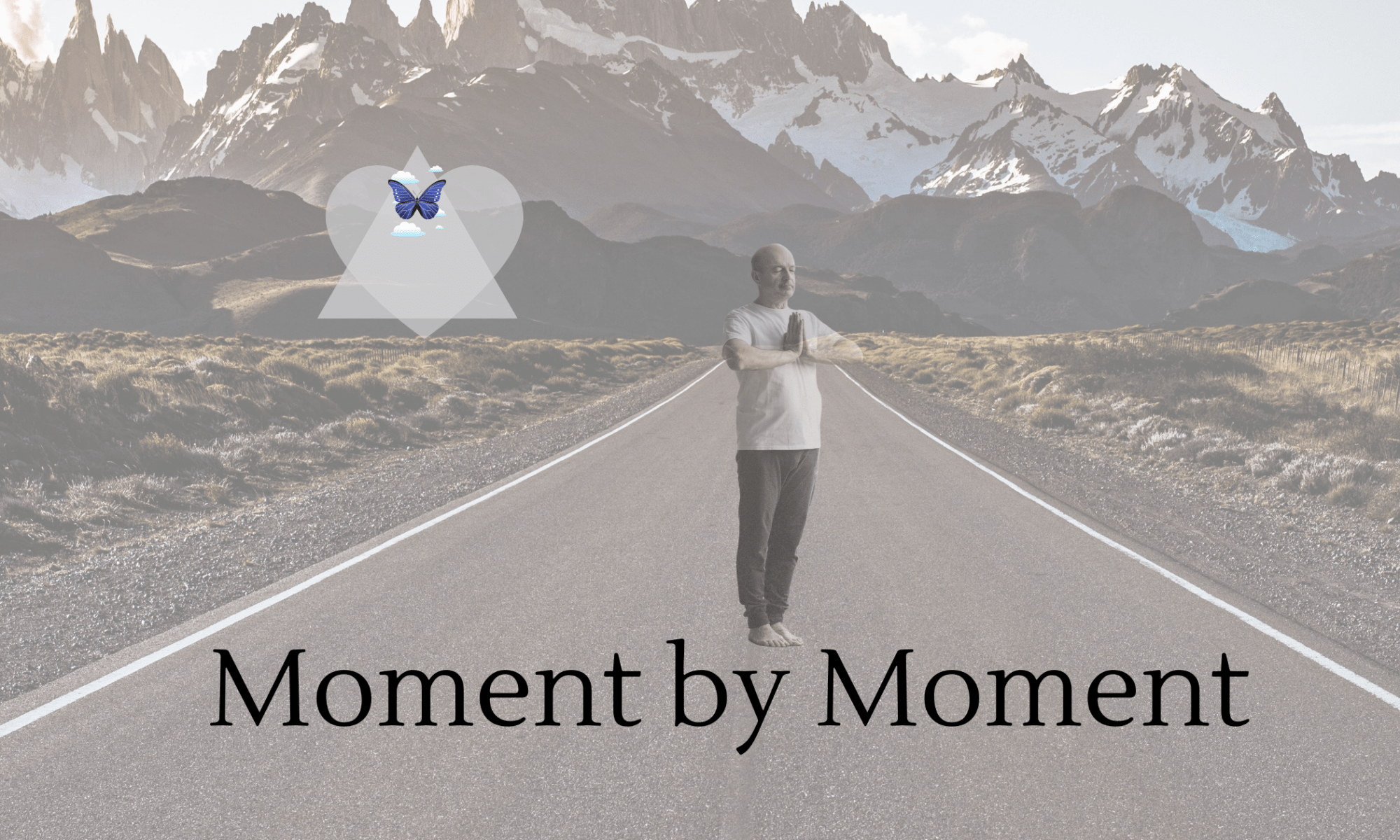
Tadasana is the simple standing foundation posture in the hatha yoga practice.  It is the beginning and the end.  The atom and the galaxy.  The man in the image above is in a variation of Tadasana. 

Some days, I get on the mat and it just seems like I don’t feel like doing anything.  But, I’ve committed to my practice, and while I definitely have periods of it falling away, I know that the root of the empowerment in yoga is DISCIPLINE.  I’ve learned over the years that forcing myself to do things that I don’t want to do (a very old school idea of discipline) seldom yields a good result.  Instead it generates a deep rift in my relationship to myself.  I am forcing myself to do something I don’t want to do.  That, is not the kind of seed I want to plant.    Perhaps understanding where I am will reveal what my next steps are.  So….Tadasana.

I stand in Tadasana.  I am amazed at how quickly I am aware of the imbalance in my physical body and I question how long I’ve been IN the imbalance and not been aware of it until now.  When I began practicing in 1993, I may not have perceived it so quickly.   My weight is forward in the balls of my feet.  I am projecting myself into the future – which is a fancy way of saying “fear”.  Of course I am.  And at this moment in time, it’s likely that you are too!  In the fast emerging post-Covid economy we are all grasping at a secure future. 

Security can never come from a fear-based foundation – at least from the perspective of yoga philosophy.  Security comes from nurturing a sense of security.  From a yogic perspective that kind of thinking creates difficult scenarios.  Projecting into the future doesn’t place us in the right position to make wise decisions. 

I examine the weight distribution shifting front and back.  The balance point eludes me.  I recognize in the  imbalance, a pattern.  The front right corner of my right foot lifts and weight shifts into my left heel.  What would create balance here?  I consider that Trikonasana, the triangle, provides opportunities to explore the connection to the earth differently.  I have nothing to lose, so I try it, and then back to Tadasana.  The imbalance has diminished, but it’s still not easy to stay centered front and back in tadasana.  I try Vriksasana, tree posture, and my hip emits a little pop.  Back to Tadasana.  Wallah!!  Tadasana arises like a mountain, stable, uplifted and free.    The energy flows through my body and insight arises about why I am here and what I am doing.  I am pulled to meditate and reminded of the power of asana to set the stage for meditation by liberating energy.    Asana nurtures clarity vs. delusion, which is more common that we might think.  It’s been a big day in my personal yoga practice – all emerging from shifting into the “now” of balanced weight distribution. 

Patanjali Yoga Sutra (an ancient text on yoga) sutra 4.33, “The sequential progression of moments is understood at the final end of it’s changes” teaches this power of each present moment as points of creation.  My lived experience of this teaching is that at the end of a series of moments we see how we arrived at a destination.  I’ve found that this arises as a clear vision of every pivotal decision I’ve made which contributed to the outcome that I am experiencing.  When this understanding arises it is always amazing, although not always cheerful.  It’s a way  of owning that we  responsible we are for our lives.   Painful as this may seem, only through this awakening process can we transcend the perception of ourselves as victims, and thus become active creative agents. 

This month we consider moving through transitions in this mindful present tense kind of way.  It’s not that we don’t have goals, I know when I’m transitioning from down dog to plank that I’m aiming for a plank, but it is the way I position myself in each microsecond of that transition which builds the plank that I will find myself in. 

I think it’s no accident that the heroes of the great Indian epics are archers.  Imagine having such a sense of vision of the pathway to a target that you could accurately set up your bow and arrow in such a way that oncoming winds would work in your favor!!  Magnificence!  Our lives are no different.  The present moment by moment awareness of the multitude of choices that we make every single minute of every single day….taking OWNERSHIP of that decision-making power, is a choice of great consequence and a fertile field for creativity.

With love and blessings

Natalie

Thanks for sharing the link http://www.natalieteachesyoga.com or my name whenever you refer to anything presented here.

Santosha (contentment)

An attitude of contentment (santosha) gives rise to unexcelled happiness, mental comfort, joy, and satisfaction. ||42||

In Marin County/San Francisco we are now at exactly 20 weeks since the first day of the shutdown.  That is a very long time, and much has happened in those five months.

One of the teachings of yoga which has become a bit controversial these days is a practice called Santosha.  In that practice, the yogi assumes that everything is perfect as it is, and goes about making living their life in that way.

Here is the underlying principle.  If you react to something you do not like, it creates a condition, a likelihood that that the condition will stay the same, or keep repeating in the life.  By choosing to look at everything as perfect, the yogi plants a seed for everything to unfold perfectly.  Here is an example (and I’m not saying this is true or not true, it’s just a hypothetical example)

During the shutdown, many people who live their lives with relative freedom experienced, maybe for the first time in their lives, a degree of oppression that prevented them from walking down the street, eating where they wanted to, going to church, hanging out in a bar, earning morning.  Whatever it is.  Everyone had a different experience of this, and many felt oppressed.  In that oppression minds were opened to understand a little better what life feels like for those who live in perpetual oppression.  We had a big shift.  Things may not be resolved as of yet, but there was definitely a shift.  So the yogi, understanding that everything is perfect, knows that only a shutdown  of this magnitude would have created the pressure cooker in which so many  minds and hearts could be changed.

On a more personal level it’s useful to look at where we each are right now.  What happened for us?  What shifted?  In those shiftings, what opportunities were created?  Sometimes we just have to train ourselves to see them.

Long before I practiced yoga, a very savvy NY recruiter was sending me out to interview for paralegal positions in some of the fanciest law firms in New York City.  Good pay, great benefits.  She also sent me to this tiny little firm, two attorneys, just hiring their first patent clerk.  I saw an opportunity.  She was astounded.  It turns out that she just included them because she knew one of their daughters.  They taught me so much about patents at that little firm, and it served me well for years to come.  Things are not always what they appear.

So, in yoga, the maximal push of a posture is not always the means to the biggest result.  On one level, when we first start, that’s how we “feel”  progress.  But in yoga the subtle shifts are sometimes the most powerful.

संतोषातनुत्तमस्सुखलाभ

saṁtoṣāt-anuttamas-sukhalābhaḥ

From the practice of contentment, one obtains unsurpassed comfort and joy.

Stability and Joy Revisited

“Yoga is the process of dehypnotism”  Shri Brahmananda Saraswati

This month the underpinning  ideas of our practices were stability (shtira)  and  joy (sukkah), as embodied in parivritta trikonasana, the Rotated Triangle.  We nurtured a balanced and activated foundation in the legs and feet, which provided the opportunity to then “reach out” with the upper body, leading with the heart and extending out into the world around us.  In practice on the mat it can be just that simple – an intention to connect to planet earth well, and an intention to extend that experience of connectedness (which is love)  into the world around us. With patience, the body will follow where the mind leads. 

Here is the crown jewel in all of this.  The stability and joy doesn’t really need to be cultivated at all. They are already within you, waiting to be revealed.  They are aspects of your true nature, svarūpe. The experienced yogin stands in their true nature.  To stand in one’s true nature is to be yoked (yoga’d!) to your essence.  Our ability to root our feet, activate our legs and extend our hearts and our arms will reflect how well we are yoked to our true nature in any moment.  The more we are yoked to our true nature internally, the more we will experience joy which creates activation, extension and rootedness in a posture.  It is a process.  For most of us, still buffeted by the fluctuations of our minds, there will be a fluttering throughout any posture when the stability fluctuates. 

A friend recently pointed out the degree to which the current state of affairs on planet earth is surfacing our shadows and much projecting on one another is occurring.  It is a prime time to become aware of our inner stability.  The media and perhaps those around us are posing powerful influences.  Using a wide variety of means to manipulate the stuff of our minds, they bombard us with opinions, accusations and suggested terrors.  We all have ways of dealing with this.  I have a friend who seems to be immersing herself in horror stories.  Catharsis!  The fear is expelled, but the conditioning of  vulnerability remains.  Yoga suggests, instead, that we dehypnotize ourselves through the process of unplugging from externals and plugging instead into the reservoir of peace and joy which is accessed through the silence in our mind.  Yes, we can stay connected to  peace with our eyes open, even when a disagreement is going on.  That is the power of yoga. 

So how do we practice this?  Self-observation.   The moment we catch ourselves fluctuating, we stop and make it a point to detach from what is coming at us from the outside and anchor in to something inside.  We develop a habit.  Say that someone around you does not like your political stance or your mask choice.  They direct angry energy at you, it is quite intense.  For most of us the first reaction is likely to be retaliation.  Any action we take which emerges from the small self will have limited effectiveness.  The actions we take while connected to our inner resources will have limitless effectiveness.  If I’m not anchored in myself and I shout back, I may get the person to go away for a while, but it’s likely to be temporary.  The same issue will arise again.  If instead we choose to stand silent in our truth, extending love all the while, our actions will extend out to hearts and minds and in ways we cannot see.

Consider taking the knee (a graceful and magnificent gesture of support and love) vs. burning down  a building.  The first extends love and changes hearts.  The second inspires nothing and demands a retaliation.  Taking the knee is an expression of svarūpe.  The first is a manifestation of fear and disconnection.  There are those who would like us to remain forever fluctuating, buffeted and hypnotized into fear and submission.  Yoga teaches that we can break away from that influence and choose to stand in love, instead.  In that breakaway our inner freedom is ensured.  Only Love is truly sovereign.  Only love (in all it’s flavors, truth, joy, sweetness etc.) is svarūpe.  We can train ourselves to choose and we can train ourselves to be steady in remaining unplugged from  external influences.  (and by the way, we can train throughout every day, not just in the big events.  Lakshmi, the cat who lives with me, forever tries to press me to be at her beck and call at all times.  It is a herculean effort to stay connected within and take care of everything else which needs to be done!  But I grow stronger and her efforts to communicate become more skillful all the time. 

Stay High

From:  Patanjali’s Yoga Sutras:

Sutra 1.12:          abhyasa-vairagya-abhyam tan-nirodhah

In Devanagri:      अभ्यासवैराग्याअभ्यां तन्निरोधः

Pronunciation:  abhyāsa-vairāgya-ābhyāṁ tan-nirodhaḥ

Idea:  The fluctuations of the mind cease through practice and detachment. 

Why practice?  Isn’t the practice now to be out on the streets supporting our allies? It is, but our time on the mat is important, too.  I once had a cat named Toshi.   I was an inexperienced cat guardian, and quite frankly, not very good at it.  I never much brushed him, it was boring and I didn’t think he liked it very much.  When the day came when I realized that he was getting older, I felt called to brush him.  We sat for some time together, brushing.  Me, and Toshi the cat.  That day, I had no time for meditation.  I posted something about it on Facebook later in the day and one of my friends said, “No, Natalie, you need to meditate AND brush Toshi.”  My time management was not very good in those days.  Brushing Toshi took precedence.  Everything about Toshi took precedence.  I have to say, when he choose to leave his body, I was so glad that I’d spent all that time with him.  But the decisions I had to make about his well-being during that time, would have been easier had I not fallen off my practice wagon.

A fundamental principle of the yoga practice as outlined in Patanjali’s Yoga Sutra is the practice of Abhyasa.  It means to dwell in the experience of yoga.  It also means to be consistent in your practice.  From one perspective, this consistency is about discipline, and the way that a dedicated discipline whittles the frivolous from their life.  From another perspective, there is the dwelling in yoga.  Scratch  below the surface of  the idea of dwelling, and we find that dwelling becomes being established in the state of yoga.  To be established in the state of yoga is to be unwavering in our expression  of yoga’s peace (shanti) in all facets of our lives.  When established in the state of yoga, nothing, I mean nothing, could sway you out of being in alignment with the truth, peace and love that is yoga (so I’m told).  We become established through consistency in practice, over a long time, without veering from our commitment.  We know where we are in our practice when we experience how much or how little it takes for our stability to turn into a wobble. At what point does the emotional turbulence of our minds take precedence over our practice?   We may be attending to the burning fire, but our attendance would be enhanced by the stability our established yoga practice confers.

Being anchored in our peace does not mean that we do not communicate.  The most effective communication unfolds when we are tapped into the higher dimension of ourselves.  If we spend a lot of time on our mats or our cushions, or in deep contemplation of the teachings, then that relationship with our higher self becomes more and more prevalent in our expression off the mat. 

Sometimes, there have been those called to act drastically under divine order.   I never assume that I am called that way.    I know that there have been times in my own life when I spoke harshly to others and I really felt it was something “higher” coming through.  But we cannot really know, so nowadays, I stay anchored in peace to the best of my ability and never presume I am being called upon to judge my brothers or sisters.  I can communicate my perspective, but I do my best not to judge.  I know I never listen to one who is judging me, why would anyone listen to me if I was judging them?

So why practice?  There is enlightenment and self-care and exercise and calmness, but right now I propose we consider the importance of maintaining our practices so that we are stable, non-reactive, loving, and wise.  Established in yoga.  As the miraculous Michelle Obama said, “When they go low, we go high.”  Or we might change that to, “When they go low, we stay high.”  To the best of my knowledge, I have perfected none of this.  But I do reflect on what I have done and have not done.  I check my results.  I do commit to practice and take the high road, to the best of my ability and if I fall I forgive myself.

Keep the love alive,

Natalie

Presence in Practice

From:  Patanjali’s Yoga Sutras:

PYS 1.12:          abhyasa-vairagya-abhyam tan-nirodhah

In Devanagri:      अभ्यासवैराग्याअभ्यां तन्निरोधः

Pronunciation:  abhyāsa-vairāgya-ābhyāṁ tan-nirodhaḥ

Idea:  The fluctuations of the mind cease through the dwelling in yoga and detachment. 

During a recent conversation with a dear friend I became upset and said many regrettable things.  Try as I might to fix it, it cannot be changed.  I’d like to take my words back, but I can’t.  The first of the yoga sutras calls our attention to the moment we turn our attention to yoga.  On one level, the entire text is summarized in that call to the power of our attention.  In practice I found the potency of practice isn’t initially in the focus itself, but in our ability to turn our attention back to our chosen point of focus when it has wandered.  In other words, choosing to turn our attention to practice is a powerful choice. Through our choices our lives are built.  Between each sentence of this paragraph, thoughts of the relationship arises.  Mid thought, I catch myself and return my attention to the sutra about which I intend to write.

As I sit down to write this, the disruption in my relationship haunts me.  In regret I continue to mull the past.  I assess and reassess.  He is not a forgiver; I think.  Neither am I; I think.  My attention flickers to avoiding any place I might run into him.   That would be very inconvenient.  I’m also not sure that it would be the best choice.   I finally decide that it is time to accept that the relationship will never be the same again.  Perhaps, I think at this point, it will be better in some way that I do not understand.  No, perhaps it’s better to avoid.  I grow tired of the fluctuations of my mind and turn my attention to the task at hand.  Writing this post.  My attention turns towards yoga. For a moment only. 

I am attached to what I want this relationship to look like.  To avoid the relationship entirely is to stay attached to what I think it should look like, which, truth be told, was the problem to begin with.  It’s my responsibility to be present to what exists, spaciously.  Not gritting my teeth and enduring, but allowing deep acceptance of how things are, and allowing the transformation that occurs when I get out of my own way enough for the situation to become spacious.

Abhyasa has two flavors   It refers to dwelling in the illuminated consciousness that allows us to see everything clearly and with love (the state of yoga).  It also refers to consistency in practice.  We take aim at a desired state of mind.  We develop spiritual muscle by continuing to turn our attention to the practices which nurture that state of mind, with consistency and discipline.  When I choose to honor my commitment to practice asana (postures) 5 minutes a day, I build spiritual muscle.  When I resist the urge to quit practicing and go have a snack, I build spiritual muscle.  When I forgive myself for skipping practice and show up the next day like I never missed a day, I build spiritual muscle.  Abhyasa, as consistency, is about building spiritual muscle.  In the long run, this is cultivating the strength to live in alignment with our inner truth.  Every time we choose to practice, we are choosing to align with our inner truth rather than external demands.  Through practice, living in our inner truth becomes a lived reality. 

Detachment is a practice of staying aligned with our inner truth, rather than allowing ourselves to be absorbed or repelled by a circumstance, object or person.   As I write this, my attention turns back to the situation with my friend.  The spiritual muscle of Abhyasa provides the strength for me to turn my attention to this article.  As I begin to consider detachment I understand what love would do in the situation.  Before I contemplated detachment, I thought only of what I thought I should do.  But in detachment my heart tells me – Your job now is not just to be present …but to be present in LOVE which is the willingness to be shown what “presence” really is.    Which might just be another way of saying being shown what friendship really is.

Through this we come to know what love really is, and what love really is, yoga really is.

Practice Possibilities;  Honor your commitment to be present in your practice in whatever way you have committed to and for as long as you have committed to practice that way.   Allow love to unfold in your life by exploring the spectrum of avoidance, presence and absorption in your relating this week.  Taking notes will help you remember what transpired.

The afflictions of attachment and aversion

सुखानुशयी रागः ॥७॥

sukha-anuśayī rāgaḥ ॥7॥

 The residue of pleasure is attachment.

duhkha-anushayi dveshah ||8||

दुःखानुशयी द्वेषः ॥८॥

duḥkha-anuśayī dveṣaḥ ॥8॥

The residue of pain is avoidance.

In the practice section of Patanjali’s Yoga Sutra, the second “padah”, Patanjali offers a set of three powerful practices which propel one towards the experience of yoga.  The three are the practices of Tapah, Svadyaya and Ishvara Pranidhanani, which were discussed in the previous post.  After presenting these practices Patanjali notes that not only will these practices lead to samadhi, but that they will also diminish our afflictions.  We all want to diminish our afflictions.  They are forms of mental fluctuations which create the experience of disturbance.  We experience them, until we learn to work with them. 

Today we will discuss two potent kleshas or afflictions:  raga (attachment) and dvesa (aversion).  In this context attachment and aversion refer to the experience where we form a judgment about a person, place or experience based on our history with it.  Either we , want it again, or we never want it again.   While it may seem that this is sound reasoning – to avoid something which has caused pain and to go near that which gives us pleasure there are three important things to note here.   First, by dividing the world into that which we like and that which we don’t like we are creating division and separation.  This moves us away from the experience of our ourselves as whole.  We split off parts of ourselves and others.  To be yoked to our higher self, to be in union with, is to join with our higher self.  Any kind of duality will interfere with that joining.  Second, these judgments are based on the erroneous idea that because we experienced something one way one day, that we will always experience it that way.  We project the past on the present.  Third, that projection of the past into the present creates an expectation which can create conflict in ourselves or with others.   The experience of connection is obstructed when we are absorbed in a memory of the past.  We only experience connection when we are present!

Practicing yoga philosophy  in our lives and in the techniques of yoga asana,  we encounter the dynamic play of opposites.  Through cultivating a harmonious aligned relationship between apparent opposites we create stable foundations for unlocking the power of a posture or an experience.  This is central to all asana, but today we will consider this approach in relation to back bends. 

Back bends transcend time.  They are constructed in such a way that it is possible through practice to open the heart chakra.   The heart chakra is an energy center, or realm of consciousness where we begin to open to our deeper connections with the whole of existence around us.   Whatever we might be holding which could be termed a judgement or a lack of forgiveness will show up as a congestion in the body which obstructs our ability to experience the back bend with a fully open heart.  I use the word experience deliberately because in one body the back bend may appear small to the observer, but is experienced as vast and open to student.  Likewise a back bend may appear as a deep curve but still contains the experience of pain or restriction for the person doing the back bend.  The postures, like all other experiences which we could label good and bad, are all relative.  As we cultivate spaciousness and non-judgement of ourselves in our postures we train the mind to be spacious rather than judgmental towards others.

ATHA YOGA-ANUŚĀSANAM (अथ योगानुशासनम्)

ATHA YOGA-ANUŚĀSANAM is the first sutra or line in the yogic text Patanjali’s Yoga Sutra. It is believed that about 2000 years ago, Yoga Master Patanjali studied deeply the yoga methods and results of successful yogins of his day.  He then organized them into what we could consider a concise technical manual of the yoga system.  The text consists of concise statements or sutras which can be memorized and then drawn from at will, as needed.  By some accounts, Patanjali is considered a mythical being.  By other accounts he is considered  a revered sage of this day.  But the general consensus is that Patanjali’s Yoga Sutras is useful guide for the development and deepening of a yoga practice. 

The first sutra of the text reads:

ATHA YOGA-ANUŚĀSANAM
(अथ योगानुशासनम्)

Which may be translated as:

                Now, Yoga. 

This apparently simple statement, like many of the simple statements found in the ancient yoga texts,  is packed like a holograph.  The whole truth of the volume of Patanjali’s sutra is contained in these 2 words.  This particular sutra, because of its vast simplicityis translated and retranslated and commented upon in a wide variety of ways.  But for today, for now, I would like to discuss the element of the present moment in a yoga practice.  Yoga, the experience of yoga, the whole of the interconnectedness of all things, is contained in the present moment.  

This seems an extraordinary statement – how could everything be now?  Especially if we are here in a very temporal form, which appears to be limited.  I feel like I’m here now.  What more is there to experience?

Our physical bodies are reservoirs of subconscious information. The shapes and forms and feeling qualities of our bodies are impacted by our past experiences.   A long-departed habit can reemerge when conditions spark a memory.  A long-departed skill re-asserts itself with surprising speed, when conditions for its expression arise.  As we move our bodies through the forms of asana (the yogic postures or poses) we awaken those unresolved memories of our history.  As we learn to work with the body to release long held stress patterns, we also learn to release those unresolved memories. 

When we experience an upset or a trauma the most fundamental unconscious reaction  is to stop our breath.  Our breath is an expression of a subtle energy called prana.  A  light bulb turning on and off is an expression of electricity –when electricity flows through the bulb it turns on.  When the electricity is shut off, the lightbulb goes off.  Prana is like electricity, when it flows things happen.  When the breath shuts down in reaction to trauma or shock, it shuts down the flow of prana.  That moment of interrupted unconsciousness is stored in the body and the stagnation interrupts the flow of prana further.  That stagnated energy and the sensory memory connected to it, is not available in the now. 

As we gently approach these areas of holding by gentle breathing during asana–  the channels of flow are reestablished.  The prana flows through the stagnated areas like water – flushing out the memories and re-assimilating those fragments of consciousness into our “now”.  Our creative energy flows more fully.  We experience a greater degree of wholeness.  The experience of wholeness is an experience of feeling better.

The process of bringing the unconscious to the conscious in asana doesn’t require force or sacrifice – it merely requires a little willingness to see and feel that which may be uncomfortable.  It is a process which often unfolds over time, but, some instances of reemerging consciousness can be instantaneous and powerful.  The key is to prepare ourselves to allow the breath to flow uninterrupted for deeper levels of self-emergence.  That process allows the prana to flow and restores movement, awareness, creativity and agility.