

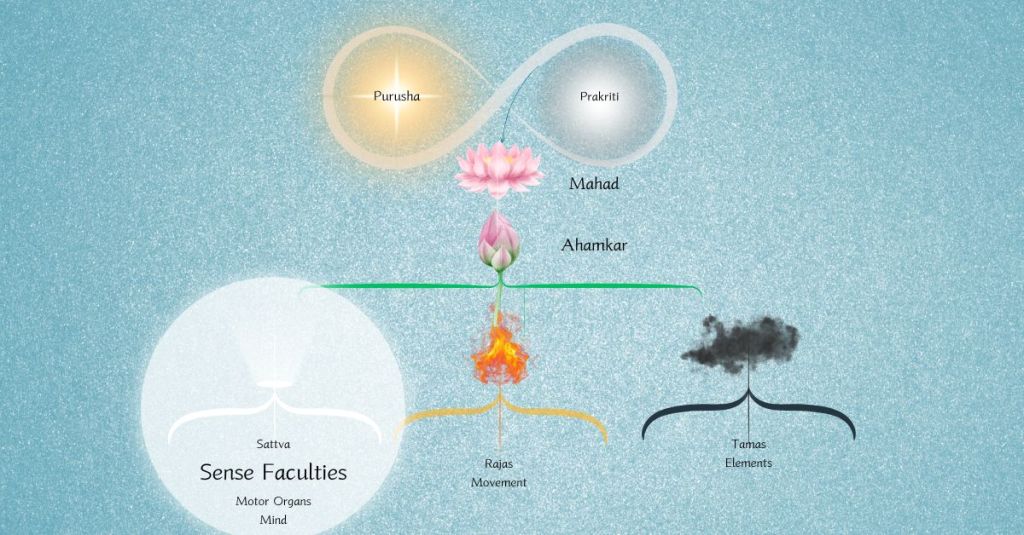
Present in the yoga cosmologies is an understanding that the world, the physical world with which we interact every day, is an illusion – “Maya”. What is not an illusion is the love that is the creator who goes by many names. The illusion is ever changing but the loving awareness behind it stays constant and the same. That loving awareness is within us and around us – omniscient, omnipotent, and everlasting. The Sankhya philosophy maps out the non-spatial terrain between our sensory interactions with the illusion and our experience of that omniscient loving awareness. Our senses interact with Maya – and that is the field we must work with on our journey. Our sense of sight relates uniquely and powerfully to the experience of the illusion. Through sight, we see a world full of enemies or friends, flowers or concrete. As with all the other senses, the yogic approach is to purify the sense of sightn so we can have direct vision through the eyes of loving awareness. As our yoga practices blossom we don’t make ourselves think something positive about the world around us so we see it out there – we actually begin to naturally see differently.
We can consider two components of seeing and vision: the physical eyes (and all the associated physical organs), and the spiritual eye – which only opens as a result of spiritual conditions. The physical eye sees the world of lack and separation – the illusion. The spiritual eye sees the truth – loving awareness. The seeing mechanisms of the physical eyes have a way of blocking the vision of the spiritual eye. By consciously directing the use of our physical eyes, we unblock the visions of the spiritual eye. The means of preparing for this are our standard yogic tools of discipline (training the eye to focus), renunciation (turning our focus away from disturbing visions) and elevation (cultivating the desire to see in a more uplifted way, and seeking association with others who sincerely are seeing in that way).
One fundamental practice is to monitor carefully what we allow in our visual field. The yogi cultivates discernment and turns the gaze away from that which is not conducive to their path. It’s not about ignoring the challenges before us, but but we don’t allow our sight to become absorbed in it. Think of the last explosive movie you saw…it’s easy to get pulled in. There are paths which work specifically with gazing on death or destruction but personally I don’t work with them, and I don’t recommend them – not because they are wrong, but because I believe that it requires extraordinarily skillful means to navigate that kind of practice effectively. It’s not something to be over confident or over trusting about. It tends to plump the ego. There are many other simpler approaches.
We work to choose what to invest our sight in. I think the best example of the challenge of gazing at the destructive was the television reporting after the September 11th attack on the World Trade Center. I lived in New York City – and all our televisions went out – and were out – for days. Most of us there saw the event as it unfolded in the material world around us. The internet was not yet a primary source of information. So, we went about doing what we needed to do. Meanwhile in the suburbs and towns across the United States of America – the public was tuning in to a 24/7 hour a day show of the repeat of the film of the towers going down. Many felt compelled to watch to be in the know about what was going to happen next. I must say, my friends who watched that loop on repeat had a much harder time dealing with the trauma than most of the people I knew who lived in the city at that time. That image of destruction looping before their eyes was burned into their consciousness – together with the accompanying fear. Watching doom on a long term basis can create some inner conditions that are difficult to deal with and heal from. So, yes, we must pay attention to the illusion, but elements of it which keep us fixed in undesirable states of mind we consume only enough to have the information that we need to manage our lives. In this case a yogic choice may have been to check in from time to time for updates rather than really tuning for a long period of time.
In general the act of gazing magnifies what you absorb through the eyes. Surround yourself with simplicity, beauty, upliftment, and check any tendency to rubber neck when the horrific or compelling crosses your path. This isn’t a prescription for walking away from a tragedy where one might be helpful, but it is a prescription for discernment. While doing the work of helping if called to do so, the yogin focuses on the potential to be helpful and not the apparent tragedy.
A question we can ask ourselves regarding right sight is “Do I want my life force (or my time) to be spent looking at this?” Intention and conscious decision making are fundamental to success in yoga. Know that what you absorb will, in some way effect the mind.
The potency of the ability to direct our gaze becomes illumined as we train on our yoga mats and meditation cushions. The directed gaze becomes a propellant for the movement of the life force, or prana, traveling in the yogi’s sushumna nadi (a central pranic channel which travels along the spine). The gaze “pulls” the life force. An uplifted gaze will pull the prana upward. This is cleansing and uplifting.
The directed gaze in an asana is called “Drishti”. Drishti means sight or vision. In the Hatha Yoga Pradipika 1.37 we meet this beautiful description of the practice of Siddhasana or Adept’s pose.
“Press the perineum with the heel of one foot, place the other foot on top of genitals. Having done this, rest the chin on the chest. Remaining still and steady, with the sense controlled, gaze steadily into the eyebrow center; it breaks open the door to liberation.” P 102, Swami Muktibodhananda tr. Translation by the Bihar school
Drishti is a practice where the Hatha yogin rests a soft gaze on a specific point while performing, moving into or out of their asana. Opinions vary as to where to rest your gaze. Some general principles to keep in mind are that you should select a gaze where the back of the neck is long and the heart lifted. A well-chosen and executed Drishti is not just about the eyes, it’s about the whole body. As your sense of Sthira and Suhka (steadiness and joy in a posture) develops in your practice, the whole body will be energized and uplifted by the gaze. The body looks towards the divine. So, yes, generally it will be an uplifted gaze. For specific instructions on drishti in various yoga postures see Light on Yoga, BKS Iyengar.
This uplifted gaze also is born in the mind of the yogi. As we shall see when we get to the mind in our exploration of the building blocks of Sankhya Philosophy, the mind influences the senses and the senses influence the mind. And uplifted mind uplifts the gaze and an uplifted gaze uplifts the mind.
Another very potent yoga practice related to the sense of sight is tratak. Tratak is a meditative, deeper more focused form of Drishti. Taking a classic meditative posture, the yogin gazes, without blinking, at a candle lit at eye level until tears come and the eyes are flushed out. Then, the yogin closes the eyes and gazes at the third eye center between the eyes and slightly back. An inner vision will manifest of the flame, a blue dot, a deity. The key to the practice is the steady gaze and not giving in to the temptation to close the eyes. Give the practice a specific length of time, say, 20 minutes.
The practice of tratak is woven deeply into the experience of the third eye and the power of manifestation through the Manipura Chakra (the Solar Plexus Chakra). I don’t really recommend trying to manifest a specific desire, but rather to understand that the truest desires of the heart – which we often are unaware of – will manifest organically as we develop the skillful means of yoga: concentration, awareness, letting go, balancing, contemplating the Ageless wisdom, and cultivating joy, to name a few.
/*This concludes our exploration of the senses as the ground floor of the map of the Sankhya philosophy – the direct experience of the world around us and how we can work with them effectively to enhance our yoga asana practice. For the next post we will begin the elements. All of the blogposts are accompanied by a separate newsletter I send out via mailchimp. There is no marketing or advertising or charge (I promise)– it’s a just to share some deeper details with motivated students. This month’s newsletter will touch on Yantras, and a closing statement on the senses. If you’d like to sign up for the newsletter please subscribe below. I don’t sell your info, I promise. You can see this month’s newsletter at https://mailchi.mp/05b51002ed24/sankhya-the-senses-sight*/



 Natalie Ullmann