2024 Why Practice?

/* hello friends, my apologies – these posts somehow ended up in drafts when I thought I sent them. Call forth a study of awareness and one clearly meets their own unconsciousness!! They are best read before the new year posts. Thank you for reading!!*/

As the new year begins we will  embark on a journey through a leisurely study  of Sankhya philosophy as a tool to enrich our personal  yoga practices.  Sankhya is a philosophy rooted in India. Itโ€™s prevalent in the bhakti yogic text of the Bhagavad  Gita.  Itโ€™s foundational for the understanding of yogaโ€™s sister discipline โ€“ the healing art of Ayurveda.  When I attended teacher training โ€“ we had to learn it.  But in practice I found it, limiting, laborious confusing, even as I understood on some deeper level that my assessment was off because I never gave it due attention.

So Iโ€™ve decided to spend time in my practice now exploring sankhya within my daily practiceโ€ฆand I thought you might enjoy being with me on that journey. Itโ€™s complex, and like our exploration of the koshas will unfold over months.

When working with the  dimensions of the classical root teachings around yoga โ€“ I find it imperative to practice with  a teaching โ€“ in order to really understand its relevance to the practice.   The intellectual exercise alone is not sufficient.

For me that means not a simple one-time design of a sequence โ€“ but a dedicated period of time that I practice with it daily.  A proverb from my teacher โ€œthrough repetition, the magic is forced to riseโ€.  This is true in all aspects of our practice. 

Why  would we want to deepen our practice by digging into the realms of philosophical thought and then trying to apply them on the mat? 

Through the classical practices of yoga we yoke to the infinity of mind.  From Patanjali Yoga Sutras: 

เคคเคฆเคธเค‚เค–เฅเคฏเฅ‡เคฏเคตเคพเคธเคจเคพเคญเคฟเคถเฅเคšเคฟเคคเฅเคฐเคฎเคชเคฟ เคชเคฐเคพเคฐเฅเคฅเค‚ เคธเค‚เคนเคคเฅเคฏเค•เคพเคฐเคฟเคคเฅเคตเคพเคคเฅ เฅฅ เฅช.เฅจเฅช เฅฅ

tadasaแนƒkhyeyavฤsanฤbhiล›citramapi parฤrthaแนƒ saแนƒhatyakฤritvฤt || 4.24 ||

Yoga Sutra IV.24  The mindstuff itself reflects the infinity of the mind and acts as the unifying agent of the countless individual manifestations.

As we go through practicing Sankhya we will uncover the pivotal nature of the mind stuff and the higher mind.  This sutra touches on thatโ€ฆAs we get clear โ€“ our mind will not reflect our neurosis, our insecurities or our fears.  Our mind will reflect the infinite state of consciousness.  At the point that it reflects that it generates a perception or union rather than division.  Of โ€œoneโ€ rather than a multitude.  In that state we become super high functioning. 

What does that have to do with asana?  What will be revealed in an intimate way is that your physical body is intimately interconnected with the infinity of mind.  Yep.  Think healing on a grand scale.

What does that high functioning unified state look like?

Good meditation

Staying calm and effective while in turbulent or painful conditions.

Finding creative solutions

Inspired action and direction.

Becoming true. 

Transforming the body.

I like becoming true best. In the moment of yoga when we experience union we know who we are โ€“ not just spiritually but what we are here to do physically.  And to keep this out of the abstract โ€“ letโ€™s say it clarifies purpose, it renders understanding in our lives, it opens possibilities- to experience the truth of who we are in tangible direct ways. 

Itโ€™s tempting to think we know who we are.  But the identity โ€“ the truth of ourselves is ever expanding, constantly changing and beyond any cultural definitions.  The world will always tell us who it wants us to be.  Yoga will always draw forth who we can be.  With discipline, understanding and wisdom yoga reveals a pathway through which those two apparently differing identities can be yoked together and cultivated as a pathway of personal growth and mastery.

The gift of approaching a study like Sankhya is that it becomes a tool through which we can tweak and adjust and fine tune our journey into and through this kind of dynamic expanding grounded  Self-expression.

In the map of Sankhya we will discover the poles of higher consciousness (simplicity) and grounded physical experience (complexity).  The fulcrum between the two is the mind.  So we will discover โ€“ as Patanjali shares with us in the sutra above that what occurs in the mind reaches into the experiences of the most fundamental sensory and action-based functions โ€“ and also reaches into the depth of what is often called the โ€œSelfโ€

We can experiment with this.  Meditate for 5-10 minutes before doing your self-practice. Observe your experience on the mat from a sensory perspective with and without meditating first.  And then continue that.  Maybe try it for a week, and then take a week off. Listen for a rhythm of your own which helps you explore what meditation does for your asana practice. Itโ€™s not unusual to have physical breakthroughs after deepening your meditation practice.  For this exercise  you would probably want to consider working with  a classical form of meditation like Vipassana. 

————————————————————————————————————————

Why practice?  Whatโ€™s the point of incorporating the teachings from the so-called source texts.

Not relevant.

I have heard this many times as a teacher and a student.  That the classical teachings are not relevant.  Before we set sail on the ship of sankhya, I thought it would be helpful to consider why โ€œNot relevantโ€ is not the answer.  For this itโ€™s helpful to revisit the folklore around the development of hatha yoga, and turn our vision towards how a so called โ€œsacred textโ€ can influence our practice in a significant way โ€“ a way worth the time it takes to incorporate such study into our practice.

Hatha Yoga was said to emerge among the untouchable caste in India sometime ago.  The untouchable caste was not permitted to attend or be in association with those who were performing sacred rituals.  They werenโ€™t permitted anything at all of the spirit.  They werenโ€™t permitted to honor God in any way that was known or acceptable at the time.  Humans do this.  They exclude.

There is a lot of power in spirituality.  To know and have a relationship with โ€œGodโ€.  People with power like to restrict access to that to a selective group.   And so, in India it is said that Lord Shiva (a a God who had some physical existence as well) taught Hatha yoga to the untouchables as a form of worship that could be secret,  and that they could not be prevented from performing.   Note:  this is very rough explanation of a very complex historical, social phenomenon.  It suffices for a paragraph, but I do encourage greater study. 

The point Iโ€™d like to make is that Hatha Yoga was designed to connect people with sacred truth โ€“ which is beyond our intellects, beyond our brains, beyond our imaginations.  Itโ€™s only found through revelation.  Hatha Yoga is an equalizer.  Anyone can practice in such a way that the doors to revelation can open.   The importance of lineage โ€“ if you have heard of that โ€“ is that it ensures that the practice descends from teacher to student in such as way that the sacred opening is still available.  Itโ€™s not obscured.  Once again, itโ€™s very likely that there are those out these who would like those doors to relevation to be obscured or want to claim the power of the practice for themselves.  But staying true to the sacred truth โ€“ the essential truth ensures that you will be moving towards the truth. 

What does that have to do with sacred texts?  And by that, I mean texts that have some connection to those original sources.  Patanjaliโ€™s Yoga Sutras, The Bhagavad Gita, the Hatha Yoga Pradipika and so on. 

By studying them yourselfโ€ฆit reinforces that your will move you  in the direction of the truth.  When we were told we had to study Sanskrit in my teacher training in 1999 โ€“ we questioned this.  Isnโ€™t it a dead language (well, I think itโ€™s being resurrected by the worldwide yoga community)?  There were a few points made in the conversation:

By reading these texts, we didnโ€™t have to rely on anyone elseโ€™s interpretation. 

Even if we didnโ€™t study  Sanskrit, we were told that we should read at least four different translations to experience the broad scope of meaning contained in the original worlds.

Sanskrit is said to be vibrational โ€“ it came into being when people were first trying to use the sounds of the voice to communicate.  Because of that – the feeling behind the words can be experienced.  It opens the door to a supra-verbal understanding of the human in the cosmos. 

The texts open up different ways of seeing life and practice our place in the  cosmos and the power that each and everyone of us has to transform ourselves and the world we live in.  The study creates experiences in the mind reflective of what asana creates in the body.  The body is also a reflection of what we access with the mind.  They are deeply interwoven.

In practice โ€“ reading sacred texts, even in our first languages โ€“ is difficult.  Because the truth contained in a true source text is so vast itโ€™s like a holograph โ€“ it contains everything in each microscopic unit.  At first we may not be able to read it at all, because on the surface no meaning comes through.  As we practice โ€“ we gain clarity and the meaning of the texts becomes more accessible. 

Processingโ€ฆ
Success! You're on the list.

sankhya

เคธเค‚เค–เฅเคฏเคพ

The next map of yoga we will explore here  is the Sankhya Philosophy, which maps the terrain from the unified field of awareness to our experience as individuals evolving into knowing ourselves and our place in the infinite universe .  We can use it as a guide when we traverse the landscape of the material realm seeking evolution, liberation and peace.  We can also use it as a guide as we carve out a pathway for the rivers of pure consciousness to irrigate the material world that we inhabit.  Translating into ideas of enumeration and rational decision making it appears to be a highly analytical discipline disconnected from our day to day experience on the mat.  But that is far from true.  Right discipline in practice creates a crucible for personal actualization. It paves the way from a life lead astray by every passing influence to alive of personal sovereignty โ€“ aligned with the will of the infinite, limitless omnipotent loving intelligence that goes by many names.

For an image of the map please see this website Sankhya.

The journey of begins with awareness of our senses – direct experience of our awareness touching the physical world via the physical body and ascends through the individual mind, the collective mind, the wisdom mind through the experience of pure duality (me and you) and then in some maps to a unified field of consciousness beyond that duality.  We will take the map beyond duality  to the unified field. 

The heart of healing exists in the unified field. The heart of yoga (which is a dualistic discipline) is  experienced in communion with the unified field. 

/*Whereas the koshas or sheaths (the five dimensions of you) are really about the individual, the Sankhya philosophy is about reorienting ourselves into our  unique place as an individual within the cosmos.  .  The practice of yoga asana leads us directly towards, aligns us with and supports us in staying steadfastly and joyfully engaged in this  ever changing process of reorientation. /

The practice  we will be exploring is using asana to bring awareness to the senses, our actions, the general qualities of nature, the individual mind, the cosmic mind, our sense of separation and yoga or unification.

As we explore these maps we gain the ability to attain mastery in asana, meditation and life. 

How can we start to consider this?  It helps to explore a new sense of our physicality.  Some approaches to yoga work with transcending the physical body, but to really understand ourselves as living as physical bodies from a yoga perspective โ€“ we start with physical awareness.  When we start our yoga practice we are entombed in conditioning about our physical bodies- that the body is shameful or exalted or it drives us or it pulls us down.  The flavors of conditioning about the body are infinite.  Open Vogue, or Greyโ€™s Anatomy or unpack your experience of gym class in the second grade. Conditioning is subtle โ€“ Habits are generated in our unconscious.

What we do want to do is to open our field of awareness as we practice. Just by giving up preferences and practicing observation we will come to know our conditioning and we may choose to leave it behind.  What thought arises as we tumble out of tree posture โ€“ or come down with a thud out of headstand.  We will break down some of these explorations in asana as we walk through the map in the coming months โ€“ but for now you can get ready, just by beginning to notice what arises on and off the mat in a very general sense.

If you’d like to receive a newsletter prepared in conjuction with these posts – illuminating other facets and designed to prompt your creative thinking about your practice Please sign up below. And I promise…you won’t be subject to marketing emails from me…this is just about talking about yoga.

Processingโ€ฆ
Success! You're on the list.

Deep Asana:ย  Igniting the power of prana through grounding and focus

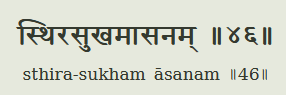
sthira-sukham-ฤsanam ||46||

Patanjaliโ€™s famous sutra โ€“ the posture should be steady and joyful

The process of grounding in the science of electricity clears fragmented electrical charges and releases them into the earth where the charge is absorbed, allowing the main stream of electricity to flow to its useful destination -say- igniting a light bulb.ย  Grounding in an asana allows misdirected prana to be absorbed into the earth facilitating effective circulation of the well-directed prana.ย  Misdirected prana is a result of our being swayed by the fluctuations of the mind (fear, desire, distraction).ย  Combine steady focus with a stable connection to the earth and your asana becomes a powerhouse.ย 

When pranic channels are flowing it is easier to cultivate alignment in a posture – there is less stagnancy and resistance.  Good alignment is actually a sound relationship between the organic forces in the universe (Gravity, centrifugal forces, centripetal forces, wind, temperature and so on).  When our inner forces (focus, prana, breath) unify with the external forces there is union, yoga and the electrical charges within and without are amped up in a harmonious fluid, balanced way.  We are joined with the universe.

—————————————————————————

The previous stages of Deep asana โ€“ where we develop our kinesthetic awareness are essential to developing mastery of energy (prana)  in asana.  And this, we learn from the Hatha Yoga Pradipika,is the heart of the practice.  When we can master our energy we can direct the prana to travel up our main pranic circuit or nadi โ€“ the sushumna nadi โ€“ igniting various energetic structures which awaken deeper self-awareness and understanding  – eventually opening into the experience of realization โ€“ where we operate consistently with a level of deep self-awareness and understanding of the forces operating around us.  Wisdom.  Mastery.  Understanding.  Empowerment.

Designing an Integrated Practice using the Map of the Five Koshas

*note – there are links to previous posts about the koshas below for your reference*

Moving towards the experience of yoga will always involve a bringing together, a yoking together, an integration. After journeying through an anatomical map like the koshas, there is benefit from integrating the information into our practice. Such integration brings individuality to our practice โ€“  no two people integrate ideas into their practice the same way. Consciously integrating the koshas into your practice will create your own beautiful personal yoga mosaic  –an array of harmonious proportions uniquely adapted  for your life.

The classic teachings of yoga โ€“ taken holistically – are an invitation to develop skillful means. To learn through practice to rein together the forces acting within and without –  to become artful and harmonious co-creators. A sustainable  and integrated practice is built on working with our practices in harmonious proportions. The advantage of a sustainable practice is longevity โ€“ it stays with us our whole lives. In classical yoga practice this is ideal as it provides an enhanced relationship to our bodies and lives through times of change. The golden ratio establishes harmony and ease. Itโ€™s about  a state of interrelationship  which -like architecture -brings strength and stability.  In sutra 2.46 of his Yoga Sutra, Patanjali calls this the stable joyful seat. (tr. The seat should be stable and joyful).

What does this have to do with the koshas? A practice designed to address each of the koshas will create a stable practice in which all dimensions of ourselves become integrated.

To do this, we can construct a chart of the practices we want to explore that will develop each of the koshas. These are practices to bring the other parts of yourself into your practice is deliberate way.

Then select practices for each kosha that you would like to develop at a given time. Then, decide how much of each is appropriate to start out with and adjust it based on your needs at a given time โ€“ maintaining the presence of all five. Examples โ€“ when I was teaching yoga full time  asana was 1.5 hours a day and everything else was 5-10 minutes a day โ€“ or once a week or month. Now, my life needs less physicality and more inner peace. I meditate 45 minutes and my asana practice is sometimes only 20 minutes. You know that the practice is out of balance by your experience of the koshas. So, if I try to do 1.5 hours a day of asana right now โ€“ my mind chatter increases dramatically. If I tried to do an hour of meditation in my teaching days, I would fall asleep. Now, meditating awakens me. Itโ€™s important to note that it also needs to be in proportion to your lifestyle.  When I worked in corporate America, I also needed very intense asana.

You will know you are succeeding in creating a harmonious balance if your practice is sustainable (meaning โ€“ you are able to fulfill the personal commitment you have made over time) โ€“ and you will experience the wondrous personal transformation that is the promise of yoga โ€“ and that will occur not only on your mat but also in your relationships, your work, your creativity your passion. 

Introduction to the Five Sheaths

The AnamayaKosha

The PranamayaKosha

The ManomayaKosha

The JnanamayaKosha

The AnandamayaKosha

If you would like to explore ways to work with the physical body to integrate the koshas, my associated newsletter will be posted on my facebook page for NatalieteachesYoga. To receive future newsletters with alternate approaches to what is shared in the blog post, please sign up below. I promise you will not receive marketing emails from me. These are designed to be educational.

Processingโ€ฆ
Success! You're on the list.

Digesting Trauma: The powerful medicine of Hatha Yoga

โ€œPTSD is the inability to forgetโ€ Dr. Ellen Kirschman 1

Yoga is the cessation of the fluctuations of the mind.  Patanjali Yoga Sutra 1.1

Yoga is the ability to digest and transform our thoughts, feelings, memories, experiences so that our clear and sacred selves will shine through. 

Yoga is the experience of peace that emerges when our afflictions have been overcome.

Yoga is the freedom that arises when our past has been processed and we are fully present.


Some experiences are very difficult to forget. If, at the moment of trauma, we are unable to fully process and digest what is happening, that experience can be held in the physical body (also identified as the “Food Body” or Anamayakosha in the yogic anatomy map known as the koshas) ย  Sometimes food and experiences are indigestible – uncomfortable, painful, difficult to absorb and process.โ€‚The blockage caused by the undigested matter can obstruct our access to the other dimensions of our being – our knowledge, wisdom and joy.โ€‚Through understanding this we can use our yoga practices to digest and healโ€‚traumatic memories stored in the physical body.

There is an inherent wisdom in the process of yoga practice.โ€‚ We can buzz along in our lives just fine, and then, one day the blockage becomes apparent and it’s time to heal it.โ€ƒ We’re not defective if we have issues.โ€‚It’s pretty normal to have a degree of trauma in the body.โ€‚Yoga is a fairly sophisticated method of dealing with the residue of trauma due to this potential for digestion and transformation.โ€‚We could just manage our symptoms.โ€‚But we are invited – in the deeper levels of yogic experience – to transform what was not processed into insight and wisdom.โ€‚It takes deep willingness, an open mind and considerable bravery.โ€‚But the rewards are ample.โ€‚

There are multiple approaches to processing trauma through our yoga practices.โ€‚We may be experiencing the impacts of the trauma on the psychological level, and our yoga practice restores equilibrium.โ€‚But going further -โ€‚by breathing and feeling and observing arising memories on the mat – if we are spacious enough – the memories are released from the physical body and new understandings of experiences awaken.โ€‚The experiences are digested.โ€‚We can use those same techniques in the presence of physical symptoms which can range from tightness to chronic misalignment to pain or acute injury.โ€‚Wise presence in yoga asanas can resolve physical trauma through wise practice.โ€ƒThis can be approached well by experimenting gently with specific postures that intuitively, or as a result of research and study, we believe will be related to the anatomical structures involved.

 As we use the tools of yoga to train ourselves to be calm, objective and present to reawakened memories of traumatic feelings and experiences, we mitigate the cycles of recurrence.  We move from the experience of being bombarded by the repetitions of memory and subconscious patterning to creating new relationships with the stories we have lived.  The charged quality of the memory becomes neutralized and laid to rest.   We may never โ€œforget itโ€ – but we can transform it into a tool for awakening, empowerment, deepening and opening to ourselves.

Just as digested food nourishes the cellular structure of the body, digested experiences nourish the stability and robustness of our neural landscape.  They transform the very mechanisms through which we understand the world.  We become less fragmented, less dissociated and more integrated.โ€‚We become whole.โ€‚In this way well-practiced yoga can be a powerful tool in the management and healing of PTSD. โ€‚Some tips for practice are:

  • Work with the quality of your breathing.โ€‚Begin with gentle but focused breath and explore how the different qualities of breath impact the physical experience of a posture.โ€‚Look for the quality of breath that is in effect when you feel a muscle release.
  • Work with the quality of your attention.โ€‚Begin with gentle but focused presence.โ€‚You can train specifically in this – take a posture and maintain your gentle receptive attention on the bones, the flesh, the skin.โ€‚The moment when a memory arises and you stay present rather than becoming lost in it is a power point for healing.
  • As you train in this way, it’s important to notice your reactions to the awakening of trauma in the body.โ€‚The most common reaction is to attempt to control it by pressing it down – psychologically, physically – a kind of powering through.โ€‚This will interfere with the release of stress pattern in the body.โ€‚Allowing is key to healing.โ€‚Assuming you are practicing with moderate intensity – you can practice staying present to discomfort.โ€‚Of course – don’t force.

.Through a carefully cultivated yoga practice we reintegrate the parts of ourselves that have been locked away through trauma.  No longer fractured in this way, we become whole, and the experience of PTSD can be transformed into a process of healing.  While the knowledge of the experience still remains, we are now no longer bound by it. 

  1. https://www.youtube.com/watch?v=IT40YKvLBTg โ†ฉ๏ธŽ

Each blog post is associated with a related newsletter with related commentary, suggested reading and maybe a song or two.โ€‚โ€‚You can find past newsletters (and the current one )on my Facebook page NatalieteachesYoga.โ€‚Sign up below to receive newsletters in your inbox. No marketing, I promise!โ€‚Just content that I hope will open your mind to deeper levels of yoga practice.โ€‚

Processingโ€ฆ
Success! You're on the list.

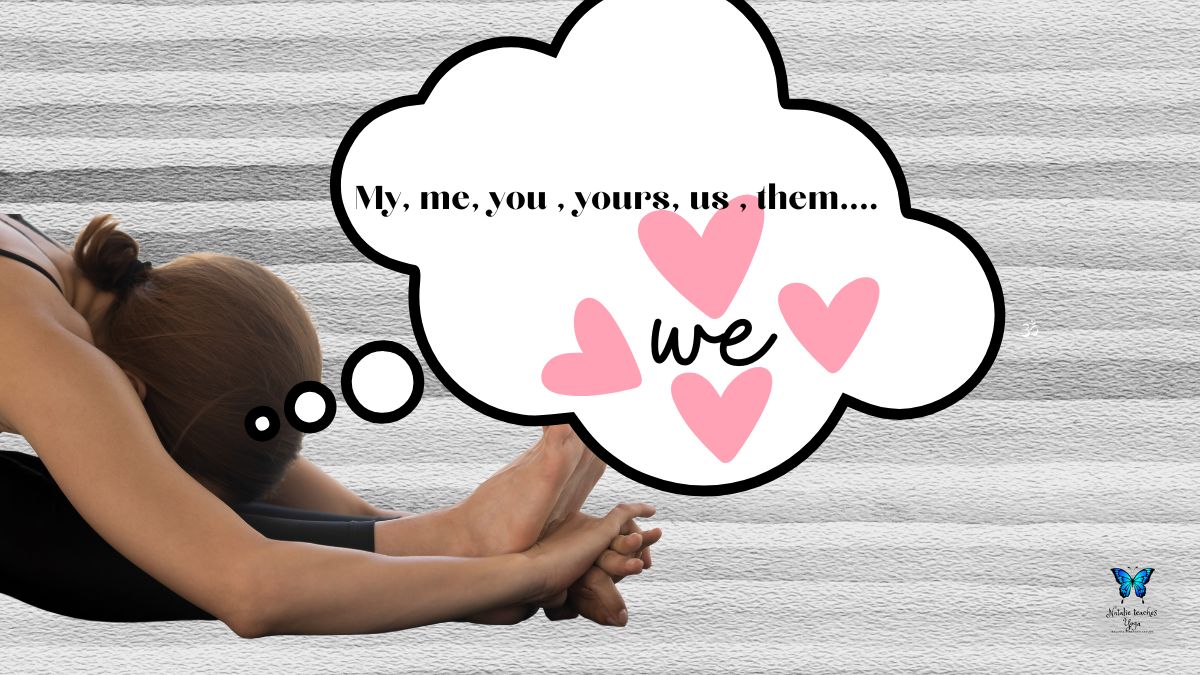
Paschimottanasa โ€“ the Grand Poobah of forward bends.ย 

(Itโ€™s a very, very powerful posture)

Paschimottanasana is a seated forward bend with legs extended straight in front of you.  Itโ€™s best if your knees point towards the ceiling so the feet  are neither rocked in nor rocked out.  If you find that you can hardly fold at all โ€“ donโ€™t be discouraged.  Itโ€™s very common โ€“ itโ€™s just no one gets their picture taken if they arenโ€™t touching their toes yet!!  Some find it helpful to bend the knees and rest the chest on the thighs.  You can also sit on the front edge of a folded blanket.

Either your standing forward bends will be easier โ€“ or your seated forward bend will be easier.ย  It reflects certain anatomical tensions in the neck and hips.ย  If the seated forward bend is stubborn and unchanging, I suggest you work a variety of ย standing forward bends first to warm up for paschimottanasana.ย  The folklore is that ย paschimottanasana is about โ€œletting goโ€ย  whatever that means.ย  Let go of what?ย  ย ย I could write a thesis on thatโ€ฆbut generally it meant I needed to soften my edges, releasing the fixed ideas that I had about how the world should work.ย  It involved letting others win disagreements, accepting discomfort, allowing change and opening to possibilities and opportunities in my life that I never would have considered.ย  It was about choosing ease.ย  For you it might mean letting go of fear and charging forward by being more active โ€“ engaging your thighs or activating your bicep muscles to pull you closer to your toes.ย  Itโ€™s always good to try do so the thing that doesnโ€™t come naturally in the moment.ย  I feel lazyโ€ฆactivating my thighs (or some other part of my anatomy) may be just thing.ย  If Iโ€™m struggling, then more ease is called for.

The bladder meridian runs down the entire back of the body, so being balanced with water will help as well.  That might mean more water, but it also might mean less water โ€“ itโ€™s about balance.

Experimentation is helpful here.  That is a great thing about our yoga postures โ€“ they give us data about ourselves that we can use to refine our lives. 

Most of all, like all things yoga, forward bend requires practice -so even if you donโ€™t like itโ€ฆkeep practicing!!

About the Body: The Body as a Communication Device

In the classic medieval text the โ€œHatha Yoga Pradipikaโ€ or The Guiding Light of the Yoking of the Sun and Moon โ€“ we learn that in classical yoga, the practice of Hatha Yoga culminates in the bodyโ€™s resonance with the sound of โ€œOmโ€.  We are tuned by the practice to a vibration where opposites are united and revealed as facets of one source. That state of unity creates a particular feeling tone. In my experience when that happens, we are feeling the love of the universe within our own form.  To do this, the biochemical aspect of the body requires cleansing (diet and various cleansing practices โ€“ the shat karma kriyas โ€“ the process of sweating during practice), the musculoskeletal system needs to be toned and balanced, and the energy body, emotions and the mind require discipline and clearing through meditation and sound practices (Om) and adjustments in personal care and ways of relating.  I know it sounds like a lot, but for most of us we do a little at a time, transforming at a pace that is appropriate for us.  The result of this is a clear โ€œsoundโ€.  We can hear it in the sound of our voice.  We can also hear it inside us as our intuition and wisdom become illuminated.  A common test is to listen to your Om at the beginning and end of the class. Or any old time you feel out of tune.  This clarity of resonance or lack there of is key to our capacity to communicate.  If youโ€™ve ever tried to sort things out with a friend when you felt foggy day you know it’s more difficult than  when you are awake and clear.  The body is a communication device โ€“ not just with our tongues and mouths, but with our posture, the brightness of our eyes, and our health.  Imbalance in our system is reflected in the body.  And through working with techniques of Hatha Yoga we can bring the system back into balance. 

A good place to start is always the musculoskeletal system. The density of the bones and the memory capacity for the fascial tissue and muscles impacts the balance of the whole body mind spirit system.  So how do we start? 

All yoga starts with Tadasana โ€“ or Mountain  -or Simple Standing Posture.  It is so simple and straightforward that every tension is apparent. We just stand upright with the balance of the weight distributed evenly across the soles of the feet, arms alongside the body.  Personally, I never try to force change in Tadasana.  I use it as a measure.  How is my Tadasana at the beginning of practice? What is it like at the end.  Like the Om, itโ€™s often very different, reflecting as greater state of balance and resonance.  Sometimes Iโ€™ll just stand in it for a long time and feel the tension patterns surface. 

Those tension patterns can tell us a lot about how we could create positive change in our lives.ย  There is no formula.ย  For me itโ€™s always my hamstrings get short and tight and my head juts forward.ย  Over the years โ€“ through spacious self-reflection and input from yoga colleagues โ€“ Iโ€™ve come to know that when that pattern emerges – some piece of me is not in the present moment.ย  Iโ€™m hanging on to a belief, or perception or way of being that doesnโ€™t serve me anymore.ย  Often by the time my body communicates something โ€“ Iโ€™ve been ignoring it for a while.ย  Sometimes insights about what needs to change will emerge during asana practice, sometimes meditation or the other forms of practice can help to illuminate the issues.ย  The key is to seek to understand in a receptive way rather than just to fix or overcome and that understanding lays the groundwork for transformation of the body and everything else through my practice.

My newsletter lays a philosophical ground drawn from Patanjali Yoga Sutra 1.40 to work with in conjunction with this blog post. Take a look here: To Know – Results of the Experience of Yoga – https://mailchi.mp/4f8d72e44e70/to-know-yoga-and-the-experience-of-knowing

Sign up for the newsletter here:

Processingโ€ฆ
Success! You're on the list.

The Fruits of Yoga: Awakening into the Experience of Infinity

About the body

II.47 Patanjali Yoga Sutra Steadiness and ease of posture is to be achieved through persistent slight effort and through the concentration of the mind upon the infinit

II.48 Patanjali Yoga Sutra When this is attained the pairs of opposites no longer limit.

(translation of Sutras by Alice Bailey)

One of the techniques from the classical practices which is really powerful in uniting the two opposites is something called moola bandha.  Moolah is โ€œrootโ€ and Banda is lock,  and the experience of moola bandha or root lock can be activated by several different approaches.

On the physical level a very simple way to begin to activate this root lock is to engage in lift the space between the anus and the genitals. Bring your attention to the area and attempt to draw it up and in toward your navel.  Now hold that for your entire practice while breathing at the same time.  For me, to be honest, I have the best luck with this if I work with it in seated forward bends and standing postures.  Some yogiโ€™s can perform this to an extent they levitate the body.  In my opinion working with it on both levels is useful, and working with it simply is safer. 

On and energetic level what moolah bandha does is move the energy in an energy center called the mooladhara chakra(the root chakra) which energizes the entire pelvic girdle. To directly experience our energy requires patience and the cultivation of a subtler level of attention.  But for some, this is easier.  Just know that if you keep practicing consistently and well you will have tangible experiences of this kind of energy and be able to learn to manage it.  As a matter of fact we all feel our energy all the time.  Some examples are the experiences of sexual desire or butterflies in the stomach. When weโ€™re focused on identification with our sexual identity,  our financial identity our tribal identity and our identity as a body (as opposed to as a spiritual being) the energy of this center moves out into the material world. We may notice this as an experience of deep fatigue. The energy also moves outward if we seek our answers outside of ourselves, rather than listening within.

 When we work with Moola Bandha this way of looking at ourselves and looking for answers shifts. We begin to wake up to a different way of understanding our lives –  what are we creating, how we participate in the larger community of the universe, what is our personal path of love and what is our authentic expression. When we start asking these kinds of questions, looking in these directions for the answers to the questions that arise in our lives Moola Bandha is activated on an energetic level. When itโ€™s activated on an energetic level it often spontaneously arises on a physical level as well.  The trick is to keep the state of mind as you re-engage the external world.

 A powerful way to support the physical practice of moola bandha is to shift our attention towards these universal considerations while we practice.  Our attention will work harmoniously with the physical contraction of the space between the anus and the genitals.  By working these two aspects together we activate a powerfully gentle form of transformation. How do we shift our attention while we are in our practice? Shouldnโ€™t our attention during our practice be on our practice?  I encourage you to ask those questions when you are on your mat in your personal practice. There are as many approaches to this integration as there are people practicing yoga.  Some people meditate before practice. Some people chant before practice. Some pray.   Some extend the benefit of their practice to others or take a moment to envision that somehow as the practice transforms them  – that the world around them will transform into a peaceful world where beings are happy and free.  The possibilities are endless hence Patanjali’s statement about the limits.     The important thing is to consider incorporating these kinds of techniques into your practice on a physical level.  In actual practice an effective moola bandha will show up in a lightness – a freedom of movement,  a steadiness of the mind,  and a stability in the grounding of the posture. It may also show up as a different understanding of yourself in the practice and this I will leave you to discover on your own!

The Elements of Sadhana: Santosha- Contentment

In the newsletters we’ve been talking about creating a sadhana – a conscious spiritual practice of yoga, a discipline of yoga as conscious spiritual practice. This past week I introduced the mahavratam or great vows outlined in Patanjaliโ€™s Yoga Sutra. These vows aren’t something that Patanjali devised โ€“ he compiled them from studying with the esteemed yoga masters of the day (which was some time a few  thousand years ago no precise date is known).  There are ten of them. They are often considered to be moral imperatives. In practice Iโ€™ve found it more useful and more authentic  – I get better results – if I let that idea of morality go and open up to practicing them whenever and however I can, trusting that they are actually learning devices for me.  Through practicing them I open to understanding who I am and who everyone else is.  As I open to understanding I make better  choices. The ten mahavratam are: nonviolence, non stealing,  adherence to truth, continence, non- hoarding, cleanliness, contentment, austerity, self- reflection and devotion. In the newsletter I briefly talked about the practice of saucha or cleanliness. Today Iโ€™d like to speak a little bit about contentment, or santosha. 

One thing to consider when practicing these – theyโ€™re also called yamas and niyamas, restraints and observances – is that we are always creating. We are creative beings – extensions of the divine, which is the creative energy of the universe, the supreme creative energy of the universe. This is an underlying paradigm of the yoga practice.  The yoga practice will reveal that we a specks of divine creative consciousness โ€“ and we can live from that truth. This is co-creating, which is yoga – to be yoked to the divine. The restraints and observances clear the palette of our consciousness, enabling creativity which is unbridled by our past. 

 With yoga the idea is that creating in alignment  with the infinite divine opens the doorway to limitless possibilities- and that wisdom, that intelligence – will create richer more satisfying possibilities than our personalities with their cravings and conditioned attunement to lack. If we choose it, these practices deepen our understanding of the elements of a good life.  This is partly why I encourage you to set aside the idea that they are imposed morality.  Practiced lovingly, they open the way to a delicious abundant live.  Less is more. 

With the practice of santosha or contentment this connection between our behaviors our beliefs our thoughts in the world that we experience is made very clear. 

Perhaps in your life you have met those or perhaps you’ve been in this space yourself ( I know I have been) where you feel a need to complain about everything. Iโ€™ve seen a real uptick in this during the COVID situation. 

 I think we can all agree there is much to be addressed in the world., but right now we have to accept whatโ€™s happened and what is happening and learn to work with it. Shaking our fists at a perceived enemy is unlikely to change the worldโ€ฆchanging ourselves is likely to change the world, not only because we engage those conversations differently. 

But letโ€™s think back to the before time – before COVID – and remember those days in offices or classrooms or social gatherings where we or our friends or neighbors or our family would lapse into days where we complained and complained and complained. Surely we’ve all known in ourselves or others that momentum that complaining develops – once you start complaining there just seems to be more to complain about. The yogis understood this very deeply through their meditations , analysis and self reflection. The practice of contentment is to practice contentment under all circumstances thatโ€™s a key of these mahavratam โ€“ under all circumstances.   So in any moment (the grandeur of universality demands we operate one moment at a time) when faced with complaining, we choose contentment.  Itโ€™s like putting down a heavy object.  โ€œI just donโ€™t want to carry the weight of my complaints, so Iโ€™m a gonna put this down, right here.โ€  Itโ€™ll be okay.  Once weโ€™ve entered a quieter state of mind, wise action can emerge more clearly. 

What does that mean – in the yoga practice – to work a difficult situation? Perhaps it is to rest in the understanding that youโ€™ve participated in the creation of it and take responsibility for the fact that youโ€™re there. You skip the blame (of yourself and others) you skip the victim story and nurture and invite the ability to see the situation differently.  Liberation arises when we realize there is no one to blame.  The practice of contentment opens our minds so that we are able to see that. To be honest, in content I perceive that there is nothing to complain about.  Itโ€™s all perfect.  But to deeply know that feeling we have to practice.  

One of the ways that we can train ourselves in the vast practice of contentment is to practice on our yoga mats. One of the most obvious powerful and potent ways to do this is to be content with a posture even as you are working to transform it. Where I am is fine but Iโ€™d like to deepen it. Iโ€™d like to expand it; Iโ€™d like to move to the next expression of it. So the first part of that is to enjoy every posture just where you are with it. This is one of the reasons why the postures that we canโ€™t do are so important. As I say this I realize that this is one of the biggest difficulties of a home practice is that we never bump into those postures that we donโ€™t like. At the same time if the classes available around us are not suitable – to force ourselves to go into a class that is just full of difficulties makes no sense either.  So what can be a good idea in your practice is to add a small step towards a posture that you would like to attain someday. For me right now this is wheel urdva dhanurasana. 

 I had an accident last fall where my wrist was smashed. Iโ€™ve consciously decided to recover slowly. In my full practice days I would do three full or wheel postures every day.  Wow right?  To me that seems like wow.  I was never a born gymnast. That posture has intense ramifications on the wrist and feels remote to me but at a certain point I had an intuition a revelation that in fact I would be able to do it again in this lifetime So what Iโ€™m going to practice this moon month is to sit at the wall and take a camel posture and place my hands on the wall. A highly modified introduction to the movement that would lead to wheel. And I am content.. This is the beauty of modifications in yoga. What they do is – if you practice them fully,happily embracing what the modification has to offer you – it’s actually like working the full posture you develop the shape energetically on a deep level and it opens from the inside out. One day yourโ€™re ready and the full posture emerges โ€“ like a chuck busting out of an egg. 

So how do we learn about modifications if weโ€™d like to incorporate them in our sadhana?  I highly recommend them even if you donโ€™t have an injury. Spend some time in modified postures.  By working with the modifications youโ€™ll learn some of the paradigms of postural yoga. Weโ€™re very fortunate to live in an opulent world where thereโ€™s all kinds of information about yoga on the Internet so Iโ€™m sure you can find some information about modifications there.  As far as books books go and even Internet the best school of yoga from which to learn about modifications is the Iyengar school so I encourage you to look into that when choosing postures to work in your sadana. 

Once youโ€™ve practiced santosha on your mat for some time don’t be surprised if you  catch yourself practicing it in your life.  You donโ€™t have to make a big trip out of doing all of these mahavratam.  Just know that they can extend to all circumstances, and theyโ€™re not limited.  Your contentment is not limited to certain circumstances.  You can start practicing them in certain circumstances until you feel confident to apply them in more challenging circumstances.  

OK thatโ€™s our blog post for today. As always itโ€™s my sincere wish that this information be useful to you and that your practice will lead you to a blessed and wonderful life. 

Refuge: Commentaries from last months emails

April 1, 2021Refuge in Hatha Yoga

HYP 1.10 for those continually tempered by the heat of tapah (pain โ€“ difficulty โ€“ challenges) hatha is like the hermitage giving protection from the heat.  For those always  united in yoga, hatha is the basis acting like a tortoise.

Perhaps this has happened to you โ€”you select a relaxing and remote vacation destination, longing for a break from the hassles of day to day life.  A deposit of thousands of dollars is placed – the time between making the arrangements and the date of the trip is consumed with the desire for that rest and relaxation.  The state which will come when life as you know it is escaped for a little while.  The day arrives.  The plane is delayed, the luggage is lost, negotiating the unfamiliar terrain of the destination, for whatever reason, falls out of the realm of an adventure and just feels a little arduous.  Now, I love to travel, Iโ€™m not knocking it, but itโ€™s not always the escape that we want it to be, there are no guarantees of relaxation or freedom on any journey.  But, as this sentence from the Hatha Yoga Pradipika puts forth, a well done yoga practice allows us to establish an essential experience of ease and refuge within.

Granted, a yoga class can have similar distractions to a pilgrimage in terms of time, obstacles, disruptions.  But the function of a yoga class is to learn, to be together in learning and community  The discovery of the inner refuge is the path of our personal practice.

The inner work of yoga, depending on the techniques you practice, can reveal many different things.  There is the awakening of insight and contemplation, there is creativity and conscious co-creation, there is awakening and there is refuge.  We have many alternatives to choose from.

Whatโ€™s specific about the techniques of Hatha Yoga is that they support and develop this experience of refuge specifically.  Itโ€™s put forth here at the beginning of the text, which is claimed to have historical roots in the origins of the practice of Hatha Yoga itself.  The beginning of the text states itโ€™s lineage back to the teaching of Shri Adinath, the first yogi, also known as Lord Shiva.  As the text unfolds we are advised to create the conditions for the experience of Hatha Yoga.  The conditions within and without, create a scaffolding for this experience of transition from a state of dualism to an experience of unity, and in that unity there is peace, there is refuge, there is healing and there is rest.

Last month we explored the kundalini energy.  When directed in unconscious ways the creative energy can lead to the experience of fluctuation, conflict and unstable moods.  Well directed and managed energy can be elevated to a steady state where such disruptions are minimized or ideally left behind.  Think about it, we know sorrow only because we have known happiness, two opposing energies will always conflict until they are harmonized and when a pendulum swings one way it inevitably swings the other way.  The idea as I understand it is that when we become anchored in this steady unified, harmonized state,  which is yoga then the fluctuations and conflicts occur, but we are not imprisoned or buffeted by them.  I measure the depth of the yoga practice these days, by my ability to stay steady in the face of those fluctuations. 

This month weโ€™ll explore techniques of focus on breath and gaze which support this experience of unity.  The Hatha Yoga Pradipika refers to miraculous states where the physical body is transformed through the practice.  This experience unfolds as we master our ability to be in union as we move in the physical world. 

ENERGY ANATOMY โ€“ The Manipura Chakra

The Manipura Chakra (the city of jewels) is located in the area of the solar plexus under the rib cage.  This chakra is โ€œworkedโ€ when we twist, when we work with our diaphragms in breathing exercises and bandhas, and when we work with our gaze.  Spiritually, psychologically, this center affects and is effected by or relationships with others in community โ€” how we see them and how we are seen.  My experience is that the gaze is a deep purifying technique for the manipura chakra.  To use our drishti (a technique of gazing) breaks down the experience of self and other and harmonizes the relationships between.

Yoga at Home

One of the nicest things about working in a personal practice at home is that you can draw out the technique which your personal journey is calling for and work with it on your own schedule and with your own ability to focus and observe and digest the experiences that you have with a given technique.    There is no one way of yoga.  Traditionally, one would work one on one with a teacher, and a form of relationship which is no longer really available or desirable for many of us.  Our opportunity in engaging our personal curriculum of yoga in a structured and mindful way provides the opportunity to experience a personal relationship with what refer to these days as the Wisdom Self.  Engaging the Wisdom Self opens a deep level of knowing which reveals the journey step by step and provides an illuminated understanding of our personal function, our opportunities for rich and unique growth, and decisions which lead to deep healing. 

Processingโ€ฆ
Success! You're on the list.

HYP 1.10 for those continually tempered by the heat of tapah (pain โ€“ difficulty โ€“ challenges) hatha is like the hermitage giving protection from the heat.  For those always  united in yoga, hatha is the basis acting like a tortoise.

April 11, 2021

Many spiritual traditions contain within them an indicator of the power of taking refuge, as a means and an end.  In Buddhism, one takes refuge in the awakened consciousness or the Buddha, the community, and the essential truth.  In Christianity, itโ€™s the experience of salvation, or being saved by surrendering into Christ consciousness.  In yoga, that refuge is liberation or mukti, the experience of releasing into the limitless divine which is known by many many names.  .  This passage is located at the very beginning of the Hatha Yoga Pradipika, a seminal text on the yogic processes.  The Hatha Yoga Pradipika is a manual for balancing the forces of the physical body to enable deeper levels of absorption in the state of union or yoga.  Hatha Yoga is notable for itโ€™s simplicity, itโ€™s power and itโ€™s promise, that the dissolving the separation of opposites or the sun and the moon, will protect us from the experience of pain. 

While the language of the HYP is mysterious and riddle-like, the practice is simple.  The text itself enumerates some extreme measuresโ€ฆ.living alone in a hermitage built to specifications outlined therein, avoiding overeating and regular folks, and avoiding long pilgrimages and women โ€“ to name a few.  But basically, whittled down to essence, the foundations of preparation prescribe that we create a life which is relatively free of conflict. The hermitage of yoga is built of our own powerful moment by moment choices to stay centered or give into the temptation to fluctuate or be fluctuated.

We live in a world of duality:  right or wrong, this or that, black or white, red or blue, science or fiction, spirit or  matter, male or female, etc.  It is our attachment to the opposing elements of that duality which causes the fluctuation within, and the conflict without.  Hatha refers to the union of the Sun and the Moon.  Our intuitive psychic qualities and our active and engaged qualities cease to be in opposition to one another.  Instead they work together. 

If youโ€™ve ever butt heads with someone with a stubbornly opposing viewpoint you know how much conflict within and without is caused by that duality.  When we choose peace the duality ceases to have power over us and we are protected from the pain of the fluctuations.  We move towards yoga. 

Processingโ€ฆ
Success! You're on the list.

April 17, 2021

Refuge II: Peace in the Body

The Hatha Yoga Pradipika describes the process of Hatha yoga as a refuge for those best by the pain of suffering.  A considerable amount of our suffering is of the body, and later on in the text when the results of practice are described we are encouraged that the pain will cease.  The text specifically points to a moment when all physical disease is eradicated.  Last week we spoke of the transformative power of moving beyond duality as reflected in the word Hatha.  Dualities are infinite in number (although limited in expression) and one such duality is the divide between the mind and the body.  Think about it.  How much of your time is spent warring with your body?  Even many forms of so-called self-care are merely thinly disguised ways to try to make the body different than it is:  itโ€™s appearance, behavior sensations.  Either itโ€™s in charge or we are (you know those struggles over the chocolate thing).  In the meditative processes of yoga itโ€™s sometimes spoken of that the mind is a battlefield.  Well so is the body.  Part of the power of well-done Hatha yoga is that this dichotomy between mind and body can be dissolved into peace, and the body, once a battleground becomes instead a vehicle, a tool, a field which can be used for healing and transformation on a psycho-spiritual level. 

In yoga 2021, we are best by images of what we should look like.  They are changing but the images of perfection still loom large.  There is much suffering in the attempt to spend your life trying to look like someone else!  Any spiritual path can be distorted into suffering. A well-done practice, engaged with wisdom and discernment, yields a state of peace with the form we are in. 

My classes are small. Being out of the studio is a blessing for that reason.  Part of that is โ€“ I encourage students to back off, to give up the striving for the physical ideal, but to still be engaged.   Itโ€™s pretty specializedโ€ฆand good for those who are wanting to engage their inner being.  It also requires an understanding uniquely yogic that just because you give up striving doesnโ€™t mean that you wonโ€™tโ€™ get what you want.   It also requires and understanding that the inner work has the power to transform the physical form.  Imagine this โ€“ your limitation โ€“ say a restriction in the hamstrings โ€“ to sit in the limitation and breathe and find peace and not fight against the limitation is the field of true inner strength.  To learn to move forward without pushing against or opposition, but instead through the creative willingness and love in your heart, wellโ€ฆ.Itโ€™s a moment to find beauty in what is instead of what should be.  And-practicing that way balances the energy field and tones the body in an integrated way.  Creating balance within the limitation rather than saying โ€ฆโ€If conditions were differentโ€ฆI would be balancedโ€ This is a measure of true power.

As I practiced this way I found that many times something would change without my doing anything.  One day I would be light enough to invert spontaneously.  A deeper or more specified level of engagement and articulation would reveal itselve providing a deeper experience of integrated balance.  But mostly, my relationship with my body changed.  I began to love it for what it was, this little skin suit I trip around in.  That alone lightened the whole thing up.

Many of you know that I broke my wrist last October.  As healing progressed deeper levels of balance and healing were revealed.  It was a significant injury.  Iโ€™m finding that those years I spent finding peace in the limitation I had, in order to move beyond them is serving me very well.  The injured  part of my body is something I love and want to care for, it isnโ€™t an obstacle or a burden or really even a limitation.  Itโ€™s an opportunity.  This is the first major injury Iโ€™ve had since practicing yoga, so much had my agility improved through practice, this kind of thing was rare and unexpected.    But compared to my experience of breaks I had experienced in my twenties which were painful and inconvenient.  My body became a landscape of areas which I dissociated from.  (One of which was this wrist, which I had broken before).  This is now an opportunity to relate to this broken part of my body with more awareness, to reintegrate into the whole of who I am in a new way.

This allows something else to happen.  I become able to celebrate the way the miraculous unfolds in the physical form  When I began to do down dog again, the carpals began to regrow. This appeared on the x-rays.

I am able to celebrate and bear witness too the bodyโ€™s miraculous power os regeneration.  At an age when the world would tell me my body should be deteriorating itโ€™s regenerating instead.  I imagine as I open my mind up to really accept and understand this,  it will change everything.  These are just a few of the ways that making peace with and building a relationship with the body via the practice of hatha yoga can be practical and useful.  So, you knowโ€ฆ.come to class!!!

Love

Natalie

Processingโ€ฆ
Success! You're on the list.

April 26, 2021

Refuge III:  Refuge in Community

Although the Hatha Yoga Pradipika advises that the practitioner establish in solitude, in the larger scope of the practices of yoga, of which Hatha Yoga is only one (others include mediation, text study, chanting, service and others) the yogi is advised to take refuge in the satsang- or meeting with other truth seekers.  Buddhism as well suggests that we take refuge in the community or โ€œsanghaโ€.  Settling into an inner landscape of non-dualism (which merely means that we stop making a division between this and that) is in itself a form of refuge.  But does this mean that we have to leave the material world behind and just melt into that inner state of peace and lack of conflict?  No. We can take refuge in our ability to practice seeing others without conflict โ€“ in a state of right relationship:  appreciating  them as sacred, focusing on the spirit which expresses through them as individuals, and neither judging nor adulating them.

This understanding emerged in my practice after a long time.  I kept searching for truth seekers or those who would provide right relationship for me, but to no avail.  As I worked with resolving my judgements and adulations (in yoga terms aversions and attachments) I found that finding right relationship in the life I was living meant to recalibrate the way that I was relating.  Period.  Can I suspend my judgement about who I think someone is or what a specific relationship means enough to allow the particular gift of a given exchange to be revealed?

In the exalted spiritual philosophies we hear about oneness and emptiness  and mirroring.  In simple day to day practice I found that became distilled into  physical form by not judging and not adulating.  From there discernment began to arise, revealing deeper potentials or possibilities for the relationships I was in.  What emerged was a much richer tapestry of relationship, one which I could not have imagined in that kind of good-bad, stay-go kind of relating I had been engaged with. 

And then, a little bonus emerged.  What was reflected back to me about myself in those relationships began to transform in a very rich, full, helpful way.

The practice of Hatha Yoga, cultivating my ability not to veer into one extreme or another, provided the support  and discipline  which empowered me to choose in every interaction whether I wanted to judge or not. 

Processingโ€ฆ
Success! You're on the list.

Refuge 4:  The Power of Spirit

HYP:IV.113. A Yogin in Samadhi is not vulnerable to any weapons, not assailable by any persons, not subject to control by the use of mantras and yantra-s (incantations and magical diagrams).

When the yogi succeeds in leaving behind their dualistic thinking, quote, this and that, unquote, good and bad, up and  down one attains an experience of unified mind, which is the entryway to the experience of yoga. It can arise in an instant, though some stay in it for an extended period of time. It’s blissful. It’s peaceful. It’s healing. It is a refuge. We are evolving spiritually, we humans, and what I see and know around me is that many people experience unified mind.  Through the  practices of yoga we can intentionally cultivate it. While most of us living in 2021 are unlikely to have enemies assaulting us with mantras and yantras, we are daily subject to bombardment by influences.   Our capacity to be still, centered and true to ourselves in the wake of this is true empowerment. This sentence above,  the last line in the Hatha Yoga Pradipika, is a beautiful affirmation of the living refuge which is manifest as we cultivate unified mind through our practice.

While I donโ€™t recommend stopping a bullet with the power of your mind, there are stories of the invulnerability of the human body when one is anchored in higher consciousness.  In one of the books scribed by the great jazz musician and yogi, Alice Coltrane, it is briefly mentioned that through the auspices of her guru Swami Satya Sai Baba, she was lifted out of her body into a transcendental peaceful state of consciousness during a significant earthquake. The body was unharmed.

I was skeptical of the relevance of this story until my mind became a bit a little clearer. I know for me that I can make a crisis worse through my noisy inner dialogue. The longer I practice the more I am able to hold peace within,. Allowing for , even wondrous,  outcomes to emerge from seeming challenges. It isn’t a blind faith, it is a consciously cultivated capacity to project a positive future for myself, rather than a fearful one. When we nurture conflicting thoughts, which is really a mundane example of dualism, this gets projected outward. We do not see our best interests amidst the fluctuations of our minds. As we learn to choose to nurture peace rather than conflict in our thoughts,  this is projected outward. We project a more harmonious future. Don’t worry, the centered peace projected out does not mean an absence of action, fun or pleasure, it just means that the conflict is gone.

As our access to media expands we can be bombarded by the opinions of those who profit greatly from capturing our trust and opinions.  To step away from the tides of this influence and anchor in and remain established (pratishtayam) in the inner refuge, we create to yoga, we become unassailable. By that I mean we can continue on our personally charted journey of evolution. The practices of yoga are designed for this degree of self-mastery or sovereignty. Yogiโ€™s can choose to explore deeper and deeper subtler dimensions of this journey, which reveal the magic and powerful love and healing which is revealed through practice.
Interested in empowered choice โ€“ making?  Check out my Destination Sovereignty Programming!

Processingโ€ฆ
Success! You're on the list.

Refuge IV:  The Power of Spirit

HYP:IV.113. A Yogin in Samadhi is not vulnerable to any weapons, not assailable by any persons, not subject to control by the use of mantras and yantra-s (incantations and magical diagrams).

When the yogi succeeds in leaving behind their dualistic thinking, quote, this and that, unquote, good and bad, up and  down one attains an experience of unified mind, which is the entryway to the experience of yoga. It can arise in an instant, though some stay in it for an extended period of time. It’s blissful. It’s peaceful. It’s healing. It is a refuge. We are evolving spiritually, we humans, and what I see and know around me is that many people experience unified mind.  Through the  practices of yoga we can intentionally cultivate it. While most of us living in 2021 are unlikely to have enemies assaulting us with mantras and yantras, we are daily subject to bombardment by influences.   Our capacity to be still, centered and true to ourselves in the wake of this is true empowerment. This sentence above,  the last line in the Hatha Yoga Pradipika, is a beautiful affirmation of the living refuge which is manifest as we cultivate unified mind through our practice.

While I donโ€™t recommend stopping a bullet with the power of your mind, there are stories of the invulnerability of the human body when one is anchored in higher consciousness.  In one of the books scribed by the great jazz musician and yogi, Alice Coltrane, it is briefly mentioned that through the auspices of her guru Swami Satya Sai Baba, she was lifted out of her body into a transcendental peaceful state of consciousness during a significant earthquake. The body was unharmed.

I was skeptical of the relevance of this story until my mind became a bit a little clearer. I know for me that I can make a crisis worse through my noisy inner dialogue. The longer I practice the more I am able to hold peace within. Allowing for , even wondrous,  outcomes to emerge from seeming challenges. It isn’t a blind faith, it is a consciously cultivated capacity to project a positive future for myself, rather than a fearful one. When we nurture conflicting thoughts, which is really a mundane example of dualism, this gets projected outward. We do not see our best interests amidst the fluctuations of our minds. As we learn to choose to nurture peace rather than conflict in our thoughts,  this is projected outward. We project a more harmonious future. Don’t worry, the centered peace projected out does not mean an absence of action, fun or pleasure, it just means that the conflict is gone.

As our access to media expands, we can be bombarded by the opinions of those who profit greatly from capturing our trust and opinions.  To step away from the tides of this influence and anchor in and remain established (pratistayam) in the inner refuge, we create to yoga, we become unassailable. By that I mean we can continue on our personally charted journey of evolution. The practices of yoga are designed for this degree of self-mastery or sovereignty. Yogiโ€™s can choose to explore deeper and deeper subtler dimensions of this journey, which reveal the magic and powerful love and healing which is revealed through practice.