Pratiṣṭhāyāṃ:  A Path to Deep Asana प्रतिष्ठायां

/* To be established in a posture is not about the first time you attain it (although that is to be deeply celebrated). It’s about accessing it – in an aligned fashion – consistently enough that you can grow your alignment within it.*/

Pratiṣṭhāyā – to become established in, is a fundamental concept in yoga practice as described in Patanjali Yoga Sutra. It’s pervasive; we are guided to become established in focus, established in asana, established in meditation, established in practice, established in the experience of yoga and more.  Once you are established your path is clear and unfolds quickly.  Yoga does not peak with  the experience of a flash of insight  (although that’s a valuable thing – it’s not the heart of the practice)  it’s about establishing oneself in an internal landscape where insight continuously fosters understanding.  To be established in a posture is not about the first time you attain it (although that is to be deeply celebrated). It’s about accessing it – in an aligned fashion – consistently enough that you can grow your alignment within it. You are relating to the posture.  Deep asana then becomes about that capacity to deepen the alignment of the posture over time. There is an eternal, never-ending quality to establishment.

/*All postures become deep postures through the practice of inhabiting them in time with greater alignment and understanding.*/

Deep asana then is relative to one’s own body – built into the practice over time and emerges with stability and ease.  It’s always advisable to step back in practice when one cannot stay stable in the posture with relative ease.

A first mode of deeper alignment which unfolds in deep asana is internal – at the level of the ManomayaKosha or mind body.  Presuming you have placed yourself well to begin with in a posture, discomfort is first addressed in the mind.   This does not mean that sensations are ignored – on the contrary paying attention to them is awakening into the posture.  But, for most of us, placing our bodies in these unusual positions is…odd. So, there is likely to be psychological discomfort and an opening up around that is very powerful. 

For those with backgrounds of dance, gymnastics or similar –  expectations take the place of the psychological discomfort of the novice.  They are constructs in the mind that obscure new levels of awareness. For the physically experienced deep asana is an invitation to shift into a new awakening, into a different kind of bodily experience – experiencing the shape without judgement, competition or preconceived ideas about how the body should inhabit the shape.  Discomforts, expectations and conquests are often mental constructs which obstruct our ability to deepen an asana in a fresh, organic and transformative way.  They are subtle forms of fear and resistance.  If we meet them with spaciousness we come to know and understand ourselves and the posture differently . 

/*Discomforts, expectations and conquests are often mental constructs which obstruct our ability to deepen an asana in a fresh, organic and transformative way.  They are subtle forms of fear and resistance.*/

Tuning in is a second mode of shifting into deep asana.  Feeling the  body holistically in space and time. Inner body scans, proprioceptive or kinesthetic exercises and relaxing around resistance  deepen  the holistic sensory experience of an asana – not once, but continually.

A third mode of establishing into deep asana is time   – time in the posture and consistent practice of the posture daily, weekly, or monthly  – over months, years, or decades.  Doing less, more consistently will yield a deeper result than doing a lot intermittently.  It’s seldom a linear process, but the intention to consistency will do much for establishing your practice.  A general rule for this is that your posture should always be stable and easeful.  So, find your edge at 1 minute, 2 minute, 3 minute and so on.  Work the mental resistance first.  Begin to identify what your mental resistance looks like. 

Example:  I’ve been working a 10 minute Virasana, and 10 minute Padmasana (5 minutes each side)  sequence for months now.  In those postures I’d been meditating in a whole new way.    A new proprioceptive awareness (my body in space) of my pelvic girdle began to emerge.  This week as I take the postures for practice my mind bounces all over the place – it’s hard to get on my mat to begin with and there is no peace. Breakthrough time – time to step back a little and cultivate the stability of mind that I need, that I can reside in consistently enough to experience the breakthrough.  I modify the postures slightly in consistent, strategic ways. A little extra propping, a little extra warming up.  I reduce my time in them at the beginning of practice and then engage them again for a short time at the end of practice. 

This kind of strategic approach to asana, while analytical, lays the ground for being your own teacher in a personal practice in an illuminated way.  You may find other ways to bring strategy and discipline to your practice, but I encourage you…gently…to experiment with  modes of deepening your understanding of your practice.  It leads to deep healing and a different flavor of progress.

Thank you for reading! Concurrent with each blog post a newsletter is issued. If you’d like to receive it please sign up below. This is not sued for marketing purposes. If you’d like to support financially, my designs are available on Redbubble. See designs on menu. New designs are available on Redbubble within a day or so of being posted here.

Processing…
Success! You're on the list.

Jnanamaya Kosha: Understanding the Past and Future in the Ever Present Now

The Jnanamaya Kosha or Wisdom Body is the 4th (sheath, dimension, body, or kosha) identified in the koshic anatomical maps of yoga. This kosha will reveal experience beyond time and duality, where our differences collapse and a single moment contains eternity.,

Wisdom is timeless and of the moment, and at a certain point absolute right and wrong dissolve into merely moments and choices. It arises from a perception that is not hampered by opinion.  When we are living in wisdom we move in synchrony with the workings of the universe.  This reflected in Patanjali’s Yoga Sutra III:53

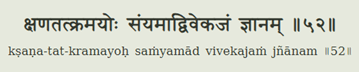
Through samyama on a particle of time and that which proceeds & succeeds it comes discrimination. –Translation by Swami Vivekananda.

A very simple way to consider this is a “flash” of  inspiration.   That unmistakable flood of everything all at once – like a holograph – you see the big picture and the details.  That holographic non-linear experience is a hallmark of the Jnanamaya Kosha. Sometimes it’s so subtle that you don’t even know the wisdom is moving through you, you just find yourself turning left when you need to go left. 

Time and sequence still exists in the JnanaMaya kosha – but  linear cause and effect dissolve into a bigger picture.   The Jnanamaya Kosha has a “zoom out” quality – the picture, the details and the context transform the sense of where you are in space and time.

My teacher used to say “You have to go way in to go way out”.  The deeper you go into your subtle interior in your yoga practice, the more expansive and holistic your vision is.  It is startling, surprising, and awesome.  It’s likely to be totally ordinary at the same time. 

Through the revelations contained in the Jnanamayakosha we may find the missing piece in the puzzle of our lives.  It reveals a deep understanding of an individual’s path through life, in the context of a billion other lives.  We may see the advantage of a shift in direction.  We are invited into intention,  discernment and awareness. The Jnanamaya Kosha is beyond time.

At the same time it reveals the macro operations of the universe. 

In the Jnanamaya Kosha – the large and the small lose their meaning.  A smile to a stranger on the street appears as significant as performing brain surgery – depending on the intent.  We may feel a sense of power and magnitude – as if our destinies are vast and magnificent, but all that wisdom asks of us may be a moment of kindness.  Because we see that an act of kindness, or honesty, no matter how small, is a magnificent act.

Here we meet our personal journeys to grow into deeply wise humans. It’s the intersection of the timeline of our lives with universal truth and how things work. 

The greatest obstacles entering the Jnanamaya Kosha is the hesitance we have that a vast degree of change that may be asked of us as the result of encountering this level of truth. It may arise as skepticism, dismissal of the numinous, or commitment to conventional paradigms, our mental constructs, busyness, and ambition of all kinds. Some methods which open the portal to the Jnanamayakosha are:

  • Well-done  Vinyasa ignites and reveals the Jnanamaya Kosha. Cultivate a pure and steady rhythm of breath. a healthy amount of detachment, and an ability to flow well and wisely through the sequence of postures.  Surrender into  synchronization with the rhythm of breath and  establish the practice in an elevated intention.
  • Study how things work through the laws of karma. This breaks our conventional paradigms of why things happen and opens us up to new ways of understanding cause and effect. Hold these laws lightly for the best effect.  
  • Patanjali’s Yoga Sutra provides many, many prescriptions for practice and the expected results.  For example – the sutra above.  Many of them are simpler to practice than this one.
  • Study of music
  • Study the  yoga asana sequencing of  the great masters.

For a few additional suggestions for playing in the Jnanamaya Kosha please see my Facebook page – NatalieteachesYoga for the most recent newsletter – or subscribe and it will be delivered to your inbox next month. No ads, I promise! Just substantive yoga content. 

Processing…
Success! You're on the list.

Time, Mastery, Vinyasa

Vinyasa, sometimes integrated with the idea of “flow” in yoga is rooted in  yogic mysticism.  It is fruitful to contemplate this time with a beginner’s mind as our practice deepens in time.  On the physical level, momentary awareness, intentional placement, the nature of transitioning and the unfolding of a sequence are effective tools to open into altered states of consciousness.  To contemplate the mystic roots of this practice reveals much about the nature of reality itself and how to engage it consciously.

In sutra 3:52 Patanjali advises that by meditating on the present moments in a sequence we come to know the nature of choice and results (discernment).

It sounds obvious and mundane, but in the revelation – it is anything but.  The yogi actually sees how they created this moment.  This provides understanding which facilitates the ability to create with intention.  We seldom arrive in a situation for the reasons we think we arrived there. 

The first time I experienced this, I was notified that I received an award.  Because I was a hot shot right?  No.  What was revealed to me during practice was that the moment of being honored was created by a dozen times when I had honored others and acted with sincere humility.  It was potent and unforgettable because I had longed for that acknowledgement for a long time,  and I am not very humble at all.  It revealed to me the potency of a small decision made with heart, and planted a seed for me to want to live a different kind of life.

So what is the physical body technique for this?  Vinyasa can be complicated, but the alpha and omega of it the rhythm of the breath in practice.  Yep.  Rhythm functions like a ticking clock.  It holds us in the present moment. Being fully in a present moment is the doorway to observing time from a different perspective. Music can be exhilarating by it’s very nature, but cultivating the presence of rhythm and lyrics consciously in our playlist choices can support opening into the full experience of asana practice and vinyasa in particular.

As home practitioners– this can be  one of the hardest facets of group practice to replicate at home.  So for this, I don’t try to replicate it.  I endeavor to work with the techniques in a different way.  Home practice allows us to explore a posture in deeper way related to positioning etc.  Once we’ve made progress with learning a sequence or a posture, benefit is obtained by spending time integrating the breath with the movement.  This kind of breathing is not like exercise breathing.  It requires a constant steady equilibrium of inhale 2 3 4, exhale 2 3 4.  Where the substance of the inhale and exhale are consistent throughout the breath.

Students have often asked about other kinds of breathing that they were told were “better” for one reason or another.  This isn’t about good or bad – it is just one specific technique used to develop one specific element of practice.  If you want to explore this deeper dimensions of yoga, I invite you to work this way with your breath.

For each blog post I create a newsletter which delves into related topics.  You can find this post’s related email here.  To sign up to receive the email in your inbox concurrent with the posting on the blog please sign up below.  I promise you will never be bombarded by marketing emails.

Processing…
Success! You're on the list.

About the body the body  – In time

Hatha Yoga Pradipika Verses 103-104

“All of the all the processes of hatha and laya yoga are but the means to attain raja yoga. (samadhi) One who attains Raja yoga is victorious over time (death).” (Bihar edition and translation)

Perhaps when you were a child you experienced being measured. Sometimes parents make marks on the wall to emphasize how much a child has grown physically. As children we were measured physically, intellectually, emotionally… how we are growing? Then at some point the nature of that measuring starts to compare itself to an end point rather than the beginning point.  We mark a wrinkle (one step towards old age) A gray hair (another step towards old age). Perhaps we worry more about a physical symptom than we would have when our hair was colored rich and deep and our skin was rosy and clear.  One great blessing of combining the inner and outer yogas is that the processes are designed to liberate us from time. A mark of a well-done yoga practice is that decline is minimized and many times even reversed. One advantage of studying the tales of the great accomplished masters is that they completely transcend time. They choose when to leave the body behind. It’s a great teaching. There are many records  (Paramahansa Yogananda, Shri Brahamananda Saraswati ) of enlightened beings whose bodies did not compose after death but remained intact as their devotees prepared the funeral rites. When Shri Brahmananda Saraswati was cremated it is said that his ashes were pure and white as snow. He also regenerated his body and brain after a stroke through study and practice of Sanskrit (an energetically based yoga practice).

What does that mean for us as contemporary yogis? We don’t really know. We don’t really know what that means. Will we be immortal? Do we want to be immortal? Will we just stay lively? Will we live on as souls beyond the body?

What we do know is that well-done yoga is a rejuvenating practice.  It’s hormonal, it’s energetic, it’s the nervous system but essentially to tap into the field of consciousness is to tap into that place beyond time and that is infinite.  To keep the spiritual dimensions of the practice front and center. Serenity makes for a great facelift.

How do we make this more tangible? The usual choices for this kind of experiment are meditation or chanting. The point is your body will change through these practices.  And you can practice it and find out.  Just note that other lifestyle choices will mitigate your results.  Wise lifestyle choices will enhance them. 

For me the door which opened the understanding of this spirit body connection was yogic chanting. I knew it immediately even though I was not spiritually or athletically accomplished. I was living in New York and had much pain in my body — weight training, aerobics, desk work, crazy diet — so many possible culprits for the pain. After finding no remedy that was clear through the western medicine lens I started yoga to ease the pain.

I noticed almost immediately that if the class started with an Om  my body didn’t hurt as much during class. I thought it was a goofy thing and I made jokes about it. I figured I was imagining things, but then I found the Jivamukti Yoga Center in New York. Chanting was central to that practice,  and I learned there that the ancient yogis understood that the body is made of sound. To those I spoke with and studied with there, when I made the statement that my practice was better if I Om’d first, it made perfect sense. I stayed with that practice for years and experienced many complex postures that I never imagined that I would do in part because my relationship with my body changed as I worked with this understanding that the body was made of sound. Things I could never imagine at 29 opened up for me as I moved towards and through a so called middle age. I am now 58 and I have less pain in my body than I did at age 29 – even in the wake of injury.

For this I rely on my yoga practice.

For the practitioner I believe that the bottom line of this is that we begin to consider that our bodies are not our masters — our hearts and our souls are. To embrace the spiritual aspects of the practice is not to deny the body but to nourish it at a deep level — beyond DNA, consciousness (which is experienced through practice) nourishes our very cells. You will be strengthened by it and it will cost you nothing to try.