Before our dive into Sankhya: Why Practice?

/*my apologies friends – there were two posts that ended up in drafts instead of being posted. I’m posting them today and will follow with the new post on Sankhya later this evening*/

Before we begin our study of Sankhya  (our first official post on that will be later today)– let’s dig in to our intentions for embarking on such a deep study. Why study this way?  Why practice?

There is value and delight in exploring the cracks and crevices of the yoga practice – going deep, mining the esoteric elements and using our time on the mat as a laboratory to experiment and empirically validate the findings of the ancient wise ones who brought forth and developed the practice.  The perpetual renewal of the desire for practice confirms that people do experience a potent and ineffable something when they practice yoga.

The rich and resonant core of the practice is unearthed through the investigation of the source of the practice.  To bow down our hearts and minds to those who have gone before us, paving the way that we too might walk towards freedom and enlightenment – to receive from the history of yoga practice.  For every step on this journey into depth and wisdom we are invited to the land of “Nyasa” the perfect placement (as in Vinyasa).  Why are we here and now? In this place in this moment?  Purpose and intention nurtures the practice and in return the practice reveals deeper truths about personal purpose and intention. 

/*Why practice?  Why practice in this way?*/

There are easier and more efficient ways to get in shape…so…

/*Why practice?  Why practice in this way?*/

There are easier ways to feel better… so….

/*Why practice?  Why do the work of studying yoga in this way?*/

Because our day to day experience of the practice yields a sense of promise, and the promise of yoga is the universal end of pain. “The end of all love longing”. (see the Kena Upanishad)

So as we embark on our exploration of the Sankhya philosophy in the coming weeks – know that sankhya understood in conjunction with our yoga asana is a profound and powerful  tool for tapping into a richer vein of practice. Yoga from the the source is path of transformation that subtly transforms the world as we are transformed through it. 

A well-done practice ranks among the world’s most treasured resources – path of treasure yielding transformation.   So….

/*why practice? the promise of the practice is there, but what does that mean for me?*/

Who will you be-coming?  What is the offering that you bring to the table in these times…and how will you wrap that package?  What is love asking of you at this time?  As with all things yoga, the questions are more important than the answers.  The questions guide our process – our unfolding in practice  – As we learn and grow our intentions unfold with us so it’s good to be flexible (we are yogis after all) – but it’s good to set our compasses- and know what our heart desires. 

So with that I nudge you to reflect before the coming year, on your practice, on your purpose, on the yield of the discipline you will bring to your study.

For every blog post, I send out an accompanying newsletter – different from the emails sent from WordPress. The newsletter allows me to go a little deeper, there are sometimes specific sutras, or chanting or musical suggestions, and maybe even some thoughts on sequencing or the body. It’s not a marketing newsletter – it’s designed for those who care enough about these topics to sign up!!!

This post’s newsletter is on with a sutra from Patanjali. If you ‘d like to see it check it out here:

To subscribe so you receive the materials on the same day – please sign up below.

Processing…
Success! You're on the list.

Jnanamaya Kosha: Understanding the Past and Future in the Ever Present Now

The Jnanamaya Kosha or Wisdom Body is the 4th (sheath, dimension, body, or kosha) identified in the koshic anatomical maps of yoga. This kosha will reveal experience beyond time and duality, where our differences collapse and a single moment contains eternity.,

Wisdom is timeless and of the moment, and at a certain point absolute right and wrong dissolve into merely moments and choices. It arises from a perception that is not hampered by opinion.  When we are living in wisdom we move in synchrony with the workings of the universe.  This reflected in Patanjali’s Yoga Sutra III:53

Through samyama on a particle of time and that which proceeds & succeeds it comes discrimination. –Translation by Swami Vivekananda.

A very simple way to consider this is a “flash” of  inspiration.   That unmistakable flood of everything all at once – like a holograph – you see the big picture and the details.  That holographic non-linear experience is a hallmark of the Jnanamaya Kosha. Sometimes it’s so subtle that you don’t even know the wisdom is moving through you, you just find yourself turning left when you need to go left. 

Time and sequence still exists in the JnanaMaya kosha – but  linear cause and effect dissolve into a bigger picture.   The Jnanamaya Kosha has a “zoom out” quality – the picture, the details and the context transform the sense of where you are in space and time.

My teacher used to say “You have to go way in to go way out”.  The deeper you go into your subtle interior in your yoga practice, the more expansive and holistic your vision is.  It is startling, surprising, and awesome.  It’s likely to be totally ordinary at the same time. 

Through the revelations contained in the Jnanamayakosha we may find the missing piece in the puzzle of our lives.  It reveals a deep understanding of an individual’s path through life, in the context of a billion other lives.  We may see the advantage of a shift in direction.  We are invited into intention,  discernment and awareness. The Jnanamaya Kosha is beyond time.

At the same time it reveals the macro operations of the universe. 

In the Jnanamaya Kosha – the large and the small lose their meaning.  A smile to a stranger on the street appears as significant as performing brain surgery – depending on the intent.  We may feel a sense of power and magnitude – as if our destinies are vast and magnificent, but all that wisdom asks of us may be a moment of kindness.  Because we see that an act of kindness, or honesty, no matter how small, is a magnificent act.

Here we meet our personal journeys to grow into deeply wise humans. It’s the intersection of the timeline of our lives with universal truth and how things work. 

The greatest obstacles entering the Jnanamaya Kosha is the hesitance we have that a vast degree of change that may be asked of us as the result of encountering this level of truth. It may arise as skepticism, dismissal of the numinous, or commitment to conventional paradigms, our mental constructs, busyness, and ambition of all kinds. Some methods which open the portal to the Jnanamayakosha are:

  • Well-done  Vinyasa ignites and reveals the Jnanamaya Kosha. Cultivate a pure and steady rhythm of breath. a healthy amount of detachment, and an ability to flow well and wisely through the sequence of postures.  Surrender into  synchronization with the rhythm of breath and  establish the practice in an elevated intention.
  • Study how things work through the laws of karma. This breaks our conventional paradigms of why things happen and opens us up to new ways of understanding cause and effect. Hold these laws lightly for the best effect.  
  • Patanjali’s Yoga Sutra provides many, many prescriptions for practice and the expected results.  For example – the sutra above.  Many of them are simpler to practice than this one.
  • Study of music
  • Study the  yoga asana sequencing of  the great masters.

For a few additional suggestions for playing in the Jnanamaya Kosha please see my Facebook page – NatalieteachesYoga for the most recent newsletter – or subscribe and it will be delivered to your inbox next month. No ads, I promise! Just substantive yoga content. 

Processing…
Success! You're on the list.

The Five Dimensions of You:  The Yogic anatomy of the Koshas – The PranamayaKosha

The study of yoga and yogic anatomy is a slowly evolving process of ever deepening understanding.  There is a difference between “knowing” yogic anatomy on a visceral level and memorizing the vocabulary.   Why is this relevant? Self-Mastery. As we explore these different modes of viewing ourselves through yogic anatomy, we open ourselves to new depths of understanding physically, psychologically, and spiritually.  We gain an illumined understanding of ourselves, our purposes and our pathway.  We become wise enough to navigate subtler realms as mapped in the concept of the sheaths or koshas (Yogic Anatomy – The Five Koshas,). The sheaths or koshas are interwoven and not distinct, like oxygen and helium molecules in the air – or dimensions as mapped by mathematics and science.  Experiencing them is like opening a portal to a universe similar to the one we live in “normally” but, it’s different.  . One moment we feel dull and confused and then an inner portal opens and we experience elevation – organically. We access wisdom, knowledge or subtle sensations of the body – and understand our wholeness differently.  Last post we explored the concept of the food body or Anamayakosha. Today I’d like to open the portal to the pranamayakosha – the pranic or breath body. It’s near and dear to all of us, and we experience it all the time.  We might not be aware of it. Exploring the pranamayakosha we step into the subtle realms of yoga.  It’s the first of the subtle koshas that many practitioners experience, which tells us that it’s connected the food body.  It’s impact on our psychological well-being tells us that it’s connected to knowledge, wisdom and bliss as well.  Just as becoming aware and awake to our physical body requires some understanding and attention, becoming aware and awake to our pranic body requires some understanding and attention too. This is why the pranamaya kosha is so important in our yoga practices – it’s where we start to explore a world beyond our usual perceptions. When the pranamaya kosha is clear – not muddied – it’s easier to experience the other bodies or sheaths with clarity.

It’s hypothesized that  prana (subtle energy – like human electricity) flows through the fascia. We don’t know for sure. We can’t yet measure it; we can only observe its effects.  This could change – science moves towards understanding yoga all the time. 

Within the pranamayakosha, the ancient yogis discerned a vast network of tiny channels which they called the nadis There are hundreds of thousands of nadis. One portal which opens the yogi’s perceptions of the pranamayosha is the breath.  Consider how breath is processed by the physical body: an invisible substance – air travels through a physical network of tiny tubes and sacs in the lungs through which the invisible substance of oxygen is absorbed and the invisible substance of carbon dioxide is released.  Prana is like this – it’s absorbed from the universe around us and it permeates and moves through the physical form –nourishing and cleansing it.  When the prana moves we are awakened, energized and healed.

Within the pranamayakosha are numerous structures formed by the intersection of the nadis. The chakras are vortexes located at key junctures of the nadis and the physical nervous system. There are three primary nadis which bracket the chakra system– the ida,  pingala and sushumna.  The prana moving through these three nadis governs the process of spiritual evolution.  When it moves clear and unobstructed we plug into knowledge, wisdom and bliss.

A first pathway to working with the pranamaykosha is to unclog the nadis and get the prana moving. All asana will unclog the nadis.  Vinyasa yoga will get the prana moving quickly.  . 

A second pathway to work with pranamayakosha is pranayama.  Pranayama is is a practice of restraining the breath in order to unclog the nadis. This is most effective when asana has been practiced consistently for a long time. Asana clears superficial levels of congestion – so the work of pranayama – deep and powerful breathwork – is not obstructed by more superficial congestion.  Pranayama is a transformative healing practice.  It’s best to prepare for it.

A third pathway to working with the pranamayakosha is sound.  The familiar sound and symbol of OM is called the “nadam”.  The ancient rishi’s or wise ones observed that Om purifies the whole system, like an ultrasound which accesses deep internal caverns of the body below the surface.  My experience with this is that working with classical Indian sound practices is the most effective means of actually clearing the nadis. Yogi’s chant the sound of OM, they meditate on the sound of Om, they listen to the sound of Om.   This would also include listening to or studying and learning Indian classical music which is designed around an understanding of OM. A fine experiment would be to explore different kinds of music when you practice.  At first what you are used to listening to may prove to be very energizing, but as you grow more adept at working with prana and sound, you may notice that Indian classical music is a distinctly powerful complement to your yoga practice.

A fourth pathway for working with the pranamayakosha is ”managing your energy” and in the yoga practices this is accomplished through attention.  A starting practice is focusing the breath or the gaze in your asana practice, with an intention to understand what your attention does to your energy and your postures.  Too weak of a process of reigning in attention leads the energy to scatter.  Too powerful of a restraint will be too harsh for the tender pranic channels. 

Four modes of creating a relationship with the pranic body:

  1. Yoga Asana
  2. Pranayama (advised for well experienced practioners)
  3. Sound
  4. Attention

A last note about the pranic body – The ancient yogic texts speak of the adamantine body formed by the hatha yoga practice.  This is distinctly related to and an outcome of the management and toning of the pranic body.  When the pranic body is well cared for – clear and moving and strong we become incredibly resilient.  The texts say all dis-ease is eradicated.  As contemporary yogis we can say that our immune system becomes incredibly potent in response to the health of the pranic body.  This, as the article included here indicates, is a result of consistent, well-done practice. 

To receive newsletters with a different perspective on the blogposts, please subscribe to my Mailchimp! I promise…no ads. Just more talk about yoga, maybe some reading and musical suggestions. All designed to supplement your yoga practice.

Processing…
Success! You're on the list.

Time, Mastery, Vinyasa

Vinyasa, sometimes integrated with the idea of “flow” in yoga is rooted in  yogic mysticism.  It is fruitful to contemplate this time with a beginner’s mind as our practice deepens in time.  On the physical level, momentary awareness, intentional placement, the nature of transitioning and the unfolding of a sequence are effective tools to open into altered states of consciousness.  To contemplate the mystic roots of this practice reveals much about the nature of reality itself and how to engage it consciously.

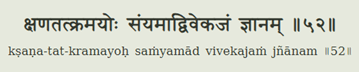
In sutra 3:52 Patanjali advises that by meditating on the present moments in a sequence we come to know the nature of choice and results (discernment).

It sounds obvious and mundane, but in the revelation – it is anything but.  The yogi actually sees how they created this moment.  This provides understanding which facilitates the ability to create with intention.  We seldom arrive in a situation for the reasons we think we arrived there. 

The first time I experienced this, I was notified that I received an award.  Because I was a hot shot right?  No.  What was revealed to me during practice was that the moment of being honored was created by a dozen times when I had honored others and acted with sincere humility.  It was potent and unforgettable because I had longed for that acknowledgement for a long time,  and I am not very humble at all.  It revealed to me the potency of a small decision made with heart, and planted a seed for me to want to live a different kind of life.

So what is the physical body technique for this?  Vinyasa can be complicated, but the alpha and omega of it the rhythm of the breath in practice.  Yep.  Rhythm functions like a ticking clock.  It holds us in the present moment. Being fully in a present moment is the doorway to observing time from a different perspective. Music can be exhilarating by it’s very nature, but cultivating the presence of rhythm and lyrics consciously in our playlist choices can support opening into the full experience of asana practice and vinyasa in particular.

As home practitioners– this can be  one of the hardest facets of group practice to replicate at home.  So for this, I don’t try to replicate it.  I endeavor to work with the techniques in a different way.  Home practice allows us to explore a posture in deeper way related to positioning etc.  Once we’ve made progress with learning a sequence or a posture, benefit is obtained by spending time integrating the breath with the movement.  This kind of breathing is not like exercise breathing.  It requires a constant steady equilibrium of inhale 2 3 4, exhale 2 3 4.  Where the substance of the inhale and exhale are consistent throughout the breath.

Students have often asked about other kinds of breathing that they were told were “better” for one reason or another.  This isn’t about good or bad – it is just one specific technique used to develop one specific element of practice.  If you want to explore this deeper dimensions of yoga, I invite you to work this way with your breath.

For each blog post I create a newsletter which delves into related topics.  You can find this post’s related email here.  To sign up to receive the email in your inbox concurrent with the posting on the blog please sign up below.  I promise you will never be bombarded by marketing emails.

Processing…
Success! You're on the list.

Repetition and Understanding Asana

There are a few ways that repetition is useful in a yoga practice.  First, it wears a groove and opens us to experiences of greater depth.  Constant change in our yoga practices is amazing- it builds resilience and the ability to adapt.  But this experience of yoga – to become yoked to our deeper wisdom self – requires that we dig down deep enough to hit a level of awakening beyond our normal waking state.  One benefit of getting in a groove, if we do it consciously, is that when our practice gets disrupted it’s easier to shift back into the positive mental and physical states we are cultivating.   Perpetual change can break  apart obstructions which obscure those deeper levels of ourselves, but once again, repetition is a key component to really getting deep in there.  Like digging a hole, if we just take out a scoop here and there as we wish…our well will never be dug deep enough to access the clear pure water.  Yoga works the same way.

Repetition is also a great tool for assessing our bodies from day to day.  To get an accurate assessment, we need to do the same posture as we did the day before.  Yesterday, my Ardha Matsyendrasana (Half seated spinal twist) was at a level I’d never experienced in 30 years of practice.  Today, it wasn’t even at my average.  This is interesting.  It’s information about my body, my habits and my stress responses to the world around me.  Repetition can lead to realization and understanding.

The other thing to consider though, is that repetition invites unconsciousness if it’s not the right time and place to do it.  I remember when I started practicing I frequented the local  Bikram studio. I thrived in the heat and the repetition.  Then one day my knees started to hurt.  I took a break from the practice and focused on Vinyasa for a while.  As I embraced returning to vinyasa, I realized that in Bikram class I was going to sleep. Instead of using repetition to fine tune my execution of the postures – I practiced by rote, but was thinking about cupcakes.  At first I thought the form of yoga I was doing was the problem.  I realized as I practiced more and became more knowledgeable that, no, I had just gotten bored and stopped paying attention to the details.  As a teacher I saw many students who gave up a posture or a style of yoga because they felt it wasn’t good for them. My experience is that when we experience a painful result it’s a call to greater attention to our moments on the mat, and to develop greater self awareness of the body in whatever way we can.  Sometimes a change in practice wakes us up.  Sometimes we just need to tune in deeply to what we are doing.

So how to practice with repetition in a way that is wise?  You can place the posture repeatedly at certain junctures in the sequence you are practicing.  Say Arhdhamatsyendrasana…at the beginning  before sun salutes, after standing, between back bends and forward bends, between each back bend.  Working this way requires that you begin with a very gentle execution of the posture and go progressively deeper. 

Another approach is to design a short sequence to prepare for the posture you are working on  and then repeat that entire short sequence at key junctures in your daily practice.  This creates depth, and you can tweak the  sequence to explore the impact of various lead ins to the posture you are exploring.

The last approach I’ll mention today is that you can just repeat a single posture several times a day, every day for a certain amount of time – a week, a month, a year.  This will help you truly own the posture in a healthy way – it creates an intimacy with it that can change your whole understanding of yoga. Practicing repetition in asana practice is a profound way to deepen your practice and to experientially deepen your understanding of particular postures, how they work, the dynamics created by placing them in certain points of sequence. It’s a great way to transition your practice and teaching from a place where you are practicing and teaching what you have been told by others into a place where you are practicing and teaching from your own inner knowing. 

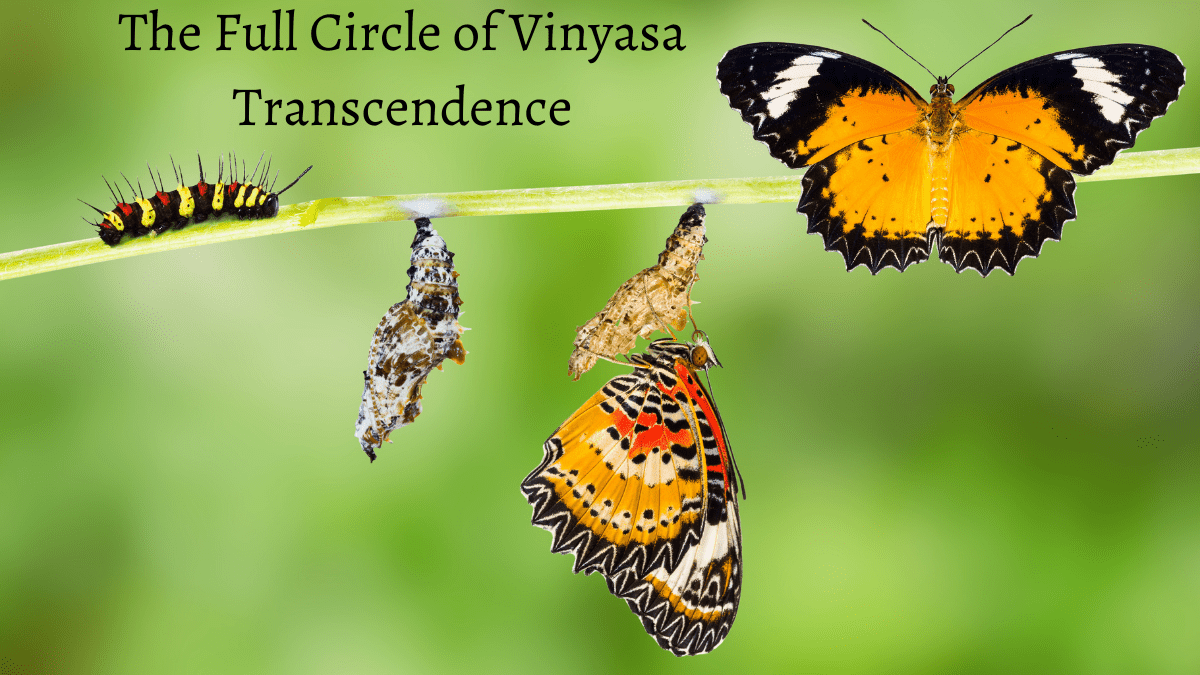
The Full Circle of Vinyasa – Transcendence

In its purest form, the Vinyasa experience  is what Patanjali calls samyamah, a synthesis of  forms of concentration which modulate the fluctuations of the mind, in this case, the focus is on breath, movement, intention and internal anchoring in the moment by moment unfolding of time.  The result is that beautiful transcendental physical flow that so many of us admire, aspire to and experience.   In my experience the vinyasa is an inner experience first, an inner experience of moving intentionally through time and space oriented primarily in an anchoring in the wisdom self. 

To understand this brings us to one of Patanjali’s key instructions about yoga, that yoga is nurtured through the practice of abhyasa (practice time spent dwelling in the true nature) or practice dwelling in our true nature, the wisdom self, and vairagya – detachment.  These practices form the landscape from which the classical practices of renunciation arise.  In it’s essential form, renunciation is an inner practice, developed through outer practice.  A simple moment when you soften around a moment of change can teach us a lot about the inner landscape of yoga.  What do we feel as we begin to move, is it sticky?  Clunky?  Awkward or painful?  Or does it flow?  Are we able to be still comfortably or at a different pace, comfortable?  Our capacity to do that is built on practicing this inner spaciousness which arises with practice and detachment.  The experience of and wake from the COVID related worldwide shutdowns has triggered an avalance of change.  Having survived four job changes and a tumultuous presidential election which, last night I found myself cringing in fear at the thought of further changes which will likely be unfolding as we move forward.  Who knows what’s coming?  Cringing.  I was  actually cringing.  And then, like a good dream my years of practice kicked in and I was awash in love and gratitude rather than fear of what was to come.  I am grateful that I was here in this beauty and that I have had the experience of knowing amazing people in my life.  Things may be different for all of us moving forward, but that doesn’t mean they won’t be good.  I find this way of vinyasa-ishly moving through a challenging experience helps me keep it in perspective.  It’s like walking through the streets of the city, any city.  Every neighborhood has it’s flavor and feel and we are just walking through those varying flavors and feels.  An uncomfortable neighborhood doesn’t require us setting up house there.  One the inner level we don’t need to set up camp in an interior landscape of opinion and belief which doesn’t serve us.  Instead we set up our camp in the wisdom self as we move through the discomforts and comforts  of life.  Th

In its purest form, the Vinyasa experience  is what Patanjali calls samyamah, a synthesis of  forms of concentration which modulate the fluctuations of the mind, in this case, the focus is on breath, movement, intention and internal anchoring in the moment by moment unfolding of time.  The result is that beautiful transcendental physical flow that so many of us admire, aspire to and experience.   In my experience the vinyasa is an inner experience first, an inner experience of moving intentionally through time and space oriented primarily in an anchoring in the wisdom self. 

To understand this brings us to one of Patanjali’s key instructions about yoga, that yoga is nurtured through the practice of abhyasa (practice time spent dwelling in the true nature) or practice dwelling in our true nature, the wisdom self, and vairagya – detachment.  These practices form the landscape from which the classical practices of renunciation arise.  In it’s essential form, renunciation is an inner practice, developed through outer practice.  A simple moment when you soften around a moment of change can teach us a lot about the inner landscape of yoga.  What do we feel as we begin to move, is it sticky?  Clunky?  Awkward or painful?  Or does it flow?  Are we able to be still comfortably or at a different pace, comfortable?  Our capacity to do that is built on practicing this inner spaciousness which arises with practice and detachment.  The experience of and wake from the COVID related worldwide shutdowns has triggered an avalance of change.  Having survived four job changes and a tumultuous presidential election which, last night I found myself cringing in fear at the thought of further changes which will likely be unfolding as we move forward.  Who knows what’s coming?  Cringing.  I was  actually cringing.  And then, like a good dream my years of practice kicked in and I was awash in love and gratitude rather than fear of what was to come.  I am grateful that I was here in this beauty and that I have had the experience of knowing amazing people in my life.  Things may be different for all of us moving forward, but that doesn’t mean they won’t be good.  I find this way of vinyasa-ishly moving through a challenging experience helps me keep it in perspective.  It’s like walking through the streets of the city, any city.  Every neighborhood has it’s flavor and feel and we are just walking through those varying flavors and feels.  An uncomfortable neighborhood doesn’t require us setting up house there.  One the inner level we don’t need to set up camp in an interior landscape of opinion and belief which doesn’t serve us.  Instead we set up our camp in the wisdom self as we move through the discomforts and comforts  of life.  Th

In its purest form, the Vinyasa experience  is what Patanjali calls samyamah, a synthesis of  forms of concentration which modulate the fluctuations of the mind, in this case, the focus is on breath, movement, intention and internal anchoring in the moment by moment unfolding of time.  The result is that beautiful transcendental physical flow that so many of us admire, aspire to and experience.   In my experience the vinyasa is an inner experience first, an inner experience of moving intentionally through time and space oriented primarily in an anchoring in the wisdom self. 

To understand this brings us to one of Patanjali’s key instructions about yoga, that yoga is nurtured through the practice of abhyasa (practice time spent dwelling in the true nature) or practice dwelling in our true nature, the wisdom self, and vairagya – detachment.  These practices form the landscape from which the classical practices of renunciation arise.  In it’s essential form, renunciation is an inner practice, developed through outer practice.  A simple moment when you soften around a moment of change can teach us a lot about the inner landscape of yoga.  What do we feel as we begin to move, is it sticky?  Clunky?  Awkward or painful?  Or does it flow?  Are we able to be still comfortably or at a different pace, comfortable?  Our capacity to do that is built on practicing this inner spaciousness which arises with practice and detachment.  The experience of and wake from the COVID related worldwide shutdowns has triggered an avalance of change.  Having survived four job changes and a tumultuous presidential election which, last night I found myself cringing in fear at the thought of further changes which will likely be unfolding as we move forward.  Who knows what’s coming?  Cringing.  I was  actually cringing.  And then, like a good dream my years of practice kicked in and I was awash in love and gratitude rather than fear of what was to come.  I am grateful that I was here in this beauty and that I have had the experience of knowing amazing people in my life.  Things may be different for all of us moving forward, but that doesn’t mean they won’t be good.  I find this way of vinyasa-ishly moving through a challenging experience helps me keep it in perspective.  It’s like walking through the streets of the city, any city.  Every neighborhood has it’s flavor and feel and we are just walking through those varying flavors and feels.  An uncomfortable neighborhood doesn’t require us setting up house there.  One the inner level we don’t need to set up camp in an interior landscape of opinion and belief which doesn’t serve us.  Instead we set up our camp in the wisdom self as we move through the discomforts and comforts  of life. That, is transcendence.