The Field of Mind & Yogic Anatomy: The Manomaya Kosha

“Yogas Chitta Vritti Nirodha” Patanjali Yoga Sutra 1.2 :

The state of yoga is achieved when we cease identifying with the fluctuations of the mind.

The mind as understood in the context of yoga anatomy is distinct from the brain. The brain doesn’t determine it’s function or condition. It is part of the subtle realms of consciousness which are distinct from the five senses.  Some yogic scholars identify the mind as a sixth sense.  The mind field, or what is called the Manomaya Kosha in the yogic anatomy maps of the five sheaths consists of conscious, unconscious, and super conscious thoughts, beliefs, concepts and ideas  — imagination, fantasy, projection, delusion and intellect.  In considering this sheath as a field we step into a realm of expansion revealed through the practices of yoga:  asana, meditation, observation, study.  Unlike the realms of prana, or wisdom or bliss the Manomaya Kosha sits in our awareness all the time. Some of it’s functions are more easily identified than others.  It interprets and defines. It assigns meaning. It governs perception. The world culture is permeated with instruction manuals for its management.   Just as we can become absorbed in the experience of the body to such an extent that everything else disappears (in sicknesses, deep pleasures or pain) we can become absorbed in the mind to such an extent that we lose sight of everything else (obsessive compulsive disorder, excessive worry, pessimism, delusion, illusion, fantasy).

Becoming aware of what happens in the ManomayaKosha, when we lose ourselves in it and what we can accomplish by managing it is a key development in our yoga practices. So essential is it in the practice of yoga – that the first line of Patanjali Yoga Sutra (which heads up this blog post) references it directly. Like the food body (Anamaya Kosha) and the pranic body (Pranamaya Kosha) can be clear and healthy and flexible and strong  – so can the mind body (the Manomaya Kosha).

The Manomaya Kosha sits at the juncture between what is human nature and what is spiritual nature. 

There are two primary tools for working with the Manomaya Kosha in our yoga practices.  The first is observation and the second is the mastery of the “seat”.

In yoga, our observation training consists of concentration on the breath, observing thoughts as they arise, consciously training to calm those fluctuations as we practice, and disciplining the body through focusing the mind.  There is association between the depths of postures and the depth of clarity in the Manomaya Kosha.  A deep posture being one where we are fully present (not lost in fantasy or topor or competitiveness or worry) and working deeply (relative to one’s own capacities) the tissues of the Anamayakosha (the muscles, bones organs skin – all of it – being squeezed and stretched and pressed upon.

We might work the observation piece like this:

  • Decide to awaken to what is in your mind
  • Establish a state of stepping back internally and witnessing (this can be the tough part)
  • Observe it objectively – meaning without getting involved – just “watch”. You will observe the arising, existing and falling away of a thought.
  • Keeping attention partially in the breath can facilitate the state of witnessing

The seat or connection to the earth is a foundation through which we master the mind in our asana practice.  It’s not unusual for awareness of our connection to the ground to be non-existent.  In all asana, and especially the classical meditative seats, there is a relationship to being grounded and experiencing a lifted spine.  This lifted spine is thought to work like an antenna for higher states of wisdom. If you are fortunate enough to see a buddha statue with a pointed hat…you are seeing his antenna!

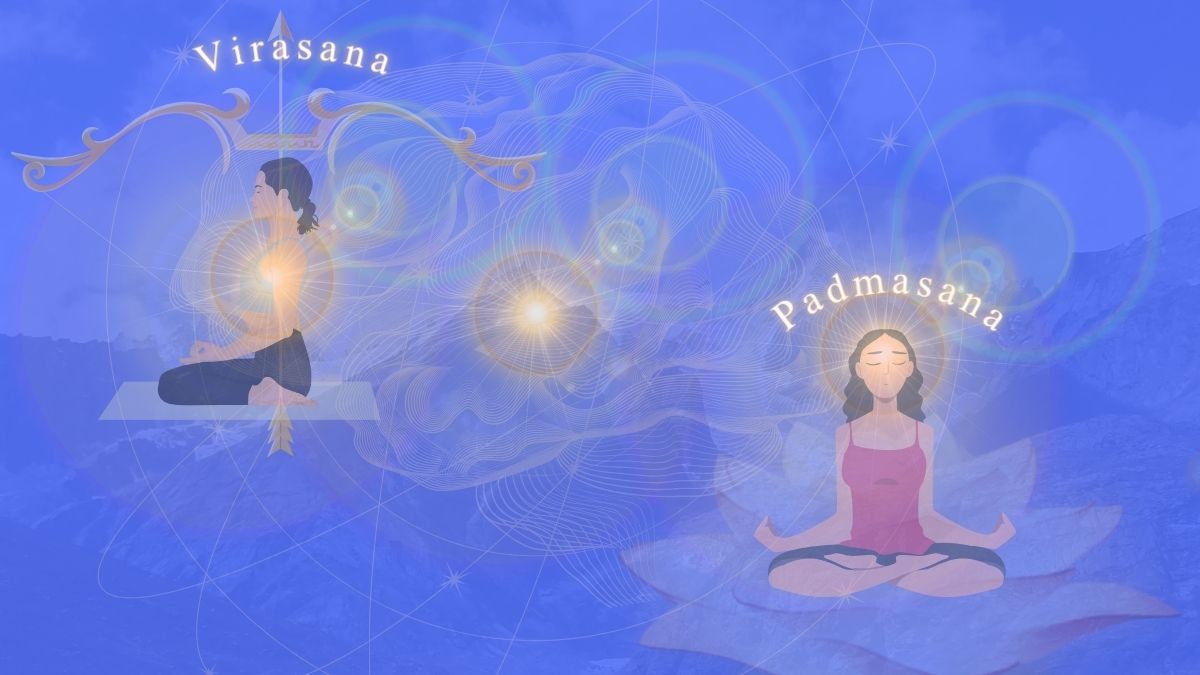
The classical seats I’d like to illuminate today are Virasana = the hero and Padmasana the lotus.  I encourage you to explore both of these with physical teachers (in person) and through your own research. These postures often become accessible only after considerable yoga practice. 

Virasana the hero is taken with the knees together, sitting between the heels with the sitz bones grounded.  The knees together – drawing inward – create a powerful gathering and focusing of energy which supports concentration and focus –  practices required for managing the mind.  The focused energy also creates a stability which lifts the spine.

Padmasana – the lotus – is unique in it’s combination of deep grounding and expansiveness.  The sitz bones are rooted into the earth, the knees are out to the side and the shins cross so that the soles of the feet face the sky.    When the shins cross a powerful acupressure point known as SP6 – the juncture of three major “yin” channels -Liver, Kidney and Spleen is toned.  Yin draws the energy inward. As with Virasana this inward energy creates a stability that lifts the spine.  Any posture with knees open to the sides will create openness and spaciousness.  With Padmasana we master our capacity to remain focused and steady in more and more expansive states of consciousness.  Padmasana allows us to sit with the experience of enlightenment. 

Want a little more “woo” in your life? No? Me neither. But yoga philosophy approached with wisdom is grounding and empowering. The philosophical elements are explored in my newsletter. I promise…it’s not a marketing email although I do suggest readings and music. You can sign up here. They are also posted simultaneously on my facebook business page – NatalieteachesYoga. Thanks for reading!

Processing…
Success! You're on the list.

About the body: Upping the Asana Game

Yoga is designed to be a lifetime practice.  Well-done practices evolve with us as we move through the changes of our lives – inviting ongoing processes of healing to unfold as our consciousness opens into deeper levels of awareness.  We’ve been talking about awareness of the spiritual heart.  One facet of the practice is that discipline and structure are required in order to have mastery over the mind and body so they don’t interfere with or obscure our experience of our essential being – our spiritual heart. 

In observation as a teacher, and as a long time yoga student, a primary focus in discipline is managing   sloth and torpor – and their  opposites – ambition and grasping.  To obtain the best results in our practice – we are well served to find a structured path between these two extremes.  We might call this the “Goldilocks” amount of effort.  Just enough.  When we are a bit lazy about our practice – it won’t be enjoyable enough to motivate us to make a commitment – we won’t really get the full picture what the yoga can do for us.  When we drive too hard there can be a backlash that causes us to drop out for some time.  Consistent practice (which in and of itself requires discipline) joined with healthy effort creates not only a lifetime practice, but also sufficient internal results to ignite the desire to keep practicing. 

One simple and very universal nonaggressive technique that we can develop to up our game in yoga is focus. Generally the practice of focus in asana will unfold from the external to the internal.  At first, we cultivate focus by not thinking about what is going on outside the room, then not thinking about what is going on beyond our mat, and then having full attention in the body and then full attention in the breath and then being able to abide consistently in the small quiet space in our hearts or minds as we move through a series of postures.  At some point we are able to do this for a sustained amount of time.  One way to check your focus is whether you are sweating or not!  Yep.  Breath makes you sweat, but so does focus.  If your practice isn’t “warming up” for you, try bringing a little more focus.  Some ways to do this might be practicing moving from one asana to another focusing on the breath.   The same move over and over i.e. Downward facing dog to Warrior One.   One breath one movement.  If your mind drifts outside of your body, try really focusing on the feeling of your hands and feet on the floor.  At first, it’s good to focus on something really neutral – and within your own body mind.  It can be helpful not to tell a story to yourself about what arises.  Just observe.  And stick to it for a while.  One week breath and movement, one week feeling hands and feet. 

—————————————————————-

I publish a newsletter in conjunction with these blog posts which rolls out themes related to the inner practices of yoga – the landscape of the mind in practice – often tied in with classic philosophical notes. Like to take a look? It only comes out every week or so, and there are no ads. I promise!

Processing…
Success! You're on the list.

Yoga, Freedom and Moving into Sovereignty

The focus this moon month in the newsletter is freedom or in Sanskrit, Mukti.  Mukti translates as “liberation”,  freedom, and it’s important to understand that freedom in the sense of yoga is different than freedom in of our day-to-day life – although they are related. We may think that having tons of money would be freedom or rebelling against social conventions would be freedom. Freedom is not inherent in those experiences.  Ask anyone who has very large amounts of money or who has lived in the counterculture for a long time and in their story you will hear of the oppressions that still remain.  In yoga  freedom is something that we develop inside ourselves as we cease identifying with the fluctuations (vritti’s) of our mind. That’s the  second sutra of Patanjali’s Yoga Sutra. The fluctuations of our mind frequently take the form of how we think of ourselves, how we think of others and how we think of the world we live in. These mental constructs can become rigid and block our ability to be open and spacious and, well, liberated.  The freedom of the yogi comes in the form of an inner sovereignty which allows us to become the masters of our own minds and to use that freedom to choose the path of love over and over again.

Yoga is a discipline that leads to freedom The practices of yoga involve experiencing certain kinds of restraint and under those conditions finding the freedom there. When the  restraint is lifted you have a different understanding of who you are. Restraint comes in the form of tying yourself in a knot in an awkward posture and remaining peaceful.  Restraint can mean  being willing to suspend our immediate desires in order to allow a higher state of wisdom consciousness to guide our actions.

When we tie ourselves in a knot in a posture we stir up the deep resistances we have to living.  The knots are knots within our consciousness and so the goal is that to breathe, to be present to what’s happening and not fight with it. Consider this first level of freedom one that you could find contentment even when circumstances around you are not to your liking.  That’s a tremendous amount of freedom. Sometimes for whatever reason it’s not the best idea to change a circumstance. Even though it’s uncomfortable, it’s better to be strong. This capacity is honed in the practice of asana.  Accept the limitation, breathe be still and allow your inner guidance to direct you step by step to moving beyond the limitation into a deeper expression of the posture.

This kind of yoga training reveals discernment – the capacity to understand if our impulses are coming from our authentic heart desires or our desire to control. It’s a powerful means of developing aligned autonomous inspired choice making. Sovereignty. It is a gift of the yoga practice born of moment by moment alignment with self and that is the freedom. Rather than having others dictate who we are or who we become  or what actions we take in our lives we are free to take action in alignment with our highest best interest.  Yoga will take us to a healthy and beautiful body of all different kinds of shapes and sizes but this is the heart of the yoga  – this sovereignty and the freedom that emerges through practice.

Experiencing Yoga:  Overcoming Obstacles within – without

This month in class – as we practice asana, we are holding space for the understanding of yoga as presented in the first pada or book of the timeless text Patanjali’s Yoga Sutra. In this pada Patanjali lays out the arc of yoga – he spells out the origin and result of the practice as well as  some fundamentals of practice itself.  He also spells out the inner and outer obstacles.  This is important.  Hundreds of thousands, maybe millions of people in the world find well-being in yoga.  We all want that  well-being, but, well, maybe we just don’t feel like we can do yoga. My teacher once taught me that the hardest part of yoga was just getting to class. Do you have obstacles? What are they?  As a yogi, I confront those obstacles daily. As a yoga teacher, my life is filled with persons telling me why they can’t practice — at job interviews, at the bank, at the dinner table and in the grocery store.    Hey, maybe you just don’t want to! Nothing wrong with that!  But if you do want to, acknowledging the obstacles and being willing to engage them can be a powerful move forward towards actually becoming stable in your practice. It’s really important to note that Patanjali spells out both inner obstacles (our thoughtforms) and outer obstacles (i.e.not feeling well). Adopting a two pronged approach to address these two apparently separate dimensions of our being can be a powerful catapult into a strong practice.

For many of us, the outer obstacles seem to be the easiest to focus on in the beginning.  It seems that  if there was just a little less traffic we could get there.  But, from the perspective of yoga, the outer obstacles always have an inner corollary.  The outer obstacles Patanjali identifies are: illness, laziness, negligence, the attraction of pleasures, confusion about the practice, attachment to the way things are and a tendency to fall back on old habits.  The inner barriers to the experience of yoga are the various thoughtforms that we have been conditioned to believe are true and unchangeable (“I’m not athletic – never have been since I was a kid”).    The solution to the equation is yoga.  In the samadhi pada Patanjali describes the experience of yoga arising as we shift away from identification with our conditioned thoughtforms and engage with and identify with the ground of consciousness which is fresh and clear and unfettered. 

Arm balances – historically – have always been a big struggle for me.  It took seven years for me to do a handstand.  When I finally stood on my hands, it was a surprise.  My physical effort had been minimal; linking to some measure of illumined consciousness had been maximal.  It’s a story I lived many times in my years of practice.  Today, faith in myself and a willingness to let go and link up with a more illumined perspective is still essential to my practice.  If that linkage wobbles, so does my posture.  But what I saw in that moment of my first handstand was that I had held myself down with the belief that I could not support myself with my own two hands.  To be honest, that epitomizes much of my life journey and my journey through yoga.  It’s been a journey from dependence to independence. 

The first step is a little bit of willingness to see what our inner thought forms are.  We don’t have to worry about changing them.  A willingness to consider that they are there can go a long way towards dissolving them.  Patanjali identifies them as:

  • What we’ve learned intellectually from valid sources
  • What we’ve learned intellectually from invalid sources
  • Hearsay – what we’ve heard about, but have never experienced.
  • The arising of states of non-wakefulness (sleepiness)
  • Recall – drawing forth of past experiences (memory)

Because the obstacles can be so deeply embedded in our programming it does take a bit of faith to get on the mat at all.  But if we desire the sovereignty to deeply transform ourselves and our world that desire can propel us along in our practice until faith in the practice emerges.  It’s all in what you focus on.