Sankhya, sovereignty and the sense of touch

In our investigation of the Sankhya philosophy and asana we begin with a study of the senses.   On the map, the senses are on the bottom row, left side – classified under sattva.  (see image below) For now we will consider sattva as awareness.  Senses are intimately connected to the quality of awareness.  Classically,  yoga is a discipline through which we access and become aware of our inner wisdom through practices by which we are trained to withdraw our senses from the external world.  As we turn them inward – our connection to the sacred and the infinite resources of wisdom and awareness are revealed.  The magnificence of asana is that it is a physical practice which results in a state of transcendent experience and understanding beyond the physical. Working consciously with our senses facilitates opening to greater levels of awareness and allows us to realize those more illumined states of awareness in the physical world.

When we practice, keeping measured attention on the breath will develop the objectivity we need to interpret the information we take in through our senses.

We can think of the information that we take in from our senses as data and the understanding and interpretation of that data is done by the mind.  Sankhya philosophy identifies different aspects of mind.  We’ll get to that later.  I just point this out because it’s just like looking at a spreadsheet,   The numbers don’t mean anything.  The meaning comes from analysis and the purpose with which you observe and work with  them. The more we can step back into an objective, non-interpretative relationship with our sense data the more we will understand about yoga.  For example, pain can be dangerous, healing, warning, or a clue for a potential adjustment. We need to be in a non-interpretive state to discern the meaning of the pain.

The following five senses organs are enumerated in the sankhya philosophy: 

The eye, the ear,  the tongue, the nose and the skin.

The disciplines of focus and austerity in the yoga practice are designed so that, just as we might learn to articulate the movement of a limb, we might also manage those sense organs.  As our practice evolves into greater levels of subtlety, we become masters of how a given piece of sensory data is interpreted.

*****************************

Today I’d like to consider touch.  Touch is a very physical sense and the physical body is the asana yogi’s primary vehicle.  The fundamental  and first level of awakening awareness of touch in the yoga practice comes through the feet on the ground.  Consider the following progression: 

  1. Tadasana: mountain posture – the feet are both on the ground  steady and even – the weight dispersed through the pads of the toes the ball and the heel. Both feet work together as one foot.
  2. Vrksasana – tree posture – we shift the weight to one foot, and connect the sole of the other foot to the inner leg.  The weight of the body is evenly dispersed through the standing foot
  3. Virabhadrasana 2 – warrior II -we begin to master weight distribution between two feet with the same sense of dispersion between the toe, ball and heel pads. 
  4. Adho Mukha Vrksanana – handstand – all the weight on two hands (look ma – no feet!)
  5. Adho Mukha Svanasana – Both hands and both feet on the earth and separated and new possibilities emerge in terms of weight distribution and articulation of the hands and feet against the earth. 

Some things we might note:

  • The touch of the body against the earth
  • The touch of two parts of the body against one another
  • The touch sensation of distribution of weight.
  • The touch sensation of activation of muscles and pressure.
  • Add to this the qualities that might be included in the experience of touch:
    • pain
    • pleasure
    • revulsion
    • hot or cold
    • heavy or light

Through attention and awareness the sense of touch becomes proprioception and kinesthetics – where our awareness of the inner landscape awakens and knowing our purpose in time and space. 

Take it further –   what is revealed is how the body works – including the internal organs.  Through attention to the more overt layers of sensation – awareness of the subtle developes and we awaken into clairsentience.  “I have a feeling”.  It’s like a gut instinct but much subtler and tuned to a different frequency.  Consider laying your hands on someone – a gesture of friendship or love or passion – all different frequencies or “vibes”.  Touch also has a relationship with the heart – this “I have a feeling” is a dimension of the emotional heart but also the spiritual heart. 

For the asana yogi, the heart is the seat of the nadam, the inner guru, sound vibration, the sound of vibration of Om.  Yes.  Vibration.  Detected by touch. 

When we practice asana we open doors to expanded understandings of….well, everything.  So as we pay attention to touch in practice – it opens the question of “pain” in yoga practice.  Many opposing views of how to relate to pain in yoga are espoused in the yoga community.  But through awareness we develop discernment about the sensations in our body – like pain.  This awareness is related to our personal sovereignty.

Consider a way  of relating to ourselves and the world which relies totally on external sources for interpretation (the doctor, the internet, our mother, the person one mat over from us in class).  This way of relating which denies our capacity to interact observe and interpret the signals of our own body.

Consider a way of relating  where the sensation itself governs us.  For example “Oops I feel something – I’m not going there into that forward bend, back bend, – I’m going to avoid sensation completely”.  The healing potential of the posture is never even approached.  We give our power of choice away to the sensation.

Consider a different way of relating, different than the ways described above.  Consider becoming aware of a sensation, observing, breathing, noticing the quality, and then noticing the quality change as we gently shift the body part a millimeter, or stretch a little deeper.   Then we come to know:

 “Oh – this pain indicates I need  the attention of the doctor”, or  

Oh, this pain indicates I need to go deeper in the practice”, or

Oh, this pain indicates I need to be gentle in practice”, or

Oh, this pain indicates I’ve been slumping at my desk.”

Through careful observation of sensation we reclaim our power of CHOICE.  No small thing.  Moving into this state of sovereignty by activating awareness and choice –  we no longer make the pain all powerful by ignoring, fighting or delegating it.  We hold the possibility in our hands and through attention we discern the next best step towards wholeness, healing and yoga.

I always try to create a post and a newsletter to be released simultaneously. They aren’t for marketing purposes. This is just a way to share what I learned in my years of teaching. In the coming releases I anticipate that the information in both will really be useful. You can sign up below. You will not receive anything other than these materials. The newsletters are also available on the NatalieteachesYoga facebook page and on Tumbler.

Processing…
Success! You're on the list.
An image of the chart of the sankhya philosophy with senses illuminated.

2024 Why Practice?

/* hello friends, my apologies – these posts somehow ended up in drafts when I thought I sent them. Call forth a study of awareness and one clearly meets their own unconsciousness!! They are best read before the new year posts. Thank you for reading!!*/

As the new year begins we will  embark on a journey through a leisurely study  of Sankhya philosophy as a tool to enrich our personal  yoga practices.  Sankhya is a philosophy rooted in India. It’s prevalent in the bhakti yogic text of the Bhagavad  Gita.  It’s foundational for the understanding of yoga’s sister discipline – the healing art of Ayurveda.  When I attended teacher training – we had to learn it.  But in practice I found it, limiting, laborious confusing, even as I understood on some deeper level that my assessment was off because I never gave it due attention.

So I’ve decided to spend time in my practice now exploring sankhya within my daily practice…and I thought you might enjoy being with me on that journey. It’s complex, and like our exploration of the koshas will unfold over months.

When working with the  dimensions of the classical root teachings around yoga – I find it imperative to practice with  a teaching – in order to really understand its relevance to the practice.   The intellectual exercise alone is not sufficient.

For me that means not a simple one-time design of a sequence – but a dedicated period of time that I practice with it daily.  A proverb from my teacher “through repetition, the magic is forced to rise”.  This is true in all aspects of our practice. 

Why  would we want to deepen our practice by digging into the realms of philosophical thought and then trying to apply them on the mat? 

Through the classical practices of yoga we yoke to the infinity of mind.  From Patanjali Yoga Sutras: 

तदसंख्येयवासनाभिश्चित्रमपि परार्थं संहत्यकारित्वात् ॥ ४.२४ ॥

tadasaṃkhyeyavāsanābhiścitramapi parārthaṃ saṃhatyakāritvāt || 4.24 ||

Yoga Sutra IV.24  The mindstuff itself reflects the infinity of the mind and acts as the unifying agent of the countless individual manifestations.

As we go through practicing Sankhya we will uncover the pivotal nature of the mind stuff and the higher mind.  This sutra touches on that…As we get clear – our mind will not reflect our neurosis, our insecurities or our fears.  Our mind will reflect the infinite state of consciousness.  At the point that it reflects that it generates a perception or union rather than division.  Of “one” rather than a multitude.  In that state we become super high functioning. 

What does that have to do with asana?  What will be revealed in an intimate way is that your physical body is intimately interconnected with the infinity of mind.  Yep.  Think healing on a grand scale.

What does that high functioning unified state look like?

Good meditation

Staying calm and effective while in turbulent or painful conditions.

Finding creative solutions

Inspired action and direction.

Becoming true. 

Transforming the body.

I like becoming true best. In the moment of yoga when we experience union we know who we are – not just spiritually but what we are here to do physically.  And to keep this out of the abstract – let’s say it clarifies purpose, it renders understanding in our lives, it opens possibilities- to experience the truth of who we are in tangible direct ways. 

It’s tempting to think we know who we are.  But the identity – the truth of ourselves is ever expanding, constantly changing and beyond any cultural definitions.  The world will always tell us who it wants us to be.  Yoga will always draw forth who we can be.  With discipline, understanding and wisdom yoga reveals a pathway through which those two apparently differing identities can be yoked together and cultivated as a pathway of personal growth and mastery.

The gift of approaching a study like Sankhya is that it becomes a tool through which we can tweak and adjust and fine tune our journey into and through this kind of dynamic expanding grounded  Self-expression.

In the map of Sankhya we will discover the poles of higher consciousness (simplicity) and grounded physical experience (complexity).  The fulcrum between the two is the mind.  So we will discover – as Patanjali shares with us in the sutra above that what occurs in the mind reaches into the experiences of the most fundamental sensory and action-based functions – and also reaches into the depth of what is often called the “Self”

We can experiment with this.  Meditate for 5-10 minutes before doing your self-practice. Observe your experience on the mat from a sensory perspective with and without meditating first.  And then continue that.  Maybe try it for a week, and then take a week off. Listen for a rhythm of your own which helps you explore what meditation does for your asana practice. It’s not unusual to have physical breakthroughs after deepening your meditation practice.  For this exercise  you would probably want to consider working with  a classical form of meditation like Vipassana. 

————————————————————————————————————————

Why practice?  What’s the point of incorporating the teachings from the so-called source texts.

Not relevant.

I have heard this many times as a teacher and a student.  That the classical teachings are not relevant.  Before we set sail on the ship of sankhya, I thought it would be helpful to consider why “Not relevant” is not the answer.  For this it’s helpful to revisit the folklore around the development of hatha yoga, and turn our vision towards how a so called “sacred text” can influence our practice in a significant way – a way worth the time it takes to incorporate such study into our practice.

Hatha Yoga was said to emerge among the untouchable caste in India sometime ago.  The untouchable caste was not permitted to attend or be in association with those who were performing sacred rituals.  They weren’t permitted anything at all of the spirit.  They weren’t permitted to honor God in any way that was known or acceptable at the time.  Humans do this.  They exclude.

There is a lot of power in spirituality.  To know and have a relationship with “God”.  People with power like to restrict access to that to a selective group.   And so, in India it is said that Lord Shiva (a a God who had some physical existence as well) taught Hatha yoga to the untouchables as a form of worship that could be secret,  and that they could not be prevented from performing.   Note:  this is very rough explanation of a very complex historical, social phenomenon.  It suffices for a paragraph, but I do encourage greater study. 

The point I’d like to make is that Hatha Yoga was designed to connect people with sacred truth – which is beyond our intellects, beyond our brains, beyond our imaginations.  It’s only found through revelation.  Hatha Yoga is an equalizer.  Anyone can practice in such a way that the doors to revelation can open.   The importance of lineage – if you have heard of that – is that it ensures that the practice descends from teacher to student in such as way that the sacred opening is still available.  It’s not obscured.  Once again, it’s very likely that there are those out these who would like those doors to relevation to be obscured or want to claim the power of the practice for themselves.  But staying true to the sacred truth – the essential truth ensures that you will be moving towards the truth. 

What does that have to do with sacred texts?  And by that, I mean texts that have some connection to those original sources.  Patanjali’s Yoga Sutras, The Bhagavad Gita, the Hatha Yoga Pradipika and so on. 

By studying them yourself…it reinforces that your will move you  in the direction of the truth.  When we were told we had to study Sanskrit in my teacher training in 1999 – we questioned this.  Isn’t it a dead language (well, I think it’s being resurrected by the worldwide yoga community)?  There were a few points made in the conversation:

By reading these texts, we didn’t have to rely on anyone else’s interpretation. 

Even if we didn’t study  Sanskrit, we were told that we should read at least four different translations to experience the broad scope of meaning contained in the original worlds.

Sanskrit is said to be vibrational – it came into being when people were first trying to use the sounds of the voice to communicate.  Because of that – the feeling behind the words can be experienced.  It opens the door to a supra-verbal understanding of the human in the cosmos. 

The texts open up different ways of seeing life and practice our place in the  cosmos and the power that each and everyone of us has to transform ourselves and the world we live in.  The study creates experiences in the mind reflective of what asana creates in the body.  The body is also a reflection of what we access with the mind.  They are deeply interwoven.

In practice – reading sacred texts, even in our first languages – is difficult.  Because the truth contained in a true source text is so vast it’s like a holograph – it contains everything in each microscopic unit.  At first we may not be able to read it at all, because on the surface no meaning comes through.  As we practice – we gain clarity and the meaning of the texts becomes more accessible. 

Processing…
Success! You're on the list.

Jnanamaya Kosha: Understanding the Past and Future in the Ever Present Now

The Jnanamaya Kosha or Wisdom Body is the 4th (sheath, dimension, body, or kosha) identified in the koshic anatomical maps of yoga. This kosha will reveal experience beyond time and duality, where our differences collapse and a single moment contains eternity.,

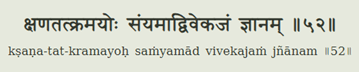
Wisdom is timeless and of the moment, and at a certain point absolute right and wrong dissolve into merely moments and choices. It arises from a perception that is not hampered by opinion.  When we are living in wisdom we move in synchrony with the workings of the universe.  This reflected in Patanjali’s Yoga Sutra III:53

Through samyama on a particle of time and that which proceeds & succeeds it comes discrimination. –Translation by Swami Vivekananda.

A very simple way to consider this is a “flash” of  inspiration.   That unmistakable flood of everything all at once – like a holograph – you see the big picture and the details.  That holographic non-linear experience is a hallmark of the Jnanamaya Kosha. Sometimes it’s so subtle that you don’t even know the wisdom is moving through you, you just find yourself turning left when you need to go left. 

Time and sequence still exists in the JnanaMaya kosha – but  linear cause and effect dissolve into a bigger picture.   The Jnanamaya Kosha has a “zoom out” quality – the picture, the details and the context transform the sense of where you are in space and time.

My teacher used to say “You have to go way in to go way out”.  The deeper you go into your subtle interior in your yoga practice, the more expansive and holistic your vision is.  It is startling, surprising, and awesome.  It’s likely to be totally ordinary at the same time. 

Through the revelations contained in the Jnanamayakosha we may find the missing piece in the puzzle of our lives.  It reveals a deep understanding of an individual’s path through life, in the context of a billion other lives.  We may see the advantage of a shift in direction.  We are invited into intention,  discernment and awareness. The Jnanamaya Kosha is beyond time.

At the same time it reveals the macro operations of the universe. 

In the Jnanamaya Kosha – the large and the small lose their meaning.  A smile to a stranger on the street appears as significant as performing brain surgery – depending on the intent.  We may feel a sense of power and magnitude – as if our destinies are vast and magnificent, but all that wisdom asks of us may be a moment of kindness.  Because we see that an act of kindness, or honesty, no matter how small, is a magnificent act.

Here we meet our personal journeys to grow into deeply wise humans. It’s the intersection of the timeline of our lives with universal truth and how things work. 

The greatest obstacles entering the Jnanamaya Kosha is the hesitance we have that a vast degree of change that may be asked of us as the result of encountering this level of truth. It may arise as skepticism, dismissal of the numinous, or commitment to conventional paradigms, our mental constructs, busyness, and ambition of all kinds. Some methods which open the portal to the Jnanamayakosha are:

  • Well-done  Vinyasa ignites and reveals the Jnanamaya Kosha. Cultivate a pure and steady rhythm of breath. a healthy amount of detachment, and an ability to flow well and wisely through the sequence of postures.  Surrender into  synchronization with the rhythm of breath and  establish the practice in an elevated intention.
  • Study how things work through the laws of karma. This breaks our conventional paradigms of why things happen and opens us up to new ways of understanding cause and effect. Hold these laws lightly for the best effect.  
  • Patanjali’s Yoga Sutra provides many, many prescriptions for practice and the expected results.  For example – the sutra above.  Many of them are simpler to practice than this one.
  • Study of music
  • Study the  yoga asana sequencing of  the great masters.

For a few additional suggestions for playing in the Jnanamaya Kosha please see my Facebook page – NatalieteachesYoga for the most recent newsletter – or subscribe and it will be delivered to your inbox next month. No ads, I promise! Just substantive yoga content. 

Processing…
Success! You're on the list.

The Five Dimensions of You:  The Yogic anatomy of the Koshas – The PranamayaKosha

The study of yoga and yogic anatomy is a slowly evolving process of ever deepening understanding.  There is a difference between “knowing” yogic anatomy on a visceral level and memorizing the vocabulary.   Why is this relevant? Self-Mastery. As we explore these different modes of viewing ourselves through yogic anatomy, we open ourselves to new depths of understanding physically, psychologically, and spiritually.  We gain an illumined understanding of ourselves, our purposes and our pathway.  We become wise enough to navigate subtler realms as mapped in the concept of the sheaths or koshas (Yogic Anatomy – The Five Koshas,). The sheaths or koshas are interwoven and not distinct, like oxygen and helium molecules in the air – or dimensions as mapped by mathematics and science.  Experiencing them is like opening a portal to a universe similar to the one we live in “normally” but, it’s different.  . One moment we feel dull and confused and then an inner portal opens and we experience elevation – organically. We access wisdom, knowledge or subtle sensations of the body – and understand our wholeness differently.  Last post we explored the concept of the food body or Anamayakosha. Today I’d like to open the portal to the pranamayakosha – the pranic or breath body. It’s near and dear to all of us, and we experience it all the time.  We might not be aware of it. Exploring the pranamayakosha we step into the subtle realms of yoga.  It’s the first of the subtle koshas that many practitioners experience, which tells us that it’s connected the food body.  It’s impact on our psychological well-being tells us that it’s connected to knowledge, wisdom and bliss as well.  Just as becoming aware and awake to our physical body requires some understanding and attention, becoming aware and awake to our pranic body requires some understanding and attention too. This is why the pranamaya kosha is so important in our yoga practices – it’s where we start to explore a world beyond our usual perceptions. When the pranamaya kosha is clear – not muddied – it’s easier to experience the other bodies or sheaths with clarity.

It’s hypothesized that  prana (subtle energy – like human electricity) flows through the fascia. We don’t know for sure. We can’t yet measure it; we can only observe its effects.  This could change – science moves towards understanding yoga all the time. 

Within the pranamayakosha, the ancient yogis discerned a vast network of tiny channels which they called the nadis There are hundreds of thousands of nadis. One portal which opens the yogi’s perceptions of the pranamayosha is the breath.  Consider how breath is processed by the physical body: an invisible substance – air travels through a physical network of tiny tubes and sacs in the lungs through which the invisible substance of oxygen is absorbed and the invisible substance of carbon dioxide is released.  Prana is like this – it’s absorbed from the universe around us and it permeates and moves through the physical form –nourishing and cleansing it.  When the prana moves we are awakened, energized and healed.

Within the pranamayakosha are numerous structures formed by the intersection of the nadis. The chakras are vortexes located at key junctures of the nadis and the physical nervous system. There are three primary nadis which bracket the chakra system– the ida,  pingala and sushumna.  The prana moving through these three nadis governs the process of spiritual evolution.  When it moves clear and unobstructed we plug into knowledge, wisdom and bliss.

A first pathway to working with the pranamaykosha is to unclog the nadis and get the prana moving. All asana will unclog the nadis.  Vinyasa yoga will get the prana moving quickly.  . 

A second pathway to work with pranamayakosha is pranayama.  Pranayama is is a practice of restraining the breath in order to unclog the nadis. This is most effective when asana has been practiced consistently for a long time. Asana clears superficial levels of congestion – so the work of pranayama – deep and powerful breathwork – is not obstructed by more superficial congestion.  Pranayama is a transformative healing practice.  It’s best to prepare for it.

A third pathway to working with the pranamayakosha is sound.  The familiar sound and symbol of OM is called the “nadam”.  The ancient rishi’s or wise ones observed that Om purifies the whole system, like an ultrasound which accesses deep internal caverns of the body below the surface.  My experience with this is that working with classical Indian sound practices is the most effective means of actually clearing the nadis. Yogi’s chant the sound of OM, they meditate on the sound of Om, they listen to the sound of Om.   This would also include listening to or studying and learning Indian classical music which is designed around an understanding of OM. A fine experiment would be to explore different kinds of music when you practice.  At first what you are used to listening to may prove to be very energizing, but as you grow more adept at working with prana and sound, you may notice that Indian classical music is a distinctly powerful complement to your yoga practice.

A fourth pathway for working with the pranamayakosha is ”managing your energy” and in the yoga practices this is accomplished through attention.  A starting practice is focusing the breath or the gaze in your asana practice, with an intention to understand what your attention does to your energy and your postures.  Too weak of a process of reigning in attention leads the energy to scatter.  Too powerful of a restraint will be too harsh for the tender pranic channels. 

Four modes of creating a relationship with the pranic body:

  1. Yoga Asana
  2. Pranayama (advised for well experienced practioners)
  3. Sound
  4. Attention

A last note about the pranic body – The ancient yogic texts speak of the adamantine body formed by the hatha yoga practice.  This is distinctly related to and an outcome of the management and toning of the pranic body.  When the pranic body is well cared for – clear and moving and strong we become incredibly resilient.  The texts say all dis-ease is eradicated.  As contemporary yogis we can say that our immune system becomes incredibly potent in response to the health of the pranic body.  This, as the article included here indicates, is a result of consistent, well-done practice. 

To receive newsletters with a different perspective on the blogposts, please subscribe to my Mailchimp! I promise…no ads. Just more talk about yoga, maybe some reading and musical suggestions. All designed to supplement your yoga practice.

Processing…
Success! You're on the list.

Time, Mastery, Vinyasa

Vinyasa, sometimes integrated with the idea of “flow” in yoga is rooted in  yogic mysticism.  It is fruitful to contemplate this time with a beginner’s mind as our practice deepens in time.  On the physical level, momentary awareness, intentional placement, the nature of transitioning and the unfolding of a sequence are effective tools to open into altered states of consciousness.  To contemplate the mystic roots of this practice reveals much about the nature of reality itself and how to engage it consciously.

In sutra 3:52 Patanjali advises that by meditating on the present moments in a sequence we come to know the nature of choice and results (discernment).

It sounds obvious and mundane, but in the revelation – it is anything but.  The yogi actually sees how they created this moment.  This provides understanding which facilitates the ability to create with intention.  We seldom arrive in a situation for the reasons we think we arrived there. 

The first time I experienced this, I was notified that I received an award.  Because I was a hot shot right?  No.  What was revealed to me during practice was that the moment of being honored was created by a dozen times when I had honored others and acted with sincere humility.  It was potent and unforgettable because I had longed for that acknowledgement for a long time,  and I am not very humble at all.  It revealed to me the potency of a small decision made with heart, and planted a seed for me to want to live a different kind of life.

So what is the physical body technique for this?  Vinyasa can be complicated, but the alpha and omega of it the rhythm of the breath in practice.  Yep.  Rhythm functions like a ticking clock.  It holds us in the present moment. Being fully in a present moment is the doorway to observing time from a different perspective. Music can be exhilarating by it’s very nature, but cultivating the presence of rhythm and lyrics consciously in our playlist choices can support opening into the full experience of asana practice and vinyasa in particular.

As home practitioners– this can be  one of the hardest facets of group practice to replicate at home.  So for this, I don’t try to replicate it.  I endeavor to work with the techniques in a different way.  Home practice allows us to explore a posture in deeper way related to positioning etc.  Once we’ve made progress with learning a sequence or a posture, benefit is obtained by spending time integrating the breath with the movement.  This kind of breathing is not like exercise breathing.  It requires a constant steady equilibrium of inhale 2 3 4, exhale 2 3 4.  Where the substance of the inhale and exhale are consistent throughout the breath.

Students have often asked about other kinds of breathing that they were told were “better” for one reason or another.  This isn’t about good or bad – it is just one specific technique used to develop one specific element of practice.  If you want to explore this deeper dimensions of yoga, I invite you to work this way with your breath.

For each blog post I create a newsletter which delves into related topics.  You can find this post’s related email here.  To sign up to receive the email in your inbox concurrent with the posting on the blog please sign up below.  I promise you will never be bombarded by marketing emails.

Processing…
Success! You're on the list.

The Elements of Sadhana: Santosha- Contentment

In the newsletters we’ve been talking about creating a sadhana – a conscious spiritual practice of yoga, a discipline of yoga as conscious spiritual practice. This past week I introduced the mahavratam or great vows outlined in Patanjali’s Yoga Sutra. These vows aren’t something that Patanjali devised – he compiled them from studying with the esteemed yoga masters of the day (which was some time a few  thousand years ago no precise date is known).  There are ten of them. They are often considered to be moral imperatives. In practice I’ve found it more useful and more authentic  – I get better results – if I let that idea of morality go and open up to practicing them whenever and however I can, trusting that they are actually learning devices for me.  Through practicing them I open to understanding who I am and who everyone else is.  As I open to understanding I make better  choices. The ten mahavratam are: nonviolence, non stealing,  adherence to truth, continence, non- hoarding, cleanliness, contentment, austerity, self- reflection and devotion. In the newsletter I briefly talked about the practice of saucha or cleanliness. Today I’d like to speak a little bit about contentment, or santosha. 

One thing to consider when practicing these – they’re also called yamas and niyamas, restraints and observances – is that we are always creating. We are creative beings – extensions of the divine, which is the creative energy of the universe, the supreme creative energy of the universe. This is an underlying paradigm of the yoga practice.  The yoga practice will reveal that we a specks of divine creative consciousness – and we can live from that truth. This is co-creating, which is yoga – to be yoked to the divine. The restraints and observances clear the palette of our consciousness, enabling creativity which is unbridled by our past. 

 With yoga the idea is that creating in alignment  with the infinite divine opens the doorway to limitless possibilities- and that wisdom, that intelligence – will create richer more satisfying possibilities than our personalities with their cravings and conditioned attunement to lack. If we choose it, these practices deepen our understanding of the elements of a good life.  This is partly why I encourage you to set aside the idea that they are imposed morality.  Practiced lovingly, they open the way to a delicious abundant live.  Less is more. 

With the practice of santosha or contentment this connection between our behaviors our beliefs our thoughts in the world that we experience is made very clear. 

Perhaps in your life you have met those or perhaps you’ve been in this space yourself ( I know I have been) where you feel a need to complain about everything. I’ve seen a real uptick in this during the COVID situation. 

 I think we can all agree there is much to be addressed in the world., but right now we have to accept what’s happened and what is happening and learn to work with it. Shaking our fists at a perceived enemy is unlikely to change the world…changing ourselves is likely to change the world, not only because we engage those conversations differently. 

But let’s think back to the before time – before COVID – and remember those days in offices or classrooms or social gatherings where we or our friends or neighbors or our family would lapse into days where we complained and complained and complained. Surely we’ve all known in ourselves or others that momentum that complaining develops – once you start complaining there just seems to be more to complain about. The yogis understood this very deeply through their meditations , analysis and self reflection. The practice of contentment is to practice contentment under all circumstances that’s a key of these mahavratam – under all circumstances.   So in any moment (the grandeur of universality demands we operate one moment at a time) when faced with complaining, we choose contentment.  It’s like putting down a heavy object.  “I just don’t want to carry the weight of my complaints, so I’m a gonna put this down, right here.”  It’ll be okay.  Once we’ve entered a quieter state of mind, wise action can emerge more clearly. 

What does that mean – in the yoga practice – to work a difficult situation? Perhaps it is to rest in the understanding that you’ve participated in the creation of it and take responsibility for the fact that you’re there. You skip the blame (of yourself and others) you skip the victim story and nurture and invite the ability to see the situation differently.  Liberation arises when we realize there is no one to blame.  The practice of contentment opens our minds so that we are able to see that. To be honest, in content I perceive that there is nothing to complain about.  It’s all perfect.  But to deeply know that feeling we have to practice.  

One of the ways that we can train ourselves in the vast practice of contentment is to practice on our yoga mats. One of the most obvious powerful and potent ways to do this is to be content with a posture even as you are working to transform it. Where I am is fine but I’d like to deepen it. I’d like to expand it; I’d like to move to the next expression of it. So the first part of that is to enjoy every posture just where you are with it. This is one of the reasons why the postures that we can’t do are so important. As I say this I realize that this is one of the biggest difficulties of a home practice is that we never bump into those postures that we don’t like. At the same time if the classes available around us are not suitable – to force ourselves to go into a class that is just full of difficulties makes no sense either.  So what can be a good idea in your practice is to add a small step towards a posture that you would like to attain someday. For me right now this is wheel urdva dhanurasana. 

 I had an accident last fall where my wrist was smashed. I’ve consciously decided to recover slowly. In my full practice days I would do three full or wheel postures every day.  Wow right?  To me that seems like wow.  I was never a born gymnast. That posture has intense ramifications on the wrist and feels remote to me but at a certain point I had an intuition a revelation that in fact I would be able to do it again in this lifetime So what I’m going to practice this moon month is to sit at the wall and take a camel posture and place my hands on the wall. A highly modified introduction to the movement that would lead to wheel. And I am content.. This is the beauty of modifications in yoga. What they do is – if you practice them fully,happily embracing what the modification has to offer you – it’s actually like working the full posture you develop the shape energetically on a deep level and it opens from the inside out. One day your’re ready and the full posture emerges – like a chuck busting out of an egg. 

So how do we learn about modifications if we’d like to incorporate them in our sadhana?  I highly recommend them even if you don’t have an injury. Spend some time in modified postures.  By working with the modifications you’ll learn some of the paradigms of postural yoga. We’re very fortunate to live in an opulent world where there’s all kinds of information about yoga on the Internet so I’m sure you can find some information about modifications there.  As far as books books go and even Internet the best school of yoga from which to learn about modifications is the Iyengar school so I encourage you to look into that when choosing postures to work in your sadana. 

Once you’ve practiced santosha on your mat for some time don’t be surprised if you  catch yourself practicing it in your life.  You don’t have to make a big trip out of doing all of these mahavratam.  Just know that they can extend to all circumstances, and they’re not limited.  Your contentment is not limited to certain circumstances.  You can start practicing them in certain circumstances until you feel confident to apply them in more challenging circumstances.  

OK that’s our blog post for today. As always it’s my sincere wish that this information be useful to you and that your practice will lead you to a blessed and wonderful life. 

Compilation of Newsletters for the April Moon Month

Kundalini Image

Compilation of Newsletters for the April Moon Month

Arundhati, the Awakening of Creation

This word arose in my awareness this month as I took a glance at The Hatha Yoga Pradipika scribed by Swami Swatmarama.  The translation I read, issued by the Bihar School in India, contained commentary by Swami Muktibodandanda of the lineage of Swami Sivananda Saraswati.  While the  text is thought to have been scribed in the centuries after 6 AD, it claims it’s mystical roots in the primordial origins of the sacred knowledge of Hatha Yoga from the beginning of time.  Swami Muktabonananda mentions Arundhati as another name for  kundalini, the powerful feminine creative source, which resides dormant and resting in the terrain of the subtle energy body commonly associated with the cradle of the pelvic bowl.  Muktabodananda breaks the word Arundhati down into “arun” translated as “dawn” and “dhati” which he translates to mean to “generate” or “create”. The dawning of a new creation.   Arundhata, he adds, means unobstructed.  It’s a  powerful description of the potent and mysterious creative potential within each and every one of us, and a clue to tapping into the potential of our yoga practice.  Hatha Yoga in it’s essential expression is a discipline in the management and effective direction of this creative force, leading us to a place of full alignment with  and expression of our sacred potential in this world and beyond.

Folklore runneth over with tales of the power and pitfalls of awakening this goddess force.  The most famous teller of these tales is Gopi Krishna who wrote a book about the unexpected eruption of his kundalini force and the trials and tribulations of having the energy charge through his body.  Any time we encounter powerful expressions of feminine creative forces it’s good to consider that, historically, feminine power has been feared and this has resulted in a great deal of distortion of information related to these energies.  My experience in energy work while working with students and clients over the years is that the awakening of this force does not have to be violent or disruptive.  It does not require forceful action to ignite it (although you can try that if you want).  It’s part of human evolution that it organically awakens when we have certain experiences, some of which are the practices of yoga.  Yoga ignites it and supports in the management and direction of  the energy.  What is important is how well prepared you are and how well you are able to sustain a healthy environment for the unfolding of this energy.

When the energy is managed in a balanced and well directed manner, what unfolds is gentle awakenings and shifts in perspective and understanding.  The way this is cultivated, is through balance.  In the simplest sense, creating an environment in the body, mind and life which is neither aggressive nor passive (think easefully assertive), neither nurturing of depression nor anger (think peace), and vaster than self absorption (think relating) will create a habitat for a productive and rich unfolding. Nurturing  a balanced state allows the process to be one of healing, rather than a struggle to control.

When the energy is directed in an uplifting but grounded  fashion,  the creative process reflects a spiritually evolutionary journey, and an important one.  It’s the upliftment that leads us to a higher vision, the transcendence of a mundane understanding of the world we live in.  What is the use of this?  A well balanced cultivated transcendence nurtures an empowered and liberating perspective.  It opens us up to our capacity to choose.  In a gentle and non-reactive way, we learn, step by step, to function without feeling trapped in the confirmed of the opinions or perceptions of those around us.  WE are opened to align with our inner truth across the varying facets of our person — from our relationship to our body to our relationship with our higher power and everything in between (in realms of love, power, creativity).

OM

From Patanjali’s Yoga Sutra:  1.28-1.29:

Repeat the sound of Om and all is revealed.  This anchors one in inner consciousness and dissolves obstacles.

This month we are investigating the direction and management of or essential creative  force, known by many names, primarily kundalini, but this month I’m thinking of it as Arundhati.  This week we’ll begin by exploring the most simple and fundamental technique for managing this energy, and that is Om.

Om is vibrationally whole.  It contains within it every sound, and every possible vibration so it is the closest thing to totality that we can merge with materially.  When we focus on parts – this or that – then our creative force becomes divided. This can diminish clarity and inhibit the yogic process.

Om is beyond language.  Beyond language there is no limit – we can create something wholly new and not yet conceived of.  Beyond language we are not bound to create within that which already can be named.

The resonance of Om permeates all levels of our being – the physical, emotional, mental and  spiritual so it’s capacity to illuminate unity impacts all of the dimensions of who we are.

Practically, how does this mystical practice pan out?  Well, when you have a moment of conflict, within or without.  Stop and Om, inside or out and allow yourself to tune into the sound and feel, it will uplift the energy and pull into the center.  Before practice, it points us in the right direction.

The Straight Arrow

To begin with:  It’s said that no effort in yoga  is ever lost.  It stays with you forever – no matter how clumsy the attempt.

The bottom line? In it’s purest form, the Arundhati (another term for the primordial sacred energy kundalini) travels through the energy channels along the spine, easily piercing the tangles and moving upward directly toward illuminated consciousness.  The only thing that can create this experience is pure devotion.  One instant of pure devotion to a spiritual ideal, love, truth or God, can be sufficient.  In an instant Arundhati’s journey is complete and we experience the Truth of everything.  The purity of the devotion comes from an unadulterated desire to experience that spiritual ideal.

Unadulterated is one word which could reflect this, uninterrupted is another one.  That would mean never wavering into lack of faith or anger or delusion about the state of affairs in the universe – meaning that we have right relationship to both our spiritual lives and our material lives in an undivided way.  Holding the space for both of them as the waves of life press against us.

In the tales of the Mahabharata and the Ramayana (ancient Indian epics which illuminate the principles of yoga), the heart of the stories revolve around archery, the greatness of the archers and the dedication to their craft.  The stories illuminate the rewards of accomplishment and the pitfalls which deter the practitioners as well.  Author Ramesh Menon, one translator of these epics, details the nature and the precision of a well-aimed arrow – the all-consuming focus and calculation required.  The target is determined,  and at the beginning of the arrow’s journey it is positioned in such a way that one would expect it to travel smoothly through varying conditions  towards it’s destination – the target.  To have such expertise and insight is phenomenal.

In a pure classical yoga practice there is only one target – the state of yoga.  If we aren’t aiming for that target, well that’s okay, the effect is never lost.  This is a spiritual principle, but you may have already observed it’s a physical one too.  You may have experienced  that when an asana aligns it’s more of a discovery than an accomplishment and after a break in practice you move back to the level of accomplishment more swiftly than the initial journey. The point is that all practice is sustainable on some level.

These detours of the straight line of Arundhati aren’t always errors.  Sometimes they are little side trips into discoveries and experiences which are helpful.  The yoga practice teaches us that just about any action or experience when offered with a sense of devotion, can serve to establish the right direction in the inner flow of our consciousness.

It’s All Good

We started the month speaking about the creative force Arundhati, most often known as kundalini.  We spoke of how this force can be violently awakened, or naturally awakened.  We’ve used spaciousness in the hips to gently open the channels surrounding the energy in it’s dormant state, and focused on our third eye centers to encourage the energy in an upward direction.  Is that it?  Is that Yoga?  Well, these are practices of yoga, but in the experience of “YOGA”, the state of union arises unites and ignites the central energy channel, the sushumna, from our roots to our crowns.  Then, there is union, there is yoga, there is bliss, there is understanding and wisdom.

So how do we do this?  Let’s take a simple decision.  Should I eat chocolate chips or carrots?  The mind flips from one to the other, “good” “bad” “black” “white” “sun” ‘moon” “right” “left”.  This movement of the mind is reflected in the channels of energy by movement from right to left, left to right.  We fluctuate.  Patanjali says that Yoga occurs when the fluctuations are no longer dominant.  Stop.  Breath.  Lift the pelvic floor. Focus on the 3rd eye center.  Center!!

Maybe the first time or the millionth time you do this the creative energy moves fully into the central channel and you move out of duality.  If you are all in, roots to crown, mind and heart, you move out of duality.  “Carrots good, chocolate chips good.  It’s all good”.  This is the union of the sun and the moon.  Opposites and fluctuations between apparent opposites no longer exist.  Any choice made from that point of view is beyond duality.  There is no wrong choice.  We become the Om itself.  Yogis absorbed in this Om state experience profound healing.  We are yoked to the cosmos within and without on a sublime level.  Don’t forge…Om is a technique which will get you there, as well, it’s the journey and the destination.

On a practical level we step into the flow.  Everyone experiences this state of union organically from time to time.  The practices of yoga allow us to cultivate them intentionally.

Compilation of Newsletters for the April Moon Month

Arundhati, the Awakening of Creation

This word arose in my awareness this month as I took a glance at The Hatha Yoga Pradipika scribed by Swami Swatmarama.  The translation I read, issued by the Bihar School in India, contained commentary by Swami Muktibodandanda of the lineage of Swami Sivananda Saraswati.  While the  text is thought to have been scribed in the centuries after 6 AD, it claims it’s mystical roots in the primordial origins of the sacred knowledge of Hatha Yoga from the beginning of time.  Swami Muktabonananda mentions Arundhati as another name for  kundalini, the powerful feminine creative source, which resides dormant and resting in the terrain of the subtle energy body commonly associated with the cradle of the pelvic bowl.  Muktabodananda breaks the word Arundhati down into “arun” translated as “dawn” and “dhati” which he translates to mean to “generate” or “create”. The dawning of a new creation.   Arundhata, he adds, means unobstructed.  It’s a  powerful description of the potent and mysterious creative potential within each and every one of us, and a clue to tapping into the potential of our yoga practice.  Hatha Yoga in it’s essential expression is a discipline in the management and effective direction of this creative force, leading us to a place of full alignment with  and expression of our sacred potential in this world and beyond.

Folklore runneth over with tales of the power and pitfalls of awakening this goddess force.  The most famous teller of these tales is Gopi Krishna who wrote a book about the unexpected eruption of his kundalini force and the trials and tribulations of having the energy charge through his body.  Any time we encounter powerful expressions of feminine creative forces it’s good to consider that, historically, feminine power has been feared and this has resulted in a great deal of distortion of information related to these energies.  My experience in energy work while working with students and clients over the years is that the awakening of this force does not have to be violent or disruptive.  It does not require forceful action to ignite it (although you can try that if you want).  It’s part of human evolution that it organically awakens when we have certain experiences, some of which are the practices of yoga.  Yoga ignites it and supports in the management and direction of  the energy.  What is important is how well prepared you are and how well you are able to sustain a healthy environment for the unfolding of this energy.

When the energy is managed in a balanced and well directed manner, what unfolds is gentle awakenings and shifts in perspective and understanding.  The way this is cultivated, is through balance.  In the simplest sense, creating an environment in the body, mind and life which is neither aggressive nor passive (think easefully assertive), neither nurturing of depression nor anger (think peace), and vaster than self absorption (think relating) will create a habitat for a productive and rich unfolding. Nurturing  a balanced state allows the process to be one of healing, rather than a struggle to control.

When the energy is directed in an uplifting but grounded  fashion,  the creative process reflects a spiritually evolutionary journey, and an important one.  It’s the upliftment that leads us to a higher vision, the transcendence of a mundane understanding of the world we live in.  What is the use of this?  A well balanced cultivated transcendence nurtures an empowered and liberating perspective.  It opens us up to our capacity to choose.  In a gentle and non-reactive way, we learn, step by step, to function without feeling trapped in the confirmed of the opinions or perceptions of those around us.  WE are opened to align with our inner truth across the varying facets of our person — from our relationship to our body to our relationship with our higher power and everything in between (in realms of love, power, creativity).

OM

From Patanjali’s Yoga Sutra:  1.28-1.29:

Repeat the sound of Om and all is revealed.  This anchors one in inner consciousness and dissolves obstacles.

This month we are investigating the direction and management of or essential creative  force, known by many names, primarily kundalini, but this month I’m thinking of it as Arundhati.  This week we’ll begin by exploring the most simple and fundamental technique for managing this energy, and that is Om.

Om is vibrationally whole.  It contains within it every sound, and every possible vibration so it is the closest thing to totality that we can merge with materially.  When we focus on parts – this or that – then our creative force becomes divided. This can diminish clarity and inhibit the yogic process.

Om is beyond language.  Beyond language there is no limit – we can create something wholly new and not yet conceived of.  Beyond language we are not bound to create within that which already can be named.

The resonance of Om permeates all levels of our being – the physical, emotional, mental and  spiritual so it’s capacity to illuminate unity impacts all of the dimensions of who we are.

Practically, how does this mystical practice pan out?  Well, when you have a moment of conflict, within or without.  Stop and Om, inside or out and allow yourself to tune into the sound and feel, it will uplift the energy and pull into the center.  Before practice, it points us in the right direction.

The Straight Arrow

To begin with:  It’s said that no effort in yoga  is ever lost.  It stays with you forever – no matter how clumsy the attempt.

The bottom line? In it’s purest form, the Arundhati (another term for the primordial sacred energy kundalini) travels through the energy channels along the spine, easily piercing the tangles and moving upward directly toward illuminated consciousness.  The only thing that can create this experience is pure devotion.  One instant of pure devotion to a spiritual ideal, love, truth or God, can be sufficient.  In an instant Arundhati’s journey is complete and we experience the Truth of everything.  The purity of the devotion comes from an unadulterated desire to experience that spiritual ideal.

Unadulterated is one word which could reflect this, uninterrupted is another one.  That would mean never wavering into lack of faith or anger or delusion about the state of affairs in the universe – meaning that we have right relationship to both our spiritual lives and our material lives in an undivided way.  Holding the space for both of them as the waves of life press against us.

In the tales of the Mahabharata and the Ramayana (ancient Indian epics which illuminate the principles of yoga), the heart of the stories revolve around archery, the greatness of the archers and the dedication to their craft.  The stories illuminate the rewards of accomplishment and the pitfalls which deter the practitioners as well.  Author Ramesh Menon, one translator of these epics, details the nature and the precision of a well-aimed arrow – the all-consuming focus and calculation required.  The target is determined,  and at the beginning of the arrow’s journey it is positioned in such a way that one would expect it to travel smoothly through varying conditions  towards it’s destination – the target.  To have such expertise and insight is phenomenal.

In a pure classical yoga practice there is only one target – the state of yoga.  If we aren’t aiming for that target, well that’s okay, the effect is never lost.  This is a spiritual principle, but you may have already observed it’s a physical one too.  You may have experienced  that when an asana aligns it’s more of a discovery than an accomplishment and after a break in practice you move back to the level of accomplishment more swiftly than the initial journey. The point is that all practice is sustainable on some level.

These detours of the straight line of Arundhati aren’t always errors.  Sometimes they are little side trips into discoveries and experiences which are helpful.  The yoga practice teaches us that just about any action or experience when offered with a sense of devotion, can serve to establish the right direction in the inner flow of our consciousness.

It’s All Good

We started the month speaking about the creative force Arundhati, most often known as kundalini.  We spoke of how this force can be violently awakened, or naturally awakened.  We’ve used spaciousness in the hips to gently open the channels surrounding the energy in it’s dormant state, and focused on our third eye centers to encourage the energy in an upward direction.  Is that it?  Is that Yoga?  Well, these are practices of yoga, but in the experience of “YOGA”, the state of union arises unites and ignites the central energy channel, the sushumna, from our roots to our crowns.  Then, there is union, there is yoga, there is bliss, there is understanding and wisdom.

So how do we do this?  Let’s take a simple decision.  Should I eat chocolate chips or carrots?  The mind flips from one to the other, “good” “bad” “black” “white” “sun” ‘moon” “right” “left”.  This movement of the mind is reflected in the channels of energy by movement from right to left, left to right.  We fluctuate.  Patanjali says that Yoga occurs when the fluctuations are no longer dominant.  Stop.  Breath.  Lift the pelvic floor. Focus on the 3rd eye center.  Center!!

Maybe the first time or the millionth time you do this the creative energy moves fully into the central channel and you move out of duality.  If you are all in, roots to crown, mind and heart, you move out of duality.  “Carrots good, chocolate chips good.  It’s all good”.  This is the union of the sun and the moon.  Opposites and fluctuations between apparent opposites no longer exist.  Any choice made from that point of view is beyond duality.  There is no wrong choice.  We become the Om itself.  Yogis absorbed in this Om state experience profound healing.  We are yoked to the cosmos within and without on a sublime level.  Don’t forge…Om is a technique which will get you there, as well, it’s the journey and the destination.

On a practical level we step into the flow.  Everyone experiences this state of union organically from time to time.  The practices of yoga allow us to cultivate them intentionally.

Be among the first to read these newsletters, and have the links to class delivered to your inbox directly!!

Processing…
Success! You're on the list.

Where Vinyasa Begins Intention

A long time ago when I began to practice yoga vinyasa, one day during practice this thought arose ….this must have something to do with surfing…that riding of the waves of breath and movement.  I sensed, that there was some common element physically.  I found out soon there after that the first “landing” of yoga vinyasa in America was in the surfing communities of Hawaii and California.  The connection between the two disciplines, I felt, must have been mula bandha.  Mula bandha is a physical lift of the pelvic floor which allows one to balance while moving.  Esoterically mula bandha is associated with the practice of inner alignment, to direct one’s energy towards the highest possible levels of mystical consciousness.  It is a practice which leads to tremendous clarity.  We don’t need to go into deep resonance with the sacred to know this, if you’ve even done a few rounds of sun salutation, you know that clarity emerges quickly with such a practice.  While there is a physical component of mula bandha, the activation of it on the level of consciousness is achieved only through intention.  The physical activation of the pelvic floor wakes the energy up.  The direction of our focus will determine where the energy goes.  There is no right or wrong about the directing of energy, but it’s good to know that our results will very much be determined by  the direction of the energy.  In true vinyasa fashion this idea is circular, our intention . will determine our focus which will determine the direction of the energy which will then create a result which will influence our intention and so forth. The most important moment In our yoga practice is the moment we override inertia and consciously go about choosing a direction. 

In the classical schools the only intention considered potent enough to activate the bandha was  desire to know God.  The aspirant would begin each practice bowing down to God and the Guru who represented God in form.  In America this intention became softened somewhat to offering the good of our practice to others, a classic Buddhist practice.  The energetic result is the same because the energy is directed towards something beyond our personal needs.  It’s uplifted.  In recent years in America the practice of intention has shifted again, now to honoring ourselves and good self care.  Good self care is essential to a yoga practice, but as an intention it can keep you anchored in what you need, rather than your most illumined potential. Following Patanjali’s formula we know that what we focus on grows.  We don’t want our needs to grow. The heart of the yoga practice is to transcend our needs and fulfill our potential (hence the complex landscape of renunciation practices which have historically defined the practice).  Deprivation is undesirable and not effective.  But to direct our intention higher than our needs is to uplevel our capacity for living.  But even this requires some conscious consideration. We need to be aware of what we are intending. 

To offer oneself as a vehicle for the divine may result in a role where you are the deliverer of blessings hard truths.  An important, but not always fun role.  An intention to serve may yield gracious and elegant opportunities to serve others, but you may have to deal with constraints on your self expression or ability to make decisions.  To intend to know true compassion may inspire you to give away your last dollar.  To intend to align with the most magnificent and expanded vision of your divine sacred infused snowflake self (no two are alike you know) well….that may lead you on your own magnificent divine journey which may include being compassionate in your own unique snowflake way.   It’s nothing we need to fear.  The point is to be awake and clear in the creative opportunity that Vinyasa presents.  Vinyasa, broken down into it’s parts is to place on purpose.  To place a purposeful intention at the beginning of our practice and then to consciously observe our ability to focus as the moments arise and fall in the practice is to take ownership of the power of asana in a whole new way.   Intending a practice is frequently invoked in yoga class, which is good.  Then it is up to us to discern the best way to use that opportunity. 

(c)natalieullmann

Make it Easy on Yourself, Trust the Process

“But, whether the form be perfect or imperfect, the Being of the form is perfect [wisdom] power, substance, and intelligence.” The Life and Teaching of the Masters of the Far East, David T. Spalding.

I was married in my early thirties to an academic, a social scientist.  I’d been raised by a father who was protestant farmer turned highly successful businessman, a capitalist.  His advice to me when I was growing up was that I could have whatever I wanted if I worked hard.  My husband the academic found this very funny, as he observed me struggling to climb my way up the corporate ladder.  “You think hard work will save you.  This is a faulty philosophy.” I resisted his analysis, but I never forgot it, and as the years went by realized that there was some truth to it.  Shortly before my father passed away I spoke to him about my occupational struggles and he said, “Well, I guess I just got lucky.”  These days, I understand that perhaps success is a result of combination of things.  I have accepted the idea that it really isn’t hard work alone.  My ex-husband would have broken down the various obstacles to receiving (or not) rewards for hard work as some combination of class and economic oppression.  This may be true from a certain perspective.  But there are those, like my father, who successful slip through all those obstacles and find themselves successful, sometimes wildly unexpectedly, as in his case.  From the yoga perspective, whether on the mat or off, the key to successful navigation of the complex landscape of our lives is a combination of focus and spiritual alignment, or steadiness and spacious, or stability and ease – all these being expressions of the dynamic play of the opposites threaded through the universe and managed through the practices of yoga.  This month we are contemplating the idea of sukha (or comfort, ease, sweetness, joy) which Patanjali, a well-respected ancient sage and expert in yoga, advises is a key component of a successful posture.  One key to bringing sukha into our practices on and off the mat, is to identify  where we make things harder than they are, and let go of that. 

One of the first things we can get hung up on is doing the posture “right”.  Doing the posture “right” is very hard work, and well, there isn’t a lot of agreement about what is “right” in a posture.   Even the shapes themselves change in time.  If we try to get all the details “right” we can end up working too hard prematurely. We might be better served to consider just doing a posture well – meaning, weight balanced, reaching in all directions of the body equally, being present in  our bodies and breathing.  You will get there.  In time, the details will fill themselves in.  You will grow from feeling your feet on the ground, to feeling your toes and your navel and your shoulder blades.  The body will wake up through breathing and quieting the mind.  We don’t have to think about the postures.  We feel them and do them.

Another thing we can get hung up on is unrealistic expectations.  I remember taking Bikram classes in New York City.  Bikram had a standard set of instructions that the teachers memorized.  One of the instructions was to touch the top of your head to your toes in seated forward bend.  I yanked and pulled and sweated for years until finally one of the teachers said “Maybe two people in the world can get their head to their toes.  But we show up and we do our best and we benefit just from that.”  I lightened up on myself a lot of after that and my postures lightened up as well.

Another way a person could work too hard in asana would be expecting that our progress would unfold in a straight line.   It seldom does.  Yoga brings into alignment infinite aspects of our being.  Sometimes regression in one area (say the physical) brings progress in another area (say, the spiritual).  In the school where I studied the folklore was that if you injured yourself it was a call to meditation and a change in the quality of the  relationship with the body.  Indeed.  Becoming comfortable and easy in our practice is partly about allowing those fluctuations in experience without resistance.  We soften into spaciousness around the moment and open to what needs tending to.  Sometimes we soften the  physical effort and discover that there is a subtlety in the body that we are invited to tend to, say, microscopically adjusting the position of our little toe (and then the whole leg shifts). 

Breathing. Feeling.  Being.  Maybe this is the essence of sukha, to remember that we are not working machines, made to be constantly doing, but that we are breathing feeling whole beings  meant to be living and unfolding gently, powerfully and lovingly into an experience of magnificence which is unimaginable but ever present, like the blossoming of a flower. 

Oh, and, when my father passed away he left me a little bit of money.  I was getting nowhere in my corporate ladder climbing and so I followed by heart and stopped doing those late nights at the office and attended a yoga teacher training.  Surprise, surprise, when the year ended and I graduated from teacher training  I was rewarded with a raise and a promotion at my corporate job.  They were pleased at how I had changed.  Hmmm….

Trust the process.  Trust the process of yoga.  Maybe it is all easier than we think. 

Processing…
Success! You're on the list.

Established in yoga…while moving through it all…

I fractured my wrist at the end of October. The cast came off, December 11. During the time in the cast I floated through time and space, a little removed from life, a little removed from pain, a little removed from sitting with this unexpected event in my life. I did some responsibility taking around that somehow, but generally, I was floated by my spiritual practices in this place beyond time. I didn’t struggle against the weight of the cast to do asana (physical postures) practice, because I understand true healing to take place on the level of consciousness, first. Lots of healing happened on that level, and then the cast came off, and I plummeted back to Earth.  I was back in my body, remembering the accident and the pain, and meeting and seeing the limitation now embedded in my physical body. I was in shock. When I left the hospital and climbed into my car, I burst into tears. It wasn’t victimy. It wasn’t woe is me tears. It was sadness for the whole world, all of us, going through this experience of restriction. It was a visceral experience of the sense of vulnerability of our bodies and the sense of vulnerability to all kinds of forces external to us. This month in my classes we are talking about pratistayam, or to be established in.  In Patanjali’s  yoga sutra Patanjali refers to yoga as a state where we dwell in our true nature and the text builds a pretty good case that where we seem to dwell in the external world is intimately related to where we dwell inside. To make a choice to dwell in our true nature is to become established, and that is to position ourselves in such a way that the impact of external forces on our ability to move through the world is diminished. We become conscious co-creators of our life experience.

When I was in the hospital, initially, after the break, I was there four days. A significant amount of the time was spent discussing pain. This was what the hospital staff worked with me on. The managing of pain. The avoiding of pain. I liked the underlying message which was, you don’t have to suffer pain. I’d spent many years with the belief that I did have to suffer pain. Of course, there is that meme “Pain is inevitable, but suffering is optional”. I will say that what when you extract the suffering, it’s no longer pain. It’s just powerful sensation. But therein lies the rub. We have to choose not to sit in the state of mind of our own suffering. Randy, the very kind, bright-natured nurse who was my primary “pain coach” advised, “You don’t want to chase pain.” What does that mean? She explained that it’s very difficult to reduce the pain once you’ve allowed it to take hold. So, the process is to ward it off in advance, in this case by regular systematic taking of meds as the doctors prescribed. Every X number of hours. Isn’t that interesting? Patanjali advises the same thing. He says future suffering is to be avoided. And I think it’s good to note that Patanjali is not just one guy with one idea, but he organized all the information from what people who were practicing in that day were doing so, you know, it’s not the kind of information that gets outdated.

So if future suffering is to be avoided, how is this done?  Yogically, there are a number of different interpretations of what that means but for today let’s just consider that part of it, avoiding future suffering, is that we train ourselves through asana pranayama meditation and good old fashioned discipline to stay anchored, to stay established in our true nature. Part of that training is learning to catch ourselves when we are not in our true nature. Randy advised that pain was a tricky thing. In my post cast life I feel what she meant. It’s random and it’s stubborn – arising with no apparent logic. Although, the mind will try to give it logical source, ‘I ate french fries yesterday and must be inflamed’. But then one might notice the pain lingers long after the french fries are gone. 

The time came last week to remove myself from painkiller killers. You can’t really take Tylenol or aspirin, in large doses, forever. I’d left the high-octane painkillers behind while still in the hospital. There are herbs and there is homeopathy. Last week I began physical therapy and what I didn’t realize was how painful the process of rehabilitation would be. I’ve spoken before here about the releasing of fascial tissue and trauma stored within it. Now I’m living that daily and an important side note – when fascia is releasing you relive the pain of the trauma itself. Medicating at that point is thought to interfere with the release process. On some level, you have to feel it to heal it on the level of consciousness.

Just transcending just moving out of the place of awareness of the pain

might support psychological health in the moment, but holistically transforming the pain creates a more integrated healing. About three days into my PT exercises a return to a generally full asana practice, as I lay down to sleep, my whole arm caught fire with pain. It was clearly a fasica release, as I could feel the impact traveling through my body, as it had at the moment of the accident, dull but shocking. I already taken my herbs for the day. That was it. I was left with chamomile tea and deep breathing, as my only recourse. “I’ve entered the world of pain.” I thought, knowing that millions of people abide there full time. Now, I have some inkling of their experience, and I am awed by it. What that must be like to live there, in pain, through your whole body, all of the time. I think to myself that I don’t want to live in the world of pain. So as I breathe deeply and consciously, I effort to reorient myself to be situated, established, not in the pain, but in the calm center I have touched many times over my years of practice. Pain is tricky. It is seductive and magnetic and absorbing. This requires some effort.

But I really don’t want to live there. I chose to dwell in my true nature. The pain is not receding, but it ceases to be me. And instead, the sensation becomes an experience I am having. It sounds like splitting hairs. But when I pull myself out of the pain experience, it’s just another experience. I know that there is some experience within me at all times, that is not pain, and that somehow I will find my way to dwell in that space. I woke up the next morning amazed that I slept. Funny that, right? We think a billion bucks is the goal but how valuable is a good night’s sleep? The big deep pain of that evening is gone, but it still comes and goes both emotionally and physically as I reclaim the use of my arm as part of the whole of my body – and work to expand my reach. And now I feel really connected to a whole new level of this pratistayam thing – to master being able to sit in that calm sweet place as I deal with the challenges of the world. The practice becomes a a deeply essential life skill to have. It’s been very exciting. I was able to use my left hand to take some vitamins yesterday. And that was a big leap. And I’ve enjoyed creating sequences without the Down Dog for the time being. No plank, no Chaturanga. And a world of creative movement has opened up too.  My treatment goal is down dog. Okay, so two months ago, right before the accident I was jogging and doing a forearm stand and enjoying the process of reclaiming each little step. And now and then, I feel a glimmer of hope that maybe, just maybe, my yoga practice will evolve into such a grand adventure, yet again.