The Anandamaya Kosha, the subtlest of the koshas, bodies, sheaths, or dimensions is commonly translated as the “Bliss Body” . Commonly is an important adverb here – as “nanda” is joy in form and “a” is often creates an opposite. So, bliss, yes, but bliss beyond form. For starters we may want to distinguish between the state of ecstasy that can be achieved by high vibing our practices through drugs, music, endorphins, and exuberance – and the state of ecstasy which is Ananda. Form bliss is not bad. “Beyond form” bliss just does different things. The nature of the Anandamaya Kosha is akin to a subtle sweet flickering sense of joy. This sense of joy arises from the experience of wholeness that is characteristic of this beautiful dimension. It is the origin of all healing, the resolution of pain and trauma, and the understanding of our place in the universe – that we are infinitely unique, genuine, and valuable. And so is everyone else. If we are in touch with the Anandamaya Kosha we don’t have to force, cultivate or practice such a perception. We experience it continuously and directly. There is no perception of competition in the world as true sparkling confidence emerges.
The Anandamaya Kosha is timeless. I once apologized to a student for a short śavāsana (Corpse Posture) at the end of class. “No problem”, he responded, “When I’m in śavāsana I’m in a timeless space – so as far as I’m concerned, it doesn’t matter whether it was 2 minutes or 10.” Good point! So, why does the amount of time that we spend in śavāsana or meditation – immersing ourselves in the Anandamaya Kosha – matter?
The koshas aren’t layered upon one another, but co-existent – like light, sunbeams, oxygen molecules and wind – they influence our life experience in an integrated way.
In the Anandamaya Kosha – in that space of wholeness – all the experiences that fracture us don’t exist (sadness, fear, lack of self-worth). The time we spend in the Anandamaya Kosha is a time of deep rest for all aspects of our being. Resting in the Anandamaya Kosha there are no mental gymnastics, no triggers to the nervous system. For whatever amount of time we are there. This is why everybody looks 10 years younger after a retreat. It is a rest in deep peace.
Practice Tips
Practice śavāsana or Yoga Nidra practice. Use a timer to avoid being worried about time.
Meditation. Once again – use a timer to avoid being worried about time.
The Jnanamaya Kosha or Wisdom Body is the 4th (sheath, dimension, body, or kosha) identified in the koshic anatomical maps of yoga. This kosha will reveal experience beyond time and duality, where our differences collapse and a single moment contains eternity.,
Wisdom is timeless and of the moment, and at a certain point absolute right and wrong dissolve into merely moments and choices. It arises from a perception that is not hampered by opinion. When we are living in wisdom we move in synchrony with the workings of the universe. This reflected in Patanjali’s Yoga Sutra III:53
Through samyama on a particle of time and that which proceeds & succeeds it comes discrimination. –Translation by Swami Vivekananda.
A very simple way to consider this is a “flash” of inspiration. That unmistakable flood of everything all at once – like a holograph – you see the big picture and the details. That holographic non-linear experience is a hallmark of the Jnanamaya Kosha. Sometimes it’s so subtle that you don’t even know the wisdom is moving through you, you just find yourself turning left when you need to go left.
Time and sequence still exists in the JnanaMaya kosha – but linear cause and effect dissolve into a bigger picture. The Jnanamaya Kosha has a “zoom out” quality – the picture, the details and the context transform the sense of where you are in space and time.
My teacher used to say “You have to go way in to go way out”. The deeper you go into your subtle interior in your yoga practice, the more expansive and holistic your vision is. It is startling, surprising, and awesome. It’s likely to be totally ordinary at the same time.
Through the revelations contained in the Jnanamayakosha we may find the missing piece in the puzzle of our lives. It reveals a deep understanding of an individual’s path through life, in the context of a billion other lives. We may see the advantage of a shift in direction. We are invited into intention, discernment and awareness. The Jnanamaya Kosha is beyond time.
At the same time it reveals the macro operations of the universe.
In the Jnanamaya Kosha – the large and the small lose their meaning. A smile to a stranger on the street appears as significant as performing brain surgery – depending on the intent. We may feel a sense of power and magnitude – as if our destinies are vast and magnificent, but all that wisdom asks of us may be a moment of kindness. Because we see that an act of kindness, or honesty, no matter how small, is a magnificent act.
Here we meet our personal journeys to grow into deeply wise humans. It’s the intersection of the timeline of our lives with universal truth and how things work.
The greatest obstacles entering the Jnanamaya Kosha is the hesitance we have that a vast degree of change that may be asked of us as the result of encountering this level of truth. It may arise as skepticism, dismissal of the numinous, or commitment to conventional paradigms, our mental constructs, busyness, and ambition of all kinds. Some methods which open the portal to the Jnanamayakosha are:
Well-done Vinyasa ignites and reveals the Jnanamaya Kosha. Cultivate a pure and steady rhythm of breath. a healthy amount of detachment, and an ability to flow well and wisely through the sequence of postures. Surrender into synchronization with the rhythm of breath and establish the practice in an elevated intention.
Study how things work through the laws of karma. This breaks our conventional paradigms of why things happen and opens us up to new ways of understanding cause and effect. Hold these laws lightly for the best effect.
Patanjali’s Yoga Sutra provides many, many prescriptions for practice and the expected results. For example – the sutra above. Many of them are simpler to practice than this one.
Study of music
Study the yoga asana sequencing of the great masters.
For a few additional suggestions for playing in the Jnanamaya Kosha please see my Facebook page – NatalieteachesYoga for the most recent newsletter – or subscribe and it will be delivered to your inbox next month. No ads, I promise! Just substantive yoga content.
Processing…
Success! You're on the list.
Whoops! There was an error and we couldn't process your subscription. Please reload the page and try again.
The state of yoga is achieved when we cease identifying with the fluctuations of the mind.
The mind as understood in the context of yoga anatomy is distinct from the brain. The brain doesn’t determine it’s function or condition. It is part of the subtle realms of consciousness which are distinct from the five senses. Some yogic scholars identify the mind as a sixth sense. The mind field, or what is called the Manomaya Kosha in the yogic anatomy maps of the five sheaths consists of conscious, unconscious, and super conscious thoughts, beliefs, concepts and ideas — imagination, fantasy, projection, delusion and intellect. In considering this sheath as a field we step into a realm of expansion revealed through the practices of yoga: asana, meditation, observation, study. Unlike the realms of prana, or wisdom or bliss the Manomaya Kosha sits in our awareness all the time. Some of it’s functions are more easily identified than others. It interprets and defines. It assigns meaning. It governs perception. The world culture is permeated with instruction manuals for its management. Just as we can become absorbed in the experience of the body to such an extent that everything else disappears (in sicknesses, deep pleasures or pain) we can become absorbed in the mind to such an extent that we lose sight of everything else (obsessive compulsive disorder, excessive worry, pessimism, delusion, illusion, fantasy).
Becoming aware of what happens in the ManomayaKosha, when we lose ourselves in it and what we can accomplish by managing it is a key development in our yoga practices. So essential is it in the practice of yoga – that the first line of Patanjali Yoga Sutra (which heads up this blog post) references it directly. Like the food body (Anamaya Kosha) and the pranic body (Pranamaya Kosha) can be clear and healthy and flexible and strong – so can the mind body (the Manomaya Kosha).
The Manomaya Kosha sits at the juncture between what is human nature and what is spiritual nature.
There are two primary tools for working with the Manomaya Kosha in our yoga practices. The first is observation and the second is the mastery of the “seat”.
In yoga, our observation training consists of concentration on the breath, observing thoughts as they arise, consciously training to calm those fluctuations as we practice, and disciplining the body through focusing the mind. There is association between the depths of postures and the depth of clarity in the Manomaya Kosha. A deep posture being one where we are fully present (not lost in fantasy or topor or competitiveness or worry) and working deeply (relative to one’s own capacities) the tissues of the Anamayakosha (the muscles, bones organs skin – all of it – being squeezed and stretched and pressed upon.
We might work the observation piece like this:
Decide to awaken to what is in your mind
Establish a state of stepping back internally and witnessing (this can be the tough part)
Observe it objectively – meaning without getting involved – just “watch”. You will observe the arising, existing and falling away of a thought.
Keeping attention partially in the breath can facilitate the state of witnessing
The seat or connection to the earth is a foundation through which we master the mind in our asana practice. It’s not unusual for awareness of our connection to the ground to be non-existent. In all asana, and especially the classical meditative seats, there is a relationship to being grounded and experiencing a lifted spine. This lifted spine is thought to work like an antenna for higher states of wisdom. If you are fortunate enough to see a buddha statue with a pointed hat…you are seeing his antenna!
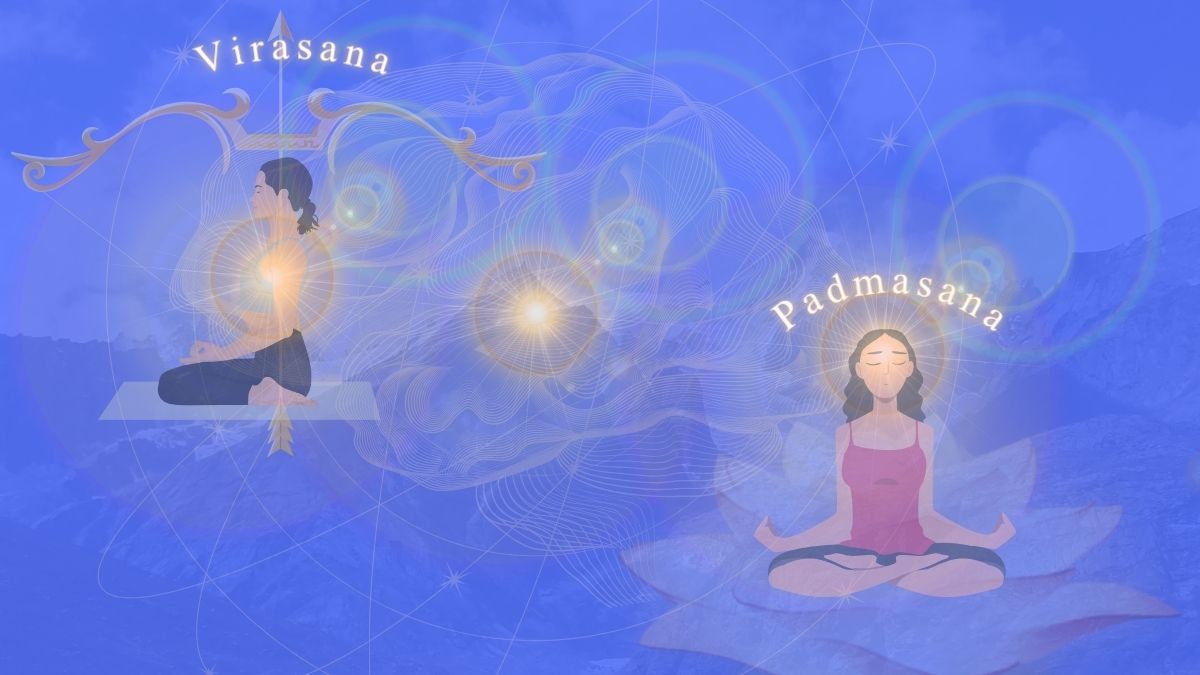
The classical seats I’d like to illuminate today are Virasana = the hero and Padmasana the lotus. I encourage you to explore both of these with physical teachers (in person) and through your own research. These postures often become accessible only after considerable yoga practice.
Virasana the hero is taken with the knees together, sitting between the heels with the sitz bones grounded. The knees together – drawing inward – create a powerful gathering and focusing of energy which supports concentration and focus – practices required for managing the mind. The focused energy also creates a stability which lifts the spine.
Padmasana – the lotus – is unique in it’s combination of deep grounding and expansiveness. The sitz bones are rooted into the earth, the knees are out to the side and the shins cross so that the soles of the feet face the sky. When the shins cross a powerful acupressure point known as SP6 – the juncture of three major “yin” channels -Liver, Kidney and Spleen is toned. Yin draws the energy inward. As with Virasana this inward energy creates a stability that lifts the spine. Any posture with knees open to the sides will create openness and spaciousness. With Padmasana we master our capacity to remain focused and steady in more and more expansive states of consciousness. Padmasana allows us to sit with the experience of enlightenment.
Want a little more “woo” in your life? No? Me neither. But yoga philosophy approached with wisdom is grounding and empowering. The philosophical elements are explored in my newsletter. I promise…it’s not a marketing email although I do suggest readings and music. You can sign up here. They are also posted simultaneously on my facebook business page – NatalieteachesYoga. Thanks for reading!
Processing…
Success! You're on the list.
Whoops! There was an error and we couldn't process your subscription. Please reload the page and try again.
The study of yoga and yogic anatomy is a slowly evolving process of ever deepening understanding. There is a difference between “knowing” yogic anatomy on a visceral level and memorizing the vocabulary. Why is this relevant? Self-Mastery. As we explore these different modes of viewing ourselves through yogic anatomy, we open ourselves to new depths of understanding physically, psychologically, and spiritually. We gain an illumined understanding of ourselves, our purposes and our pathway. We become wise enough to navigate subtler realms as mapped in the concept of the sheaths or koshas (Yogic Anatomy – The Five Koshas,). The sheaths or koshas are interwoven and not distinct, like oxygen and helium molecules in the air – or dimensions as mapped by mathematics and science. Experiencing them is like opening a portal to a universe similar to the one we live in “normally” but, it’s different. . One moment we feel dull and confused and then an inner portal opens and we experience elevation – organically. We access wisdom, knowledge or subtle sensations of the body – and understand our wholeness differently. Last post we explored the concept of the food body or Anamayakosha. Today I’d like to open the portal to the pranamayakosha – the pranic or breath body. It’s near and dear to all of us, and we experience it all the time. We might not be aware of it. Exploring the pranamayakosha we step into the subtle realms of yoga. It’s the first of the subtle koshas that many practitioners experience, which tells us that it’s connected the food body. It’s impact on our psychological well-being tells us that it’s connected to knowledge, wisdom and bliss as well. Just as becoming aware and awake to our physical body requires some understanding and attention, becoming aware and awake to our pranic body requires some understanding and attention too. This is why the pranamaya kosha is so important in our yoga practices – it’s where we start to explore a world beyond our usual perceptions. When the pranamaya kosha is clear – not muddied – it’s easier to experience the other bodies or sheaths with clarity.
It’s hypothesized that prana (subtle energy – like human electricity) flows through the fascia. We don’t know for sure. We can’t yet measure it; we can only observe its effects. This could change – science moves towards understanding yoga all the time.
Within the pranamayakosha, the ancient yogis discerned a vast network of tiny channels which they called the nadis There are hundreds of thousands of nadis. One portal which opens the yogi’s perceptions of the pranamayosha is the breath. Consider how breath is processed by the physical body: an invisible substance – air travels through a physical network of tiny tubes and sacs in the lungs through which the invisible substance of oxygen is absorbed and the invisible substance of carbon dioxide is released. Prana is like this – it’s absorbed from the universe around us and it permeates and moves through the physical form –nourishing and cleansing it. When the prana moves we are awakened, energized and healed.
Within the pranamayakosha are numerous structures formed by the intersection of the nadis. The chakras are vortexes located at key junctures of the nadis and the physical nervous system. There are three primary nadis which bracket the chakra system– the ida, pingala and sushumna. The prana moving through these three nadis governs the process of spiritual evolution. When it moves clear and unobstructed we plug into knowledge, wisdom and bliss.
A first pathway to working with the pranamaykosha is to unclog the nadis and get the prana moving. All asana will unclog the nadis. Vinyasa yoga will get the prana moving quickly. .
A second pathway to work with pranamayakosha is pranayama. Pranayama is is a practice of restraining the breath in order to unclog the nadis. This is most effective when asana has been practiced consistently for a long time. Asana clears superficial levels of congestion – so the work of pranayama – deep and powerful breathwork – is not obstructed by more superficial congestion. Pranayama is a transformative healing practice. It’s best to prepare for it.
A third pathway to working with the pranamayakosha is sound. The familiar sound and symbol of OM is called the “nadam”. The ancient rishi’s or wise ones observed that Om purifies the whole system, like an ultrasound which accesses deep internal caverns of the body below the surface. My experience with this is that working with classical Indian sound practices is the most effective means of actually clearing the nadis. Yogi’s chant the sound of OM, they meditate on the sound of Om, they listen to the sound of Om. This would also include listening to or studying and learning Indian classical music which is designed around an understanding of OM. A fine experiment would be to explore different kinds of music when you practice. At first what you are used to listening to may prove to be very energizing, but as you grow more adept at working with prana and sound, you may notice that Indian classical music is a distinctly powerful complement to your yoga practice.
A fourth pathway for working with the pranamayakosha is ”managing your energy” and in the yoga practices this is accomplished through attention. A starting practice is focusing the breath or the gaze in your asana practice, with an intention to understand what your attention does to your energy and your postures. Too weak of a process of reigning in attention leads the energy to scatter. Too powerful of a restraint will be too harsh for the tender pranic channels.
Four modes of creating a relationship with the pranic body:
Yoga Asana
Pranayama (advised for well experienced practioners)
Sound
Attention
A last note about the pranic body – The ancient yogic texts speak of the adamantine body formed by the hatha yoga practice. This is distinctly related to and an outcome of the management and toning of the pranic body. When the pranic body is well cared for – clear and moving and strong we become incredibly resilient. The texts say all dis-ease is eradicated. As contemporary yogis we can say that our immune system becomes incredibly potent in response to the health of the pranic body. This, as the article included here indicates, is a result of consistent, well-done practice.
To receive newsletters with a different perspective on the blogposts, please subscribe to my Mailchimp! I promise…no ads. Just more talk about yoga, maybe some reading and musical suggestions. All designed to supplement your yoga practice.
Processing…
Success! You're on the list.
Whoops! There was an error and we couldn't process your subscription. Please reload the page and try again.
Vinyasa, sometimes integrated with the idea of “flow” in yoga is rooted in yogic mysticism. It is fruitful to contemplate this time with a beginner’s mind as our practice deepens in time. On the physical level, momentary awareness, intentional placement, the nature of transitioning and the unfolding of a sequence are effective tools to open into altered states of consciousness. To contemplate the mystic roots of this practice reveals much about the nature of reality itself and how to engage it consciously.
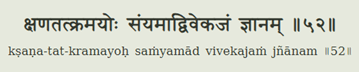
In sutra 3:52 Patanjali advises that by meditating on the present moments in a sequence we come to know the nature of choice and results (discernment).
It sounds obvious and mundane, but in the revelation – it is anything but. The yogi actually sees how they created this moment. This provides understanding which facilitates the ability to create with intention. We seldom arrive in a situation for the reasons we think we arrived there.
The first time I experienced this, I was notified that I received an award. Because I was a hot shot right? No. What was revealed to me during practice was that the moment of being honored was created by a dozen times when I had honored others and acted with sincere humility. It was potent and unforgettable because I had longed for that acknowledgement for a long time, and I am not very humble at all. It revealed to me the potency of a small decision made with heart, and planted a seed for me to want to live a different kind of life.
So what is the physical body technique for this? Vinyasa can be complicated, but the alpha and omega of it the rhythm of the breath in practice. Yep. Rhythm functions like a ticking clock. It holds us in the present moment. Being fully in a present moment is the doorway to observing time from a different perspective. Music can be exhilarating by it’s very nature, but cultivating the presence of rhythm and lyrics consciously in our playlist choices can support opening into the full experience of asana practice and vinyasa in particular.
As home practitioners– this can be one of the hardest facets of group practice to replicate at home. So for this, I don’t try to replicate it. I endeavor to work with the techniques in a different way. Home practice allows us to explore a posture in deeper way related to positioning etc. Once we’ve made progress with learning a sequence or a posture, benefit is obtained by spending time integrating the breath with the movement. This kind of breathing is not like exercise breathing. It requires a constant steady equilibrium of inhale 2 3 4, exhale 2 3 4. Where the substance of the inhale and exhale are consistent throughout the breath.
Students have often asked about other kinds of breathing that they were told were “better” for one reason or another. This isn’t about good or bad – it is just one specific technique used to develop one specific element of practice. If you want to explore this deeper dimensions of yoga, I invite you to work this way with your breath.
For each blog post I create a newsletter which delves into related topics. You can find this post’s related email here. To sign up to receive the email in your inbox concurrent with the posting on the blog please sign up below. I promise you will never be bombarded by marketing emails.
Processing…
Success! You're on the list.
Whoops! There was an error and we couldn't process your subscription. Please reload the page and try again.
Hatha Yoga in the classical sense is a journey of integration where the body becomes the perfect vehicle for a different kind of consciousness – the adamantine body. This happens through integration – where the physical form is transformed by the substance of that consciousness. Through breath and positioning the energy channels of the body – the nadis – become clear. Allowing yourself to experience breath in the varieties of positions is essential. And I use the word “experience” deliberately. It isn’t about forcing the breath through a posture that feels stuck. It’s about being easeful and allowing enough that the breath can still be felt and enjoyed regardless of what shape you in. In that sense it is a cleansing the breath is a cleansing solvent for the nadis. There is not better place to breathe than in a posture where you are bumping up again your limitations. Often they are not muscle and bone, they are energetic – energy is stagnant. And, when the energy is stagnant, so is your mind. Movement is so important, and yoga asana is designed for this. This cleansing of the physical form allows the spirit to become more tangible in the physical realm. A well-done posture facilitates this integration.
That intersection of matter and spirit begins at the level of the thoracic spine – at the heart. The integration is simplest and most straightforward in the backbends. This alignment of these two forces (material and spiritual) occurs when the feet are well positioned. Parallel the feet in a back bend and the point of integration of the primary opposing forces – of gravity and upliftment is shifted from the lumbar spine to the thoracic spine. This creates a gentle, subtle space in that very restricted area. You will know the opening has occurred by the way you feel. There may be tears or a sense of wonder or great love which occurs with the opening. The practice at that juncture is to be spacious and allowing of the powerful feelings which unfold -and to understand that your practice is moving into another level – beyond mere physical release and into transformation.
Interested in stepping a little more deeply into the philosophy and inner practices of yoga? I send a newsletter once a week or less, in conjunction with blog posts, where we explore the inner practices of yoga within the context of a life. Sometimes drawn directly from the traditional yoga texts, and sometimes just commentary on the big picture of a yoga practice – I always intend it to convey something that will be useful to you. I don’t sell anything in these newsletters – it’s an offering and a way to keep my own practice fresh.
Processing…
Success! You're on the list.
Whoops! There was an error and we couldn't process your subscription. Please reload the page and try again.
Each of our bodies is a unique constellation of tension and ease born of the musculoskeletal landscape we were born with, the impact of habits of movement, the impact of emotional, psychological and physical trauma, and bodily awareness, In Hatha Yoga, we are invited to iron out these differences – bringing the ecosystem of our individuality into a harmony embodied in the sound vibration of Om.
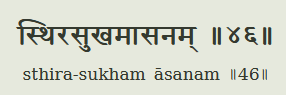
The seasons are turning cooler, our attentions turn inward yet again, and we are invited to shift gears in our yoga practices. This subtle adjusting of focus and style to harmonize with the seasons is a classical organic element of yoga practice which invites us to consider balance in our lives, our practices and our creative work. In yoga the balance emerges as the fine tuning of our awareness and integration in the pairs of opposites – activation and ease. The foundation for this teaching is found in Patanjali’s Yoga Sutra.
The postures develop our capacity to discern. We can consider the following in crafting our personal practices – the perfect posture is born of cultivating a personal understanding of places in the body you need to activate, and the places in the body that you to would benefit from bringing ease to. For this – we can work with large areas of the body (the back of the legs) or more specific areas of the body(the juncture of my sacrum and vertebrae L1) depending on the degree of awareness we have of the nature of the sensation.
A tool I use to discern tension and holding versus slack and unconsciousness (or lack of any feeling of awareness at all)l is to work with repetitions.
Choose a basic posture, one that is reflective of some physical discomfort you have in life.
Practice this base posture – breathing and scanning the body nonjudgmentally for various sensations.
Practice some postures you believe might be helpful – scanning the body and breathing throughout.
Repeat the base posture – scanning the body again. What feels different?
Repeat the repetition.
I’ll sometimes go through a repetition sequence several times with several small sequences within a day of practice if I have time. Sometimes I just run through it once.
Note that many discomforts in the spine are born of tension in the neck and hips, so you may want to include postures that dress the neck and hips in repetition sequences.
Did you like the post? In my newsletter I dig a little deeper into the philosophical aspects of working with the postures. You will never get more than newsletter a week, and the newsletter is meant for edification and entertainment – not sales.
Processing…
Success! You're on the list.
Whoops! There was an error and we couldn't process your subscription. Please reload the page and try again.
It’s very popular these days to skip over the restraint practices in yoga (ethical vows, structured asana practice, breathing and concentration practices, lifestyle observations). Mastering them is the key to transforming yourself and your life through the practices of yoga and is an important facet of practice. Liberation as intended in classical yoga is a very specific experience. It’s not about crashing through to a new shape with the body even if it hurts. It’s not about “doing our own thing” without structure or discipline. It’s about being awakened into the experience of our spiritual wholeness. The restraint practices should not, and do not have to be dramatic or drastic. It might mean staying in a particular posture even if you are a little uncomfortable – maybe sometimes when you are a lot uncomfortable – in order to move beyond your sense of limitation. To practice yoga in this way does require a high degree of discernment – of learning to feel and experience the body and develop skillful means of working with our sensations. To some extent no teacher can really tell us that.
We used to work with the guideline that if the sensation is sharp you need to back off and approach the posture in a different way. For a dull softer discomfort we would generally stay in the posture and breathe ease into the form. The sensations we have are never black and white, so a guideline like this can’t be followed blindly.
We could consider this…if we bump into a tugging resisting sensation, then we are trying to expand in a place where there is currently contraction, and our work then is to find a way to allow the expansion. Breath is a good starting place, but it requires some attention to how one is breathing. How well you are able to receive an inhale? What conditions support that? Can you allow the lungs to expand? That quality of expansion will travel throughout the body as we allow it, and will gently open our places of deep holding and restrictions. To push against or fight against it will yield a different result. If we soften the mind and the heart and work with wisdom the experience of restraint transforms into its opposite – the experience of liberation. Tension melts and we are no longer restricted by tightness. This transformation of opposites into a unified experience is yoga – to yoke together.
The restraints imposed by the global experience of pandemic have resulted in massive shifts in the way we live and work and love. Training ourselves to be spacious and allowing in of those changes fosters our capacity for resilience and blossoming.
The focus this moon month in the newsletter is freedom or in Sanskrit, Mukti. Mukti translates as “liberation”, freedom, and it’s important to understand that freedom in the sense of yoga is different than freedom in of our day-to-day life – although they are related. We may think that having tons of money would be freedom or rebelling against social conventions would be freedom. Freedom is not inherent in those experiences. Ask anyone who has very large amounts of money or who has lived in the counterculture for a long time and in their story you will hear of the oppressions that still remain. In yoga freedom is something that we develop inside ourselves as we cease identifying with the fluctuations (vritti’s) of our mind. That’s the second sutra of Patanjali’s Yoga Sutra. The fluctuations of our mind frequently take the form of how we think of ourselves, how we think of others and how we think of the world we live in. These mental constructs can become rigid and block our ability to be open and spacious and, well, liberated. The freedom of the yogi comes in the form of an inner sovereignty which allows us to become the masters of our own minds and to use that freedom to choose the path of love over and over again.
Yoga is a discipline that leads to freedom The practices of yoga involve experiencing certain kinds of restraint and under those conditions finding the freedom there. When the restraint is lifted you have a different understanding of who you are. Restraint comes in the form of tying yourself in a knot in an awkward posture and remaining peaceful. Restraint can mean being willing to suspend our immediate desires in order to allow a higher state of wisdom consciousness to guide our actions.
When we tie ourselves in a knot in a posture we stir up the deep resistances we have to living. The knots are knots within our consciousness and so the goal is that to breathe, to be present to what’s happening and not fight with it. Consider this first level of freedom one that you could find contentment even when circumstances around you are not to your liking. That’s a tremendous amount of freedom. Sometimes for whatever reason it’s not the best idea to change a circumstance. Even though it’s uncomfortable, it’s better to be strong. This capacity is honed in the practice of asana. Accept the limitation, breathe be still and allow your inner guidance to direct you step by step to moving beyond the limitation into a deeper expression of the posture.
This kind of yoga training reveals discernment – the capacity to understand if our impulses are coming from our authentic heart desires or our desire to control. It’s a powerful means of developing aligned autonomous inspired choice making. Sovereignty. It is a gift of the yoga practice born of moment by moment alignment with self and that is the freedom. Rather than having others dictate who we are or who we become or what actions we take in our lives we are free to take action in alignment with our highest best interest. Yoga will take us to a healthy and beautiful body of all different kinds of shapes and sizes but this is the heart of the yoga – this sovereignty and the freedom that emerges through practice.
“All of the all the processes of hatha and laya yoga are but the means to attain raja yoga. (samadhi) One who attains Raja yoga is victorious over time (death).” (Bihar edition and translation)
Perhaps when you were a child you experienced being measured. Sometimes parents make marks on the wall to emphasize how much a child has grown physically. As children we were measured physically, intellectually, emotionally… how we are growing? Then at some point the nature of that measuring starts to compare itself to an end point rather than the beginning point. We mark a wrinkle (one step towards old age) A gray hair (another step towards old age). Perhaps we worry more about a physical symptom than we would have when our hair was colored rich and deep and our skin was rosy and clear. One great blessing of combining the inner and outer yogas is that the processes are designed to liberate us from time. A mark of a well-done yoga practice is that decline is minimized and many times even reversed. One advantage of studying the tales of the great accomplished masters is that they completely transcend time. They choose when to leave the body behind. It’s a great teaching. There are many records (Paramahansa Yogananda, Shri Brahamananda Saraswati ) of enlightened beings whose bodies did not compose after death but remained intact as their devotees prepared the funeral rites. When Shri Brahmananda Saraswati was cremated it is said that his ashes were pure and white as snow. He also regenerated his body and brain after a stroke through study and practice of Sanskrit (an energetically based yoga practice).
What does that mean for us as contemporary yogis? We don’t really know. We don’t really know what that means. Will we be immortal? Do we want to be immortal? Will we just stay lively? Will we live on as souls beyond the body?
What we do know is that well-done yoga is a rejuvenating practice. It’s hormonal, it’s energetic, it’s the nervous system but essentially to tap into the field of consciousness is to tap into that place beyond time and that is infinite. To keep the spiritual dimensions of the practice front and center. Serenity makes for a great facelift.
How do we make this more tangible? The usual choices for this kind of experiment are meditation or chanting. The point is your body will change through these practices. And you can practice it and find out. Just note that other lifestyle choices will mitigate your results. Wise lifestyle choices will enhance them.
For me the door which opened the understanding of this spirit body connection was yogic chanting. I knew it immediately even though I was not spiritually or athletically accomplished. I was living in New York and had much pain in my body — weight training, aerobics, desk work, crazy diet — so many possible culprits for the pain. After finding no remedy that was clear through the western medicine lens I started yoga to ease the pain.
I noticed almost immediately that if the class started with an Om my body didn’t hurt as much during class. I thought it was a goofy thing and I made jokes about it. I figured I was imagining things, but then I found the Jivamukti Yoga Center in New York. Chanting was central to that practice, and I learned there that the ancient yogis understood that the body is made of sound. To those I spoke with and studied with there, when I made the statement that my practice was better if I Om’d first, it made perfect sense. I stayed with that practice for years and experienced many complex postures that I never imagined that I would do in part because my relationship with my body changed as I worked with this understanding that the body was made of sound. Things I could never imagine at 29 opened up for me as I moved towards and through a so called middle age. I am now 58 and I have less pain in my body than I did at age 29 – even in the wake of injury.
For this I rely on my yoga practice.
For the practitioner I believe that the bottom line of this is that we begin to consider that our bodies are not our masters — our hearts and our souls are. To embrace the spiritual aspects of the practice is not to deny the body but to nourish it at a deep level — beyond DNA, consciousness (which is experienced through practice) nourishes our very cells. You will be strengthened by it and it will cost you nothing to try.