Where Vinyasa Begins Intention

A long time ago when I began to practice yoga vinyasa, one day during practice this thought arose ….this must have something to do with surfing…that riding of the waves of breath and movement.  I sensed, that there was some common element physically.  I found out soon there after that the first “landing” of yoga vinyasa in America was in the surfing communities of Hawaii and California.  The connection between the two disciplines, I felt, must have been mula bandha.  Mula bandha is a physical lift of the pelvic floor which allows one to balance while moving.  Esoterically mula bandha is associated with the practice of inner alignment, to direct one’s energy towards the highest possible levels of mystical consciousness.  It is a practice which leads to tremendous clarity.  We don’t need to go into deep resonance with the sacred to know this, if you’ve even done a few rounds of sun salutation, you know that clarity emerges quickly with such a practice.  While there is a physical component of mula bandha, the activation of it on the level of consciousness is achieved only through intention.  The physical activation of the pelvic floor wakes the energy up.  The direction of our focus will determine where the energy goes.  There is no right or wrong about the directing of energy, but it’s good to know that our results will very much be determined by  the direction of the energy.  In true vinyasa fashion this idea is circular, our intention . will determine our focus which will determine the direction of the energy which will then create a result which will influence our intention and so forth. The most important moment In our yoga practice is the moment we override inertia and consciously go about choosing a direction. 

In the classical schools the only intention considered potent enough to activate the bandha was  desire to know God.  The aspirant would begin each practice bowing down to God and the Guru who represented God in form.  In America this intention became softened somewhat to offering the good of our practice to others, a classic Buddhist practice.  The energetic result is the same because the energy is directed towards something beyond our personal needs.  It’s uplifted.  In recent years in America the practice of intention has shifted again, now to honoring ourselves and good self care.  Good self care is essential to a yoga practice, but as an intention it can keep you anchored in what you need, rather than your most illumined potential. Following Patanjali’s formula we know that what we focus on grows.  We don’t want our needs to grow. The heart of the yoga practice is to transcend our needs and fulfill our potential (hence the complex landscape of renunciation practices which have historically defined the practice).  Deprivation is undesirable and not effective.  But to direct our intention higher than our needs is to uplevel our capacity for living.  But even this requires some conscious consideration. We need to be aware of what we are intending. 

To offer oneself as a vehicle for the divine may result in a role where you are the deliverer of blessings hard truths.  An important, but not always fun role.  An intention to serve may yield gracious and elegant opportunities to serve others, but you may have to deal with constraints on your self expression or ability to make decisions.  To intend to know true compassion may inspire you to give away your last dollar.  To intend to align with the most magnificent and expanded vision of your divine sacred infused snowflake self (no two are alike you know) well….that may lead you on your own magnificent divine journey which may include being compassionate in your own unique snowflake way.   It’s nothing we need to fear.  The point is to be awake and clear in the creative opportunity that Vinyasa presents.  Vinyasa, broken down into it’s parts is to place on purpose.  To place a purposeful intention at the beginning of our practice and then to consciously observe our ability to focus as the moments arise and fall in the practice is to take ownership of the power of asana in a whole new way.   Intending a practice is frequently invoked in yoga class, which is good.  Then it is up to us to discern the best way to use that opportunity. 

(c)natalieullmann

The last word on Sukha (सूख) – Joy

We spent a lot of time this month speaking of the cultivation of ease in our lives and yoga postures – sukha.  But there is another essential facet of the sukha experience which in some ways eclipses the idea of ease, and that is JOY.  Joy is key in the yoga practice:  we cultivate it, and the experience of it is the culmination of the yoga experience. 

The Joy referred to in yoga is a spirit rooted, inspired state which arises from within as our practice unfolds It differs from an outward kind of happiness or pleasure in that it grows in stability over time as we become established in our well-done practices, it’s lack of correlation with so-called “happy” experiences in life, and that it emerges from within.  My personal experience, the few times I’ve touched it, is that it’s flavor is truly sweet.

This deeper flavor of sukha is connected with primarily through our cultivation and openness to our inner development and practices, breathwork, devotion to our relationship with our higher power, meditation, and sacred text study.  You may have other inner practices which serve as deepeners in your personal spiritual recipe.  It’s the deepeners which bring us to yogic Joy.  Joy is this form is also met through good service to others.  This doesn’t mean necessarily running down to the local soup kitchen to ladle soup to the homeless, although it could mean that.  It means truly seeking to render service in whatever role you have assumed, whether it be a clerk or the president, a school teacher or a musician.    You may have discovered that joy of this nature is infectious.  If you have ever been blessed by the experience of having your table waited on by someone who is embodying true service…it can almost be giddying to be in the presence of such a person. 

Another aspect of Joy to consider is that when Patanjali (an ancient sage and expert on yoga) tells us in his seminal work “The Yoga Sutras of Patanjali” that our postures should be stable and joyful, he’s advising us that we don’t need to suffer. This is very very important.   Yoga is not a “no pain no gain”.  endeavor.  Everything that yoga has to offer is encompassed in an ever increasing stability in the state of joy. You are  meant to be happy.  The work in the practice though, is the discovery of what happiness truly is. 

May you have a blessed and wonderful week and I hope to see you in class today!  Links below. 

This post is from the weekly newsletter I send out to students, complete with easy links for classes. If you would like to see this in your email once a week, and once more when the new moon month begins, please sign up for my email!!

Processing…
Success! You're on the list.

Established in yoga…while moving through it all…

I fractured my wrist at the end of October. The cast came off, December 11. During the time in the cast I floated through time and space, a little removed from life, a little removed from pain, a little removed from sitting with this unexpected event in my life. I did some responsibility taking around that somehow, but generally, I was floated by my spiritual practices in this place beyond time. I didn’t struggle against the weight of the cast to do asana (physical postures) practice, because I understand true healing to take place on the level of consciousness, first. Lots of healing happened on that level, and then the cast came off, and I plummeted back to Earth.  I was back in my body, remembering the accident and the pain, and meeting and seeing the limitation now embedded in my physical body. I was in shock. When I left the hospital and climbed into my car, I burst into tears. It wasn’t victimy. It wasn’t woe is me tears. It was sadness for the whole world, all of us, going through this experience of restriction. It was a visceral experience of the sense of vulnerability of our bodies and the sense of vulnerability to all kinds of forces external to us. This month in my classes we are talking about pratistayam, or to be established in.  In Patanjali’s  yoga sutra Patanjali refers to yoga as a state where we dwell in our true nature and the text builds a pretty good case that where we seem to dwell in the external world is intimately related to where we dwell inside. To make a choice to dwell in our true nature is to become established, and that is to position ourselves in such a way that the impact of external forces on our ability to move through the world is diminished. We become conscious co-creators of our life experience.

When I was in the hospital, initially, after the break, I was there four days. A significant amount of the time was spent discussing pain. This was what the hospital staff worked with me on. The managing of pain. The avoiding of pain. I liked the underlying message which was, you don’t have to suffer pain. I’d spent many years with the belief that I did have to suffer pain. Of course, there is that meme “Pain is inevitable, but suffering is optional”. I will say that what when you extract the suffering, it’s no longer pain. It’s just powerful sensation. But therein lies the rub. We have to choose not to sit in the state of mind of our own suffering. Randy, the very kind, bright-natured nurse who was my primary “pain coach” advised, “You don’t want to chase pain.” What does that mean? She explained that it’s very difficult to reduce the pain once you’ve allowed it to take hold. So, the process is to ward it off in advance, in this case by regular systematic taking of meds as the doctors prescribed. Every X number of hours. Isn’t that interesting? Patanjali advises the same thing. He says future suffering is to be avoided. And I think it’s good to note that Patanjali is not just one guy with one idea, but he organized all the information from what people who were practicing in that day were doing so, you know, it’s not the kind of information that gets outdated.

So if future suffering is to be avoided, how is this done?  Yogically, there are a number of different interpretations of what that means but for today let’s just consider that part of it, avoiding future suffering, is that we train ourselves through asana pranayama meditation and good old fashioned discipline to stay anchored, to stay established in our true nature. Part of that training is learning to catch ourselves when we are not in our true nature. Randy advised that pain was a tricky thing. In my post cast life I feel what she meant. It’s random and it’s stubborn – arising with no apparent logic. Although, the mind will try to give it logical source, ‘I ate french fries yesterday and must be inflamed’. But then one might notice the pain lingers long after the french fries are gone. 

The time came last week to remove myself from painkiller killers. You can’t really take Tylenol or aspirin, in large doses, forever. I’d left the high-octane painkillers behind while still in the hospital. There are herbs and there is homeopathy. Last week I began physical therapy and what I didn’t realize was how painful the process of rehabilitation would be. I’ve spoken before here about the releasing of fascial tissue and trauma stored within it. Now I’m living that daily and an important side note – when fascia is releasing you relive the pain of the trauma itself. Medicating at that point is thought to interfere with the release process. On some level, you have to feel it to heal it on the level of consciousness.

Just transcending just moving out of the place of awareness of the pain

might support psychological health in the moment, but holistically transforming the pain creates a more integrated healing. About three days into my PT exercises a return to a generally full asana practice, as I lay down to sleep, my whole arm caught fire with pain. It was clearly a fasica release, as I could feel the impact traveling through my body, as it had at the moment of the accident, dull but shocking. I already taken my herbs for the day. That was it. I was left with chamomile tea and deep breathing, as my only recourse. “I’ve entered the world of pain.” I thought, knowing that millions of people abide there full time. Now, I have some inkling of their experience, and I am awed by it. What that must be like to live there, in pain, through your whole body, all of the time. I think to myself that I don’t want to live in the world of pain. So as I breathe deeply and consciously, I effort to reorient myself to be situated, established, not in the pain, but in the calm center I have touched many times over my years of practice. Pain is tricky. It is seductive and magnetic and absorbing. This requires some effort.

But I really don’t want to live there. I chose to dwell in my true nature. The pain is not receding, but it ceases to be me. And instead, the sensation becomes an experience I am having. It sounds like splitting hairs. But when I pull myself out of the pain experience, it’s just another experience. I know that there is some experience within me at all times, that is not pain, and that somehow I will find my way to dwell in that space. I woke up the next morning amazed that I slept. Funny that, right? We think a billion bucks is the goal but how valuable is a good night’s sleep? The big deep pain of that evening is gone, but it still comes and goes both emotionally and physically as I reclaim the use of my arm as part of the whole of my body – and work to expand my reach. And now I feel really connected to a whole new level of this pratistayam thing – to master being able to sit in that calm sweet place as I deal with the challenges of the world. The practice becomes a a deeply essential life skill to have. It’s been very exciting. I was able to use my left hand to take some vitamins yesterday. And that was a big leap. And I’ve enjoyed creating sequences without the Down Dog for the time being. No plank, no Chaturanga. And a world of creative movement has opened up too.  My treatment goal is down dog. Okay, so two months ago, right before the accident I was jogging and doing a forearm stand and enjoying the process of reclaiming each little step. And now and then, I feel a glimmer of hope that maybe, just maybe, my yoga practice will evolve into such a grand adventure, yet again.

Surrendering into Power

We’ve been dancing around the practices of kriya yoga: Tapah, Svadyaya, Ishwara Pranidhanani.  They are central to the practice of yoga, on and off the mat. They are embodied in trikonasana and they are a simple doorway into the deeper dimensions of the practice.  These three building blocks of the yoga practice can be loosely translated into English as: effort, self-reflection, and surrender. Ishwara Pranidhanani, so-called “surrender”, may appear to be the antithesis of power. The translation of surrender, carrying as it does the connotation of defeat, may bear a coloring of sacrifice.  A closer examination yields a different point of view.  Surrender is required anytime we are invited to step up our game.  Ishwara is the “one beyond form “ and “Pranidhanani” is to bow down to.  The bowing down is not to make oneself less than, but rather to soften our rigidity that we might be transformed into something greater. .  The formless quality of Ishwara allows us to utilize any variety of divine entity or quality in our practice   Think: caterpillar, butterfly. It is that simple.  What do we wish to transform into?  Practice reveals that Ishwara Pranidhani is the most powerful of the three practices as softening our rigidities opens the door to great fullness of our being. This is great power, albeit of an inner sort. When we relinquish the struggles and conquests of our limited personalities, the spiritual power of our connection to source is moves through us, transformation occurs.  We all know our best relationships occur when the two of us together are better than each of us alone.  This requires a little softening.  It requires a little alchemy. It invites us to get out of our own way so to speak. This moment is about relationships, healing occurs when the us and them dissolves.

Ustrasana, camel posture, embodies this.  Our personalities and sense of conventional power are seated in the third chakra in the solar plexus, the heart resting right above this.  Relinquishing the tight hold of our personal power in the solar plexus region invites the flowering at the heart center.

The Forces Within

The Forces Within

In my observations as a yoga teacher all the postures we take, on and off the mat, have a variety of expressions one of which is the reflection of what we are feeling that day.  Some people shift from expression to expression in their postures, trying to find the one that “fits”.  Some people identify with one expression or another and hang out there for awhile until a new idea sparks transformation, or they feel the pain of the imbalance acutely and decide it’s time to change.  The days we live in require a great deal of strength and resilience.  Students thrive when given the opportunity to nurture their strength.  All of the Tadasana based straight line postures (Plank, Chaturanga Daṇḍāsana (low plank), Vasisthasana (side plank), Vrksasana (tree)) invite us to reflect on and move beyond the psycho-spiritual-physical tangles which obstruct our ability to experience the power of our wholeness. 

I always teach plank early in the class.  Why?  Because it tells me a lot about who I’m teaching and what they are in the mindset to engage with on any given day.    Over the years I’ve come across (and experienced in my own body) some common expressions of plank which could be thought of like this:

  1. The Conqueror:  Every ounce of will is drawn forth, the eyes and jaw tighten, the body is wrapped around the posture like grasping onto a twig if  we were falling off a cliff.  The breath is forced or held. 
  2. The Non-Chalant:  A similar determination to conquer the plank, or perhaps the way one feels in that moment, but being aware of the mind body implications of everything, we attempt to look cool.  The face and jaw are relaxed, the will is strong, but maybe the leg or the eye or the arm are twitching out a steady current of subconscious disharmony.
  3. The Dread:  The teacher says plank and there is hesitation (not today!  Do I have to do this today?).  The brows furrow – the face and body droop before even attempting to shift into the posture.  The body shifts forward into the plank and then crumples to the floor under the weight of expectations. 
  4. The Flying Buttock:  Exactly what it sounds like, our tailbone is not in alignment with the rest of the spine and is jutting up towards the sky.  Somehow, it seems to make things easier.  But the dis-alignment interferes with the subtle dynamic of balanced strength which we can cultivate through these straight-line postures.  In other words.  It’s easier, but not the easiest.  It’s a little like contorting yourself to adapt to an intrusive seatmate on a plane or subway.  We hold back a little from our ability to extend out into the world with the flying buttock shape.
  5. The aligned: The alignment comes all together, balanced front and back forward and backward and up and down and right and left and it’s EASY. And it SHOWS. This plank can be held for a very long time, by persons of all ages and appearances of physical body strength. The person inhabits the body rather than conquering it through will. The capacity for strength emerges from inside, not out.

None of these are bad or wrong but they can be invitations to bring a little more yoga into our yoga.  Yoga meaning to “yoke together”  to bring a little more of our inner being into our actions on and off the mat. 

Embracing the spiritual practices of yoga opens us to the exhilarating vastness of possibility.  To integrate that vastness into our lives requires a moment by moment yoking to spirit as we take action.    Breath is the key to this on and off the mat. Breath is a doorway to the subtle realms.  Developing an understanding of balance in the body supports this.  Balance in the body frees us from some of the struggles of the postures and opens an inner spaciousness which allows us to inhabit a physical action and tap into the vast potential of a given moment.  Releasing the external goals allows the body to be aligned by the illumined inner and outer forces, rather than our perceived shortcomings.

To cultivate right effort in your plank  try these:

  1. Focus on the breath
  2. Focus on the balance, which will always be some evening out of two opposing forces
  3. Release the goal – or perhaps the thought of the goal-including your expectations of what it would take to achieve it
  4. Extend in all directions
  5. Repetition and consistency

Practice of an integrated plank posture reveals our capacity to succeed through attention, presence, balance and extension (used in a geometric sense rather than anatomical), allowing us to funnel our spiritual potential into our physical form.  We no longer have to build strength, we become strength.

Open Sesame

It is an extraordinary moment.  Around me, I see those moving through life untouched by the turmoil in the world.  I see others, devastated.  I find myself fluctuating between the two.  Fluctuating is the key word here.  Flux is a substance used in metal joining (Attaching two metal pieces to form say, a ring).  It has a function of purification which facilitates the yoking of the pieces together.  The flux of my life is this moment of heat and challenge.  That process of fluctuating is a purifying one, my doubts, my fears, my worries, my angers are brought to the surface and purged.  In the moment that alchemical reaction is happening I have a choice.  I can identify with the matter which is being expelled or I can release and let it go.  To identify with it will move me away from yoga.  To release it and keep doing the work – allows me to move deeper into the experience of alchemical strength.  The joining of spirit and matter.

Forearm stand is the current focus of my personal practice.  Each morning  against the closed bathroom door, with an eye towards learning to balance in the center of the room, I lift, awkwardly into the position.  The other day I was in a time crunch but wanted to honor my commitment to work on the posture every day.  I flipped upside down and reached my foot back towards the door behind me to press against it and come back into balance and…the door swung open behind me.  What followed was an inelegant dance of flailing limbs and indecision resulting in a sideways crash into two drums, an electronic keyboard and an altar (I have yet to ascend into the level of real estate which would allow me to have a separate room dedicated to my yoga practice). 

It happens. 

But the glory is always there, the divine spark never leaves, and it surfaced a moment later when I picked myself up from the rubble, calmly said “ouch”, reordered the chaos in the belongings I’d crashed into,  and then promptly took child’s posture.   I just knew that any imbalances in my musculoskeletal system from the flailing would be rebalanced in steady breathing child’s pose.  Here’s to agility.  I don’t talk about it much, but I’m 57 years old (just a number of course), and I walked away from this without even a day of pain.  It was all absorbed within minutes.  This is the power of a well-balanced integrated yoga practice.    Agility.  Don’t try this at home!  But just know that when we allow ourselves to go deep in the process of yoga, power emerges in the most unexpected and subtle ways.

The impact surfaced the next day in an interesting way.  Pain?  No.  Restriction?  No.  Imbalance?  No.  But I was unable to lift into forearm stand.  I couldn’t get off the ground at all. 

“I guess, “  I thought, “this is what they mean by a setback.”  I settled into another child’s posture and allowed myself to find peace with that, breathing, accepting, not judging.  Then I proceeded to take headstand, a steady and confident posture for me.  Had I forced myself to keep trying the forearm stand I would have gone into conquest.   I want harmonious union, not conquest.  So, I honored the setback but maintained some ground in the world of the upside down. 

Conquest is exhilarating.  But it doesn’t stand on it’s own.  It requires that you reclaim it day after day after day.  Claiming the same victory over and over.  Harmonious union, with a posture or a life circumstance,  establishes a foundation of creative growth and an expansion of possibilities.  This is why inhabiting the simpler postures with awareness and love deepens our practices so much.  We become one with the shapes that way.  We internalize them and then that wisdom extends into every posture that we do. 

There was a time I learned in life that showing up consistently would change everything.  That became my effort.  Just to show up even if I felt tremendous resistance or fear.  Historically, when a relationship felt difficult, I would avoid and run away.  Showing up did change things.  But it was a fight inside to do that and that conflict continued to show up in the relationships I was trying to show up for.  Something deeper than showing up was called for.  Wholeheartedness was called for.  I learned that I needed to resolve the part of me that wanted to run away to begin with.   Personal resolution opened the door to experiences in relationship in which conflict transformed into love. 

The question then became less about conquering my shortcomings and more about understanding and embracing life as it was. After all, why keep balancing against a closed door when an opened door offers so many un-imagined possibilities?

Are you ready?

The heart of the yoga teaching  is that there is a unified essence underlying the spiritual teachings of the world.  There are many paths, and one destination, although each one of us experiences the destination differently.  All spiritual teachings are merely fingers pointing at the moon.  There is one truth which exists beyond the form of any teaching.  The teaching merely points us in the right direction, and through practice and grace the experience of yoga, of union with the divine, is experienced directly. We choose the depth of our exploration, and so  we choose the depths of the empowerment we wish to draw from the practice.  Wholeheartedness and integrity are  never finite.  To be congruent, inside and out, is to discover an extraordinary form of strength.  The seeker becomes the finder when joy and feeling better give way to true self knowledge and empowerment.

The word yoga comes from the root word “yuj” which means to yoke together.  Like an ox pulling a cart, how much easier things can be when another is by our side, yoked to us and pulling the cart with us?  In it’s most essential and authentic form, yoga is about aligning and working together with the divine heart mind, the truth, love itself.  That process of yoking – building that connection – building communication and co-working  as terrains are travelled and burdens hauled, is the heart of the journey.  The working of the relationship  creates the connection.  Alignment with our true nature, is the work to be done.  The healing of the fundamental schism – that experience of being alone and unyoked – is the pathway to coming into our true power, our true resourcefulness, our true prosperity and  creativity, our true identity as love itself.    This experience of wholeness within – our Destination Sovereignty – is available to all who are willing to change their minds and open their hearts.  It is the resolution of all lack, all loneliness, all love longing. 

So how do we begin?

I taught for some time in Central New Jersey, where traffic was, erratic.  One day it would be fine, and the next it would take hours to drive down the road.  When describing how long it took to get somewhere we would say – “It takes a half an hour for travel and a half an hour for the adventure.”  You never knew what was going to happen.  When we embark on a journey it serves us to consider that it will be an adventure.  This way disruptions became scenic detours and delays opportunities to rest.  The spiritual journey is no different.  The only guarantee is that when the journey is over we will not be the same as we were before.  Life is like that you know, but to take a spiritual path, the path of yoga,   is to take the reins and  face the adventure head on.  Old ways will be shed, new ways will be introduced, we will allow ourselves to be melted down and reshaped into more exalted forms. 

So perhaps we should begin our journey to sovereignty by asking ourselves

“Am I ready?” 

Many people at this point are tempted to check out.  As we scan our lives for stability and security we may want to ask ourselves is there is really anything out there we can count on?  If so, maybe it’s not the right time to embark.  But if we are wobbly and uncertain, stressfully buffeted from one way to the other, wishing we had anchor, a secure place to rest our heads, then, we might want to ask ourselves again,

“Am I ready?”

While there are no guarantees, to have a sense of security within ourselves, well, that is certainly helpful, isn’t it?

It is not a question of repeating spiritually what others have done before us, for our adventure begins beyond that.  It is a question of a new creation, entirely new, with all the unforeseen events, the risks, the hazards that it entails–a real adventure, whose goal is certain victory, but the road to which is unknown and must be traced out step by step in the unexplored.  Something that has never been in this present universe and that will never be again in the same way.  If that interests you….well, let us embark. 

From “The Sunlit Path”, Passages from Conversation and Writings of the Mother, Aurobindo Ashram, Pondicherry, India

Moment by Moment

Tadasana, again. 

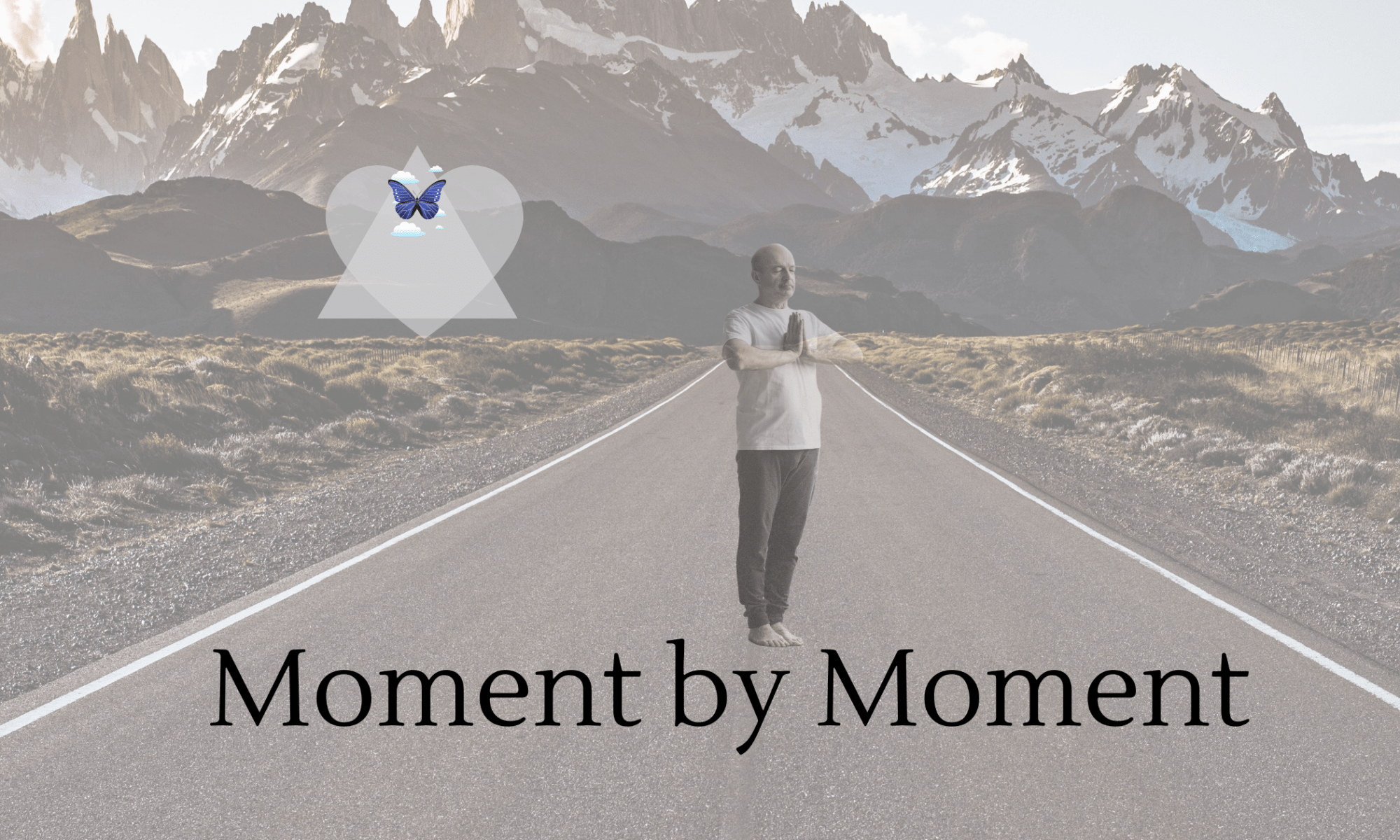
Tadasana is the simple standing foundation posture in the hatha yoga practice.  It is the beginning and the end.  The atom and the galaxy.  The man in the image above is in a variation of Tadasana. 

Some days, I get on the mat and it just seems like I don’t feel like doing anything.  But, I’ve committed to my practice, and while I definitely have periods of it falling away, I know that the root of the empowerment in yoga is DISCIPLINE.  I’ve learned over the years that forcing myself to do things that I don’t want to do (a very old school idea of discipline) seldom yields a good result.  Instead it generates a deep rift in my relationship to myself.  I am forcing myself to do something I don’t want to do.  That, is not the kind of seed I want to plant.    Perhaps understanding where I am will reveal what my next steps are.  So….Tadasana.

I stand in Tadasana.  I am amazed at how quickly I am aware of the imbalance in my physical body and I question how long I’ve been IN the imbalance and not been aware of it until now.  When I began practicing in 1993, I may not have perceived it so quickly.   My weight is forward in the balls of my feet.  I am projecting myself into the future – which is a fancy way of saying “fear”.  Of course I am.  And at this moment in time, it’s likely that you are too!  In the fast emerging post-Covid economy we are all grasping at a secure future. 

Security can never come from a fear-based foundation – at least from the perspective of yoga philosophy.  Security comes from nurturing a sense of security.  From a yogic perspective that kind of thinking creates difficult scenarios.  Projecting into the future doesn’t place us in the right position to make wise decisions. 

I examine the weight distribution shifting front and back.  The balance point eludes me.  I recognize in the  imbalance, a pattern.  The front right corner of my right foot lifts and weight shifts into my left heel.  What would create balance here?  I consider that Trikonasana, the triangle, provides opportunities to explore the connection to the earth differently.  I have nothing to lose, so I try it, and then back to Tadasana.  The imbalance has diminished, but it’s still not easy to stay centered front and back in tadasana.  I try Vriksasana, tree posture, and my hip emits a little pop.  Back to Tadasana.  Wallah!!  Tadasana arises like a mountain, stable, uplifted and free.    The energy flows through my body and insight arises about why I am here and what I am doing.  I am pulled to meditate and reminded of the power of asana to set the stage for meditation by liberating energy.    Asana nurtures clarity vs. delusion, which is more common that we might think.  It’s been a big day in my personal yoga practice – all emerging from shifting into the “now” of balanced weight distribution. 

Patanjali Yoga Sutra (an ancient text on yoga) sutra 4.33, “The sequential progression of moments is understood at the final end of it’s changes” teaches this power of each present moment as points of creation.  My lived experience of this teaching is that at the end of a series of moments we see how we arrived at a destination.  I’ve found that this arises as a clear vision of every pivotal decision I’ve made which contributed to the outcome that I am experiencing.  When this understanding arises it is always amazing, although not always cheerful.  It’s a way  of owning that we  responsible we are for our lives.   Painful as this may seem, only through this awakening process can we transcend the perception of ourselves as victims, and thus become active creative agents. 

This month we consider moving through transitions in this mindful present tense kind of way.  It’s not that we don’t have goals, I know when I’m transitioning from down dog to plank that I’m aiming for a plank, but it is the way I position myself in each microsecond of that transition which builds the plank that I will find myself in. 

I think it’s no accident that the heroes of the great Indian epics are archers.  Imagine having such a sense of vision of the pathway to a target that you could accurately set up your bow and arrow in such a way that oncoming winds would work in your favor!!  Magnificence!  Our lives are no different.  The present moment by moment awareness of the multitude of choices that we make every single minute of every single day….taking OWNERSHIP of that decision-making power, is a choice of great consequence and a fertile field for creativity.

With love and blessings

Natalie

Thanks for sharing the link http://www.natalieteachesyoga.com or my name whenever you refer to anything presented here.

Santosha (contentment)

An attitude of contentment (santosha) gives rise to unexcelled happiness, mental comfort, joy, and satisfaction. ||42||

In Marin County/San Francisco we are now at exactly 20 weeks since the first day of the shutdown.  That is a very long time, and much has happened in those five months.

One of the teachings of yoga which has become a bit controversial these days is a practice called Santosha.  In that practice, the yogi assumes that everything is perfect as it is, and goes about making living their life in that way.

Here is the underlying principle.  If you react to something you do not like, it creates a condition, a likelihood that that the condition will stay the same, or keep repeating in the life.  By choosing to look at everything as perfect, the yogi plants a seed for everything to unfold perfectly.  Here is an example (and I’m not saying this is true or not true, it’s just a hypothetical example)

During the shutdown, many people who live their lives with relative freedom experienced, maybe for the first time in their lives, a degree of oppression that prevented them from walking down the street, eating where they wanted to, going to church, hanging out in a bar, earning morning.  Whatever it is.  Everyone had a different experience of this, and many felt oppressed.  In that oppression minds were opened to understand a little better what life feels like for those who live in perpetual oppression.  We had a big shift.  Things may not be resolved as of yet, but there was definitely a shift.  So the yogi, understanding that everything is perfect, knows that only a shutdown  of this magnitude would have created the pressure cooker in which so many  minds and hearts could be changed.

On a more personal level it’s useful to look at where we each are right now.  What happened for us?  What shifted?  In those shiftings, what opportunities were created?  Sometimes we just have to train ourselves to see them.

Long before I practiced yoga, a very savvy NY recruiter was sending me out to interview for paralegal positions in some of the fanciest law firms in New York City.  Good pay, great benefits.  She also sent me to this tiny little firm, two attorneys, just hiring their first patent clerk.  I saw an opportunity.  She was astounded.  It turns out that she just included them because she knew one of their daughters.  They taught me so much about patents at that little firm, and it served me well for years to come.  Things are not always what they appear.

So, in yoga, the maximal push of a posture is not always the means to the biggest result.  On one level, when we first start, that’s how we “feel”  progress.  But in yoga the subtle shifts are sometimes the most powerful.

संतोषातनुत्तमस्सुखलाभ

saṁtoṣāt-anuttamas-sukhalābhaḥ

From the practice of contentment, one obtains unsurpassed comfort and joy.

Why Practice?

My teacher said once “What is the greatest obstacle to practicing yoga?  [dramatic pause] Getting started. “ That is a challenge we face day after day.  It’s not just the first day we practice.  It’s every day.  Sometimes the second class may be the hardest one to get to because after the first class we know that we will change if we continue to practice.  What then do we draw on to get us past that point to the mat for the second class?  Or the 10,000th class?  Faith.  Faith in what?  Faith in the practice of yoga.  Faith in the practice of yoga how?  Faith that something good may come of our practice which would be worth the effort.  Faith that something good will happen in spite of all the disappointments we may have faced. Faith that yoga might help us to find something, something beyond the fringes of our current understanding of the way the world works, that might help us to live in the world more easily.  Nurturing our curiosity brings us to the first class, nurturing our faith helps us to continue the practice.  How do we nurture our faith in yoga? 

In the days when I began my yoga practice, my teachers drew on the stories of the enlightened masters of the old schools.  I understood that yoga brought about a state of liberation.  Upon deeper investigation and searching I learned those states of liberation often involved removing ones consciousness entirely from the material world and dwelling in absorption with the divine.  It was a sexy, titillating idea peppered with promises of deep bliss states.  After years of practice, I fell into questioning this.  While I’d never attained the exalted states of the Jivanmuktas (the ones who attained this exalted state) I had experienced enough connection to the divine to have experienced detachment from the material world.  Big deal, I thought, I still have to go back into the material world, pay my bills and deal with difficult people.  So, I left that goal behind and continued to ask myself, what is this yoga for?  After so many years spent in practice I couldn’t give up.  That is when things began to change, and a deep teaching it was. 

I went back into the world of work, inhabiting job roles I found oppressive and navigating social and economic hierarchies which were not always kind.  Here is what I found.  The disciplines of yoga had freed me.  Physically I was still entangled in these roles and hierarchy but my mind was free….most of the time….free to choose who I wanted to be in that moment and by that I meant how I wanted to respond to the aggressive or unkind environment. 

There was no overt breakout that occurred.  It was subtle and gradual.  If my employer said something which hurt my feelings, I felt I could detach my attention from the pain and direct it to something useful.  Completing the tasks at hand which would provide useful skills for a better position.  In the unkind social hierarchies I could keep myself from retaliating for longer and longer periods of time and later detach enough to exit those social circles all together.

My focus developed in such a way that I could apply a healthy balanced measure of discipline to my day – allowing me to consciously own the power of a moment so I could focus on creative activities long before neglected.

But most of all this freedom which emerged from the disciplines of yoga opened the door for me to choose to be different.  Instead of feeling like I was stuck in  a role I hated I could choose to move in the direction of being someone wanted to be, rather than being condemned to repeat the same story over the over again. 

So the goals look different from how they were lived by the great yoga masters of history,  but the practice and disciplines themselves still proved to have a valid result. 

So what exactly does the process of yoga do?   Done in accordance with the original recipes, with an willing heart and an open mind, the process of yoga breaks down our conditioning.  From the time we were born we were conditioned by schools and governments, our families our friends, the media and our fears , in subtle and deep ways.  Sometimes this conditioning is so deeply entrenched that we are unaware at all that we aren’t seeing what is there.  But it controls our every moment by moment decision. 

So how do we get to our second class?  Faith.  Faith that it will be worth it.  Faith that there substance in the practice which will be valuable.  A good use of your time.  Faith that, while what happens for us may not look like what happens for others, that it will be a good result, aligned with our personal truth.   IN the words of yoga master K. Pattabhi Jois, “Keep practicing, all is coming!”