Time, Mastery, Vinyasa

Vinyasa, sometimes integrated with the idea of “flow” in yoga is rooted in  yogic mysticism.  It is fruitful to contemplate this time with a beginner’s mind as our practice deepens in time.  On the physical level, momentary awareness, intentional placement, the nature of transitioning and the unfolding of a sequence are effective tools to open into altered states of consciousness.  To contemplate the mystic roots of this practice reveals much about the nature of reality itself and how to engage it consciously.

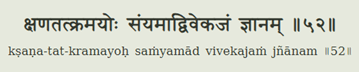
In sutra 3:52 Patanjali advises that by meditating on the present moments in a sequence we come to know the nature of choice and results (discernment).

It sounds obvious and mundane, but in the revelation – it is anything but.  The yogi actually sees how they created this moment.  This provides understanding which facilitates the ability to create with intention.  We seldom arrive in a situation for the reasons we think we arrived there. 

The first time I experienced this, I was notified that I received an award.  Because I was a hot shot right?  No.  What was revealed to me during practice was that the moment of being honored was created by a dozen times when I had honored others and acted with sincere humility.  It was potent and unforgettable because I had longed for that acknowledgement for a long time,  and I am not very humble at all.  It revealed to me the potency of a small decision made with heart, and planted a seed for me to want to live a different kind of life.

So what is the physical body technique for this?  Vinyasa can be complicated, but the alpha and omega of it the rhythm of the breath in practice.  Yep.  Rhythm functions like a ticking clock.  It holds us in the present moment. Being fully in a present moment is the doorway to observing time from a different perspective. Music can be exhilarating by it’s very nature, but cultivating the presence of rhythm and lyrics consciously in our playlist choices can support opening into the full experience of asana practice and vinyasa in particular.

As home practitioners– this can be  one of the hardest facets of group practice to replicate at home.  So for this, I don’t try to replicate it.  I endeavor to work with the techniques in a different way.  Home practice allows us to explore a posture in deeper way related to positioning etc.  Once we’ve made progress with learning a sequence or a posture, benefit is obtained by spending time integrating the breath with the movement.  This kind of breathing is not like exercise breathing.  It requires a constant steady equilibrium of inhale 2 3 4, exhale 2 3 4.  Where the substance of the inhale and exhale are consistent throughout the breath.

Students have often asked about other kinds of breathing that they were told were “better” for one reason or another.  This isn’t about good or bad – it is just one specific technique used to develop one specific element of practice.  If you want to explore this deeper dimensions of yoga, I invite you to work this way with your breath.

For each blog post I create a newsletter which delves into related topics.  You can find this post’s related email here.  To sign up to receive the email in your inbox concurrent with the posting on the blog please sign up below.  I promise you will never be bombarded by marketing emails.

Processing…
Success! You're on the list.

About the Body: Headstand

Let’s not take a headstand out of the yoga practice!  Find a good Iyengar instructor and learn it from them! 

Around 2012 there were rumors that yoga  teaching  insurance would no longer cover classes where headstand was taught.  It was a rumor.  A  threatening one to us old school teachers who were under the gun at the time.   But headstand  is a posture which is open to debate.  In the classical schools it is the king of all postures.  In more modern accommodating classes, you may not ever encounter it. 

I am in the first group.  I studied and taught Jivamukti Yoga which has roots in the Krishnamacharya lineage.  Krishnamacharya was the root guru of three notable  traditions originating in his students  – Ashtanga (associated with K. Pattabhi Jois), Iyengar (associated with B.K.S.  Iyengar) and yoga as taught by T.K.V. Desikachar which he called “yoga”. 

At Jivamukti we practiced headstand for five minutes a day, and it was taught in almost every class.  I feared it deeply.  When K. Pattabhi Jois came to New York to teach I walked through my fear and took some of the classes the classes.  The first day he singled me out and did not let me run to wall during headstand.  He held me off balance in the posture for 12 very, very long breaths.  I was sweating bullets and seeing my life pass before my eyes.  The next day, he walked over, put in me in the headstand in a balanced way, and then walked away.  From that moment forward it was a favorite.

This was how it was taught in those days.  For me, this  was very effective. 

I’d had a long-standing issue in which  my cervical spine would lock up and cause much pain to me.  Going to the chiropractor helped but nothing really changed. 

I walked out of the Puck building that day and stopped on the sidewalk to stretch my post headstand neck.  As I stretched my neck the spaces between the cervical vertebrae expanded and my neck elongated in a way I’d never felt before.  I was already sold on yoga, but with that opening I was sold in a new way.  My curiosity about Patanjali, ancient sage of yoga and so called “jungle doctor” had been unleashed in my practice in a whole new way.  There was healing to be found in yoga.  The world looked a little different.

As a body worker and Shiatsu therapist I suspect in a casual unproven way that the pressure on my cranial sutures released some stress patterns in deep levels of my fascia.  (but don’t try this at home on your own, find a good teacher!). 

Remember headstand is just Tadasana, mountain posture turned around.  The posture is famed for the capacity to uproot all those places where we are stodgy and stuck in our ways.  It’s a fabulous transformer

Processing…
Success! You're on the list.

The Center of Gravity

In the Asian bodywork schools they identify the center of our being as the hara. We might think of it as a center of gravity, thev but the hard includes within it our presence. Being Present to our gravity, what relates us to the earth is why we are here. If, when we sit into our center of gravity there is ease and agility we are moving into the place where alignment can happen. If sitting into our center of gravity causes pain we are moving away from the place of alignment. It is that simple. We must discern uncomfortable growth from pain. This capacity arises through attention. Presence. This is the essence of asana. Sthira, sukham asanam. The posture, the seat should be stable and easeful. No struggle. When you sink into it you are uplifted. If this is not the case, change your stance. Move into a place where alignment happens. Look at your feet, connected to the earth, and change something, just a little. Explore the feet the earth what do you notice? What would you change?

Methods of Asana and Mindfulness

When we embark on a spiritual practice it’s not unusual to open into some romantic and fantastical teachings.  They are very attractive and inspiring.  Also there are also important truths contained in those fanciful teachings.  The more mundane teachings often obscure the vast potential we engage when we embark on our spiritual journeys.  Occasionally, we find a teacher who can deliver an ordinary teaching in a way that communicates the vast potential of yoga pan extraordinary and delightful way.

One such teacher who I encountered was  Lama Marut.  In a meditation workshop he lead us through a weaving path of teachings, delightful, rich, fanciful, funny, very inspiring and just a tad cynical.  Subsequently, in the Q&A that followed, he offered this in a jovial and mildly mocking tone:  “First, just try to watch your breath for 10 breaths without getting distracted.  When you can do that, then worry about the rest of it.”  [I paraphrase!] And then we “sat” to try to watch 10 breaths together.

I’d been meditating for years, but what a teaching!  I discovered that I was far away from focusing for ten consistent breaths.  I could count them, sure but I could count breaths  while I constructed a to do list in my mind.  Within ten breaths my mind turned hundreds of times.  To rest my attention wholly in the breath for ten small breaths was beyond the scope of mindfulness I had acquired at that time. It’s a technique which we can refine and develop and, if we choose, deepen.    We begin by observing the relationship between our attention and the breath.

We can consider this in our asana practice. 

Where are we for each breath?  Drowning in the sound of our breath may help us to stay in a posture without pain, can catapult us into transcendent states and great bliss, but the opportunity to develop the kinesthetic sense of the body is lost.  Concentration on the minutiae of the body develops an intellectual construction which can obscure subtle dimensions of the lived experience of a posture. 

Our call to attention today is to wake up and be present to our body, our breath, our emotions, the room and the turnings of our minds as we take a posture, and to cultivate our capacity to hold all that in our attention as we move through our asana practice.  In a middle ground way – if we allow ourselves to ease openly into intimacy with the moment – presence to  the breath and the body opens the portal to the purer state of underlying awareness. When that happens, we are all in the posture.  Perhaps you have experienced this.  The expansion of attention effects our experience.  As we focus on our breath while attending to the whole of our bodies, our minds, our impact on others and  our place in the universe  we come to know who were are, why we are here and who we can be. 

Repetition and Understanding Asana

There are a few ways that repetition is useful in a yoga practice.  First, it wears a groove and opens us to experiences of greater depth.  Constant change in our yoga practices is amazing- it builds resilience and the ability to adapt.  But this experience of yoga – to become yoked to our deeper wisdom self – requires that we dig down deep enough to hit a level of awakening beyond our normal waking state.  One benefit of getting in a groove, if we do it consciously, is that when our practice gets disrupted it’s easier to shift back into the positive mental and physical states we are cultivating.   Perpetual change can break  apart obstructions which obscure those deeper levels of ourselves, but once again, repetition is a key component to really getting deep in there.  Like digging a hole, if we just take out a scoop here and there as we wish…our well will never be dug deep enough to access the clear pure water.  Yoga works the same way.

Repetition is also a great tool for assessing our bodies from day to day.  To get an accurate assessment, we need to do the same posture as we did the day before.  Yesterday, my Ardha Matsyendrasana (Half seated spinal twist) was at a level I’d never experienced in 30 years of practice.  Today, it wasn’t even at my average.  This is interesting.  It’s information about my body, my habits and my stress responses to the world around me.  Repetition can lead to realization and understanding.

The other thing to consider though, is that repetition invites unconsciousness if it’s not the right time and place to do it.  I remember when I started practicing I frequented the local  Bikram studio. I thrived in the heat and the repetition.  Then one day my knees started to hurt.  I took a break from the practice and focused on Vinyasa for a while.  As I embraced returning to vinyasa, I realized that in Bikram class I was going to sleep. Instead of using repetition to fine tune my execution of the postures – I practiced by rote, but was thinking about cupcakes.  At first I thought the form of yoga I was doing was the problem.  I realized as I practiced more and became more knowledgeable that, no, I had just gotten bored and stopped paying attention to the details.  As a teacher I saw many students who gave up a posture or a style of yoga because they felt it wasn’t good for them. My experience is that when we experience a painful result it’s a call to greater attention to our moments on the mat, and to develop greater self awareness of the body in whatever way we can.  Sometimes a change in practice wakes us up.  Sometimes we just need to tune in deeply to what we are doing.

So how to practice with repetition in a way that is wise?  You can place the posture repeatedly at certain junctures in the sequence you are practicing.  Say Arhdhamatsyendrasana…at the beginning  before sun salutes, after standing, between back bends and forward bends, between each back bend.  Working this way requires that you begin with a very gentle execution of the posture and go progressively deeper. 

Another approach is to design a short sequence to prepare for the posture you are working on  and then repeat that entire short sequence at key junctures in your daily practice.  This creates depth, and you can tweak the  sequence to explore the impact of various lead ins to the posture you are exploring.

The last approach I’ll mention today is that you can just repeat a single posture several times a day, every day for a certain amount of time – a week, a month, a year.  This will help you truly own the posture in a healthy way – it creates an intimacy with it that can change your whole understanding of yoga. Practicing repetition in asana practice is a profound way to deepen your practice and to experientially deepen your understanding of particular postures, how they work, the dynamics created by placing them in certain points of sequence. It’s a great way to transition your practice and teaching from a place where you are practicing and teaching what you have been told by others into a place where you are practicing and teaching from your own inner knowing. 

About the Body: Focus, Concentration, Drishti

What is Drishti?  Drishti is the placing the gaze at a particular place while in a yoga posture (an asana).  Specific points of gaze are prescribed for certain postures, but it can be helpful to begin with just a few general rules. 

  •  The gaze is placed specifically and gently and a little out of focus.  Ideally you don’t really “look” at anything.  (this technique can be applied in tratak as well – see this week’s newsletter on Facebook).
  • A properly placed gazing point will properly position the head and neck, so if your neck hurts in a posture, adjust where you are gazing.
  • As a general rule, the neck is long, and the chin is neutral.  The gaze then rests directly in front of you. 
  • In some postures, the head is turn to look upward (Trikonasana or Ardha Chandrasana).  In these cases the head is turned and the gaze is directed towards the sky, however if that strains the neck or forces the chin up or down, then place the eye gaze straight in front of you – in the same direction your heart or sternum bone is facing.
  •  The tip of the nose can be used in any posture.  In my opinion this can be the most intense of the drishtis.

What does the drishti do?  It builds your focus!!  Through applying it you may discover what focus can really do for your postures.  It raises the heat level in the body.  It steadies the mind, and thus steadies the body.  It brings you into the present – which can help enormously if you are practicing being in postures for a long time (which is really good to do!).  Focus can help you learn to manage discomfort – not through ignoring, but used wisely focus gazing outward and breathing when you are uncomfortable can teach you to be present to and transform your experience of pain.    

Processing…
Success! You're on the list.

About the body: Upping the Asana Game

Yoga is designed to be a lifetime practice.  Well-done practices evolve with us as we move through the changes of our lives – inviting ongoing processes of healing to unfold as our consciousness opens into deeper levels of awareness.  We’ve been talking about awareness of the spiritual heart.  One facet of the practice is that discipline and structure are required in order to have mastery over the mind and body so they don’t interfere with or obscure our experience of our essential being – our spiritual heart. 

In observation as a teacher, and as a long time yoga student, a primary focus in discipline is managing   sloth and torpor – and their  opposites – ambition and grasping.  To obtain the best results in our practice – we are well served to find a structured path between these two extremes.  We might call this the “Goldilocks” amount of effort.  Just enough.  When we are a bit lazy about our practice – it won’t be enjoyable enough to motivate us to make a commitment – we won’t really get the full picture what the yoga can do for us.  When we drive too hard there can be a backlash that causes us to drop out for some time.  Consistent practice (which in and of itself requires discipline) joined with healthy effort creates not only a lifetime practice, but also sufficient internal results to ignite the desire to keep practicing. 

One simple and very universal nonaggressive technique that we can develop to up our game in yoga is focus. Generally the practice of focus in asana will unfold from the external to the internal.  At first, we cultivate focus by not thinking about what is going on outside the room, then not thinking about what is going on beyond our mat, and then having full attention in the body and then full attention in the breath and then being able to abide consistently in the small quiet space in our hearts or minds as we move through a series of postures.  At some point we are able to do this for a sustained amount of time.  One way to check your focus is whether you are sweating or not!  Yep.  Breath makes you sweat, but so does focus.  If your practice isn’t “warming up” for you, try bringing a little more focus.  Some ways to do this might be practicing moving from one asana to another focusing on the breath.   The same move over and over i.e. Downward facing dog to Warrior One.   One breath one movement.  If your mind drifts outside of your body, try really focusing on the feeling of your hands and feet on the floor.  At first, it’s good to focus on something really neutral – and within your own body mind.  It can be helpful not to tell a story to yourself about what arises.  Just observe.  And stick to it for a while.  One week breath and movement, one week feeling hands and feet. 

—————————————————————-

I publish a newsletter in conjunction with these blog posts which rolls out themes related to the inner practices of yoga – the landscape of the mind in practice – often tied in with classic philosophical notes. Like to take a look? It only comes out every week or so, and there are no ads. I promise!

Processing…
Success! You're on the list.

About the Body – Hatha, The Heart and the Thoracic Spine

Hatha Yoga in the classical sense is a journey of integration where the body becomes the perfect vehicle for a different kind of consciousness – the adamantine body.  This happens through integration – where the physical form is transformed by the substance of that consciousness. Through breath and positioning the energy channels of the body – the nadis – become clear.  Allowing yourself to experience breath in the varieties of positions  is essential.  And I use the word “experience” deliberately.  It isn’t about forcing the breath through a posture that feels stuck.  It’s about being easeful and allowing enough that the breath can still be felt and enjoyed regardless of what shape you in.  In that sense it is a cleansing the breath is a cleansing solvent for the nadis.  There is not better place to breathe than in a posture where you are bumping up again your limitations.  Often they are not muscle and bone, they are energetic – energy is stagnant.  And, when the energy is stagnant, so is your mind.  Movement is so important, and yoga asana is designed for this.  This cleansing of the physical form allows the spirit to become more tangible in the physical realm.  A well-done posture facilitates this integration.

That intersection of matter and spirit begins at the level of the thoracic spine – at the heart.    The integration is simplest and most straightforward in the backbends.  This alignment of these two forces (material and spiritual) occurs when the feet are well positioned. Parallel the feet in a back bend and the point of integration of the primary opposing forces – of gravity and upliftment  is shifted from the lumbar spine to the thoracic spine.  This  creates a gentle, subtle space in that very restricted area.  You will know the opening has occurred by the way you feel.  There may be tears or a sense of wonder or great love which occurs with the opening.  The practice at that juncture is to be spacious and allowing of the powerful feelings which unfold -and to understand that your practice is moving into another level – beyond mere physical release and into transformation. 

Interested in stepping a little more deeply into the philosophy and inner practices of yoga? I send a newsletter once a week or less, in conjunction with blog posts, where we explore the inner practices of yoga within the context of a life. Sometimes drawn directly from the traditional yoga texts, and sometimes just commentary on the big picture of a yoga practice – I always intend it to convey something that will be useful to you. I don’t sell anything in these newsletters – it’s an offering and a way to keep my own practice fresh.

Processing…
Success! You're on the list.

About the body:  Empowerment and Ease

About the body:  Yoga and the Parasympathetic nervous system

When we breathe calmly, peacefully, rhythmically through the nostrils, we ignite our parasympathetic nervous system – the relaxation response.  In that mode – many things happen.  Rigid long held stress patterns in the body dissolve, the immune system is nourished and deep healing occurs.  It is also easier to access deeper levels of inner states of consciousness – which allow for different perceptions of the world – for transformation on the level of mind. 

As we take a posture we want to ignite this kind of easeful experience while remaining awake, alert and active.  The more challenging a posture is for us – the more powerful it will be to nurture this kind of breathing.  This is pivotal in transforming our life experience from being a person with a body that is always controlling us – to being a person who has some degree of mastery over the physical and energetic bodies.  It’s important.  

Interested in a little philosophy with your postures? Please join my newsletter community. No ads, just ideas. Once a week.

Processing…
Success! You're on the list.

Paschimottanasa – the Grand Poobah of forward bends. 

(It’s a very, very powerful posture)

Paschimottanasana is a seated forward bend with legs extended straight in front of you.  It’s best if your knees point towards the ceiling so the feet  are neither rocked in nor rocked out.  If you find that you can hardly fold at all – don’t be discouraged.  It’s very common – it’s just no one gets their picture taken if they aren’t touching their toes yet!!  Some find it helpful to bend the knees and rest the chest on the thighs.  You can also sit on the front edge of a folded blanket.

Either your standing forward bends will be easier – or your seated forward bend will be easier.  It reflects certain anatomical tensions in the neck and hips.  If the seated forward bend is stubborn and unchanging, I suggest you work a variety of  standing forward bends first to warm up for paschimottanasana.  The folklore is that  paschimottanasana is about “letting go”  whatever that means.  Let go of what?    I could write a thesis on that…but generally it meant I needed to soften my edges, releasing the fixed ideas that I had about how the world should work.  It involved letting others win disagreements, accepting discomfort, allowing change and opening to possibilities and opportunities in my life that I never would have considered.  It was about choosing ease.  For you it might mean letting go of fear and charging forward by being more active – engaging your thighs or activating your bicep muscles to pull you closer to your toes.  It’s always good to try do so the thing that doesn’t come naturally in the moment.  I feel lazy…activating my thighs (or some other part of my anatomy) may be just thing.  If I’m struggling, then more ease is called for.

The bladder meridian runs down the entire back of the body, so being balanced with water will help as well.  That might mean more water, but it also might mean less water – it’s about balance.

Experimentation is helpful here.  That is a great thing about our yoga postures – they give us data about ourselves that we can use to refine our lives. 

Most of all, like all things yoga, forward bend requires practice -so even if you don’t like it…keep practicing!!