The Anandamaya Kosha, the subtlest of the koshas, bodies, sheaths, or dimensions is commonly translated as the “Bliss Body” . Commonly is an important adverb here – as “nanda” is joy in form and “a” is often creates an opposite. So, bliss, yes, but bliss beyond form. For starters we may want to distinguish between the state of ecstasy that can be achieved by high vibing our practices through drugs, music, endorphins, and exuberance – and the state of ecstasy which is Ananda. Form bliss is not bad. “Beyond form” bliss just does different things. The nature of the Anandamaya Kosha is akin to a subtle sweet flickering sense of joy. This sense of joy arises from the experience of wholeness that is characteristic of this beautiful dimension. It is the origin of all healing, the resolution of pain and trauma, and the understanding of our place in the universe – that we are infinitely unique, genuine, and valuable. And so is everyone else. If we are in touch with the Anandamaya Kosha we don’t have to force, cultivate or practice such a perception. We experience it continuously and directly. There is no perception of competition in the world as true sparkling confidence emerges.
The Anandamaya Kosha is timeless. I once apologized to a student for a short śavāsana (Corpse Posture) at the end of class. “No problem”, he responded, “When I’m in śavāsana I’m in a timeless space – so as far as I’m concerned, it doesn’t matter whether it was 2 minutes or 10.” Good point! So, why does the amount of time that we spend in śavāsana or meditation – immersing ourselves in the Anandamaya Kosha – matter?
The koshas aren’t layered upon one another, but co-existent – like light, sunbeams, oxygen molecules and wind – they influence our life experience in an integrated way.
In the Anandamaya Kosha – in that space of wholeness – all the experiences that fracture us don’t exist (sadness, fear, lack of self-worth). The time we spend in the Anandamaya Kosha is a time of deep rest for all aspects of our being. Resting in the Anandamaya Kosha there are no mental gymnastics, no triggers to the nervous system. For whatever amount of time we are there. This is why everybody looks 10 years younger after a retreat. It is a rest in deep peace.
Practice Tips
Practice śavāsana or Yoga Nidra practice. Use a timer to avoid being worried about time.
Meditation. Once again – use a timer to avoid being worried about time.
The state of yoga is achieved when we cease identifying with the fluctuations of the mind.
The mind as understood in the context of yoga anatomy is distinct from the brain. The brain doesn’t determine it’s function or condition. It is part of the subtle realms of consciousness which are distinct from the five senses. Some yogic scholars identify the mind as a sixth sense. The mind field, or what is called the Manomaya Kosha in the yogic anatomy maps of the five sheaths consists of conscious, unconscious, and super conscious thoughts, beliefs, concepts and ideas — imagination, fantasy, projection, delusion and intellect. In considering this sheath as a field we step into a realm of expansion revealed through the practices of yoga: asana, meditation, observation, study. Unlike the realms of prana, or wisdom or bliss the Manomaya Kosha sits in our awareness all the time. Some of it’s functions are more easily identified than others. It interprets and defines. It assigns meaning. It governs perception. The world culture is permeated with instruction manuals for its management. Just as we can become absorbed in the experience of the body to such an extent that everything else disappears (in sicknesses, deep pleasures or pain) we can become absorbed in the mind to such an extent that we lose sight of everything else (obsessive compulsive disorder, excessive worry, pessimism, delusion, illusion, fantasy).
Becoming aware of what happens in the ManomayaKosha, when we lose ourselves in it and what we can accomplish by managing it is a key development in our yoga practices. So essential is it in the practice of yoga – that the first line of Patanjali Yoga Sutra (which heads up this blog post) references it directly. Like the food body (Anamaya Kosha) and the pranic body (Pranamaya Kosha) can be clear and healthy and flexible and strong – so can the mind body (the Manomaya Kosha).
The Manomaya Kosha sits at the juncture between what is human nature and what is spiritual nature.
There are two primary tools for working with the Manomaya Kosha in our yoga practices. The first is observation and the second is the mastery of the “seat”.
In yoga, our observation training consists of concentration on the breath, observing thoughts as they arise, consciously training to calm those fluctuations as we practice, and disciplining the body through focusing the mind. There is association between the depths of postures and the depth of clarity in the Manomaya Kosha. A deep posture being one where we are fully present (not lost in fantasy or topor or competitiveness or worry) and working deeply (relative to one’s own capacities) the tissues of the Anamayakosha (the muscles, bones organs skin – all of it – being squeezed and stretched and pressed upon.
We might work the observation piece like this:
Decide to awaken to what is in your mind
Establish a state of stepping back internally and witnessing (this can be the tough part)
Observe it objectively – meaning without getting involved – just “watch”. You will observe the arising, existing and falling away of a thought.
Keeping attention partially in the breath can facilitate the state of witnessing
The seat or connection to the earth is a foundation through which we master the mind in our asana practice. It’s not unusual for awareness of our connection to the ground to be non-existent. In all asana, and especially the classical meditative seats, there is a relationship to being grounded and experiencing a lifted spine. This lifted spine is thought to work like an antenna for higher states of wisdom. If you are fortunate enough to see a buddha statue with a pointed hat…you are seeing his antenna!
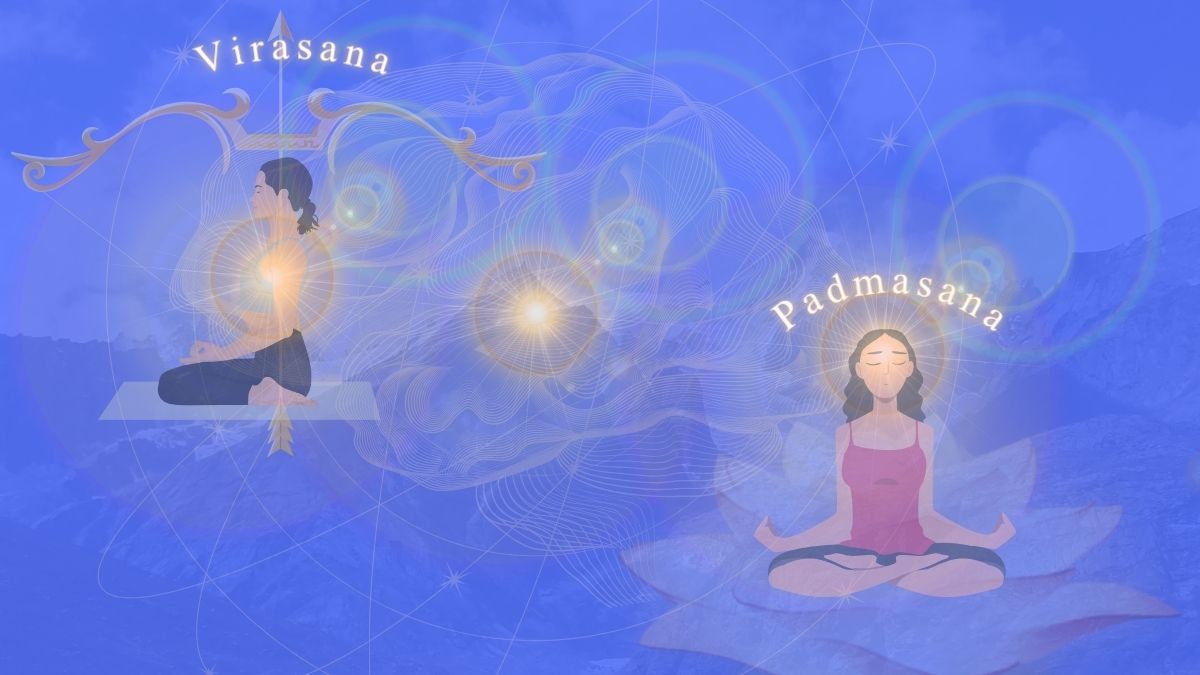
The classical seats I’d like to illuminate today are Virasana = the hero and Padmasana the lotus. I encourage you to explore both of these with physical teachers (in person) and through your own research. These postures often become accessible only after considerable yoga practice.
Virasana the hero is taken with the knees together, sitting between the heels with the sitz bones grounded. The knees together – drawing inward – create a powerful gathering and focusing of energy which supports concentration and focus – practices required for managing the mind. The focused energy also creates a stability which lifts the spine.
Padmasana – the lotus – is unique in it’s combination of deep grounding and expansiveness. The sitz bones are rooted into the earth, the knees are out to the side and the shins cross so that the soles of the feet face the sky. When the shins cross a powerful acupressure point known as SP6 – the juncture of three major “yin” channels -Liver, Kidney and Spleen is toned. Yin draws the energy inward. As with Virasana this inward energy creates a stability that lifts the spine. Any posture with knees open to the sides will create openness and spaciousness. With Padmasana we master our capacity to remain focused and steady in more and more expansive states of consciousness. Padmasana allows us to sit with the experience of enlightenment.
Want a little more “woo” in your life? No? Me neither. But yoga philosophy approached with wisdom is grounding and empowering. The philosophical elements are explored in my newsletter. I promise…it’s not a marketing email although I do suggest readings and music. You can sign up here. They are also posted simultaneously on my facebook business page – NatalieteachesYoga. Thanks for reading!
Processing…
Success! You're on the list.
Whoops! There was an error and we couldn't process your subscription. Please reload the page and try again.
The study of yoga and yogic anatomy is a slowly evolving process of ever deepening understanding. There is a difference between “knowing” yogic anatomy on a visceral level and memorizing the vocabulary. Why is this relevant? Self-Mastery. As we explore these different modes of viewing ourselves through yogic anatomy, we open ourselves to new depths of understanding physically, psychologically, and spiritually. We gain an illumined understanding of ourselves, our purposes and our pathway. We become wise enough to navigate subtler realms as mapped in the concept of the sheaths or koshas (Yogic Anatomy – The Five Koshas,). The sheaths or koshas are interwoven and not distinct, like oxygen and helium molecules in the air – or dimensions as mapped by mathematics and science. Experiencing them is like opening a portal to a universe similar to the one we live in “normally” but, it’s different. . One moment we feel dull and confused and then an inner portal opens and we experience elevation – organically. We access wisdom, knowledge or subtle sensations of the body – and understand our wholeness differently. Last post we explored the concept of the food body or Anamayakosha. Today I’d like to open the portal to the pranamayakosha – the pranic or breath body. It’s near and dear to all of us, and we experience it all the time. We might not be aware of it. Exploring the pranamayakosha we step into the subtle realms of yoga. It’s the first of the subtle koshas that many practitioners experience, which tells us that it’s connected the food body. It’s impact on our psychological well-being tells us that it’s connected to knowledge, wisdom and bliss as well. Just as becoming aware and awake to our physical body requires some understanding and attention, becoming aware and awake to our pranic body requires some understanding and attention too. This is why the pranamaya kosha is so important in our yoga practices – it’s where we start to explore a world beyond our usual perceptions. When the pranamaya kosha is clear – not muddied – it’s easier to experience the other bodies or sheaths with clarity.
It’s hypothesized that prana (subtle energy – like human electricity) flows through the fascia. We don’t know for sure. We can’t yet measure it; we can only observe its effects. This could change – science moves towards understanding yoga all the time.
Within the pranamayakosha, the ancient yogis discerned a vast network of tiny channels which they called the nadis There are hundreds of thousands of nadis. One portal which opens the yogi’s perceptions of the pranamayosha is the breath. Consider how breath is processed by the physical body: an invisible substance – air travels through a physical network of tiny tubes and sacs in the lungs through which the invisible substance of oxygen is absorbed and the invisible substance of carbon dioxide is released. Prana is like this – it’s absorbed from the universe around us and it permeates and moves through the physical form –nourishing and cleansing it. When the prana moves we are awakened, energized and healed.
Within the pranamayakosha are numerous structures formed by the intersection of the nadis. The chakras are vortexes located at key junctures of the nadis and the physical nervous system. There are three primary nadis which bracket the chakra system– the ida, pingala and sushumna. The prana moving through these three nadis governs the process of spiritual evolution. When it moves clear and unobstructed we plug into knowledge, wisdom and bliss.
A first pathway to working with the pranamaykosha is to unclog the nadis and get the prana moving. All asana will unclog the nadis. Vinyasa yoga will get the prana moving quickly. .
A second pathway to work with pranamayakosha is pranayama. Pranayama is is a practice of restraining the breath in order to unclog the nadis. This is most effective when asana has been practiced consistently for a long time. Asana clears superficial levels of congestion – so the work of pranayama – deep and powerful breathwork – is not obstructed by more superficial congestion. Pranayama is a transformative healing practice. It’s best to prepare for it.
A third pathway to working with the pranamayakosha is sound. The familiar sound and symbol of OM is called the “nadam”. The ancient rishi’s or wise ones observed that Om purifies the whole system, like an ultrasound which accesses deep internal caverns of the body below the surface. My experience with this is that working with classical Indian sound practices is the most effective means of actually clearing the nadis. Yogi’s chant the sound of OM, they meditate on the sound of Om, they listen to the sound of Om. This would also include listening to or studying and learning Indian classical music which is designed around an understanding of OM. A fine experiment would be to explore different kinds of music when you practice. At first what you are used to listening to may prove to be very energizing, but as you grow more adept at working with prana and sound, you may notice that Indian classical music is a distinctly powerful complement to your yoga practice.
A fourth pathway for working with the pranamayakosha is ”managing your energy” and in the yoga practices this is accomplished through attention. A starting practice is focusing the breath or the gaze in your asana practice, with an intention to understand what your attention does to your energy and your postures. Too weak of a process of reigning in attention leads the energy to scatter. Too powerful of a restraint will be too harsh for the tender pranic channels.
Four modes of creating a relationship with the pranic body:
Yoga Asana
Pranayama (advised for well experienced practioners)
Sound
Attention
A last note about the pranic body – The ancient yogic texts speak of the adamantine body formed by the hatha yoga practice. This is distinctly related to and an outcome of the management and toning of the pranic body. When the pranic body is well cared for – clear and moving and strong we become incredibly resilient. The texts say all dis-ease is eradicated. As contemporary yogis we can say that our immune system becomes incredibly potent in response to the health of the pranic body. This, as the article included here indicates, is a result of consistent, well-done practice.
To receive newsletters with a different perspective on the blogposts, please subscribe to my Mailchimp! I promise…no ads. Just more talk about yoga, maybe some reading and musical suggestions. All designed to supplement your yoga practice.
Processing…
Success! You're on the list.
Whoops! There was an error and we couldn't process your subscription. Please reload the page and try again.
My cat, Lakshmi, has developed a strange behavior. She’s claimed a spot in front of the house, kind of in the sun. There’s mulch, but raw earth is touchable directly underneath it. She lays there and sleeps very deeply — very, very deeply. We can walk right up to her and she doesn’t wake up. I can scoop her up in my arms and she is so deeply in another state of consciousness that she doesn’t object.
It’s fall in Northern California and soon, if we are lucky, the rains will come – big buckets of rain, months of soggy ground. Today I head out to the beach intending to walk and then, as usual, found myself just laying on the earth for a long while, a long, long while, in a deep and dreamy altered state. When I woke and began walking, on this slightly chilly day when beach days are almost over, there were few people at the beach. Just a few, but many among them were just laying on the beach – like female elephant seals waiting to give birth. No books, no radio. Bodies drawing on the energy of the earth to tap into a mysterious and nourishing deep rest.
The value of the connection to the earth is reflected in Patanjali’s Yoga Sutra, a classic source text of yoga. Patanjali speaks to us about the nature of mind. He speaks to us about the breath. He speaks to us, briefly, about the yoga postures or asanas. The asanas, he states, should be stable and joyful. (shtira and suhka). Asana translates as seat, and we find in texts like the Hatha Yoga Pradipika (HYP), that the key asanas are seats. The postures are ways to sit on the earth. Connecting to the earth, resonating with the earth is key to a good yoga posture. That connection is the foundation on which every posture is built. In the understanding of contemporary environmental scientists – planet earth has an abundance of electrons and direct connection to the earth and this well of electrons nourish and heals us. In our lives, disconnected from the natural world, we are frequently depleted.[i](The article is here – Earthing.) The HYP offers that this resonance is key to the healing of the disease in the body with yoga. The ancient yogis who developed this practice were clearly on a path of great discovery and understanding, just as we are. We don’t have to take anyone’s word for this. Yoga is our personal experiment and we can access the same experiences they had when we follow the maps they left behind.
When planning our practice, this idea can be useful. Of course we practice wherever we can, but practicing on natural surfaces (like wood or sand or earth) taps into the flow of these electrons. This in turn supports the flow of energy in our own bodies . Clear flowing prana changes the resonance of the body. Similarly, wearing and practicing with other natural materials will also facilitate this energetic flow. These are simple things to experiment with in our practices and the potential gain is significant.
[i] Chevalier G, Sinatra ST, Oschman JL, Sokal K, Sokal P. Earthing: health implications of reconnecting the human body to the Earth’s surface electrons. J Environ Public Health. 2012;2012:291541. doi: 10.1155/2012/291541. Epub 2012 Jan 12. PMID: 22291721; PMCID: PMC3265077.
When we embark on a spiritual practice it’s not unusual to open into some romantic and fantastical teachings. They are very attractive and inspiring. Also there are also important truths contained in those fanciful teachings. The more mundane teachings often obscure the vast potential we engage when we embark on our spiritual journeys. Occasionally, we find a teacher who can deliver an ordinary teaching in a way that communicates the vast potential of yoga pan extraordinary and delightful way.
One such teacher who I encountered was Lama Marut. In a meditation workshop he lead us through a weaving path of teachings, delightful, rich, fanciful, funny, very inspiring and just a tad cynical. Subsequently, in the Q&A that followed, he offered this in a jovial and mildly mocking tone: “First, just try to watch your breath for 10 breaths without getting distracted. When you can do that, then worry about the rest of it.” [I paraphrase!] And then we “sat” to try to watch 10 breaths together.
I’d been meditating for years, but what a teaching! I discovered that I was far away from focusing for ten consistent breaths. I could count them, sure but I could count breaths while I constructed a to do list in my mind. Within ten breaths my mind turned hundreds of times. To rest my attention wholly in the breath for ten small breaths was beyond the scope of mindfulness I had acquired at that time. It’s a technique which we can refine and develop and, if we choose, deepen. We begin by observing the relationship between our attention and the breath.
We can consider this in our asana practice.
Where are we for each breath? Drowning in the sound of our breath may help us to stay in a posture without pain, can catapult us into transcendent states and great bliss, but the opportunity to develop the kinesthetic sense of the body is lost. Concentration on the minutiae of the body develops an intellectual construction which can obscure subtle dimensions of the lived experience of a posture.
Our call to attention today is to wake up and be present to our body, our breath, our emotions, the room and the turnings of our minds as we take a posture, and to cultivate our capacity to hold all that in our attention as we move through our asana practice. In a middle ground way – if we allow ourselves to ease openly into intimacy with the moment – presence to the breath and the body opens the portal to the purer state of underlying awareness. When that happens, we are all in the posture. Perhaps you have experienced this. The expansion of attention effects our experience. As we focus on our breath while attending to the whole of our bodies, our minds, our impact on others and our place in the universe we come to know who were are, why we are here and who we can be.
There are a few ways that repetition is useful in a yoga practice. First, it wears a groove and opens us to experiences of greater depth. Constant change in our yoga practices is amazing- it builds resilience and the ability to adapt. But this experience of yoga – to become yoked to our deeper wisdom self – requires that we dig down deep enough to hit a level of awakening beyond our normal waking state. One benefit of getting in a groove, if we do it consciously, is that when our practice gets disrupted it’s easier to shift back into the positive mental and physical states we are cultivating. Perpetual change can break apart obstructions which obscure those deeper levels of ourselves, but once again, repetition is a key component to really getting deep in there. Like digging a hole, if we just take out a scoop here and there as we wish…our well will never be dug deep enough to access the clear pure water. Yoga works the same way.
Repetition is also a great tool for assessing our bodies from day to day. To get an accurate assessment, we need to do the same posture as we did the day before. Yesterday, my Ardha Matsyendrasana (Half seated spinal twist) was at a level I’d never experienced in 30 years of practice. Today, it wasn’t even at my average. This is interesting. It’s information about my body, my habits and my stress responses to the world around me. Repetition can lead to realization and understanding.
The other thing to consider though, is that repetition invites unconsciousness if it’s not the right time and place to do it. I remember when I started practicing I frequented the local Bikram studio. I thrived in the heat and the repetition. Then one day my knees started to hurt. I took a break from the practice and focused on Vinyasa for a while. As I embraced returning to vinyasa, I realized that in Bikram class I was going to sleep. Instead of using repetition to fine tune my execution of the postures – I practiced by rote, but was thinking about cupcakes. At first I thought the form of yoga I was doing was the problem. I realized as I practiced more and became more knowledgeable that, no, I had just gotten bored and stopped paying attention to the details. As a teacher I saw many students who gave up a posture or a style of yoga because they felt it wasn’t good for them. My experience is that when we experience a painful result it’s a call to greater attention to our moments on the mat, and to develop greater self awareness of the body in whatever way we can. Sometimes a change in practice wakes us up. Sometimes we just need to tune in deeply to what we are doing.
So how to practice with repetition in a way that is wise? You can place the posture repeatedly at certain junctures in the sequence you are practicing. Say Arhdhamatsyendrasana…at the beginning before sun salutes, after standing, between back bends and forward bends, between each back bend. Working this way requires that you begin with a very gentle execution of the posture and go progressively deeper.
Another approach is to design a short sequence to prepare for the posture you are working on and then repeat that entire short sequence at key junctures in your daily practice. This creates depth, and you can tweak the sequence to explore the impact of various lead ins to the posture you are exploring.
The last approach I’ll mention today is that you can just repeat a single posture several times a day, every day for a certain amount of time – a week, a month, a year. This will help you truly own the posture in a healthy way – it creates an intimacy with it that can change your whole understanding of yoga. Practicing repetition in asana practice is a profound way to deepen your practice and to experientially deepen your understanding of particular postures, how they work, the dynamics created by placing them in certain points of sequence. It’s a great way to transition your practice and teaching from a place where you are practicing and teaching what you have been told by others into a place where you are practicing and teaching from your own inner knowing.
About the body: Yoga and the Parasympathetic nervous system
When we breathe calmly, peacefully, rhythmically through the nostrils, we ignite our parasympathetic nervous system – the relaxation response. In that mode – many things happen. Rigid long held stress patterns in the body dissolve, the immune system is nourished and deep healing occurs. It is also easier to access deeper levels of inner states of consciousness – which allow for different perceptions of the world – for transformation on the level of mind.
As we take a posture we want to ignite this kind of easeful experience while remaining awake, alert and active. The more challenging a posture is for us – the more powerful it will be to nurture this kind of breathing. This is pivotal in transforming our life experience from being a person with a body that is always controlling us – to being a person who has some degree of mastery over the physical and energetic bodies. It’s important.
Interested in a little philosophy with your postures? Please join my newsletter community. No ads, just ideas. Once a week.
Processing…
Success! You're on the list.
Whoops! There was an error and we couldn't process your subscription. Please reload the page and try again.
In the classic medieval text the “Hatha Yoga Pradipika” or The Guiding Light of the Yoking of the Sun and Moon – we learn that in classical yoga, the practice of Hatha Yoga culminates in the body’s resonance with the sound of “Om”. We are tuned by the practice to a vibration where opposites are united and revealed as facets of one source. That state of unity creates a particular feeling tone. In my experience when that happens, we are feeling the love of the universe within our own form. To do this, the biochemical aspect of the body requires cleansing (diet and various cleansing practices – the shat karma kriyas – the process of sweating during practice), the musculoskeletal system needs to be toned and balanced, and the energy body, emotions and the mind require discipline and clearing through meditation and sound practices (Om) and adjustments in personal care and ways of relating. I know it sounds like a lot, but for most of us we do a little at a time, transforming at a pace that is appropriate for us. The result of this is a clear “sound”. We can hear it in the sound of our voice. We can also hear it inside us as our intuition and wisdom become illuminated. A common test is to listen to your Om at the beginning and end of the class. Or any old time you feel out of tune. This clarity of resonance or lack there of is key to our capacity to communicate. If you’ve ever tried to sort things out with a friend when you felt foggy day you know it’s more difficult than when you are awake and clear. The body is a communication device – not just with our tongues and mouths, but with our posture, the brightness of our eyes, and our health. Imbalance in our system is reflected in the body. And through working with techniques of Hatha Yoga we can bring the system back into balance.
A good place to start is always the musculoskeletal system. The density of the bones and the memory capacity for the fascial tissue and muscles impacts the balance of the whole body mind spirit system. So how do we start?
All yoga starts with Tadasana – or Mountain -or Simple Standing Posture. It is so simple and straightforward that every tension is apparent. We just stand upright with the balance of the weight distributed evenly across the soles of the feet, arms alongside the body. Personally, I never try to force change in Tadasana. I use it as a measure. How is my Tadasana at the beginning of practice? What is it like at the end. Like the Om, it’s often very different, reflecting as greater state of balance and resonance. Sometimes I’ll just stand in it for a long time and feel the tension patterns surface.
Those tension patterns can tell us a lot about how we could create positive change in our lives. There is no formula. For me it’s always my hamstrings get short and tight and my head juts forward. Over the years – through spacious self-reflection and input from yoga colleagues – I’ve come to know that when that pattern emerges – some piece of me is not in the present moment. I’m hanging on to a belief, or perception or way of being that doesn’t serve me anymore. Often by the time my body communicates something – I’ve been ignoring it for a while. Sometimes insights about what needs to change will emerge during asana practice, sometimes meditation or the other forms of practice can help to illuminate the issues. The key is to seek to understand in a receptive way rather than just to fix or overcome and that understanding lays the groundwork for transformation of the body and everything else through my practice.
The imagery of yoga is embedded in the understanding of yoga. On one level the imagery is just about communicating an idea – how to convey an abstract principle in a way that all kinds of students can understand. On another level it is about communicating technique – something is called what it is called for a reason. On another level it ignites our spiritual know which supports the execution of the posture.
One of my favorite examples of the spiritual image of a posture conveying the experience of the posture is Navasana – boat posture. In the classical yogic way of looking at life – there is suffering. The practices of yoga, meditation, mindfulness, and the associated behavioral prescriptions are considered a vehicle which can carry us to the other side of suffering – peace, joy and liberation. The suffering is global and cosmic. It’s also deeply personal, intimate and immediate. The capacity of the global suffering to land as the personal experience of suffering in our lives is mitigated by our practice of yoga. The uncomfortable experience may be present, but we don’t experience it the same way when we are well practiced. Navasana, or boat posture, is an asana where we embody the boat which can safely convey us across the vast presence of suffering in the cosmos to the safe shore of the state of yoga.
At its worst, Navasana is a clench your teeth, grin and bear it hold your breath posture. At its best we lightly balance on our sitz bones, heart lifted, reaching our toes to the sky. We can aspire to endure the posture or to understand the posture enough to find the lift that will take us across the sea of discomfort that life can be. It’s a posture that invites us to take ourselves lightly.
In my experience working with students the key to the posture is the connection of the sitz bones to the earth. Too far forward, the posture will be more challenging than it needs to be – but notice where the challenge emerges in the body. It points to an area that may need some awakening try a combination of strengthening and stretching the area with good breath and attention. Too far back on the sitz bone the heart closes. To discover the sweet spot for balance prop yourself a bit. Sit with knees bent. Place your hands on the floor slightly behind you. Lift one foot at a time until you feel comfortable with the action. Lift both feet, then press your hands into the earth and rock forward on your sitz bones, experimenting to find the spot where it’s easiest to hold your feet in the air. Lift your hands.
Processing…
Success! You're on the list.
Whoops! There was an error and we couldn't process your subscription. Please reload the page and try again.
At its simplest…any asana is wholesomely built on a balanced connection to the earth. Whatever parts of the body are connected with the earth…evenly distribute the weight throughout that footprint and then reach up and out. This is an accessible basis of alignment rooted in physical and spiritual realities. It also does something interesting…done with ease and spacious focused breathing it will re-balance the structure of the body by strengthening that which needs strength and softening imbalanced patterns of tension. The weight distribution across the seat of the posture (the part of the body which connects to the earth) becomes the limiting factor in how far you take the posture on a given day. In standing postures the energetic work comes with mastery of the foot structure – what lifts up (the arches) and what roots downs (outer edges and heels) and balancing that dynamic.
One posture which demonstrates this in an interesting way is Virabadrasana 1 or Warrior 1. Classically, the back foot is at a 45 degree angle to the front foot. Reaching into the heel and stretching the front knee forward – we then gently adjust the hips to move the left hip forward. Sometime this taught instead with the back heel lifted so the hips can be square like a lunge. The classical version – with the dynamic of rooting through the feet, allows for grounding and upliftment, stability and joy. By lifting the back heel into a lunge like position…the position of the hips squared forward becomes primary, and the connection to the earth secondary. Of course I am clearly biased! An artful student could apply these ideas in a lunge – like Virabhadrasa 1. I do believe that a body is similar to any other physical structure. You wouldn’t build the third floor of a building before you’d built the foundation. But the point is to investigate how you are anchoring your posture – and if that creates equanimity, balance, joy. The word asana refers to a seat or one’s situation in relation to the earth. In this sense these energetics are also connected to the idea of giving and receiving – taking in and releasing – which is reflected in the breath and in our capacity to be spacious and stable as we move through our lives.
It’s worth the experiment to explore Virabhadrasana 1 to learn what stability means to you in a kinesthetic sense. Which approach leads you to feel stable and why? And which version allows you to reach out and expand in a multitude of directions. It’s always good to practice an experiment like this consistently over a chosen period of time. The body will be different every day and life experiences will have an impact on the felt experiences and the actual musculoskeletal alignment on any given day. Big changes in a life can bring deep changes in the body – by investigating with some consistency in practice as we move through life we can develop insight, clarity and understanding.
Processing…
Success! You're on the list.
Whoops! There was an error and we couldn't process your subscription. Please reload the page and try again.







 Natalie Ullmann