Why practice ? 

Classical yoga is designed as an intentional practice where the body is used as a vehicle to know ourselves,  to realize ourselves in our whole true nature. This true nature is also referred to as the state of yoga, and it arises as we cease identifying with the fluctuations of the mind. When that happens….

तदा द्रष्टुः स्वरूपेऽवस्थानम् ॥ १.३ ॥

tadā draṣṭuḥ svarūpe’vasthānam || 1.3 ||

(3) Then the seer abides in His Own Nature   /*tr. Swami Satchitanada*/

Our true nature is understood to extend beyond the limits of our physical form, and  so we could think of the practices as tapping into, unlocking or accessing understanding, wisdom and creative capabilities which are beyond the firings of the neurons in our brain.  This experience of the state of yoga releases the time bound functions of ourselves, of the cells of the body, revealing the brightness of the mind. This occurs without force. Alignment of the body mind spirit in practice opens the portals.  When that occurs we discover potential – Our true nature or pure organic potential.  It’s mystical and it’s not religious.  These capacities extend  beyond the individual self so there is a recovery of knowledge.  There is also recovery of our connection with what we might call the universal mind and that in turn illuminates our connection to all other minds. (Sutra 4.4 personal translation) It’s also described as yoking to God  – an old fashioned word for something which is still contemporary and relevant. There are many ways to parse out this experience.

As yogi’s we are invited to travel the path to these results in a very personal way. 

The nature of discipline called for to achieve these ends is self-discipline.  Yoga is a study in self-discipline which, as it evolves, opens into a realm of refined and elegant personal sovereignty. Like any other craft, such a discipline invites us to do a little planning, a little strategy.  Yoga is not a “do your own thing kind of freedom” as much as it is a “refined structure revealing the deeper nature of personal freedom and potential” thing, and so it requires a little thought,  a little work, a little investigation. And so every year as I prepare for the practice of the coming year I ask myself – why practice?  Why practice in this way?  Why not throw it all away and take up pickleball like everyone else?

First I tend to approach this intention setting with an understanding of what’s happening.  What am I called to respond to? 

The world around us is currently in overdrive.  There is nothing peaceful and still about it.  In the world of business in particular – globalization, technology and competitive drive has created an environment which is sharp, deceptive, requiring of constant attention and agility , adaptation and perpetual learning, and study.  That what we are dealing with – if not for ourselves, for our children.  How can we craft practice goals for the year within that chaotic landscape?

This is how I see it, your place in the landscape is unique, You will have your own unique constellation of chaos. But the question the practice raises remains the same. And the faith piece is discovered through practicing in unlikely landscapes. The landscape dictates the curriculum. I encourage you not to make it all about fixing the chaos, but instead, about aligning you more deeply with your heart. It requires a relinquishment of the shoulds. “I gained weight this year. I should do a hard sweaty practice. My heart responds no, actually you need to relax, rest your nervous system and go out for walks, and maybe paint some yantras…because they are fun!” The new year is an invitation to tune into your heart and listen to what it longs to do. The faith piece or shraddha is the faith that that all the different shapes of yoga are designed to support us. So we might ask – what does yoga do and how can I work it to apply it in my present circumstance?  What is my central intention?  And what tools in my toolkit will help me fulfill that intention?

Establishing a clear intention to pursue the bountiful rewards of yoga – that accessing of an infinite well of understanding, creativity, healing, joy, love and accomplishment- supports a swifter approach the goal. Patanjali tells us:

Yoga Sutra 1.21: Tīvra-saṃvegānām āsannaḥ

तीव्रसंवेगानामासन्नः ॥ १.२१ ॥

tīvrasaṃvegānāmāsannaḥ || 1.21 ||

/*To the keen and intent practitioner this Samadhi comes quickly.*/tr. Swami Satchitananda

/*Success is nearest to those whose efforts are intense and sincere.*/tr. Osho

Samadhi, this full consciousness of the yoga – nothing lacking, is realized most quickly when we embrace that fullness as a goal.  When we know where we are going (having intent) will get us there faster.  Yes, Samadhi is a meditative state to be attained, but if sustained we can be in it all the time.  After all Swami Satchitananda, a renunciate, built Yogaville, Om’d at Woodstock and changed the landscape of American thought – no small feat. Osho – having attained Samadhi at an early age rocked the world with his radical upending of spiritual norms.  And so did Gautama Buddha. A well-structured yoga practice supports a well constructed life. We may not become celebrities, but our impact is vast nonetheless.

So, our intentions are critical for they will contribute to the world in a bigger way than we might imagine.

Because of the subtle and vast nature of yoga, I’ve found it works best to set a subtle intention for the year, i.e. to understand peace or creation or backbending rather than to stop being angry, manifest a stack of gold and do urdhva dhanurasana. Being specific in that way can also yield quick results but the subtler intentions bring effective long term healing and transformation. For starters you may want to peruse Patanjali’s Yoga Sutras, third padah, The Vibhuti Padah. This entire section of the book speaks of attainments in yoga. Used incorrectly they can be obstacles to the larger goal of samadhi, but the study of their nature will give you an idea of how yoga works. It’s a list of what you might concentrate on, and the result that comes from concentrating in that way. By focusing on an elephant, you gain the strength of an elephant and so on. An intention is no more than what you will concentrate on, invite in, seek out and look for. Maitri or friendliness, how about that for an intention!

Because yoga is affilitated with the realms beyond desire, I invite you to craft your intentions beyond desire. Consider it as the study that it is, and trust that what the practice will evoke and bring forth from you and for you will grace you with sublime understanding of that which you seek to be creating.

Scroll down for some thoughts about posts the coming year. For in depth commentary on some of the aspects of the blogposts, please sign up for the newsletter. This isn’t for marketing, ever. It’s designed to be thought provoking and inspire you to practice yoga!

Processing…
Success! You're on the list.

******************************************************************

We will continue our journey through the map of the Sankhya Philosophy in the coming year, with a resurrection of the “About the body” teachings and some structured discussion on asana. 

It took us a year to get through the senses.  Of course it did, the sense organs are anchored into dense physical reality totally bound by the slowest vibration of earth.  Slow is not bad…but we are talking the material world, very dense – which is also not bad.  But as we move our way up the chart to the highest states of consciousness the subtleties of energy, mind and beyond – we become lighter, less time bound.  It’s a science fiction idea, but something the human race is embracing.  Time is fluid and can be our tool rather than our master.  As we explored the senses we discovered means to manage them, and to purify them.  These sense directed practices continue as long as we are practicing, although we may engage with them differently along the way.  In January we will begin with our exploration of the elements, also materially but molecular and energetic as opposed to solid.  If you have ever had acupuncture you’ve worked with your elements.  And now, acupuncture is a common feature of medical practice.  We are all lightening up! 

sight, vision and yoga

Present in the yoga cosmologies is an  understanding that the world, the physical world with which we interact every day, is an illusion –  “Maya”.  What is  not an illusion is the love that is the creator who goes by many names. The illusion is ever changing but the loving awareness behind it stays constant and the same.  That loving awareness is within us and around us – omniscient, omnipotent, and everlasting.  The Sankhya philosophy maps out the non-spatial terrain between our sensory interactions with the illusion and our experience of that omniscient loving awareness. Our senses interact with Maya – and that is the field we must work with on our journey. Our sense of sight relates uniquely and powerfully to the experience of the illusion.  Through sight, we see a world full of enemies or friends, flowers or concrete. As with all the other senses, the yogic approach is to purify the sense of sightn so we can have direct vision through the eyes of loving awareness.  As our yoga practices blossom we don’t make ourselves think something positive about the world around us so we see it out there – we actually begin to naturally see differently.

We can consider two components of seeing and vision: the physical eyes (and all the associated physical organs), and the spiritual eye – which only opens as a result of spiritual conditions.  The physical eye sees the world of lack and separation – the illusion.  The spiritual eye sees the truth – loving awareness.  The seeing mechanisms of the physical eyes have a way of blocking the vision of the spiritual eye.   By consciously directing the use of our physical eyes, we unblock the visions of the spiritual eye. The means of preparing for this are our standard yogic tools of discipline (training the eye to focus), renunciation (turning our focus away from disturbing visions) and elevation (cultivating the desire to see in a more uplifted way, and seeking association with others who sincerely are seeing in that way). 

One fundamental practice is to monitor carefully what we allow in our visual field.  The yogi cultivates discernment and turns the gaze away from that which is not conducive to their path.  It’s not about ignoring the challenges before us, but but we don’t allow our sight to become absorbed in it. Think of the last explosive movie you saw…it’s easy to get pulled in. There are paths which work specifically with gazing on death or destruction but personally I don’t work with them, and I don’t recommend them – not because they are wrong, but because I believe that it requires extraordinarily skillful means to navigate that kind of practice effectively. It’s not something to be over confident or over trusting about.  It tends to plump the ego. There are many other simpler approaches.   

We work to choose what to invest our sight in. I think the best example of the challenge of gazing at the destructive was the television reporting after the September 11th attack on the World Trade Center.  I lived in New York City – and all our televisions went out – and were out – for days.  Most of us there saw the event as it unfolded in the material world around us.  The internet was not yet a primary source of information.  So, we went about doing what we needed to do.  Meanwhile in the suburbs and towns across the United States of America – the public was tuning in to a 24/7 hour a day show of the repeat of the film of the towers going down.  Many felt compelled to watch to be in the know about what was going to happen next.  I must say, my friends who watched that loop on repeat had a much harder time dealing with the trauma than most of the people I knew who lived in the city at that time.  That image of destruction looping before their eyes was burned into their consciousness – together with the accompanying fear.  Watching doom on a long term basis can create some inner conditions that are difficult to deal with and heal from.  So, yes, we must pay attention to the illusion, but elements of it which keep us fixed in undesirable states of mind we consume only enough to have the information that we need to manage our lives.  In this case a yogic choice may have been to check in from time to time for updates rather than really tuning for a long period of time.

In general the act of gazing magnifies what you absorb through the eyes.  Surround yourself with simplicity, beauty, upliftment, and check any tendency to rubber neck when the horrific or compelling crosses your path.  This isn’t a prescription for walking away from a tragedy where one might be helpful, but it is a prescription for discernment. While doing the work of helping if called to do so, the yogin focuses on the potential to be helpful and not the apparent tragedy.

A question we can ask ourselves regarding right sight is “Do I want my life force (or my time)  to be spent looking at this?” Intention and conscious decision making are fundamental to success in yoga.  Know that what you absorb will, in some way effect the mind.

The potency of the ability to direct our gaze becomes illumined as we train on our yoga mats and meditation cushions.  The directed gaze becomes a propellant for the movement of the life force, or prana, traveling in the yogi’s sushumna nadi (a central pranic channel which travels along the spine).  The gaze “pulls” the life force. An uplifted gaze will pull the prana upward.  This is cleansing and uplifting.

The directed gaze in an asana is called “Drishti”. Drishti means sight or vision.  In the Hatha Yoga Pradipika 1.37 we meet this beautiful description of the practice of Siddhasana or Adept’s pose. 

“Press the perineum with the heel of one foot, place the other foot on top of  genitals.  Having done this, rest the chin on the chest.  Remaining still and steady, with the sense controlled, gaze steadily into the eyebrow center; it breaks open the door to liberation.” P 102,   Swami Muktibodhananda tr. Translation by the Bihar school

Drishti is a practice where the Hatha yogin rests a soft gaze on a specific point while performing, moving into or out of their asana.  Opinions vary as to where to rest your gaze.  Some general principles to keep in mind are that you should select a gaze where the back of the neck is long and the heart lifted.  A well-chosen and executed Drishti is not just about the eyes, it’s about the whole body.  As your sense of Sthira and Suhka (steadiness and joy in a posture) develops in your practice, the whole body will be energized and uplifted by the gaze.  The body looks towards the divine. So, yes, generally it will be an uplifted gaze.  For specific instructions on drishti in various yoga postures see Light on Yoga, BKS Iyengar.

This uplifted gaze also is born in the mind of the yogi.  As we shall see when we get to the mind in our exploration of the building blocks of Sankhya Philosophy, the mind influences the senses and the senses influence the mind. And uplifted mind uplifts the gaze and an uplifted gaze uplifts the mind.

Another very potent yoga practice related to the sense of sight is tratak.  Tratak is a meditative, deeper more focused form of Drishti.  Taking a classic meditative posture, the yogin gazes, without blinking, at a candle lit at eye level until tears come and the eyes are flushed out.  Then, the yogin closes the eyes and gazes at the third eye center between the eyes and slightly back.  An inner vision will manifest of the flame, a blue dot, a deity.   The key to the practice is the steady gaze and not giving in to the temptation to close the eyes. Give the practice a specific length of time, say, 20 minutes.

 The practice of tratak is woven deeply into the experience of the third eye and the power of manifestation through the Manipura Chakra (the Solar Plexus Chakra). I don’t really recommend trying to manifest a specific desire, but rather to understand that  the truest desires of the heart – which we often are unaware of –  will manifest organically as we develop the skillful means of yoga: concentration, awareness, letting go, balancing, contemplating the Ageless wisdom, and cultivating joy, to name a few.

/*This concludes our exploration of the senses as the ground floor of the map of the Sankhya philosophy – the direct experience of the world around us and how we can work with them effectively to enhance our yoga asana practice. For the next post we will begin the elements.  All of the blogposts are accompanied by a separate newsletter I send out via mailchimp.  There is no marketing or advertising or charge (I promise)– it’s a just to share some deeper details with motivated students.  This month’s newsletter will touch on Yantras, and a closing statement on the senses.  If you’d like to sign up for the newsletter please subscribe below.  I don’t sell your info, I promise.  You can see this month’s newsletter at https://mailchi.mp/05b51002ed24/sankhya-the-senses-sight*/

Processing…
Success! You're on the list.

An Intro and a Segue from Touching to Hearing; CAN YOU HEAR ME? TURNING TOWARDS THE SOUND OF OUR OWN HEARTS

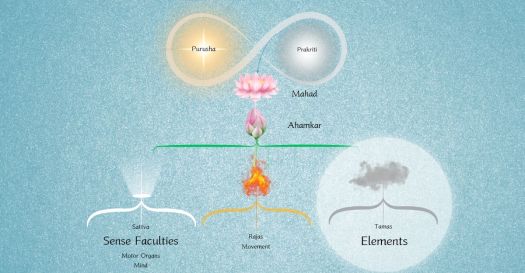
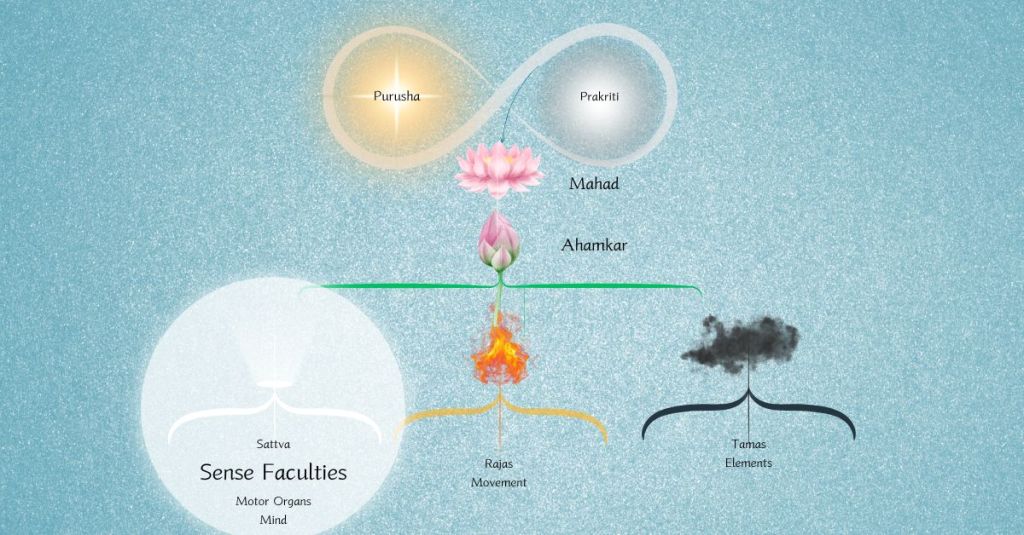
For those of you first joining us, we have been looking at our yoga practices from the perspective of the classical teachings found in the yoga philosophy and related  texts.  We’ve been using the classical teachings as maps to explore in our asana practice.  The segment we are working on now is a segment on the Indian philosophy of Sankhya. The map of the philosophy is shown below.  It is a map of the cosmos from a particular perspective.  We are journeying from the densest most physical aspects of our being to the most ethereal aspects of the cosmos.  Technically, Sankhya and Yoga are completely separated disciplines. Philosophy, science, art are evolving permutations of interwoven understanding. All philosophies, sciences and arts touch one another, influence one another evolve one another. There is likely more than one map of Sankhya floating around the universe or the internet and ideas – like philosophy – end to cross-pollinate.  Most yoga teachers learn about Sankhya philosophy in teacher training and I believe it’s worth exploring the subtle influence that it may have exerted in the understandings of yoga that have emerged.  This post is  not intended as a definitive answer to the question of what the Sankhya philosophy is, but  rather how we can use an understanding of the philosophy to deepen our lived understanding of ourselves and our yoga practices.

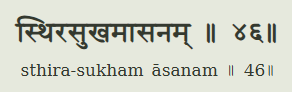
/*Patanjali advises in Yoga Sutra 2.46:

*स्थिरसुखमासनम् ॥४६॥

sthira-sukham-āsanam ||46||

The posture should be stable and easeful. */

We began our exploration of Sankhya and the senses with the sense of touch.  We’ll be moving into an exploration of the sense of  hearing, but first there are a few additional notes on working with the sense of touch as it relates to our asana practice. 

As we develop our practices and deepen our awareness of touch – subtle deep unconscious patterns of tension will surface in our practice.  There are two  facets of working with that tension: first, to release those deep stress patterns and second, to move our bodies (on and off the mat) in ways that minimize the creation and holding of those stress patterns.  When practicing asana it is important not to pile new tension patterns on top of the more deeply held ones in our eagerness to make a posture happen.

The primary way that a new tension pattern is created is to skip a level of your practice.  To push through to a new level of posture before you have released the tension patterns which were revealed in a lighter expression of the posture.  This results in a strain in the body’s tissue as opposing forces are exerted on a joint, muscle, or a specific pattern in the fascial tissue. 

/*Forcing a yoga posture to happen is not the same as transcending pain and pleasure.*/

To stay in ease is to stay in union (yoga).  To force, grip or struggle is to create separation – dis-ease.  Anti-yoga.  To stay in ease doesn’t mean you don’t work hard, stay focused and open to the idea that you might be able to accomplish something beyond your own expectations. Consider this: a certain amount of ease is necessary for any kind of success.

And then there is prana…

As we begin to develop discernment through the sense of physical touch in our practice, we will develop a sensitivity that allows us to detect sensory experiences which originate in prana.   Prana is a subtle substance –  an energy. Like sound it travels and has a felt presence.  Like sound it manifests in a spectrum where different beings can perceive different levels of it.  We know that different species perceive sensory information very differently.  That would be true of perceiving prana as well.  Some of us can feel it acutely, some of us can’t feel it at all. 

And finally, sound is prana.  Sound in various subtle degrees travels through the body in pranic circuits. This is why it reveals and heals. When we touch the ground with our hands and feet the channels are charged with the heartbeat of the earth.

As we begin to  develop this feeling/touch/sensory discernment we discover that some of what we perceive as physical pain are  actually blockages or fragilities which on the level of prana.

The clarity of the pranic channels (which we can feel through our sense of touch) is directly related to our capacity to hear and to hear on a subtle level (and to see and to smell and to taste, etc).  This is the connection between touch and hearing in the yoga practice

/*Notice in the modified Sankhya Chart below the position of the sense on the map*/

CAN YOU HEAR ME? TURNING TOWARDS THE SOUND OF OUR OWN HEARTS

The Sankhya philosophy provides one possible map of the terrain of the mind body spirit connection.  The journey can unfold as a trip where we elevate from tuning in only to our dense physical senses to opening to consciousness awareness in different degrees.  This would commonly be called a journey towards enlightenment.  The journey can also unfold as a kind of embodiment – where  – like shamen we experience an inspired state of consciousness and then bring the inspiration down, to  embody and manifest that experience in the physical world.  One of the most “known” experiences of this process of bringing spirit into physical reality is the manifestation of deep healing by various saints and mystics.  Probably the most well-known is Jesus – whose miraculous healings of lepers and raising of the dead are probably heard of by most people, even if they don’t believe in it.  If you dig enough there are tales of other such healings by saints in all traditions.  A more secular example of bringing spirit into the physical  occurs with inspired innovations i.e. the light bulb or the personal computer.  Sometimes innovation is planned and sought after but often it’s inspired. 

The senses are the interface of consciousness with the manifested world on the Sankhya map.  We touch the world, we hear the world, we see the world and so on. The yogi seeks to manage and clear the senses so that they do not interfere with our exploration of elevated states of consciousness.  Yoga seeks to do what some people turn to substances to do. Drugs can numb the chatter of the mind, drugs can ignite an expanded state of consciousness. But with yoga, these states are attained through personal mastery, awareness and skill (i.e. mastering and clearing the senses). It removes the dependency that substances require.  Yogis are independent.

Mastery of sound is an essential practice in hatha yoga. The yogin becomes unified with the ancient wisdom that permeates the deep silence connected with through practice.  Then, the yogin aspires to staying harmoniously anchored in that “vibration” as they move through the world. This vibration  is depicted by the ubiquitous symbol Om.  Asana practice is both the ground of that harmonic synchrony and the training for sustained experience of that harmonic synchrony.  There are a variety of practices used to cultivate this experience.   In a very straightforward everyday way on the mat we can begin to condition ourselves to excel in these practices.  The training goes something like this:

  1.  External sounds capture our attention on the mat. Some are quite annoying – talking,  sirens, construction, airplanes, and other machinery.  The yogin trains themselves to turn their attention from the external noise and into the inner landscape. There they meet another layer of sound –
  2. Internal Chatter. Much of the chatter of our minds originates in experiences and beliefs rooted in the past with  no place in the present.  With mindful attention the yogi becomes aware of their absorption in this inner chatter and they train themselves to turn inward to a still deeper level of sound –
  3. Subtle Sounds – The yogin hear many subtle sounds within as their pranic channels are cleared through consistent practice – Bells, whistles, drums and humming.  In time, willingness to turn away from these distracting subtle sounds reveals yet a deeper subtler sound –
  4. Nadam – Most likely this is the subtlest sound that a human can hear.  It is steady, constant, ever present – like white noise but more ethereal.  Tuning our attention away from more overt inner and outer noises to this perpetual background hum within and without, and allowing ourselves to relax into it begins a process of deep healing and awakening.   But even then…the yogin turns their attention away from it, and towards something deeper –
  5. The Anahata Nadam.  The anahata nadam is the sound that is complete silence without vibration – the “unstruck” sound.  Here the yogin relaxes into the deep silence and in stepwise fashion becomes absorbed in expanding stages of continuity. 

We practice this way on the mat, and asana facilitates this process.  In later stages conscious meditative seats (asanas) like virasana and padmasana support the process of allowing ourselves to be absorbed in silence without falling asleep or going unconscious.

In practicing asana how can we support this process in personal practice or when leading a class?  The playlist.  The playlist is most beneficial at early stages of this process.  When the chatter of the mind is overwhelming and distracting on the mat that is when you want the playlist.  It is also really helpful in situations of deep unconsciousness where you or those you are leading just can’t stay present – which is a result of trauma.  It either wakes you up or calms you down.  The goal is the experience of yoga – this inner absorptive yoking.  It’s important to be aware that familiar music or verbal music will have associated mental imagery and memories and feelings that will be ignited and it’s likely to draw the attention outward rather than inward.  Sometimes this is needed.  But just be aware that a rousing playlist of familiar or exciting song might operate in a way that is inconsistent with your goal. 

When you create your playlists consider creating a musical experience which propels the journey towards yoga and not to somewhere else.  Like a soundtrack to a movie you are building up to something:   an experience of yogic absorption for yourself or the student. 

Indian classical music is designed to take you to this point, so it’s very useful. But if you use it too early in the process it can be too potent and cause a different kind of distraction.

Consider as well that when we take in music it can nourish us; pure sounds are deeply nourishing.  Note that doesn’t always mean soft or new agey.  A pure note is a perfect note.  Some music that we love has those pure notes, and you will develope an ear for the perfect note as your practice unfolds.  Allowing yourself to be nourished by deep clear sound is deeply healing as well as enlightening, and this can lead to all kinds of magnificence if approached with an open mind and heart. 

The anahata nadam – that deepest level of sound resides in your spiritual heart.  That’s where the note of silence lives.  So when you touch it for the first time as a yogi you will feel and hear the spiritual heart. 

Working with sound in asanas is accessible to all  and an abundant and beautiful experience. 

Each blog post has an associated newsletter. No marketing! I promise. To sign up to receive the next email please do so below. To see the accompanying newsletter for this post, they are publicly posted on my facebook business page for NatalieteachesYoga.

Processing…
Success! You're on the list.

Sankhya, sovereignty and the sense of touch

In our investigation of the Sankhya philosophy and asana we begin with a study of the senses.   On the map, the senses are on the bottom row, left side – classified under sattva.  (see image below) For now we will consider sattva as awareness.  Senses are intimately connected to the quality of awareness.  Classically,  yoga is a discipline through which we access and become aware of our inner wisdom through practices by which we are trained to withdraw our senses from the external world.  As we turn them inward – our connection to the sacred and the infinite resources of wisdom and awareness are revealed.  The magnificence of asana is that it is a physical practice which results in a state of transcendent experience and understanding beyond the physical. Working consciously with our senses facilitates opening to greater levels of awareness and allows us to realize those more illumined states of awareness in the physical world.

When we practice, keeping measured attention on the breath will develop the objectivity we need to interpret the information we take in through our senses.

We can think of the information that we take in from our senses as data and the understanding and interpretation of that data is done by the mind.  Sankhya philosophy identifies different aspects of mind.  We’ll get to that later.  I just point this out because it’s just like looking at a spreadsheet,   The numbers don’t mean anything.  The meaning comes from analysis and the purpose with which you observe and work with  them. The more we can step back into an objective, non-interpretative relationship with our sense data the more we will understand about yoga.  For example, pain can be dangerous, healing, warning, or a clue for a potential adjustment. We need to be in a non-interpretive state to discern the meaning of the pain.

The following five senses organs are enumerated in the sankhya philosophy: 

The eye, the ear,  the tongue, the nose and the skin.

The disciplines of focus and austerity in the yoga practice are designed so that, just as we might learn to articulate the movement of a limb, we might also manage those sense organs.  As our practice evolves into greater levels of subtlety, we become masters of how a given piece of sensory data is interpreted.

*****************************

Today I’d like to consider touch.  Touch is a very physical sense and the physical body is the asana yogi’s primary vehicle.  The fundamental  and first level of awakening awareness of touch in the yoga practice comes through the feet on the ground.  Consider the following progression: 

  1. Tadasana: mountain posture – the feet are both on the ground  steady and even – the weight dispersed through the pads of the toes the ball and the heel. Both feet work together as one foot.
  2. Vrksasana – tree posture – we shift the weight to one foot, and connect the sole of the other foot to the inner leg.  The weight of the body is evenly dispersed through the standing foot
  3. Virabhadrasana 2 – warrior II -we begin to master weight distribution between two feet with the same sense of dispersion between the toe, ball and heel pads. 
  4. Adho Mukha Vrksanana – handstand – all the weight on two hands (look ma – no feet!)
  5. Adho Mukha Svanasana – Both hands and both feet on the earth and separated and new possibilities emerge in terms of weight distribution and articulation of the hands and feet against the earth. 

Some things we might note:

  • The touch of the body against the earth
  • The touch of two parts of the body against one another
  • The touch sensation of distribution of weight.
  • The touch sensation of activation of muscles and pressure.
  • Add to this the qualities that might be included in the experience of touch:
    • pain
    • pleasure
    • revulsion
    • hot or cold
    • heavy or light

Through attention and awareness the sense of touch becomes proprioception and kinesthetics – where our awareness of the inner landscape awakens and knowing our purpose in time and space. 

Take it further –   what is revealed is how the body works – including the internal organs.  Through attention to the more overt layers of sensation – awareness of the subtle developes and we awaken into clairsentience.  “I have a feeling”.  It’s like a gut instinct but much subtler and tuned to a different frequency.  Consider laying your hands on someone – a gesture of friendship or love or passion – all different frequencies or “vibes”.  Touch also has a relationship with the heart – this “I have a feeling” is a dimension of the emotional heart but also the spiritual heart. 

For the asana yogi, the heart is the seat of the nadam, the inner guru, sound vibration, the sound of vibration of Om.  Yes.  Vibration.  Detected by touch. 

When we practice asana we open doors to expanded understandings of….well, everything.  So as we pay attention to touch in practice – it opens the question of “pain” in yoga practice.  Many opposing views of how to relate to pain in yoga are espoused in the yoga community.  But through awareness we develop discernment about the sensations in our body – like pain.  This awareness is related to our personal sovereignty.

Consider a way  of relating to ourselves and the world which relies totally on external sources for interpretation (the doctor, the internet, our mother, the person one mat over from us in class).  This way of relating which denies our capacity to interact observe and interpret the signals of our own body.

Consider a way of relating  where the sensation itself governs us.  For example “Oops I feel something – I’m not going there into that forward bend, back bend, – I’m going to avoid sensation completely”.  The healing potential of the posture is never even approached.  We give our power of choice away to the sensation.

Consider a different way of relating, different than the ways described above.  Consider becoming aware of a sensation, observing, breathing, noticing the quality, and then noticing the quality change as we gently shift the body part a millimeter, or stretch a little deeper.   Then we come to know:

 “Oh – this pain indicates I need  the attention of the doctor”, or  

Oh, this pain indicates I need to go deeper in the practice”, or

Oh, this pain indicates I need to be gentle in practice”, or

Oh, this pain indicates I’ve been slumping at my desk.”

Through careful observation of sensation we reclaim our power of CHOICE.  No small thing.  Moving into this state of sovereignty by activating awareness and choice –  we no longer make the pain all powerful by ignoring, fighting or delegating it.  We hold the possibility in our hands and through attention we discern the next best step towards wholeness, healing and yoga.

I always try to create a post and a newsletter to be released simultaneously. They aren’t for marketing purposes. This is just a way to share what I learned in my years of teaching. In the coming releases I anticipate that the information in both will really be useful. You can sign up below. You will not receive anything other than these materials. The newsletters are also available on the NatalieteachesYoga facebook page and on Tumbler.

Processing…
Success! You're on the list.
An image of the chart of the sankhya philosophy with senses illuminated.

Before our dive into Sankhya: Why Practice?

/*my apologies friends – there were two posts that ended up in drafts instead of being posted. I’m posting them today and will follow with the new post on Sankhya later this evening*/

Before we begin our study of Sankhya  (our first official post on that will be later today)– let’s dig in to our intentions for embarking on such a deep study. Why study this way?  Why practice?

There is value and delight in exploring the cracks and crevices of the yoga practice – going deep, mining the esoteric elements and using our time on the mat as a laboratory to experiment and empirically validate the findings of the ancient wise ones who brought forth and developed the practice.  The perpetual renewal of the desire for practice confirms that people do experience a potent and ineffable something when they practice yoga.

The rich and resonant core of the practice is unearthed through the investigation of the source of the practice.  To bow down our hearts and minds to those who have gone before us, paving the way that we too might walk towards freedom and enlightenment – to receive from the history of yoga practice.  For every step on this journey into depth and wisdom we are invited to the land of “Nyasa” the perfect placement (as in Vinyasa).  Why are we here and now? In this place in this moment?  Purpose and intention nurtures the practice and in return the practice reveals deeper truths about personal purpose and intention. 

/*Why practice?  Why practice in this way?*/

There are easier and more efficient ways to get in shape…so…

/*Why practice?  Why practice in this way?*/

There are easier ways to feel better… so….

/*Why practice?  Why do the work of studying yoga in this way?*/

Because our day to day experience of the practice yields a sense of promise, and the promise of yoga is the universal end of pain. “The end of all love longing”. (see the Kena Upanishad)

So as we embark on our exploration of the Sankhya philosophy in the coming weeks – know that sankhya understood in conjunction with our yoga asana is a profound and powerful  tool for tapping into a richer vein of practice. Yoga from the the source is path of transformation that subtly transforms the world as we are transformed through it. 

A well-done practice ranks among the world’s most treasured resources – path of treasure yielding transformation.   So….

/*why practice? the promise of the practice is there, but what does that mean for me?*/

Who will you be-coming?  What is the offering that you bring to the table in these times…and how will you wrap that package?  What is love asking of you at this time?  As with all things yoga, the questions are more important than the answers.  The questions guide our process – our unfolding in practice  – As we learn and grow our intentions unfold with us so it’s good to be flexible (we are yogis after all) – but it’s good to set our compasses- and know what our heart desires. 

So with that I nudge you to reflect before the coming year, on your practice, on your purpose, on the yield of the discipline you will bring to your study.

For every blog post, I send out an accompanying newsletter – different from the emails sent from WordPress. The newsletter allows me to go a little deeper, there are sometimes specific sutras, or chanting or musical suggestions, and maybe even some thoughts on sequencing or the body. It’s not a marketing newsletter – it’s designed for those who care enough about these topics to sign up!!!

This post’s newsletter is on with a sutra from Patanjali. If you ‘d like to see it check it out here:

To subscribe so you receive the materials on the same day – please sign up below.

Processing…
Success! You're on the list.

sankhya

संख्या

The next map of yoga we will explore here  is the Sankhya Philosophy, which maps the terrain from the unified field of awareness to our experience as individuals evolving into knowing ourselves and our place in the infinite universe .  We can use it as a guide when we traverse the landscape of the material realm seeking evolution, liberation and peace.  We can also use it as a guide as we carve out a pathway for the rivers of pure consciousness to irrigate the material world that we inhabit.  Translating into ideas of enumeration and rational decision making it appears to be a highly analytical discipline disconnected from our day to day experience on the mat.  But that is far from true.  Right discipline in practice creates a crucible for personal actualization. It paves the way from a life lead astray by every passing influence to alive of personal sovereignty – aligned with the will of the infinite, limitless omnipotent loving intelligence that goes by many names.

For an image of the map please see this website Sankhya.

The journey of begins with awareness of our senses – direct experience of our awareness touching the physical world via the physical body and ascends through the individual mind, the collective mind, the wisdom mind through the experience of pure duality (me and you) and then in some maps to a unified field of consciousness beyond that duality.  We will take the map beyond duality  to the unified field. 

The heart of healing exists in the unified field. The heart of yoga (which is a dualistic discipline) is  experienced in communion with the unified field. 

/*Whereas the koshas or sheaths (the five dimensions of you) are really about the individual, the Sankhya philosophy is about reorienting ourselves into our  unique place as an individual within the cosmos.  .  The practice of yoga asana leads us directly towards, aligns us with and supports us in staying steadfastly and joyfully engaged in this  ever changing process of reorientation. /

The practice  we will be exploring is using asana to bring awareness to the senses, our actions, the general qualities of nature, the individual mind, the cosmic mind, our sense of separation and yoga or unification.

As we explore these maps we gain the ability to attain mastery in asana, meditation and life. 

How can we start to consider this?  It helps to explore a new sense of our physicality.  Some approaches to yoga work with transcending the physical body, but to really understand ourselves as living as physical bodies from a yoga perspective – we start with physical awareness.  When we start our yoga practice we are entombed in conditioning about our physical bodies- that the body is shameful or exalted or it drives us or it pulls us down.  The flavors of conditioning about the body are infinite.  Open Vogue, or Grey’s Anatomy or unpack your experience of gym class in the second grade. Conditioning is subtle – Habits are generated in our unconscious.

What we do want to do is to open our field of awareness as we practice. Just by giving up preferences and practicing observation we will come to know our conditioning and we may choose to leave it behind.  What thought arises as we tumble out of tree posture – or come down with a thud out of headstand.  We will break down some of these explorations in asana as we walk through the map in the coming months – but for now you can get ready, just by beginning to notice what arises on and off the mat in a very general sense.

If you’d like to receive a newsletter prepared in conjuction with these posts – illuminating other facets and designed to prompt your creative thinking about your practice Please sign up below. And I promise…you won’t be subject to marketing emails from me…this is just about talking about yoga.

Processing…
Success! You're on the list.

Pratiṣṭhāyāṃ:  A Path to Deep Asana प्रतिष्ठायां

/* To be established in a posture is not about the first time you attain it (although that is to be deeply celebrated). It’s about accessing it – in an aligned fashion – consistently enough that you can grow your alignment within it.*/

Pratiṣṭhāyā – to become established in, is a fundamental concept in yoga practice as described in Patanjali Yoga Sutra. It’s pervasive; we are guided to become established in focus, established in asana, established in meditation, established in practice, established in the experience of yoga and more.  Once you are established your path is clear and unfolds quickly.  Yoga does not peak with  the experience of a flash of insight  (although that’s a valuable thing – it’s not the heart of the practice)  it’s about establishing oneself in an internal landscape where insight continuously fosters understanding.  To be established in a posture is not about the first time you attain it (although that is to be deeply celebrated). It’s about accessing it – in an aligned fashion – consistently enough that you can grow your alignment within it. You are relating to the posture.  Deep asana then becomes about that capacity to deepen the alignment of the posture over time. There is an eternal, never-ending quality to establishment.

/*All postures become deep postures through the practice of inhabiting them in time with greater alignment and understanding.*/

Deep asana then is relative to one’s own body – built into the practice over time and emerges with stability and ease.  It’s always advisable to step back in practice when one cannot stay stable in the posture with relative ease.

A first mode of deeper alignment which unfolds in deep asana is internal – at the level of the ManomayaKosha or mind body.  Presuming you have placed yourself well to begin with in a posture, discomfort is first addressed in the mind.   This does not mean that sensations are ignored – on the contrary paying attention to them is awakening into the posture.  But, for most of us, placing our bodies in these unusual positions is…odd. So, there is likely to be psychological discomfort and an opening up around that is very powerful. 

For those with backgrounds of dance, gymnastics or similar –  expectations take the place of the psychological discomfort of the novice.  They are constructs in the mind that obscure new levels of awareness. For the physically experienced deep asana is an invitation to shift into a new awakening, into a different kind of bodily experience – experiencing the shape without judgement, competition or preconceived ideas about how the body should inhabit the shape.  Discomforts, expectations and conquests are often mental constructs which obstruct our ability to deepen an asana in a fresh, organic and transformative way.  They are subtle forms of fear and resistance.  If we meet them with spaciousness we come to know and understand ourselves and the posture differently . 

/*Discomforts, expectations and conquests are often mental constructs which obstruct our ability to deepen an asana in a fresh, organic and transformative way.  They are subtle forms of fear and resistance.*/

Tuning in is a second mode of shifting into deep asana.  Feeling the  body holistically in space and time. Inner body scans, proprioceptive or kinesthetic exercises and relaxing around resistance  deepen  the holistic sensory experience of an asana – not once, but continually.

A third mode of establishing into deep asana is time   – time in the posture and consistent practice of the posture daily, weekly, or monthly  – over months, years, or decades.  Doing less, more consistently will yield a deeper result than doing a lot intermittently.  It’s seldom a linear process, but the intention to consistency will do much for establishing your practice.  A general rule for this is that your posture should always be stable and easeful.  So, find your edge at 1 minute, 2 minute, 3 minute and so on.  Work the mental resistance first.  Begin to identify what your mental resistance looks like. 

Example:  I’ve been working a 10 minute Virasana, and 10 minute Padmasana (5 minutes each side)  sequence for months now.  In those postures I’d been meditating in a whole new way.    A new proprioceptive awareness (my body in space) of my pelvic girdle began to emerge.  This week as I take the postures for practice my mind bounces all over the place – it’s hard to get on my mat to begin with and there is no peace. Breakthrough time – time to step back a little and cultivate the stability of mind that I need, that I can reside in consistently enough to experience the breakthrough.  I modify the postures slightly in consistent, strategic ways. A little extra propping, a little extra warming up.  I reduce my time in them at the beginning of practice and then engage them again for a short time at the end of practice. 

This kind of strategic approach to asana, while analytical, lays the ground for being your own teacher in a personal practice in an illuminated way.  You may find other ways to bring strategy and discipline to your practice, but I encourage you…gently…to experiment with  modes of deepening your understanding of your practice.  It leads to deep healing and a different flavor of progress.

Thank you for reading! Concurrent with each blog post a newsletter is issued. If you’d like to receive it please sign up below. This is not sued for marketing purposes. If you’d like to support financially, my designs are available on Redbubble. See designs on menu. New designs are available on Redbubble within a day or so of being posted here.

Processing…
Success! You're on the list.

Deep Asana:  Understanding your joints for deep healing.

/*This is the first in a four part series about deep asana and creating personal sequences*/

In the classical schools of yoga  the healing power  of deep asana Is a powerful rubric. By deep asana I am referring to the classical spinal twists (i.e., ardha matsyendrasana) , lotus (padmasana), and all the various binds. These deep squeeze postures  are purposeful in their intensity in a way that large muscle strengthening or or deeply relaxing postures are not. To practice them effectively we must understand how the joints function – and what the deep asana does.

For example

  • Padmasana. The knee is a hinge joint. The ankles are mosaics of tiny interconnecting bones that move like ball bearings to allow maximal movement – but the structural stability of the joint is borne of the way those joints fit together, fettered together by soft tissue – fascia, ligaments, and such. When we do padmasana – the deep exterior rotation of the legs must emerge from the hip socket to protect the functioning of knees and ankles. If we are practicing padmasana – we must balance that deep external rotation of the hip joint with stabilizing strengtheners in our standing practice. Particularly the internal rotations which connect the feet to the earth through the inner ball of the foot. These inner rotations, while originating in the connection to the earth travel up the leg and into the hip socket and pelvic girdle. Stable hip/pelvic girdle structure is needed for standing, walking, and containing the soft internal organs. a correctly activated inner rotation will strengthen whatever tiny muscles which need to be strengthen and will establish ease in those which have been acting as supports when it wasn’t their function. So we must understand how the joints work – and what their purposes are and how they relate to each other.

  • Ardha matsyendrasana: Vertebrae spin gently in restricted rotations around a central axis. Each vertebrae is uniquely shaped for its perfect placement in the column of the spine. The shape of each one contributes to the moving stability of the spinal column. When performing a deep asana form of a spinal twist, we are invited to gently explore the boundaries of the vertebral rotation. The spine must be lifted and relatively straight to protect the cushions between the vertebrae, which protect the nerves. Remember important components of the nervous system travel through the spine – your central nervous system! A classical spinal twist is not a full body twist – it is focused on the spine. The sacrum does not participate in the twist. Instead, the pelvic girdle is given structural stability built from the ground up  either through knowledgeable activation of appropriate muscles or through placement i.e., through sitting squarely on the ground.
  • The pelvic girdle is a bunch of moving pieces. Yep. It’s not a solid bowl. Those moving pieces can misalign in subtle ways,  impact the alignment of the vertebral column and the ability of the vertebrae to turn. The stability in the alignment of your feet and knees supports this structure. Building the asana from the ground up helps with this.
  • Deep asana is not forceful asana. There are lineages where force was used effectively but I am not aware of any school that currently works successfully with dramatic deep quick forceful adjustments into deep asana. Gentle knowledgeable movement is as effective, if not more so in the stable ongoing practice of deep asana.
  • Modifications and simpler postures are your friends. You can design or learn modifications that will work specifically on the joints which present obstacles in our practice of deep asana. In my practice I work for long periods of time in specific modifications to open joints, like the hip or the  turning of the spine, before moving into the deep posture.  This creates a stable foundation for the deeper postures which is safe and healing.

Note – the relationship with deep asana is very different for those who started yoga before their bone structures were fully formed.  Yeah. The sacrum is still forming up to age 5. For the rest of us – bones remain malleable through our lives, depending on lifestyle – so change is possible, but it is best executed gradually and consistently.

Through the squeezing wringing of soft tissues in the joints – deep seated stress patterns in the fascial tissue are released, and structures in the pranamayakosha – the pranic body are aligned and rejuvenated. After squeezing – fresh blood and prana will flow into a joint to nourish it.

I encourage you to learn more about the way your joints function and how each posture – in its classical form (see Light on Yoga) articulates the joints. Note that Mr. Iyengar who is depicted in the pictures in this book, started very young. He’s like a gumby. But you can still see external rotations, internal rotations, deep spine twists, in those classical images. Gently experiment with what you learn – so it is no longer an academic exercise to learn about your yogic anatomy.

My Mailchimp newsletter is sent concurrently with this – it’s designed to illuminate related ideas to stimulate understanding and spark your thinking about your practice. I promised I won’t send you marketing emails.

Processing…
Success! You're on the list.