Classical yoga is designed as an intentional practice where the body is used as a vehicle to know ourselves, to realize ourselves in our whole true nature. This true nature is also referred to as the state of yoga, and it arises as we cease identifying with the fluctuations of the mind. When that happens….
तदा द्रष्टुः स्वरूपेऽवस्थानम् ॥ १.३ ॥
tadā draṣṭuḥ svarūpe’vasthānam || 1.3 ||
(3) Then the seer abides in His Own Nature /*tr. Swami Satchitanada*/
Our true nature is understood to extend beyond the limits of our physical form, and so we could think of the practices as tapping into, unlocking or accessing understanding, wisdom and creative capabilities which are beyond the firings of the neurons in our brain. This experience of the state of yoga releases the time bound functions of ourselves, of the cells of the body, revealing the brightness of the mind. This occurs without force. Alignment of the body mind spirit in practice opens the portals. When that occurs we discover potential – Our true nature or pure organic potential. It’s mystical and it’s not religious. These capacities extend beyond the individual self so there is a recovery of knowledge. There is also recovery of our connection with what we might call the universal mind and that in turn illuminates our connection to all other minds. (Sutra 4.4 personal translation) It’s also described as yoking to God – an old fashioned word for something which is still contemporary and relevant. There are many ways to parse out this experience.
As yogi’s we are invited to travel the path to these results in a very personal way.
The nature of discipline called for to achieve these ends is self-discipline. Yoga is a study in self-discipline which, as it evolves, opens into a realm of refined and elegant personal sovereignty. Like any other craft, such a discipline invites us to do a little planning, a little strategy. Yoga is not a “do your own thing kind of freedom” as much as it is a “refined structure revealing the deeper nature of personal freedom and potential” thing, and so it requires a little thought, a little work, a little investigation. And so every year as I prepare for the practice of the coming year I ask myself – why practice? Why practice in this way? Why not throw it all away and take up pickleball like everyone else?
First I tend to approach this intention setting with an understanding of what’s happening. What am I called to respond to?
The world around us is currently in overdrive. There is nothing peaceful and still about it. In the world of business in particular – globalization, technology and competitive drive has created an environment which is sharp, deceptive, requiring of constant attention and agility , adaptation and perpetual learning, and study. That what we are dealing with – if not for ourselves, for our children. How can we craft practice goals for the year within that chaotic landscape?
This is how I see it, your place in the landscape is unique, You will have your own unique constellation of chaos. But the question the practice raises remains the same. And the faith piece is discovered through practicing in unlikely landscapes. The landscape dictates the curriculum. I encourage you not to make it all about fixing the chaos, but instead, about aligning you more deeply with your heart. It requires a relinquishment of the shoulds. “I gained weight this year. I should do a hard sweaty practice. My heart responds no, actually you need to relax, rest your nervous system and go out for walks, and maybe paint some yantras…because they are fun!” The new year is an invitation to tune into your heart and listen to what it longs to do. The faith piece or shraddha is the faith that that all the different shapes of yoga are designed to support us. So we might ask – what does yoga do and how can I work it to apply it in my present circumstance? What is my central intention? And what tools in my toolkit will help me fulfill that intention?
Establishing a clear intention to pursue the bountiful rewards of yoga – that accessing of an infinite well of understanding, creativity, healing, joy, love and accomplishment- supports a swifter approach the goal. Patanjali tells us:
Yoga Sutra 1.21: Tīvra-saṃvegānām āsannaḥ
तीव्रसंवेगानामासन्नः ॥ १.२१ ॥
tīvrasaṃvegānāmāsannaḥ || 1.21 ||
/*To the keen and intent practitioner this Samadhi comes quickly.*/tr. Swami Satchitananda
/*Success is nearest to those whose efforts are intense and sincere.*/tr. Osho
Samadhi, this full consciousness of the yoga – nothing lacking, is realized most quickly when we embrace that fullness as a goal. When we know where we are going (having intent) will get us there faster. Yes, Samadhi is a meditative state to be attained, but if sustained we can be in it all the time. After all Swami Satchitananda, a renunciate, built Yogaville, Om’d at Woodstock and changed the landscape of American thought – no small feat. Osho – having attained Samadhi at an early age rocked the world with his radical upending of spiritual norms. And so did Gautama Buddha. A well-structured yoga practice supports a well constructed life. We may not become celebrities, but our impact is vast nonetheless.
So, our intentions are critical for they will contribute to the world in a bigger way than we might imagine.
Because of the subtle and vast nature of yoga, I’ve found it works best to set a subtle intention for the year, i.e. to understand peace or creation or backbending rather than to stop being angry, manifest a stack of gold and do urdhva dhanurasana. Being specific in that way can also yield quick results but the subtler intentions bring effective long term healing and transformation. For starters you may want to peruse Patanjali’s Yoga Sutras, third padah, The Vibhuti Padah. This entire section of the book speaks of attainments in yoga. Used incorrectly they can be obstacles to the larger goal of samadhi, but the study of their nature will give you an idea of how yoga works. It’s a list of what you might concentrate on, and the result that comes from concentrating in that way. By focusing on an elephant, you gain the strength of an elephant and so on. An intention is no more than what you will concentrate on, invite in, seek out and look for. Maitri or friendliness, how about that for an intention!
Because yoga is affilitated with the realms beyond desire, I invite you to craft your intentions beyond desire. Consider it as the study that it is, and trust that what the practice will evoke and bring forth from you and for you will grace you with sublime understanding of that which you seek to be creating.
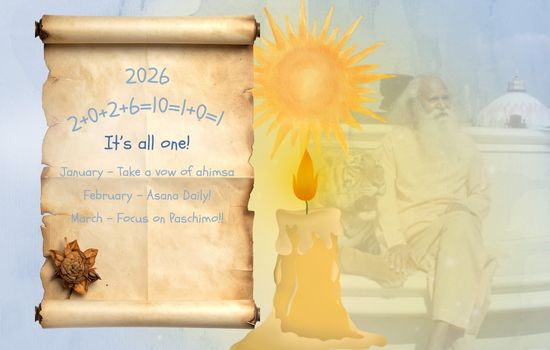
Scroll down for some thoughts about posts the coming year. For in depth commentary on some of the aspects of the blogposts, please sign up for the newsletter. This isn’t for marketing, ever. It’s designed to be thought provoking and inspire you to practice yoga!
******************************************************************
We will continue our journey through the map of the Sankhya Philosophy in the coming year, with a resurrection of the “About the body” teachings and some structured discussion on asana.
It took us a year to get through the senses. Of course it did, the sense organs are anchored into dense physical reality totally bound by the slowest vibration of earth. Slow is not bad…but we are talking the material world, very dense – which is also not bad. But as we move our way up the chart to the highest states of consciousness the subtleties of energy, mind and beyond – we become lighter, less time bound. It’s a science fiction idea, but something the human race is embracing. Time is fluid and can be our tool rather than our master. As we explored the senses we discovered means to manage them, and to purify them. These sense directed practices continue as long as we are practicing, although we may engage with them differently along the way. In January we will begin with our exploration of the elements, also materially but molecular and energetic as opposed to solid. If you have ever had acupuncture you’ve worked with your elements. And now, acupuncture is a common feature of medical practice. We are all lightening up!

 Natalie Ullmann