“Yogas Chitta Vritti Nirodha” Patanjali Yoga Sutra 1.2 :
The state of yoga is achieved when we cease identifying with the fluctuations of the mind.
The mind as understood in the context of yoga anatomy is distinct from the brain. The brain doesn’t determine it’s function or condition. It is part of the subtle realms of consciousness which are distinct from the five senses. Some yogic scholars identify the mind as a sixth sense. The mind field, or what is called the Manomaya Kosha in the yogic anatomy maps of the five sheaths consists of conscious, unconscious, and super conscious thoughts, beliefs, concepts and ideas — imagination, fantasy, projection, delusion and intellect. In considering this sheath as a field we step into a realm of expansion revealed through the practices of yoga: asana, meditation, observation, study. Unlike the realms of prana, or wisdom or bliss the Manomaya Kosha sits in our awareness all the time. Some of it’s functions are more easily identified than others. It interprets and defines. It assigns meaning. It governs perception. The world culture is permeated with instruction manuals for its management. Just as we can become absorbed in the experience of the body to such an extent that everything else disappears (in sicknesses, deep pleasures or pain) we can become absorbed in the mind to such an extent that we lose sight of everything else (obsessive compulsive disorder, excessive worry, pessimism, delusion, illusion, fantasy).
Becoming aware of what happens in the ManomayaKosha, when we lose ourselves in it and what we can accomplish by managing it is a key development in our yoga practices. So essential is it in the practice of yoga – that the first line of Patanjali Yoga Sutra (which heads up this blog post) references it directly. Like the food body (Anamaya Kosha) and the pranic body (Pranamaya Kosha) can be clear and healthy and flexible and strong – so can the mind body (the Manomaya Kosha).
The Manomaya Kosha sits at the juncture between what is human nature and what is spiritual nature.
There are two primary tools for working with the Manomaya Kosha in our yoga practices. The first is observation and the second is the mastery of the “seat”.
In yoga, our observation training consists of concentration on the breath, observing thoughts as they arise, consciously training to calm those fluctuations as we practice, and disciplining the body through focusing the mind. There is association between the depths of postures and the depth of clarity in the Manomaya Kosha. A deep posture being one where we are fully present (not lost in fantasy or topor or competitiveness or worry) and working deeply (relative to one’s own capacities) the tissues of the Anamayakosha (the muscles, bones organs skin – all of it – being squeezed and stretched and pressed upon.
We might work the observation piece like this:
- Decide to awaken to what is in your mind
- Establish a state of stepping back internally and witnessing (this can be the tough part)
- Observe it objectively – meaning without getting involved – just “watch”. You will observe the arising, existing and falling away of a thought.
- Keeping attention partially in the breath can facilitate the state of witnessing
The seat or connection to the earth is a foundation through which we master the mind in our asana practice. It’s not unusual for awareness of our connection to the ground to be non-existent. In all asana, and especially the classical meditative seats, there is a relationship to being grounded and experiencing a lifted spine. This lifted spine is thought to work like an antenna for higher states of wisdom. If you are fortunate enough to see a buddha statue with a pointed hat…you are seeing his antenna!

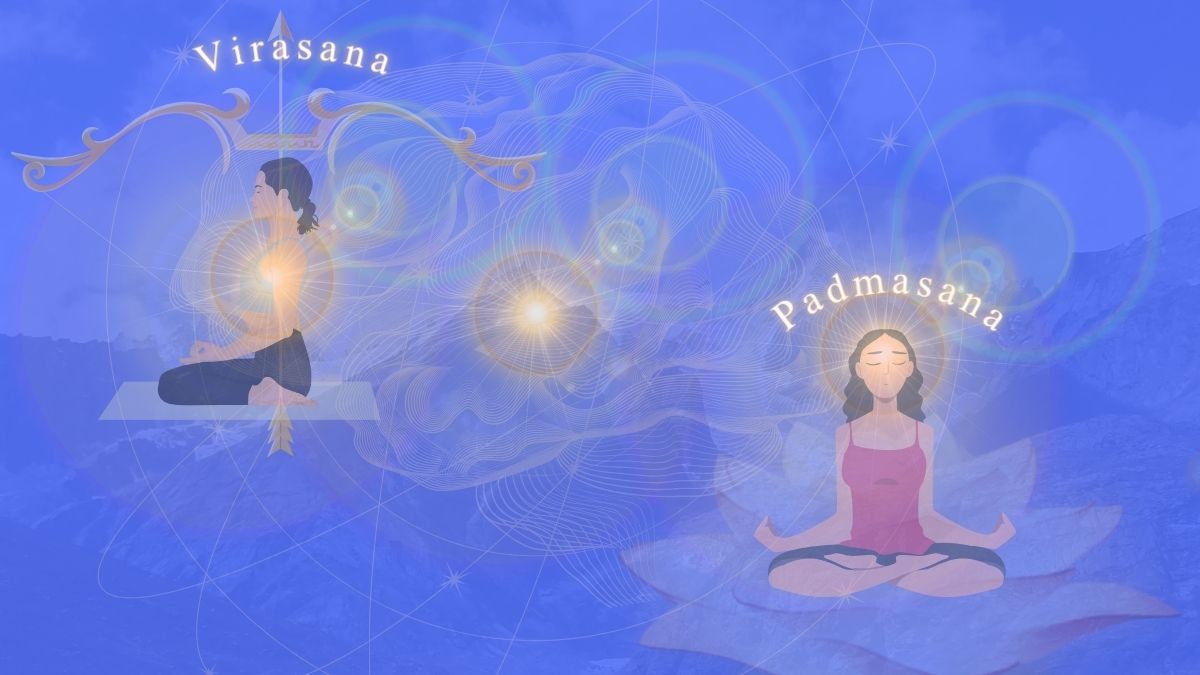
The classical seats I’d like to illuminate today are Virasana = the hero and Padmasana the lotus. I encourage you to explore both of these with physical teachers (in person) and through your own research. These postures often become accessible only after considerable yoga practice.
Virasana the hero is taken with the knees together, sitting between the heels with the sitz bones grounded. The knees together – drawing inward – create a powerful gathering and focusing of energy which supports concentration and focus – practices required for managing the mind. The focused energy also creates a stability which lifts the spine.
Padmasana – the lotus – is unique in it’s combination of deep grounding and expansiveness. The sitz bones are rooted into the earth, the knees are out to the side and the shins cross so that the soles of the feet face the sky. When the shins cross a powerful acupressure point known as SP6 – the juncture of three major “yin” channels -Liver, Kidney and Spleen is toned. Yin draws the energy inward. As with Virasana this inward energy creates a stability that lifts the spine. Any posture with knees open to the sides will create openness and spaciousness. With Padmasana we master our capacity to remain focused and steady in more and more expansive states of consciousness. Padmasana allows us to sit with the experience of enlightenment.
Want a little more “woo” in your life? No? Me neither. But yoga philosophy approached with wisdom is grounding and empowering. The philosophical elements are explored in my newsletter. I promise…it’s not a marketing email although I do suggest readings and music. You can sign up here. They are also posted simultaneously on my facebook business page – NatalieteachesYoga. Thanks for reading!


 Natalie Ullmann