स्थूलस्वरूपसूक्ष्मान्वयार्थवत्त्वसंयमाद् भूतजयः ॥४४॥
sthūla‑svarūpa‑sūkṣmānvayārthavattva‑saṁyamād bhūta‑jayaḥ
III.46 By samyama on the five forms of the elements (bhutas), which are gross form, essence, subtleness, interconnectedness, and its purpose, then mastery over those bhutas is attained. Swami Jnaneshhvara Bharati (American initiated by Swami Rama (and others) in the Himalayan tradition).
ततो णिमादिप्रादुर्भावः कायसंपत्तद्धर्मानभिघातश्च ॥४५॥
tato ’ṇimādi‑prādurbhāvaḥ kāya‑saṁpat tad‑dharmān‑abhighātaś ca
III.45 Through that mastery over the elements, comes the abilities of making the body atomically small, perfect, and indestructible in its characteristics or components, as well as brining other such powers. Swami Jnaneshhvara Bharati an American initiated by Swami Rama (and others) in the Himalayan tradition.
/*As you may have discovered in studying these sutras on the elements that that they are numbered differently in different editions, due to the omission or inclusion of an earlier sutra III.22 “By meditation on the present moment’s reality, knowledge of past and future arises.” This sutra is removed from certain editions by those who believe it is a restatement of III.16 “knowledge of past, present, future through samyama on the threefold change.” I think they are different. What do you think, and why? This teaches us something about the subtle and detailed nature of the kind of contemplations that Patanjali calls us to.*/
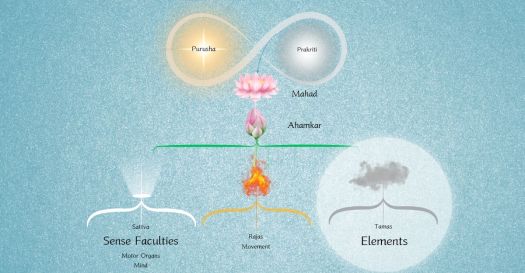
Let us step back a minute and consider anavaya, a word sometimes translated as interconnectedness, also a natural order of things, interrelation, continuity, and pervasiveness. It is one of the dimensions of the elements, together with gross form, essence, subtleness, and purpose, that Patanjali invites us to contemplate. Interconnectedness is not only a feature of the pervasive nature of the elements, but interconnectedness also defines the Sankha chart – there is this and then this and then this. While we are breaking down the Sankhya chart for the purposes of investigation – igniting an inner awareness of the facets of the chart that will guide our practice – the Sankhya chart functions as a whole – a universal engine of moving parts that make up the cosmos. In the “real world” as opposed to our digital conversation – the facets cannot be separated – just as you cannot pull apart the facets of a diamond. Each facet is a lens, but a diamond is one whole jewel. And like the facets of the diamond – we can look into the facets of the sankhya chart (i.e. the elements) to glimpse the inner radiance that is the core of the practice, the inner radiance being the radiant spiritual illumination of awareness, which is known by many names. As practitioners this is key – if we decide to extract one piece of the practice and ignore it, the big picture unravels.
We discussed that in the descent from pure consciousness to matter that Sankhya maps, water comes from fire (via condensation). From this perspective, water is denser, more material and more opaque than fire. But that does not mean it is more potent – this is an important spiritual principle, that spiritual power overcomes pure material power. As we shall see, exploring the chart from the bottom to the top, as we go higher the potency of the facets increases.
Fire is the pivot point between the spiritual dimensions of consciousness and the material. Here we begin to see how a spiritual dimension of practice, say meditation or ahimsa (non-violence) can transform the physical world. In our passion for the illumined forms of practice – the clutter in our pranic channels is combusted quickly – impacting health, appearance, and relationships.
What arises as we contemplate fire?
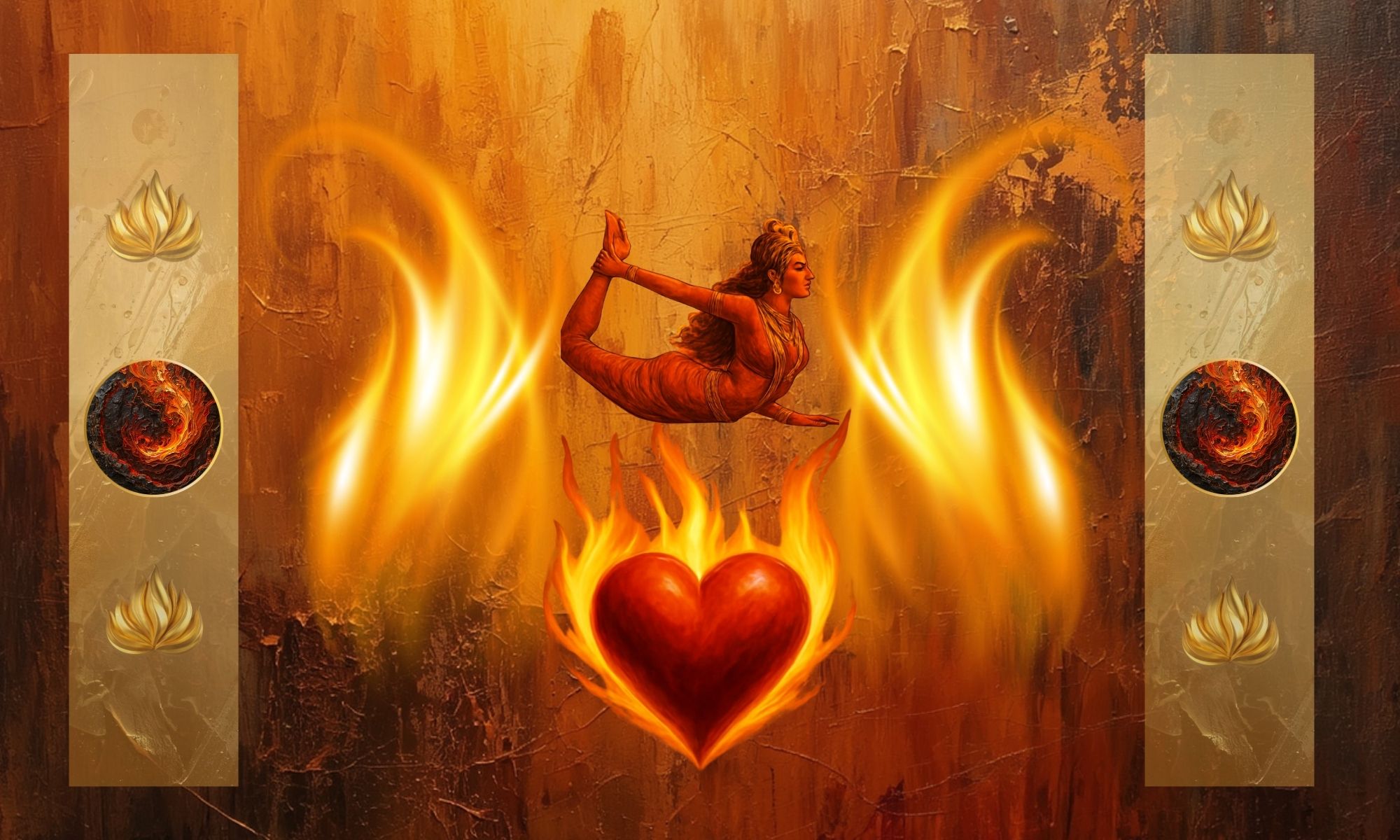
Fire does not have a form like a physical object does, but it expresses as flames which are visible aspects of fire’s essential essence and purpose, combustion. The shape of the flame – its tangible outwardly visible form– is created by a combination of subtle and gross factors: the very physical nature of the fuel, the air flow around it, and gravity – the pull of the mass of the earth. The flame we see is a gaseous field with solid particles within it. Its form speaks to us of its nature, upward movement, luminosity, and transformation…a bridge from the spirit to the material and vice versa.
Fire, like water and earth, is all pervasive (anavaya) in its potential — from the illumination in the light bulb beaming down on my desk to the molten lava in the center of the earth, to the ignition in my digestive juices or in my car. The subtle element of fire is everywhere – even though its flame or form is not always visible. This is the contemplation of anavaya or interconnectedness.
Fire is incandescent, luminous, warming, and weightless. As water’s essence expresses in movement and flow, the essence of fire expresses itself in the process of combustion. Fire, which expresses as combustion, is associated with the Manipura chakra, situated in the solar plexus where our digestion occurs. Digestion, whether of food, residues of emotional processes, or the churned-up stuff of the ego identity, sits at the heart of a successful the hatha yoga practice. The process of combustion is the process of digestion; The process of combustion is the process of transformation. This is the contemplation of essence, the intrinsic, unchangeable essence or svarupa.
This essence of combustion reveals the purpose or arthavattva of fire. To combust or transform. For ancient peoples fire transformed logs into light and heat creating evolutionary visibility and the ability to stay warm and cook food. For the contemporary yogi, the fire element as it expresses through tapasya (austerity), physical heat and energetic combustions invoked by practice transforms the yogi into a potent, conscious, intentional action taker on the mat and in the world.
But to achieve this aim, the fire must be managed – both on the mat and off. Too much fire and the body wastes away, the mind becomes disturbed, and the practice gets disrupted. The practice is prescribed in a passionate “take no prisoners” form, but I believe the truth is that the perfect practice for each individual is the one where the fire is sufficient to clean them up, but not so strong that it depletes the subtle “juices” described in the texts (ojas, soma and others ) which are fundamental building blocks of life. Traditionally, dairy products were consumed to offset the fire stoked by practice, but contemporary dairy products are tainted by the modern farming practices used in producing dairy. Almonds and coconut are two plant substances used to replace the traditional ojas replenishers.
Fire management is a key feature in the asanas themselves. Inversions interrupt the flow of soma into the digestive fire thus slowing down the aging process. Dhanurasana (bow posture) stokes the digestive fire, especially when you rock on the belly. All properly executed twists, but especially Ardha Matsyendrasana (seated spinal twist) stoke the fire in the manipura (The solar plexus) chakra, stimulating digestion. This is why we do not eat a meal for two hours before intense practice. It is like putting a big log on an open fire…if it is too big it puts the fire out. This is also why we do not drink water before and after practice. It dampens the transformative nature of practice.
What about hot yoga? Yes, herein lies the controversy around hot yoga. It jumpstarts the process of transformation with an external variable. I always liked hot yoga, but it does something different. The Tapasya or austerity is to endure the hot room. There are yoga precedents for this in certain kinds of fire ceremonies and rituals but just be mindful that this external fire does not work the same way as the internal combustion facet of classical hatha yoga. In hot yoga the water element functions as a primary cleanser through ingestion during class and sweating. It is a little more accessible, but it does not have the same kind of bridging of spirit and material that classical hatha offers …to yoke the sun and the moon, the body with the divine.
Fire is a central element in the practice of yoga asana. It functions as a living bridge between spirit and matter, facilitating the classical aspiration of yogi to uncover their true nature.
By contemplating the gross form of fire, its subtle essence, its inherent continuity, and its purpose, we begin to see how the same luminous power that shapes the cosmos also shapes our inner world. And we begin to see that the practices in the texts can contribute to our understanding of asana in powerful ways.I always send out a newsletter concurrent with the blog post which covers the theme from a slightly different perspective and includes playlist ideas, mantras and anything else that comes up. I often include an “About the body” section that works with the ideas we are contemplating. I never use the emails for marketing purposes, just for information and fun. You’ll receive one newsletter a month, at most.