
Imagine a day…like any other day, a little full, sensory input impinging from all directions. You need a break, you need a breath of fresh air…so out you go, into your car, roll down the windows and, go. The wide open spaces beckon, a bit distant from the exhaust of air conditioners, and cars and the exhales of millions of people.
One such day, I hopped in my car and headed to the west. From my loft in New Jersey to the shores of the Delaware Water Gap – one of those pockets of nature within which, if a person goes deep enough, the smell of the machines disappears and one can breath again. I embarked on a swift steep climb up what seemed to be a hill of some sort. My mind was whirling about whatever it was I was angry about which I have now long forgotten. Using that energy, I climbed steadily upward. The altitude increased, the air grew cleaner. The higher I climbed the easier it was to breathe. Then suddenly, it stopped. The storm of thoughts. The anger. The noise. There was nothing but peace. Pure air, pure land, pure breath.
I sat down on the ground, crossed my legs in siddhasana, closed my eyes and went into meditation.
/*Pure Air, Pure Breath, Pure Mind.*/
——————————————————
Take a deep breath. Let the breath breathe you.
In our studies of the Sankhya chart we’ve traveled through the foundation level of the chart, starting with the five senses as the way consciousness meets the world that we’re perceiving and interacting with. Then, moving to the elements, we explored the lived experience of the stability of earth, the flow of water, and the transformative potential of fire. Now we enter the realm of air: movement, exchange, inspiration, and the invisible forces that connect life to life.
/*Take a breath. That’s air you are breathing. I can’t see this pure air, but I know it when I inhale it.*/
As we move into the air realm we’re in the invisible. We’re in the level of form that we can’t see with the physical eyes, although we can feel it {sometimes}. Air is a subtler dimension of experience, and moving into air means moving toward subtler realms.
All of the elements exist within and around us. We consume water and food of the earth, and fire is embodied as the enzymes catalyzing substances in the body. Air is a medium of continual exchange. That metabolic function of absorbing nutrients from air and releasing it as CO2 is constant. It’s involuntary, although we can choose to halt the in and out breath. We are continuously taking it in and releasing it. This makes our relationship with air fundamental to the deeper aspects of yoga practice. Exchange requires movement. Air fulfills it’s purpose through movement and expresses in the world through movement. Air moves lightly.
Air creates weather systems of peace or destruction and carries life-giving oxygen from the world around us into our bodies. Air comforts in breezes and sharply cuts in frozen tundra. Air, like water, travels in currents, and through these currents travel becomes possible. Its invisibility supports miracles, like a leaf slowly drifting from a tree. It makes drifts in sand and water. And like the elements before it, it stands in its own holiness.
Gentle breezes are nice. Sharp Santa Ana winds hurt the skin. Sometimes air doesn’t seem to move at all. There is a quality of air in the open outdoors that feels very different from air trapped in an office building. Air untouched by humans has a freshness about it. Air is all pervasive. So are the other elements, but somehow the pervasiveness of air is very salient.
Air is the medium of the mind. You may have noticed in your yoga or meditation time that focusing in on the breath, the air coming and going, stills our thoughts.
Through breath we are connected to one another. We cannot confine air. Like it or not, we are constantly sharing it.
Its form is tricky to define. It is invisible, mostly silent, vast, and all-pervasive. It feels like it extends toward infinity. It contains molecules that perform key functions, including oxygen and carbon dioxide. It is subtle.
/*Air is the medium in which movement becomes possible.*/
/*the breath in asana practice is the mechanics of moving the air in practice in such a way that our prana is directed in such a way that facilitates the experience of enlightenment*/
/* We breathe it in and out, and that fuels our practice.*/
The Nature of Air
The qualities of air touch the divine in a mysterious way…and so we speak of inspiration. And so, in a deeper way, air is deeply associated with the process of creation from a spiritual perspective.
The English word inspiration literally means “to breathe into.” Before a poem is written, before a painting is painted, before a life changes direction, something stirs. An idea arrives like a breath. In this way air becomes more than atmosphere. It becomes the element of possibility entering form.
/* Air is the place where the Divine breathes beingness into form.*/
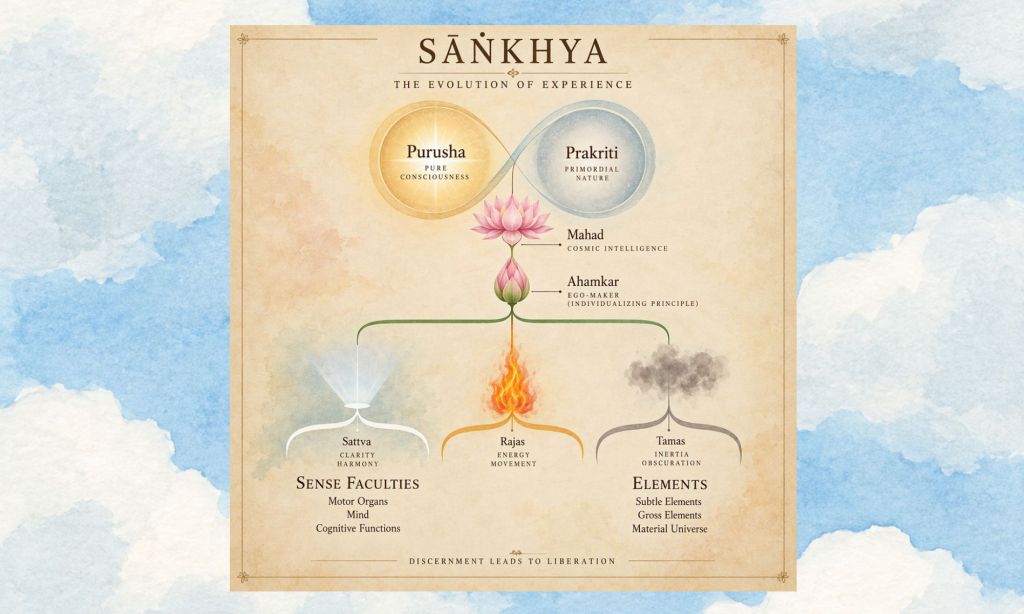
In the evolution of prakriti depicted in the Sankya chart…were we able to go into deeper detail in the image we would see that the element air descends from the element ether. In ether there is no form or movement but there is subtle vibration which, if sufficient becomes the movement of air – which can be felt by the physical body. This might be why legends of the birth of the universe often include the divine breathing into form to awaken it.
Contemplating Air Through the Sutras
Working with our personal practice, part of the challenge is to continue to find ways to deepen the practice – what helps us get to the next level if a teacher isn’t pushing us? The classic yogic texts are really good for this – you can pull out a theme and use it as a point of focus for a specific period of time. I’ve tried to demonstrate this through the blog and my exploration of the sankhya chart here is intended to ignite your desire to engage that way. So, for the elements, Patanjali gives us a particular structure to study the elements and reveals a particular result when our study has taken root.
स्थूलस्वरूपसूक्ष्मान्वयार्थवत्त्वसंयमाद्भूतजयः ॥ ३.४४ ॥
/* please note in some versions of Patanjali Yoga Sutras these appear as sutras 3.45 and 3.46, here they are 3.44 and 3.45*/
sthūla-svarūpa-sūkṣma-anvaya-arthavattva-saṁyamād bhūta-jayaḥ
One pointed meditation upon the five forms which every element takes, produces mastery over every element. These five forms are the gross nature, the elemental form, the quality, the pervasiveness, and basic purpose. –tr. Alice Bailey
ततोऽणिमादिप्रादुर्भावः कायसम्पत्तद्धर्मानभिघातश्च ॥ ३.४५ ॥
tato’ṇimādi-prādurbhāvaḥ kāya-sampat tad-dharmānabhighātaś ca
Through this mastery, minuteness and siddhis (powers) are attained, likewise bodily perfection and freedom from all hindrances – tr. Alice Bailey
When we contemplate something yogically – it works in a very specific way – different mechanics than mindfulness, although mindfulness can be useful. The yogin draws as much of their focus as possible onto something (in this case the elements) sustaining that focus in various degrees until one’s entire mind becomes completely absorbed in the particular element that we are studying. This is samyama – to bring ones mind WHOLLY to the focus on the chosen topic.
Samyama has three parts – we practice concentrating (Dharana), meditation (Dhyana), and complete absorption (Samadhi). The stages are described as a focus that is like dripping water, then pouring oil, then total absorption.
As we work with this, it’s fine to work with dripping water style focus. Sometimes the deeper levels of yoga are best approached on retreat. But just know that the longer we are able to sustain focus the deeper our practice will get. Consider this frequent instruction, “Focus on your breath.” What happens when you become totally absorbed in your breath for a moment on the mat? The experience of the body is altered significantly.
Patanjali explains that through samyama on the gross, essential, subtle, interconnected, and purposeful aspects of the elements, mastery over them arises. I find that I must tune my mind like radar on the element for each aspect, and sometimes just do a brainstorm. The accuracy of the brain storm is a reflection on the quality of my concentration. Does the brainstorm stay in the realm of validity? Or does it wander into imagination? It’s a subtle difference.
A contemplation on air may look like something like this:
- What is the gross physical aspect of air? movement, absorption, upliftment, permeability, nourishment, expansion. While all the elements are interwoven in the causality events – air is very frequently agent of motion and the change of motion. It expands to fill all available space.
- What is its essential nature? Mobility, expansiveness, permeability, lightness, and freedom from fixed form. It is difficult to restrain and invisible.
- What is its subtle aspect? Air is the place where divine breathes beingness into form. As spirit descends into matter, the movement of material creation starts here, at the level of air. So, linking our breath and working with air in our practice opens us into that realm of sacred creativity. As we’ll talk about more in the ether section, It’s here in the element of air that the anahata nadam, the unstruck sound in the ethers that the yogin hears in the perfection of practice, becomes the struck sound, the nadam or as more generally known AUM \.
- What is its interconnectedness? Interconnects people, plants, non-human animals, even fish through molecule exchange (and divine essence). . Air is the mechanism through which heaven and earth are joined through the rain cycle. The nature of air’s connective qualities is exchange. Things are separate and connected at the same time.
- What is its purpose? Air is the mechanism through which heaven and earth remain in conversation.
When we contemplate, it’s good to bear in mind that ultimately we want to nurture the direct experience in the yoga asana practice itself (or meditation, but this blog is more for hatha yogis).
And so, as I breathe in my asana today the motion of the inhale and the exhale relates closely to the exchange of Oxygen and CO2 in my body reveals space in the body. The vertebra move gently apart. Through inhaling and exhaling the yogi uses the action of air in the physical body to create the optimal conditions for taking a particular shape or posture and supporting the movement of prana through the physical form. The inhale and the exhale ignites the vibration of prana.
Practices for contemplating Air:
- Let the breath breathe you. It’s not a metaphor, step back enough from making the breath happen to allow it to be itself. Hang out there for as long as you can. What happens?
- Practice simple retention of breath – inhale 2, 3,4, pause, exhale 2, 3, 4 pause. Try to keep the laid back quality of engagement with the breath as you do this so, as you pause and gently retain the breath you realize the lightness of touch that air invites.
- What happens when you retain the breath? Does it stay the same? What kind of pressure pushes you to release the breath?
- What happens organically when the breath is released? Does it stay the same? What changes?
/*About the image: These image came in a moment of inspiration where I was contemplating air, but began to hear Tibetan Buddhist mantras playing in my head. I envisioned prayer flags blowing in the wind…and kept hearing the words “wind horse” and “winds of change are blowing”. I wasn’t sure about the connection, to my air blog post, but put the time into creating the image anyway. Two days later the elections results came in in the United States of America revealing a multitude of women elected for office at the same time. A turning of the winds in a dramatic way which answered the prayers of many people, particularly women who have faced subtle but painful oppression under the current administration. The image was created in Canva, in the usual fashion, but the element of the wind horse and the wish fulfilling jewel were generated by AI. The interesting thing was that usually, the wish fulfilling jewel is on the horses back…but I was unable to get the image right. So, I decided to leave the wish fulfilling gem on the ground, even though that seemed strange. But after the election it seemed perfect as the symbol of the gift of the answered prayers trickling down to the earth…just as described in the evolution of prakriti. */
There is always a mail chimp newsletter published at the same time that the blog post goes up that goes into more detail about the subject matter presented in the blog post. I promise that you will not receive marketing emails by signing up through this email list. Just useful and thought provoking content.
Discover more from Natalie Ullmann
Subscribe to get the latest posts sent to your email.

